
A Spousal Lifetime Access Trust (SLAT) represents a sophisticated and powerful instrument in the realm of estate planning, designed primarily to reduce a married couple’s taxable estate while simultaneously providing a measure of financial security for the surviving spouse. At its core, a SLAT is an irrevocable trust established by one spouse (the “grantor” or “donor spouse”) for the benefit of the other spouse (the “beneficiary spouse”) and, often, their descendants. The unique appeal of a SLAT lies in its ability to remove assets from the grantor’s taxable estate, thus utilizing their federal gift tax exemption, while still allowing the beneficiary spouse to access those assets during their lifetime. This delicate balance of wealth transfer and continued access makes the SLAT an invaluable tool for high-net-worth individuals navigating complex financial and estate planning landscapes.
Deconstructing the Spousal Lifetime Access Trust (SLAT)
Understanding the fundamental characteristics of a SLAT is crucial to appreciating its strategic utility. It’s not merely another trust; it’s a finely tuned mechanism with specific objectives and implications.
The Core Definition
A SLAT is an irrevocable trust created by one spouse, funding it with their separate property or a portion of their community property. The other spouse is designated as the primary beneficiary, with rights to receive distributions from the trust during their lifetime for specific purposes, such as health, education, maintenance, and support (often referred to as HEMS standards). Upon the beneficiary spouse’s death, or sometimes after the deaths of both spouses, the remaining assets typically pass to other beneficiaries, usually the couple’s children or grandchildren, free of further estate tax. The key differentiator is the lifetime access afforded to the spouse, providing a safety net that many other irrevocable trusts lack.
A Tool for Wealth Transfer and Protection
The primary motivations for establishing a SLAT are twofold: wealth transfer and asset protection. By transferring assets into an irrevocable trust, the grantor effectively removes them from their personal estate for estate tax purposes. This leverages the grantor’s lifetime gift tax exemption, a significant consideration given the often substantial federal estate tax rates. Concurrently, assets held within a properly structured SLAT are generally shielded from future creditors, lawsuits, and even certain unforeseen circumstances that might threaten personal wealth. This dual benefit positions the SLAT as a robust strategy for both tax efficiency and security.
Irrevocability and Its Implications
The irrevocable nature of a SLAT is central to its tax benefits but also represents its most significant commitment. Once assets are transferred into a SLAT, the grantor generally cannot reclaim them or unilaterally alter the trust’s terms. This loss of direct control is precisely what allows the assets to be excluded from the grantor’s taxable estate. While the beneficiary spouse retains access, this access is governed by the trust document and the trustee’s discretion, not the grantor’s direct command. This irrevocability demands careful consideration and thorough planning, as modifications are either impossible or exceptionally difficult and often require court approval or the consent of all beneficiaries.
The Strategic Advantages of Employing a SLAT
SLATs offer a compelling suite of advantages that cater to the sophisticated needs of wealth management and intergenerational transfer.
Minimizing Estate and Gift Taxes
One of the most potent benefits of a SLAT is its ability to reduce a couple’s gross taxable estate. When the grantor funds the SLAT, they are making a completed gift. This gift utilizes a portion of their lifetime gift tax exemption (which is unified with the estate tax exemption). Once the assets are in the SLAT, any future appreciation on those assets also grows outside of the grantor’s taxable estate. This “freezing” of the estate value at the time of the gift can result in substantial estate tax savings, especially for couples whose combined wealth exceeds the federal estate tax exemption limits.
Asset Protection from Creditors
Assets held within an irrevocable SLAT are typically insulated from the grantor’s future creditors, legal judgments, and even the beneficiary spouse’s creditors, provided the trust is properly structured and the transfer into the trust was not a fraudulent conveyance. This layer of protection offers peace of mind, knowing that a significant portion of the family’s wealth is safeguarded against unforeseen liabilities or economic downturns. This protection extends beyond the grantor, offering a secure financial base for the beneficiary spouse and future generations.
Providing for a Spouse While Transferring Wealth
The “lifetime access” component for the beneficiary spouse distinguishes the SLAT from many other irrevocable trusts. Unlike gifting assets outright, which might expose them to the beneficiary spouse’s future creditors or subsequent spouses, a SLAT allows distributions to be made to the beneficiary spouse under defined conditions. This ensures that the donor spouse’s partner has a source of funds for their needs, even after the assets have been removed from the taxable estate. This balance of control and support is a key attraction for married couples seeking to secure their legacy without jeopardizing current spousal support.
State Income Tax Benefits (Jurisdiction Dependent)
In certain states, SLATs can also offer state income tax advantages, particularly if structured as a “grantor trust” for income tax purposes but as a completed gift for estate tax purposes. This complex interplay allows the grantor to pay the income taxes on the trust’s earnings, which further reduces their personal estate without being considered an additional gift to the trust. This effectively allows the trust assets to grow tax-free within the trust, leveraging the grantor’s individual income tax payment as an additional tax-free gift to the trust beneficiaries.
The Mechanics of SLAT Creation and Operation
The successful implementation of a SLAT requires a clear understanding of the roles involved and the operational procedures.
The Grantor, Trustee, and Beneficiary Roles
- Grantor (Donor Spouse): The spouse who creates and funds the trust. They initiate the wealth transfer and define the trust’s terms.
- Beneficiary Spouse: The spouse for whom the trust is primarily established, with access to trust distributions during their lifetime.
- Trustee: The individual or entity responsible for managing the trust assets, making investment decisions, and distributing funds according to the trust’s terms. To maintain the trust’s tax benefits, the trustee should ideally be an independent party (not the grantor or the beneficiary spouse). Children of the couple or professional fiduciaries are common choices.
Funding the SLAT

Assets commonly used to fund a SLAT include appreciated marketable securities, real estate, interests in privately held businesses, or cash. The selection of assets is crucial; highly appreciating assets are often preferred as their future growth will also be excluded from the grantor’s estate. The transfer of assets constitutes a gift, which must be reported on a federal gift tax return (Form 709) and utilizes a portion of the grantor’s lifetime gift tax exemption. Careful valuation of gifted assets is essential.
Distribution Provisions and Control
The trust document specifies the conditions under which the trustee can make distributions to the beneficiary spouse. These provisions are critical for tax purposes. Often, distribution standards are limited to “health, education, maintenance, and support” (HEMS) to avoid the assets being included in the beneficiary spouse’s taxable estate. The beneficiary spouse does not have unfettered access; their ability to receive funds is subject to the trustee’s discretion based on the established guidelines. This controlled access is key to the SLAT’s asset protection and estate tax benefits.
The Importance of Independent Trustees
While it is legally permissible for the beneficiary spouse to serve as a trustee, it significantly complicates the tax benefits and asset protection. If the beneficiary spouse is also the sole trustee and has broad discretion over distributions, the trust assets could be included in their taxable estate upon death. Therefore, appointing an independent trustee (e.g., a child, a trusted friend, a corporate trustee, or a professional fiduciary) is generally recommended to ensure the trust achieves its intended tax and asset protection objectives.
Critical Considerations and Potential Pitfalls
Despite its advantages, a SLAT is not without complexities and potential drawbacks that require careful evaluation.
The Irrevocable Nature and Loss of Direct Control
As an irrevocable trust, the grantor relinquishes direct control over the assets once they are transferred. This means they cannot unilaterally revoke the trust, change beneficiaries, or reclaim the assets if their financial situation or wishes change. This loss of flexibility is a significant commitment and requires a long-term perspective.
Impact of Divorce or Spouse’s Death
One of the most frequently cited concerns with SLATs is the potential impact of divorce or the beneficiary spouse’s death.
- Divorce: If the couple divorces, the grantor has effectively made a gift to a trust that benefits their former spouse. The grantor may no longer wish for their ex-spouse to have access to these funds. While the trust assets are generally protected from division in a divorce, the grantor cannot simply dissolve the SLAT and reclaim the assets. Meticulous planning, including specific language in the trust document for contingencies like divorce, is crucial.
- Spouse’s Death: If the beneficiary spouse dies before the grantor, their access to the trust assets ceases. The trust will then typically continue for the benefit of other named beneficiaries (e.g., children) or terminate and distribute its assets. The grantor, having funded the SLAT, cannot regain access to those assets, which remain outside their estate for future estate tax planning.
Reciprocal Trust Doctrine
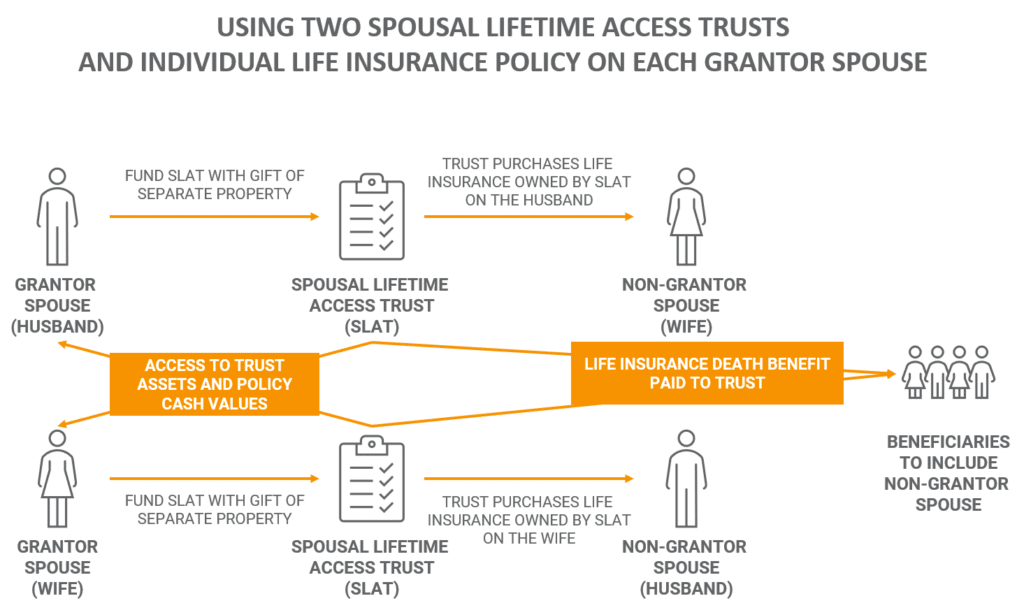
Couples sometimes consider creating two identical SLATs, one for each spouse, to maximize their gift tax exemptions. However, the IRS’s “Reciprocal Trust Doctrine” can challenge such arrangements. If the trusts are substantially identical and were created as part of a single transaction, the IRS may “uncross” them, treating each spouse as the grantor of the trust benefiting themself. This would negate the estate tax benefits. To avoid this, SLATs for each spouse must have materially different terms, distribution provisions, or beneficiaries to avoid being classified as reciprocal.
Choosing the Right Assets for Funding
Selecting assets for a SLAT requires strategic thought. Assets with high appreciation potential are often ideal, as their future growth occurs outside the grantor’s estate. However, illiquid assets can pose challenges for distributions or trust administration. It’s also vital to consider the income tax basis of assets. Gifting high-basis assets (those with a low built-in capital gain) might be more advantageous than gifting low-basis assets, as the latter could result in significant capital gains taxes when sold by the trustee if not properly managed.
Legal and Tax Expertise is Non-Negotiable
Given the intricate legal and tax implications, establishing a SLAT demands the expertise of qualified estate planning attorneys and tax advisors. Incorrect drafting, improper funding, or failure to comply with gifting requirements can undermine the trust’s intended benefits, leading to adverse tax consequences or unintended outcomes. Professional guidance ensures the SLAT is properly structured to meet the grantor’s specific goals and withstand potential IRS scrutiny.
SLATs in the Broader Estate Planning Landscape
SLATs are not standalone solutions but integral components of a comprehensive estate plan, often working in conjunction with or complementing other estate planning vehicles.
SLAT vs. Irrevocable Life Insurance Trust (ILIT)
Both SLATs and Irrevocable Life Insurance Trusts (ILITs) are irrevocable, often grantor trusts, designed to remove assets from a taxable estate. However, their primary purposes differ. An ILIT is specifically designed to own life insurance policies, keeping the death benefit out of the insured’s taxable estate. A SLAT, on the other hand, can hold a broader range of assets and provides lifetime access for the beneficiary spouse. While a SLAT could own a life insurance policy, an ILIT is typically optimized for that singular purpose, often allowing the grantor to make annual exclusion gifts to pay premiums.
SLAT vs. Revocable Living Trust
A Revocable Living Trust is primarily a probate avoidance tool, allowing assets to pass to beneficiaries outside of court-supervised probate. It offers no estate tax or asset protection benefits, as the grantor retains full control and can revoke or amend it at any time. A SLAT, in contrast, is irrevocable and designed precisely for estate tax minimization and asset protection. These two trust types serve fundamentally different purposes and are often used in tandem within a holistic estate plan.

Complementary Strategies
A SLAT can be a highly effective component of a larger estate plan that might also include charitable giving strategies, qualified personal residence trusts (QPRTs), grantor retained annuity trusts (GRATs), or family limited partnerships (FLPs). For example, a couple might use a SLAT to maximize their gift tax exemptions while also establishing a charitable lead trust to benefit their favorite causes. The choice of specific tools depends entirely on the couple’s financial situation, estate size, philanthropic goals, and risk tolerance. Ultimately, a SLAT provides flexibility and security for one’s spouse while ensuring that wealth is transferred efficiently to the next generation, making it a powerful and strategic choice for many affluent families.
aViewFromTheCave is a participant in the Amazon Services LLC Associates Program, an affiliate advertising program designed to provide a means for sites to earn advertising fees by advertising and linking to Amazon.com. Amazon, the Amazon logo, AmazonSupply, and the AmazonSupply logo are trademarks of Amazon.com, Inc. or its affiliates. As an Amazon Associate we earn affiliate commissions from qualifying purchases.