
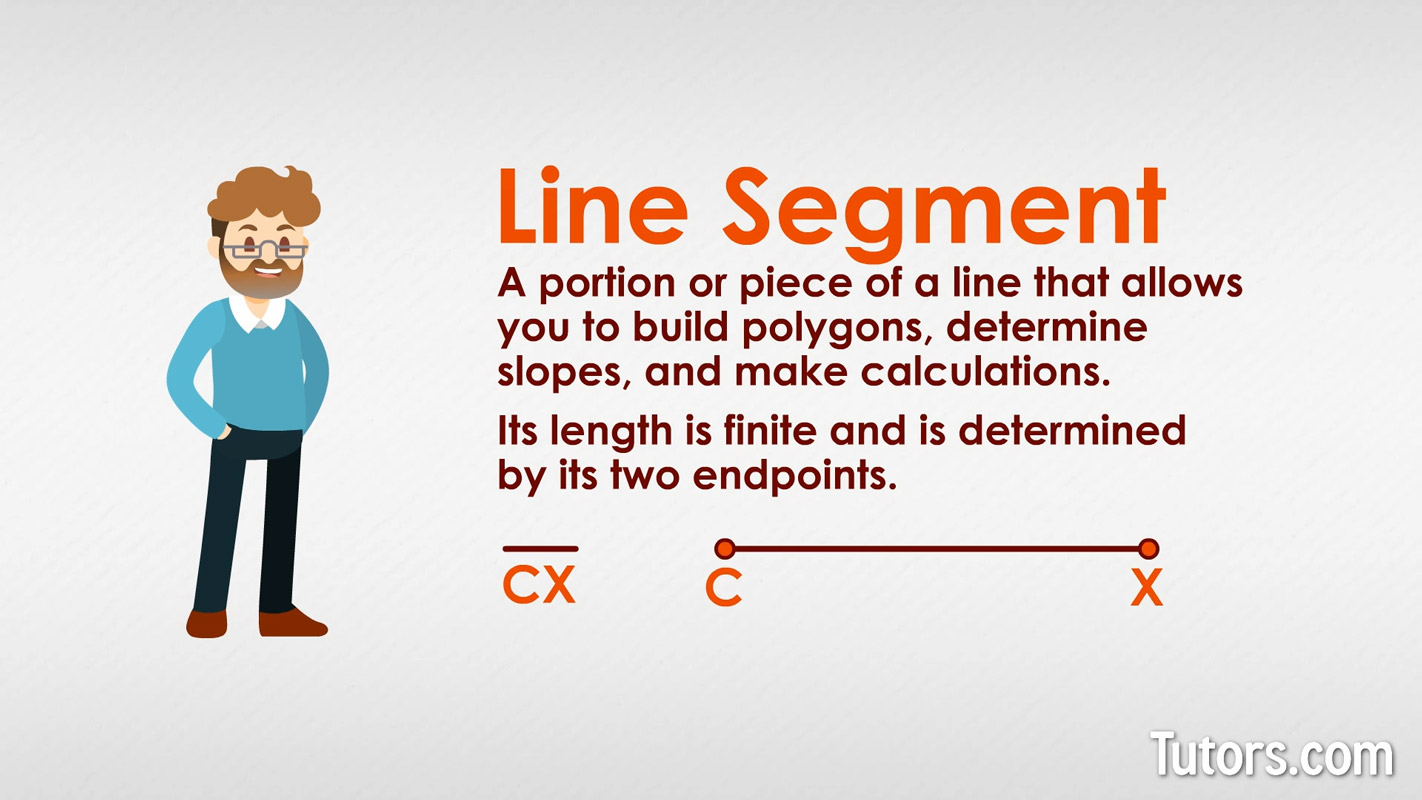
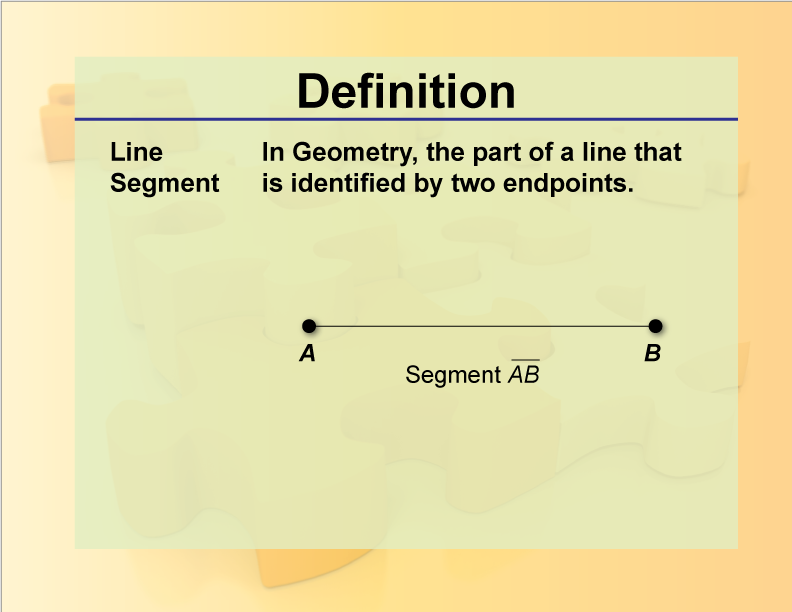
In the classical sense, a segment is defined as a part of a line that is bounded by two distinct end points and contains every point on the line between them. While this definition suffices for a high school textbook, the tech industry has transformed this humble geometric primitive into the backbone of modern digital creation. From the complex architectural blueprints rendered in CAD software to the sophisticated spatial mapping used by autonomous vehicles, the “segment” is the fundamental unit of data that bridges the gap between abstract mathematical theory and tangible technological innovation.

Understanding what a segment is in the context of geometry requires looking beyond the ruler and pencil. In the digital age, segments are the vectors that define our virtual worlds, the constraints that guide robotic arms, and the foundational elements of computer vision. This article explores the evolution of the geometric segment through the lens of technology, software development, and the future of digital design.
The Digital Foundations: Defining the Segment in a Virtual Workspace
In computer science and digital modeling, a segment is rarely just a static line. It is a vector—a piece of data containing coordinates, directionality, and often, metadata. When a software developer or a 3D artist creates a segment, they are establishing a relationship between two nodes in a three-dimensional Cartesian coordinate system.
Defining the Segment in a Virtual Workspace
In the realm of software engineering, a segment is represented as a data structure. It consists of two vertices, $V1(x1, y1, z1)$ and $V2(x2, y2, z2)$. Unlike a theoretical line that extends to infinity, the digital segment is defined by its limitations. These limitations are what allow computers to render shapes. By connecting thousands or even millions of these segments, software can create “polygonal meshes.” These meshes form the skin of characters in video games or the aerodynamic shells of digital car prototypes. The precision of these segments determines the “resolution” of the geometry; the smaller and more numerous the segments, the smoother the resulting curve or surface appears to the human eye.
Why Linear Precision Matters for Rendering
The tech behind graphics processing units (GPUs) relies heavily on the “rasterization” of geometric segments. When a computer renders a 3D scene, it must translate these geometric segments into pixels on a screen. This process, known as the graphics pipeline, involves complex calculations to determine which segments are visible, how light interacts with the angle of a segment, and how segments intersect. If the geometric definition of a segment is off by even a fraction of a millimeter in a simulation, the resulting “artifacting”—visual glitches—can ruin the immersion of a virtual reality experience or lead to catastrophic errors in precision manufacturing.
Segments in Computer-Aided Design (CAD) and Engineering
For engineers and architects, the geometric segment is the primary tool for translating human intent into physical reality. Software suites like AutoCAD, SolidWorks, and Revit have turned the geometric segment into a “smart object.”
From Euclidean Principles to Parametric Design
In traditional geometry, a segment is static. In modern tech, segments are often “parametric.” This means that the length and orientation of a segment are defined by variables. If an architect changes the height of a digital building’s foundation, the software automatically recalculates every connected segment to maintain structural integrity. This interconnectedness allows for rapid prototyping. The segment is no longer just a line; it is a constraint-driven entity that understands its relationship to the segments around it.
Mesh vs. NURBS: Managing Segments for Surface Integrity
In the world of high-end design, there are two primary ways to handle segments. Polygonal modeling uses flat segments to create shapes (think of a disco ball). However, for industries like aerospace or automotive design, flat segments aren’t enough. They use NURBS (Non-Uniform Rational B-Splines). While a NURBS curve looks smooth, it is mathematically calculated based on weighted control segments. Understanding how to manipulate these segments is what allows engineers to design the perfectly aerodynamic curves of a Boeing 787 wing or the ergonomic grip of a high-tech surgical instrument.
The Role of Segments in Artificial Intelligence and Computer Vision
One of the most exciting frontiers in technology is the field of computer vision, where AI is taught to “see” and interpret the world. Here, the geometric segment takes on a new role: identification and categorization.
Edge Detection and Line Segment Detectors (LSD)
For an AI to recognize a doorway, a road, or a human face, it must first perform “segmentation.” This involves identifying the edges of objects. Algorithms such as the Canny Edge Detector or the Line Segment Detector (LSD) scan images for gradients in pixel intensity to identify linear segments. By isolating these segments, the AI can build a wireframe of the environment. In autonomous driving, the car’s software identifies the segments that make up lane markings and curb edges. The ability of the AI to accurately identify a geometric segment in a split second is quite literally a matter of life and death.
Spatial Computing and the Reconstruction of Physical Reality
With the rise of AR (Augmented Reality) and VR (Virtual Reality), devices like the Apple Vision Pro or Meta Quest use LiDAR and structured light to map physical rooms. This process involves “point cloud” generation, where millions of points are captured. The software then performs “surface reconstruction,” connecting these points with segments to create a digital twin of the user’s environment. In this context, the segment is the bridge between the physical world and the digital overlay, allowing virtual objects to “sit” realistically on a physical table.
Advanced Software Applications and the Evolution of Geometry
The complexity of modern technology requires segments to be more than just lines between two points; they are now components of complex simulations that predict the future.
High-Performance Computing in Engineering Simulations
In Finite Element Analysis (FEA), engineers break down a complex physical object—like a bridge or a turbine blade—into millions of small geometric segments and shapes. This “discretization” allows the computer to calculate how physical forces like heat, pressure, or vibration move through each individual segment. By analyzing the stress on each segment, tech can predict where a structure might fail before it is ever built. This is the pinnacle of “segment” utility: a mathematical concept used to prevent real-world disasters.
The Future of Generative Design
We are entering the era of generative design, where engineers input goals and constraints (such as “lightest possible weight” and “maximum strength”) and AI generates the geometry. These AI-driven designs often look organic or “alien” because the software optimizes the placement of every geometric segment far more efficiently than a human could. In these cases, segments are the DNA of the object, arranged by algorithms to achieve peak performance.
Security and Integrity in Geometric Data
As our reliance on digital geometry grows, so does the need to protect the data that defines these segments. In the tech world, “Geometric Integrity” is a burgeoning field of digital security.
Protecting Intellectual Property in 3D Modeling
When a company designs a proprietary engine part, the specific arrangement of geometric segments is their intellectual property. Digital watermarking and encrypted CAD files are used to ensure that these geometric “recipes” aren’t stolen. Furthermore, in the world of additive manufacturing (3D printing), ensuring that the segments in a print file haven’t been tampered with is crucial. A malicious actor could theoretically alter a few segments in a digital file, causing a 3D-printed aerospace component to have a hidden structural flaw.
Conclusion: The Enduring Impact of the Segment
While the basic definition of a segment—a line between two points—remains unchanged since the time of Euclid, its application has been revolutionized by technology. In the digital age, segments are the fundamental particles of our virtual reality, the logic gates of our computer vision, and the structural blueprints of our physical world.
Whether you are a developer writing code for the next great video game, an engineer simulating the stress on a skyscraper, or an AI researcher training a neural network to recognize the world, the segment is your most vital tool. As we move further into the realms of the metaverse, AI-driven manufacturing, and autonomous robotics, the humble geometric segment will continue to be the essential link between mathematical thought and technological reality. Understanding it is not just a matter of geometry; it is a prerequisite for understanding the future of tech itself.
aViewFromTheCave is a participant in the Amazon Services LLC Associates Program, an affiliate advertising program designed to provide a means for sites to earn advertising fees by advertising and linking to Amazon.com. Amazon, the Amazon logo, AmazonSupply, and the AmazonSupply logo are trademarks of Amazon.com, Inc. or its affiliates. As an Amazon Associate we earn affiliate commissions from qualifying purchases.