
A Comparative Market Analysis (CMA) is a crucial tool for anyone involved in buying, selling, or even just keeping an eye on the real estate market. For sellers, it helps determine the optimal listing price. For buyers, it provides a solid foundation for making an offer. For real estate professionals, it’s a cornerstone of their advisory services. Understanding what a CMA is, how it’s generated, and what it reveals can significantly impact the success of a property transaction and, by extension, your financial well-being in the real estate arena.
The Foundation: What Exactly is a CMA?
At its core, a Comparative Market Analysis is an in-depth examination of a property’s market value, achieved by comparing it to similar, recently sold properties in the same geographical area. It is not an appraisal, which is a formal valuation conducted by a licensed appraiser for lending purposes. Instead, a CMA is a market-driven estimation of a property’s worth, primarily used by real estate agents to guide their clients.
Differentiating CMA from Appraisal
The distinction between a CMA and an appraisal is significant, especially from a financial perspective. An appraisal is a standardized, legally binding valuation often required by mortgage lenders to ensure the property’s value supports the loan amount. Appraisers follow strict methodologies and use specific data sources to arrive at a defensible value. They also charge a fee for their services.
A CMA, on the other hand, is typically prepared by a real estate agent or broker. While it uses a similar comparative approach, its purpose is primarily advisory. It helps agents advise sellers on pricing their homes competitively to attract buyers and achieve the best possible sale price, and it helps buyers determine a fair offer price that is likely to be accepted by the seller. CMAs are generally less formal than appraisals and are often provided as part of an agent’s service to attract or retain clients. The data used might be more readily available through the Multiple Listing Service (MLS) and other real estate databases that agents have access to. The interpretation of this data, and the resulting price range, is where the agent’s expertise and market knowledge come into play.
The Purpose and Benefits of a CMA
The primary purpose of a CMA is to establish a realistic and competitive market price for a property. For sellers, this means avoiding underpricing, which leaves money on the table, or overpricing, which can lead to a property languishing on the market, becoming stale, and ultimately selling for less than it could have. A well-executed CMA gives sellers confidence in their chosen listing price, aligning their expectations with market realities.
For buyers, a CMA is an invaluable tool for negotiating. By understanding the recent sale prices of comparable properties, buyers can make informed offers that are both attractive to sellers and represent good value for the buyer. It helps prevent buyers from overpaying in a competitive market or making offers that are so low they are unlikely to be considered.
Beyond pricing, CMAs offer several other benefits:
- Market Insight: They provide a snapshot of current market conditions, including demand, inventory levels, and typical selling times for similar properties.
- Strategic Pricing: They help agents and sellers develop a strategic pricing approach, considering not just sold comparable properties but also those currently on the market and those that failed to sell.
- Negotiation Leverage: A well-substantiated CMA can be used as a persuasive tool during negotiations, demonstrating the market’s valuation of the property.
- Client Education: CMAs educate clients about the factors influencing property value, fostering trust and transparency in the transaction process.
Crafting a CMA: The Data and Methodology
The accuracy and effectiveness of a CMA hinge on the quality of data used and the systematic methodology employed in its creation. It’s a process that requires not only access to information but also a keen understanding of local market dynamics and property specifics.
Key Data Points for a CMA
The foundation of any robust CMA lies in the careful selection and analysis of relevant data. The most critical pieces of information include:

- Recently Sold Comparable Properties (Comps): These are properties that are as similar as possible to the subject property and have sold within a defined recent timeframe, typically the last three to six months. Similarity refers to a range of factors including size, age, number of bedrooms and bathrooms, lot size, architectural style, and general condition. The closer the comps, the more reliable the analysis.
- Currently Listed Comparable Properties: These properties offer insight into what the market is currently asking for similar homes. They help in understanding the competitive landscape and the potential price range buyers are currently considering. While their sale price is unknown, their list price and days on market provide valuable clues about buyer interest and seller expectations.
- Expired or Withdrawn Listings: Properties that failed to sell provide crucial information about properties that were either overpriced, had significant condition issues, or faced unfavorable market conditions. Analyzing these can help avoid pricing the subject property in a way that leads to a similar outcome.
- Property Specifics: Detailed information about the subject property itself is paramount. This includes its square footage, number of bedrooms and bathrooms, lot size, age, condition, upgrades and renovations, unique features, and its location within the neighborhood.
The Comparative Analysis Process
Once the relevant data is gathered, the agent or broker embarks on the comparative analysis. This involves a systematic process of evaluating how the subject property measures up against the selected comparables:
- Selection of Comps: The agent identifies 3-5 (sometimes more, depending on market activity) of the most similar recently sold properties. Location is paramount, followed by size, features, and condition.
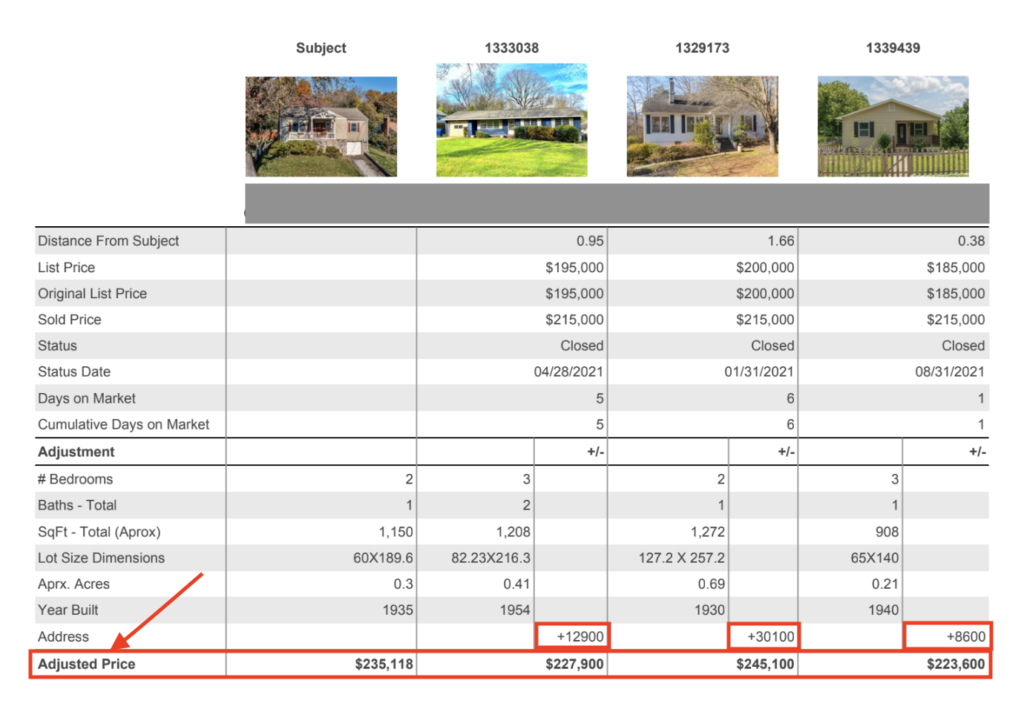
- Adjustment for Differences: No two properties are identical. The agent makes adjustments to the sales prices of the comparable properties to account for differences between them and the subject property. For example, if a comp has a larger, renovated kitchen and the subject property does not, the comp’s sale price might be adjusted downwards to reflect this difference. Conversely, if a comp has fewer bedrooms, its sale price might be adjusted upwards if the subject property has more. These adjustments are often monetary, based on the agent’s understanding of how much each feature typically adds or subtracts from a property’s value in that market.
- Valuation Range Determination: After making necessary adjustments, the agent arrives at a range of adjusted sale prices for the comparable properties. This range provides a basis for estimating the subject property’s market value.
- Market Trend Analysis: The agent also considers broader market trends. Is the market appreciating, depreciating, or stable? Are there many homes for sale (buyer’s market) or few (seller’s market)? This macro-level view refines the value estimation.
- Final Price Recommendation: Based on the adjusted comparable sales, current listings, expired listings, and market trends, the agent provides a recommended listing price or price range for the subject property. This recommendation is usually presented with supporting documentation and a clear explanation of the reasoning behind it.
Interpreting a CMA: What the Numbers Mean for Your Finances
A CMA is more than just a list of numbers; it’s a financial roadmap that guides decisions in the real estate market. Understanding how to interpret its findings is crucial for maximizing your investment and minimizing financial risk.
Factors Influencing CMA Value
Several key factors contribute to the final valuation presented in a CMA, each with a direct impact on the property’s financial standing:
- Location, Location, Location: This age-old real estate adage holds true. Properties in desirable neighborhoods, with good school districts, proximity to amenities, and strong community appeal, will invariably command higher prices, even if other physical characteristics are similar. The CMA will reflect this by showing higher sales prices for comps in superior locations.
- Property Condition and Upgrades: The state of repair and the quality of renovations significantly influence value. A well-maintained home with modern kitchens and bathrooms, updated HVAC systems, and attractive landscaping will be valued higher than a comparable property in poor condition or with outdated features. The adjustments made in the CMA process directly quantify these differences.
- Size and Layout: Square footage is a primary driver of value. Beyond total size, the functionality of the layout – such as open-plan living spaces, desirable bedroom-to-bathroom ratios, and adequate storage – also plays a role. A home with a more desirable and efficient layout will often fetch a higher price.
- Market Demand and Supply: The number of active listings versus the number of buyers actively searching in a particular area heavily influences pricing. In a seller’s market, where demand outstrips supply, prices tend to be higher. In a buyer’s market, prices may be more negotiable. A CMA will reveal this through the days on market for comps and the relationship between list prices and sale prices.
- Recent Sales Trends: The direction the market has been moving is critical. If comparable properties have been selling for progressively higher prices over the past few months, it indicates an appreciating market, and the CMA will likely reflect this upward trend. Conversely, declining sales prices suggest a cooling market.

Strategic Decisions Informed by a CMA
The insights gleaned from a CMA empower smart financial decisions for both buyers and sellers:
For Sellers:
- Optimal Listing Price: The CMA is your primary guide for setting a competitive yet profitable listing price. It helps avoid the costly mistake of overpricing, which can deter buyers and lead to a prolonged selling period, potentially forcing a price reduction later. Conversely, it ensures you don’t leave money on the table by underpricing.
- Understanding ROI on Improvements: By comparing your property to similarly improved or unimproved comparables, you can better gauge the return on investment for any recent upgrades or renovations.
- Negotiation Strategy: A well-prepared seller, armed with a solid CMA, is in a stronger negotiating position. They can confidently counter lower offers with data-backed evidence of their property’s market value.
For Buyers:
- Informed Offer Price: The CMA helps you determine a fair and competitive offer price. It prevents you from overpaying in a heated market and provides a logical basis for your offer, increasing its chances of acceptance.
- Identifying Undervalued Properties: By comparing a property’s asking price to the CMA, buyers can spot potential deals where a property might be listed below its market value due to motivated sellers or specific circumstances.
- Negotiation Leverage: Similar to sellers, buyers can use the CMA to support their offer, demonstrating that it is in line with recent sales of comparable properties.
- Investment Potential: For investors, understanding the CMA of a potential purchase helps assess its current market value and potential for appreciation, aiding in calculating projected returns.
In essence, a CMA transforms abstract market data into actionable financial intelligence. It’s a tool that, when properly utilized, can lead to more profitable transactions, reduced risk, and greater confidence in one of the most significant financial decisions individuals make: buying or selling real estate.
aViewFromTheCave is a participant in the Amazon Services LLC Associates Program, an affiliate advertising program designed to provide a means for sites to earn advertising fees by advertising and linking to Amazon.com. Amazon, the Amazon logo, AmazonSupply, and the AmazonSupply logo are trademarks of Amazon.com, Inc. or its affiliates. As an Amazon Associate we earn affiliate commissions from qualifying purchases.