
In the realm of modern technology, particularly within software development, digital signal processing (DSP), and artificial intelligence, mathematics serves as the invisible scaffolding. Among the various mathematical concepts that engineers encounter, the “period” in trigonometry stands as one of the most foundational yet transformative principles. Whether you are developing a physics engine for a high-performance video game, optimizing a data transmission protocol, or building a transformer-based machine learning model, understanding the periodicity of trigonometric functions is essential.
In trigonometry, a “period” refers to the specific interval over which a function repeats its values. While this may sound like a simple concept from a high school classroom, its implications in the tech sector are vast. This article explores the technical mechanics of the trigonometric period and how it is applied across the digital landscape to create the tools and software we rely on today.
The Fundamentals of Periodicity in Digital Systems
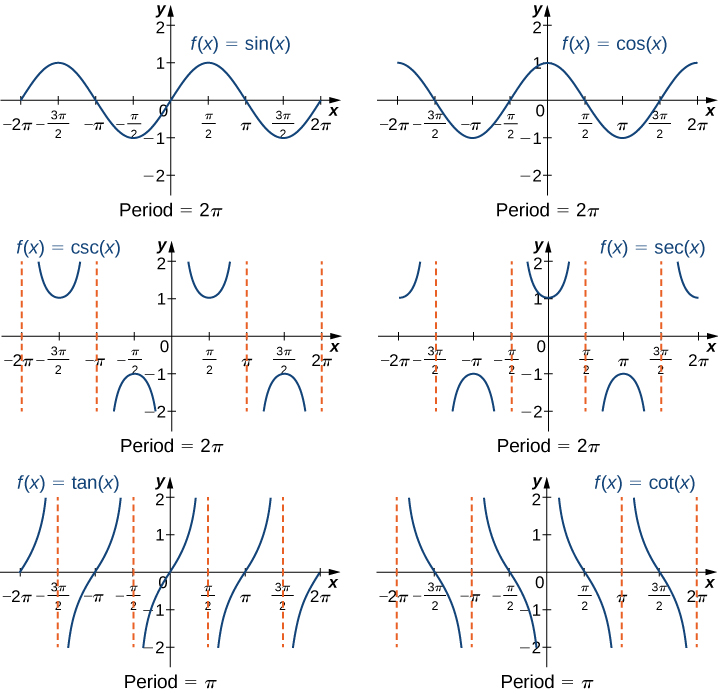
To understand the period in a technical context, we must first look at the most common trigonometric functions: sine ($sin$) and cosine ($cos$). These functions are periodic because they oscillate in a predictable, repeating wave. In a standard unit circle, a full rotation occurs every $2pi$ radians (or 360 degrees). Therefore, the “natural period” of a basic sine or cosine wave is $2pi$.
Defining the Sine and Cosine Waveform in Software
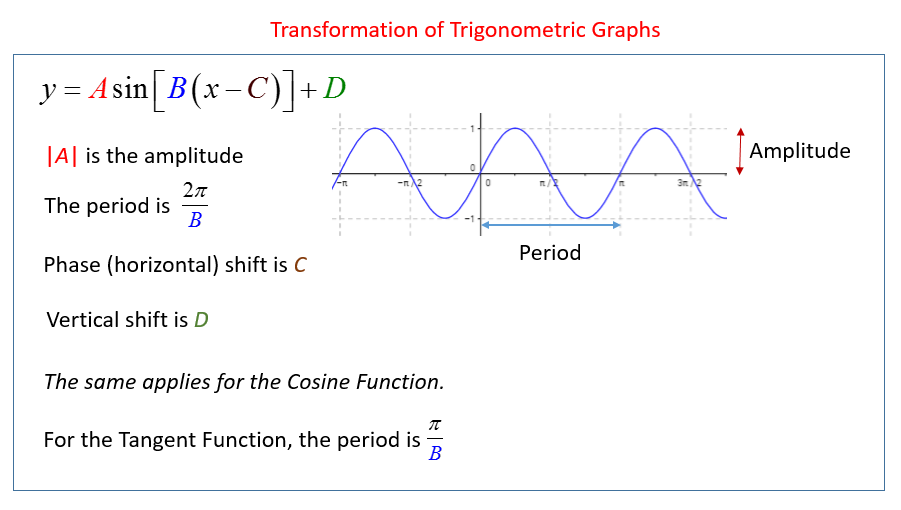
In software engineering, specifically when working with libraries like NumPy in Python or the Math object in JavaScript, trigonometric functions are utilized to model any phenomenon that fluctuates. The period $T$ of a function such as $y = sin(Bx)$ is calculated by the formula $T = 2pi / |B|$.
For developers, the variable $B$ is often the most critical component. It represents the frequency coefficient. In technical terms, if you are designing a digital synthesizer or a pulsating UI element, adjusting the period allows you to control the speed of the oscillation. A smaller $B$ results in a longer period (a slow, sweeping wave), while a larger $B$ creates a shorter period (a rapid, high-frequency vibration).
Why the 2π Cycle Matters in Algorithm Design
Modern algorithms, particularly those involved in encryption and compression, rely on the predictability of the $2pi$ cycle. Because the period is constant, developers can map complex data sets onto a circular range. This is the basis for cyclic redundancy checks (CRC) and various hashing algorithms where data needs to “wrap around” within a fixed memory space. By understanding the period, software architects can ensure that their algorithms handle cyclical data without encountering “out of bounds” errors or discontinuities in logic.
Practical Applications: From Signal Processing to Computer Graphics
Trigonometric periods are not just theoretical constructs; they are the workhorses of the hardware and software that define our digital experience. From the pixels on your screen to the wireless signals connecting your devices, periodicity is everywhere.
Digital Signal Processing (DSP) and Sampling Rates
One of the most significant applications of the trigonometric period is in Digital Signal Processing. Every piece of audio hardware—from high-end studio interfaces to the speakers in your smartphone—functions by converting continuous analog waves into discrete digital data.
According to the Nyquist-Shannon sampling theorem, to accurately reconstruct a signal, the sampling rate must be at least twice the frequency of the highest frequency component. Here, the “period” of the incoming sound wave dictates how often the software must “look” at the data. If the software miscalculates the period of the input frequency, it results in “aliasing”—a technical glitch where a high-frequency sound is misrepresented as a low-frequency one. Modern audio codecs like MP3 and AAC use the Period/Frequency relationship to compress data by removing frequencies that the human ear cannot perceive, all based on the periodic nature of sound waves.
Animating Smooth Transitions in UI/UX Design
In frontend development and game design, “easing functions” are used to make movements look natural. A character jumping or a menu sliding onto a screen rarely moves at a constant speed; instead, they follow an “In-Out” curve.
Trigonometric periods allow developers to create “harmonic motion.” By using a sine wave restricted to a specific portion of its period (e.g., from 0 to $pi/2$), a developer can create a smooth acceleration and deceleration effect. This is far more computationally efficient than hard-coding every frame of an animation, as the browser’s engine can simply calculate the position based on the current timestamp and the period of the movement function.
Coding the Period: Implementation in Python and JavaScript
Understanding the theory is one thing, but implementing trigonometric periods in code requires an understanding of how programming languages handle floating-point math and radians.
Using Math.sin() for Oscillatory Logic
In JavaScript, the Math.sin() function expects an input in radians. To create a script that triggers an event every 5 seconds using a trigonometric period, a developer might use the system clock as the input.
// A simple oscillation logic for a UI pulse effect
let time = Date.now() / 1000; // current time in seconds
let period = 2; // the effect repeats every 2 seconds
let frequency = (2 * Math.PI) / period;
let opacity = (Math.sin(time * frequency) + 1) / 2;
// This scales the -1 to 1 range of sine to a 0 to 1 range for CSS opacity
This snippet demonstrates how the period is manipulated to fit a specific technical requirement. By dividing the sine output and shifting it, the developer transforms a mathematical oscillation into a functional piece of UI code.
Handling Phase Shifts and Frequency in Data Models
In data science, particularly when analyzing “Time-Series” data (like website traffic or server load), we often see seasonal periods. Python’s SciPy and Pandas libraries allow engineers to perform Fourier Transforms. This process takes a complex, messy data signal and breaks it down into its constituent trigonometric periods.
By identifying these periods, a DevOps engineer can predict when a server is likely to hit peak capacity. If the “period” of high traffic is 24 hours, the software can automatically scale cloud resources (like AWS EC2 instances) to meet the demand before the period peaks, saving the company money and preventing downtime.
The Role of Trigonometric Periods in Modern Artificial Intelligence
As we move into the era of Large Language Models (LLMs) and Generative AI, trigonometry has found a surprising new home in the architecture of neural networks.
Positional Encoding in Transformer Models
One of the biggest challenges in natural language processing (NLP) was teaching machines the “order” of words. Unlike humans, computers see a sentence as a bag of data. The “Transformer” architecture—the tech behind ChatGPT—solved this using something called Positional Encoding.
Positional encoding uses sine and cosine functions of different frequencies (and thus, different periods) to create a unique signature for every position in a sequence. Because each period is mathematically distinct, the AI can use these trigonometric values to “understand” where a word sits in a sentence and how far it is from another word. This is a brilliant application of the trigonometric period to solve a high-level logic problem in machine learning.
Time-Series Forecasting and Seasonal Decomposition
AI tools used in FinTech and weather forecasting rely heavily on “Seasonal Decomposition of Time Series” (STL). This involves identifying the “Period” of a trend. For instance, an AI analyzing retail data will identify a weekly period (7 days) and an annual period (365 days). By stripping away the noise and focusing on these periodic oscillations, the AI can provide highly accurate predictions. This technical application of the trig period allows businesses to automate inventory management and logistics with a degree of precision that was impossible a decade ago.

Conclusion: The Period as a Technical Essential
In summary, the “period in trig” is far more than a variable in an equation; it is a fundamental unit of measurement for the digital world. For the software developer, it is a tool for creating smooth animations and efficient loops. For the hardware engineer, it is the key to managing signals and data transmission. For the AI researcher, it is the mechanism that allows machines to perceive structure in sequences of data.
As technology continues to evolve toward more complex simulations and autonomous systems, the ability to manipulate and understand periodic functions will remain a critical skill. By mastering the period, tech professionals can write better code, build more resilient systems, and push the boundaries of what is possible in digital innovation. Whether you are working in the cloud, on a mobile app, or within the weights of a neural network, the trigonometric period is the pulse that keeps the system running.
aViewFromTheCave is a participant in the Amazon Services LLC Associates Program, an affiliate advertising program designed to provide a means for sites to earn advertising fees by advertising and linking to Amazon.com. Amazon, the Amazon logo, AmazonSupply, and the AmazonSupply logo are trademarks of Amazon.com, Inc. or its affiliates. As an Amazon Associate we earn affiliate commissions from qualifying purchases.