
In the intricate world of finance, few concepts are as ubiquitous and fundamental as the percentage. From the daily news headlines detailing economic growth or inflation to the fine print on a credit card statement, percentages are the universal language that helps us quantify change, understand proportions, and make informed financial decisions. Far from being a mere academic exercise, grasping “what is a percentage of a number” is an essential life skill, a cornerstone of financial literacy that empowers individuals to navigate personal budgets, investment strategies, and the broader economic landscape with confidence.

At its heart, a percentage is a way of expressing a number as a fraction of 100. The term “percent” literally means “per hundred” or “out of one hundred.” It provides a standardized and easily comparable metric, allowing us to compare different quantities even when their total amounts vary wildly. Without a solid understanding of percentages, deciphering financial reports, comparing loan offers, or even understanding a discount at a store becomes a formidable challenge. This article aims to demystify percentages, illustrate their critical role in money matters, and equip you with the knowledge to apply them effectively in your financial life.
The Core Concept: Understanding Percentages
Before diving into their financial applications, it’s crucial to solidify our understanding of what percentages fundamentally represent and how they are calculated. This foundational knowledge will serve as the bedrock for all subsequent financial analyses.
Defining “Percent” and its Notation (%)
A percentage is a dimensionless number used to express a part of a whole in relation to 100. The symbol “%” is universally recognized as the indicator of a percentage. When we say “20%”, we mean 20 parts out of every 100 parts of a given whole. This concept makes it incredibly useful for comparing different quantities because the denominator (100) is always the same. Whether you’re comparing 20 out of 100 apples, or 20,000 out of 100,000 people, the proportion remains consistent: 20%.
Converting Between Percentages, Decimals, and Fractions
To effectively work with percentages, it’s essential to understand their relationship with decimals and fractions, and how to convert between them seamlessly.
-
Percentage to Decimal: To convert a percentage to a decimal, simply divide the percentage by 100 (or move the decimal point two places to the left).
-
Example: 25% = 25 / 100 = 0.25
-
Example: 5.5% = 5.5 / 100 = 0.055
-
-
Decimal to Percentage: To convert a decimal to a percentage, multiply the decimal by 100 (or move the decimal point two places to the right) and add the “%” symbol.
-
Example: 0.75 = 0.75 * 100 = 75%
-
Example: 1.2 = 1.2 * 100 = 120%
-
-
Percentage to Fraction: To convert a percentage to a fraction, write the percentage as a numerator over a denominator of 100, then simplify the fraction if possible.
- Example: 40% = 40/100 = 2/5
-
Fraction to Percentage: To convert a fraction to a percentage, first convert the fraction to a decimal by dividing the numerator by the denominator, then multiply by 100.
- Example: 3/4 = 0.75 = 0.75 * 100 = 75%
These conversions are crucial because most financial calculations involving percentages are performed using their decimal equivalents.
Basic Calculation: Finding a Percentage of a Number
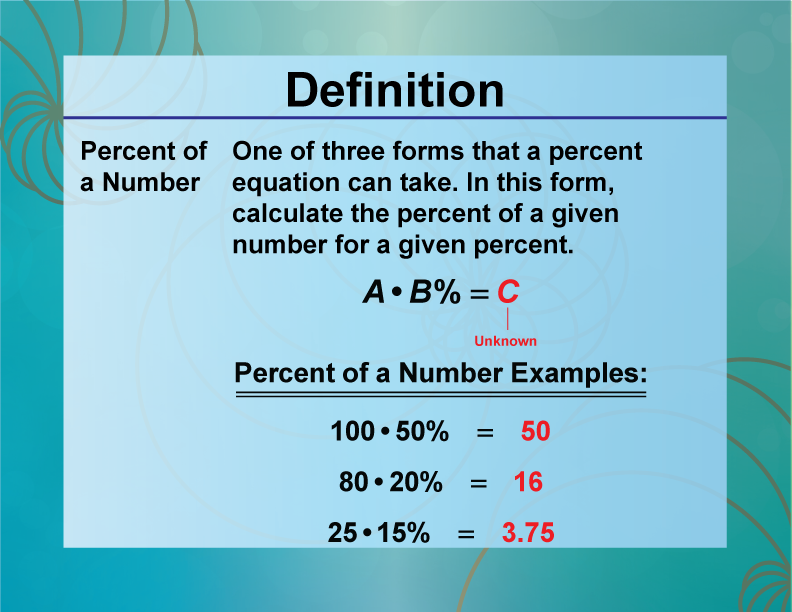
The most fundamental operation is calculating a percentage of a given number. This is done by converting the percentage to its decimal form and then multiplying it by the number.
-
Formula: Percentage of Number = (Percentage / 100) * Number
- Or more simply: Percentage of Number = Decimal Equivalent * Number
-
Example 1: Discount Calculation
You see an item priced at $80, and it’s on sale for 20% off. To find the discount amount:
Discount = 20% of $80 = 0.20 * $80 = $16
The sale price would be $80 – $16 = $64.
-
Example 2: Sales Tax
If your local sales tax is 7% and you buy something for $150:
Sales Tax = 7% of $150 = 0.07 * $150 = $10.50
The total cost would be $150 + $10.50 = $160.50.
Percentages in Personal Finance: Everyday Applications
Percentages are not just theoretical concepts; they are integral to nearly every financial transaction and decision we make daily. Understanding them can significantly impact your financial well-being.
Discounts and Sales: Saving Money Effectively
Shopping offers often present savings as percentages (e.g., “30% off,” “Buy one, get one 50% off”). Knowing how to quickly calculate these discounts allows you to determine actual savings and compare deals effectively, ensuring you’re getting the best value for your money. Misinterpreting a percentage discount can lead to overspending or missing out on true savings.
Interest Rates: Loans, Savings, and Credit Cards
This is arguably one of the most significant applications of percentages in personal finance.
-
Loans (Mortgages, Car Loans, Personal Loans): The interest rate (Annual Percentage Rate or APR) dictates how much extra you pay for borrowing money. A 5% interest rate on a loan means you’ll pay an additional 5% of the principal amount annually (or on a compounded basis) for the privilege of borrowing.
-
Savings Accounts & Investments: Conversely, a percentage interest rate on your savings or investments means your money is growing by that percentage annually. Understanding compounding interest—where interest is earned not just on the principal but also on accumulated interest—is paramount for long-term wealth growth.
-
Credit Cards: Credit cards often carry high-interest rates, sometimes 15-25% APR or more. Unpaid balances accrue interest rapidly, turning a small debt into a much larger one if not managed carefully. Knowing how to calculate the interest charged on your outstanding balance is crucial to avoiding debt traps.
Taxes and Deductions: Understanding Your Paycheck and Obligations
Your paycheck is a prime example of percentages at work. Income tax, Social Security, and Medicare (FICA) are all calculated as percentages of your gross income. Understanding your effective tax rate (the percentage of your income paid in taxes) and various deductions helps you grasp your net income and plan your budget accurately. It also empowers you to make informed decisions about tax-advantaged accounts like 401(k)s or IRAs, which allow you to defer taxes on a percentage of your income.
Budgeting and Expense Tracking: Allocating Your Income
Effective budgeting often involves allocating percentages of your income to different categories: housing, food, transportation, savings, and discretionary spending. For example, the popular 50/30/20 rule suggests 50% of income for needs, 30% for wants, and 20% for savings and debt repayment. This percentage-based approach makes budgeting flexible and scalable, adapting to various income levels while maintaining healthy financial proportions. Tracking your expenses as a percentage of your total spending helps identify areas where you might be overspending or where adjustments could lead to greater savings.
Percentages in Investing and Wealth Growth
Beyond daily finances, percentages are the backbone of investment analysis and wealth accumulation strategies. They allow investors to measure performance, manage risk, and project future growth.
Return on Investment (ROI): Measuring Performance
ROI is a fundamental metric used to evaluate the profitability of an investment. It’s expressed as a percentage, indicating the gain or loss relative to the initial investment.
ROI = [(Current Value of Investment – Cost of Investment) / Cost of Investment] * 100%
A positive ROI means profit, while a negative ROI indicates a loss. Comparing ROIs helps investors choose between different opportunities.
Compounding Interest: The Power of Growth
Often called the “eighth wonder of the world,” compounding interest is the process where the interest earned on an investment also earns interest. The longer the money is invested and the higher the percentage interest rate, the more dramatic the effect. A 7% annual return compounded over 30 years can turn a modest sum into a significant nest egg, far outpacing simple interest. Understanding this percentage-driven growth is key to successful long-term investing.
Portfolio Allocation: Diversifying Your Assets
Investors often allocate their assets across different categories (stocks, bonds, real estate, cash) based on percentages. For example, a common rule of thumb suggests that the percentage of your portfolio allocated to bonds should be roughly equal to your age, with the remainder in stocks. This percentage-based allocation strategy helps manage risk and aligns investments with personal financial goals and risk tolerance.
Inflation and Purchasing Power: The Hidden Cost
Inflation, expressed as a percentage, represents the rate at which the general level of prices for goods and services is rising, and subsequently, the purchasing power of currency is falling. If your investments are yielding a 5% return, but inflation is at 3%, your real return is only 2%. Understanding inflation’s percentage impact is crucial for preserving and growing your wealth in real terms.
Percentages in Business and Economic Context
For entrepreneurs, business leaders, and those following economic trends, percentages provide invaluable insights into operational efficiency, market dynamics, and macroeconomic health.
Profit Margins and Markups: Pricing Strategies
Businesses rely heavily on percentages to set prices and evaluate profitability.
-
Gross Profit Margin: This percentage indicates how much profit a company makes from its sales after accounting for the cost of goods sold. (Gross Profit / Revenue) * 100%.
-
Net Profit Margin: This percentage shows how much profit a company makes after all expenses (including taxes) are deducted from revenue. (Net Profit / Revenue) * 100%.
-
Markups: When pricing products, businesses use markups, often expressed as a percentage of the cost, to ensure they cover expenses and generate profit.
These percentages are critical for strategic pricing, cost control, and financial health assessment.
Growth Rates: Sales, Market Share, and GDP
Percentages are the standard for measuring growth.
-
Sales Growth: A company’s sales growth is often expressed as a percentage increase over a previous period.
-
Market Share: This percentage represents the proportion of the total market that a company controls. An increasing market share percentage indicates competitive strength.
-
Gross Domestic Product (GDP) Growth: National economies are measured by their GDP growth rate, a key indicator of economic health.
Understanding these growth percentages is vital for business strategy, investment analysis, and economic forecasting.
Financial Ratios: Analyzing Business Health
Many critical financial ratios are expressed as percentages, offering quick insights into a company’s liquidity, solvency, and operational efficiency. Examples include:
-
Debt-to-Equity Ratio: While often a simple ratio, it can be interpreted in percentage terms to show how much of a company’s financing comes from debt versus equity.
-
Return on Equity (ROE): This percentage measures a company’s profitability in relation to the equity invested by shareholders.
Economic Indicators: Unemployment Rates and CPI
At a macroeconomic level, percentages dominate the reporting of crucial economic indicators. The unemployment rate is the percentage of the labor force that is unemployed and actively seeking work. The Consumer Price Index (CPI), which measures inflation, is expressed as a percentage change over time. These percentages are regularly cited by policymakers, investors, and the public to gauge the overall health and direction of the economy.
Mastering Percentage Calculations: Practical Tips and Tools
While the concepts are straightforward, errors in percentage calculations can have significant financial consequences. Here are some tips to enhance your proficiency.
Mental Math Shortcuts
For common percentages (e.g., 10%, 25%, 50%), practice mental math. To find 10% of a number, just move the decimal one place to the left (e.g., 10% of $250 is $25). For 25%, divide by 4. These shortcuts speed up decision-making.
Leveraging Calculators and Spreadsheets
For more complex calculations or larger datasets, don’t hesitate to use a calculator. Financial calculators often have a dedicated “%” button. Spreadsheets like Microsoft Excel or Google Sheets are invaluable for financial planning, allowing you to set up formulas that automatically calculate percentages for budgets, investment tracking, and loan amortizations.
Avoiding Common Misconceptions
Be wary of “percentage point” versus “percentage change.” If an interest rate goes from 4% to 5%, that’s a 1 percentage point increase, but a 25% percentage change (1 percentage point increase / 4% original rate = 0.25 = 25%). These distinctions are crucial in financial reporting. Also, understand the base: a percentage is always “of” something. Changing the base changes the absolute value, even if the percentage remains constant.

Conclusion
Understanding “what is a percentage of a number” is not merely an academic exercise; it’s a critical component of financial literacy and empowerment. From calculating everyday discounts and understanding interest rates on loans and savings to analyzing complex investment returns and interpreting macroeconomic indicators, percentages are the indispensable tools that allow us to quantify financial information, compare options, and make informed decisions.
By mastering the core concepts, practicing conversions, and recognizing their diverse applications across personal finance, investing, and business, you unlock a deeper understanding of your financial world. Embrace percentages not as daunting mathematical hurdles, but as powerful allies in your journey towards financial wisdom and security. They are the language of money, and fluency in this language is a non-negotiable asset in today’s financially driven world.
aViewFromTheCave is a participant in the Amazon Services LLC Associates Program, an affiliate advertising program designed to provide a means for sites to earn advertising fees by advertising and linking to Amazon.com. Amazon, the Amazon logo, AmazonSupply, and the AmazonSupply logo are trademarks of Amazon.com, Inc. or its affiliates. As an Amazon Associate we earn affiliate commissions from qualifying purchases.