
Compound interest is often hailed as the “eighth wonder of the world,” and for good reason. It’s the phenomenon where the interest you earn on your initial principal also starts earning interest, creating an exponential growth effect. While this concept is fundamental to personal finance, understanding how it works when compounded monthly can unlock deeper insights into savings, investments, and even debt. For individuals aiming to grow their wealth strategically, mastering monthly compound interest is not just an academic exercise; it’s a practical skill that informs critical financial decisions.
In this comprehensive guide, we’ll demystify monthly compound interest, breaking down its components, providing practical calculation methods, and illustrating its profound impact on your financial journey. Whether you’re planning for retirement, saving for a down payment, or simply looking to understand your bank statements better, comprehending monthly compounding is an invaluable asset.
Understanding the Power of Monthly Compound Interest
Before diving into calculations, it’s crucial to grasp the fundamental concept of compound interest and why its monthly application holds particular significance. It’s the engine behind long-term wealth accumulation, offering a stark contrast to simpler interest models.
What is Compound Interest?
At its core, compound interest is interest on interest. Instead of just earning returns on your initial principal (as with simple interest), you earn returns on the principal plus all the accumulated interest from previous periods. Imagine a snowball rolling down a hill; it gathers more snow, becoming larger and picking up even more snow at an accelerated pace. Your money, under the influence of compounding, behaves similarly. The longer your money is invested, and the more frequently the interest is compounded, the faster your wealth can grow. This acceleration is the true magic of compounding.
Simple vs. Compound Interest: A Crucial Distinction
To truly appreciate compound interest, it helps to compare it with simple interest. Simple interest is calculated only on the initial principal amount. For example, if you invest $1,000 at a 5% simple annual interest rate, you would earn $50 each year, regardless of how long the money is invested. After three years, you’d have $1,150 ($1,000 principal + $150 interest).
Compound interest, however, adds the earned interest back to the principal. Using the same example:
-
Year 1: $1,000 * 5% = $50. New principal = $1,050.
-
Year 2: $1,050 * 5% = $52.50. New principal = $1,102.50.
-
Year 3: $1,102.50 * 5% = $55.13. New principal = $1,157.63.
Even over just three years, the difference ($1,157.63 vs. $1,150) is noticeable. Over decades, this seemingly small difference can amount to hundreds of thousands, or even millions, of dollars.
Why Monthly Compounding Matters
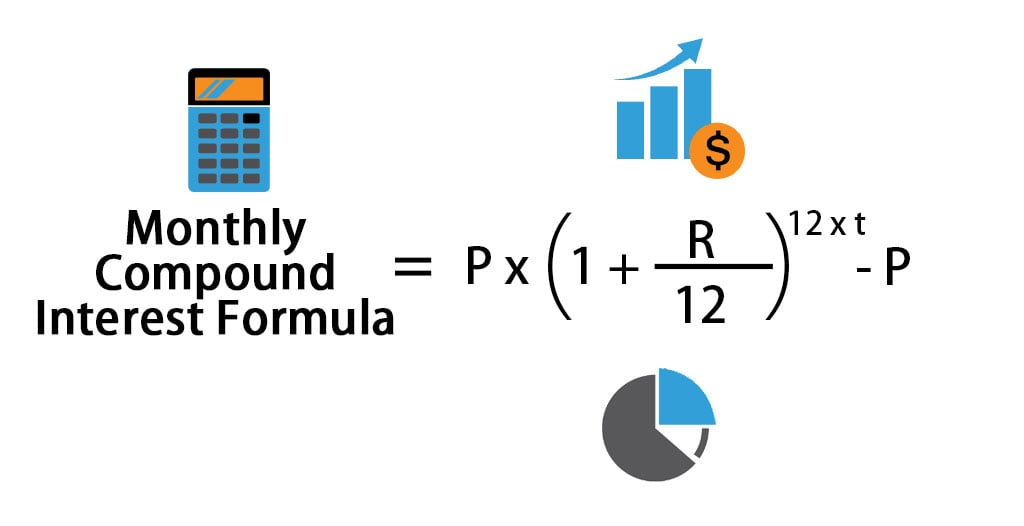
The frequency of compounding plays a vital role in how quickly your money grows. While interest can be compounded annually, semi-annually, quarterly, or even daily, monthly compounding is one of the most common frequencies encountered in savings accounts, Certificates of Deposit (CDs), and many investment vehicles. When interest is compounded monthly, it means that at the end of each month, the interest earned for that month is added to your principal, and then the next month’s interest is calculated on this new, larger principal. This more frequent application of interest leads to faster growth compared to annual or quarterly compounding, given the same annual interest rate. It gives your money more opportunities to snowball, accelerating your returns and making every month an opportunity for your wealth to expand.
The Formula for Monthly Compound Interest
Calculating compound interest monthly might sound intimidating, but it’s straightforward once you understand the formula and its components. This mathematical bedrock empowers you to predict your financial future and make informed decisions.
Deconstructing the Compound Interest Formula
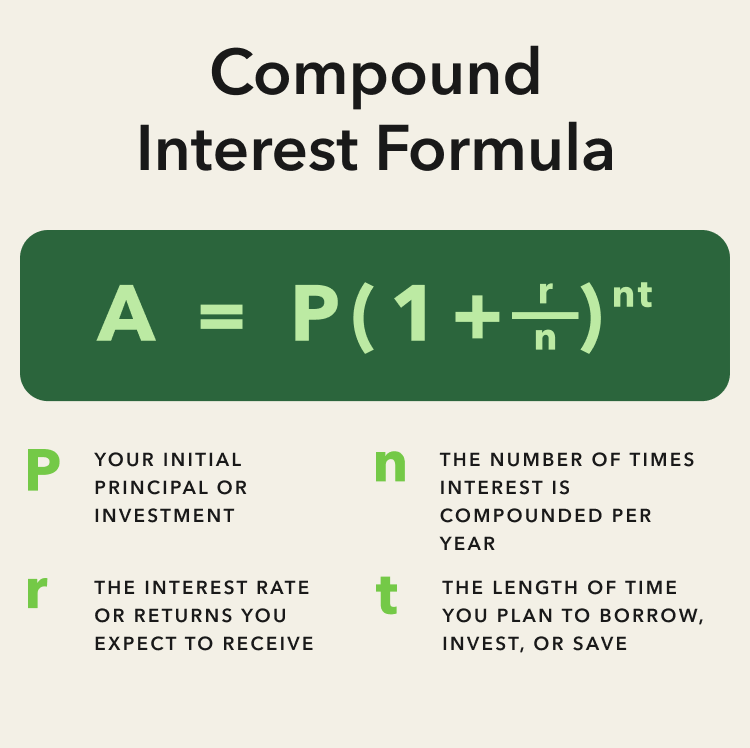
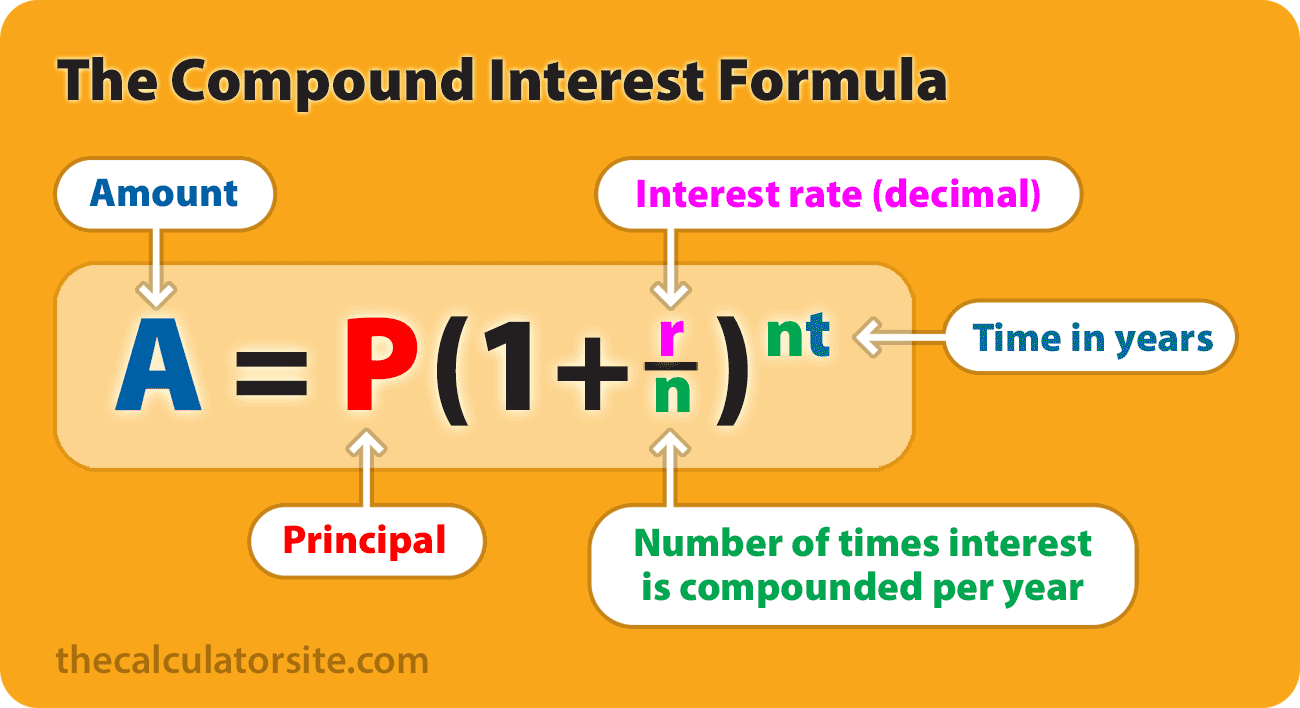
The universal formula for compound interest is:
A = P(1 + r/n)^(nt)
Let’s break down each variable:
-
A = Future Value of the Investment/Loan, including interest. This is the total amount of money you’ll have after a specified period.
-
P = Principal Investment Amount. This is the initial sum of money deposited or borrowed.
-
r = Annual Interest Rate (as a decimal). It’s crucial to convert the percentage rate into a decimal (e.g., 5% becomes 0.05).
-
n = Number of Times that Interest is Compounded Per Year. For monthly compounding, n will always be 12.
-
t = Number of Years the Money is Invested or Borrowed For.
The core of the formula lies in (1 + r/n). This represents the growth factor per compounding period. Raising it to the power of (nt) accounts for the total number of compounding periods over the investment horizon.
Step-by-Step Calculation Example
Let’s walk through a practical example to solidify your understanding.
Scenario: You deposit $5,000 into a savings account that offers a 3% annual interest rate, compounded monthly. You want to know how much money you will have after 10 years.
Given:
-
P = $5,000
-
r = 3% = 0.03
-
n = 12 (monthly compounding)
-
t = 10 years
Step 1: Convert the annual rate to a monthly rate.
r/n = 0.03 / 12 = 0.0025
Step 2: Calculate the total number of compounding periods.
nt = 12 * 10 = 120
Step 3: Plug the values into the formula.
A = 5000 * (1 + 0.0025)^(120)
Step 4: Calculate the value inside the parentheses.
1 + 0.0025 = 1.0025
Step 5: Raise the result to the power of the total compounding periods.
1.0025 ^ 120 ≈ 1.34935
Step 6: Multiply by the principal.
A = 5000 * 1.34935
A ≈ $6,746.75
After 10 years, your initial $5,000 investment will grow to approximately $6,746.75 with monthly compounding. The interest earned would be $1,746.75 ($6,746.75 – $5,000). If this were simple interest at 3%, you’d only earn $1,500 ($5,000 * 0.03 * 10). The extra $246.75 is the power of compounding at work.
Key Factors Influencing Growth
Several factors significantly influence the growth of your investments through monthly compounding:
-
Initial Principal (P): A larger initial investment naturally leads to larger absolute returns.
-
Interest Rate (r): Higher interest rates accelerate growth exponentially. Even a fraction of a percentage point difference can yield substantial results over time.
-
Time (t): This is arguably the most critical factor. The longer your money is compounded, the more potent the “interest on interest” effect becomes. This highlights the importance of starting early.
-
Compounding Frequency (n): As discussed, more frequent compounding (like monthly vs. annually) leads to slightly higher returns because the interest is added to the principal and begins earning interest sooner.
Practical Applications and Scenarios
Understanding the mechanics of monthly compound interest isn’t just for academic pursuits; it has tangible applications across various aspects of your financial life. From growing your savings to managing debt, the principles remain consistent.
Savings Accounts and Certificates of Deposit (CDs)
Most traditional savings accounts and CDs offered by banks compound interest monthly. This means that every 30 days or so, the interest earned in that period is calculated and added to your balance. The next month’s interest will then be computed on this new, slightly larger balance. For savers, this is beneficial as it provides a steady, albeit often modest, growth trajectory for their funds. When comparing different savings products, always check the annual percentage yield (APY) rather than just the annual interest rate, as APY already factors in the effect of compounding frequency, giving you a more accurate picture of your actual earnings.
Investment Portfolios
The concept of monthly compounding extends powerfully into the world of investments. While stock market returns aren’t fixed like a savings account, many investment vehicles leverage compounding. For instance, reinvesting dividends from stocks or mutual funds effectively means those dividends become part of your principal, earning future returns. If these dividends are paid monthly or quarterly and reinvested immediately, they contribute to a compounding effect similar to monthly interest, amplifying your portfolio’s growth over the long term. This is a cornerstone strategy for retirement accounts like 401(k)s and IRAs, where long-term growth is paramount.
Loans and Debt: The Reverse Effect
While compounding works wonders for your savings, it can be a formidable adversary when it comes to debt. Loans, especially high-interest ones like credit cards, often compound interest monthly, if not daily. If you carry a balance on a credit card, the interest accrued each month is added to your principal debt, and the next month’s interest is calculated on this larger amount. This rapidly inflates your debt, making it harder to pay off. Mortgages and personal loans also utilize compounding, though their structures typically involve fixed monthly payments that gradually reduce the principal. Understanding how interest compounds on your liabilities is just as crucial as understanding it for your assets; it motivates aggressive debt repayment strategies.
Retirement Planning
For retirement planning, monthly compounding is an absolute game-changer. Contributions to retirement accounts like 401(k)s, 403(b)s, and IRAs grow significantly over decades, largely due to monthly (or even more frequent) compounding. An investment made in your 20s has 40+ years to compound, experiencing many more compounding periods than an investment made in your 40s. Even small, consistent monthly contributions, coupled with the power of compounding, can transform into substantial nest eggs by retirement age. This underscores the oft-repeated advice: start saving for retirement as early as possible.
Tools and Resources for Calculation
While the formula for monthly compound interest is clear, manual calculations for complex scenarios (like varying contributions over time) can become tedious. Fortunately, a plethora of tools and resources exist to simplify this process and provide instant insights.
Online Compound Interest Calculators
The easiest and most accessible way to figure monthly compound interest is through online calculators. A simple search for “compound interest calculator monthly” will yield numerous reliable options from financial institutions, investment platforms, and personal finance websites. These tools typically allow you to input your principal, annual interest rate, compounding frequency (select monthly), duration, and often even additional monthly contributions. They instantly display the future value, total interest earned, and sometimes even a detailed breakdown of growth over time, often with interactive charts. These are excellent for quick estimations and comparing different scenarios.
Spreadsheet Software (Excel/Google Sheets)
For those who prefer a more hands-on approach or need to integrate calculations into a broader financial plan, spreadsheet software like Microsoft Excel or Google Sheets is incredibly powerful. You can easily set up your own compound interest calculator using the built-in financial functions.
The primary function you’ll use is FV (Future Value). The syntax for FV is:
=FV(rate, nper, pmt, [pv], [type])
-
rate: The interest rate per period. For monthly compounding at an annual rate of 3%, this would be0.03/12. -
nper: The total number of payment periods. For 10 years of monthly compounding, this would be10*12. -
pmt: The payment made each period (e.g., additional monthly contributions). If there are no additional contributions, this is0. -
pv: The present value, or the principal investment amount. This should be entered as a negative number if it’s an outflow (money you are investing). -
type: (Optional) When payments are due (0 for end of period, 1 for beginning). Default is 0.
Example for $5,000 principal at 3% monthly compounding for 10 years (no additional payments):
=FV(0.03/12, 10*12, 0, -5000)
This formula will directly give you the future value of $6,746.75, matching our manual calculation. Spreadsheets also allow you to create tables to visualize year-by-year or month-by-month growth, adding flexibility for complex financial modeling.
Financial Calculators
Dedicated financial calculators (physical devices like the Texas Instruments BA II Plus or HP 12c) are indispensable tools for finance professionals, students, and serious investors. These calculators have specific functions for time value of money (TVM) calculations, allowing you to input variables like N (number of periods), I/Y (interest rate per year), PV (present value), PMT (payment), and FV (future value) to solve for any unknown. While they require a bit of a learning curve, they offer precision and speed for complex calculations, especially when dealing with varying payment schedules or irregular compounding frequencies.
Mobile Apps
In today’s digital age, numerous mobile apps offer compound interest calculation features. Many personal finance apps or dedicated investment apps include built-in calculators that can quickly project growth based on your inputs. These offer convenience and accessibility, allowing you to run scenarios on the go and integrate them into your overall financial tracking. Look for apps that provide clear visualizations and allow you to save different scenarios for comparison.
Maximizing Your Monthly Compounding
Understanding how to calculate monthly compound interest is only half the battle; the other half is actively leveraging this knowledge to maximize your financial growth. A few key strategies can significantly enhance the compounding effect on your wealth.
Start Early and Be Consistent
The most potent factor in compounding is time. The longer your money has to grow, the more opportunities it has to earn interest on interest. Starting to save and invest early, even with modest amounts, gives your money decades to compound, leading to exponentially larger sums compared to starting later with larger contributions. Consistency in your contributions, such as setting up automated monthly transfers to savings or investment accounts, further fuels the compounding engine, making it a powerful habit that works silently in your favor.
Prioritize Higher Interest Rates
While time is king, the interest rate is a close second. Even a seemingly small difference in annual interest rates can lead to substantial disparities in future value over long periods. When choosing savings accounts, CDs, or investment products, always compare the annual percentage yield (APY) to identify options with the most favorable rates. A 0.5% or 1% higher rate can translate into thousands, if not tens of thousands, of additional dollars over your investment horizon. Regularly review market rates to ensure your money isn’t languishing in low-yield accounts if better alternatives are available.
Reinvest Your Earnings
For investments that generate dividends or capital gains, reinvesting these earnings is crucial for maximizing the compounding effect. Instead of taking dividends as cash, choose to automatically reinvest them to buy more shares or units of the investment. This increases your principal, which in turn generates more dividends or gains in the future, creating a virtuous cycle of accelerated growth. Most brokerage accounts offer automatic dividend reinvestment plans (DRIPs), making this strategy effortless to implement.
Understand and Minimize Fees
Fees, whether they are account maintenance fees, transaction fees, or expense ratios for investment funds, can subtly erode your compound returns. Every dollar lost to fees is a dollar that cannot compound for you. Be vigilant about understanding all fees associated with your savings and investment accounts. Opt for low-cost index funds, exchange-traded funds (ETFs), or commission-free platforms where possible. Over decades, even seemingly small fees can significantly diminish your total accumulated wealth.
Regular Review and Adjustment
Your financial goals and circumstances are likely to change over time. Therefore, it’s essential to regularly review your savings and investment strategies. Periodically assess whether your accounts are still offering competitive interest rates, if your investment portfolio aligns with your risk tolerance and goals, and if you can increase your monthly contributions. Adjusting your strategy as needed ensures that you are continuously optimizing the power of monthly compounding to work best for your evolving financial journey.
Mastering the mechanics of monthly compound interest is a foundational skill for anyone serious about personal finance. It transforms abstract numbers into actionable insights, revealing the true potential of consistent saving and smart investing. By understanding the formula, leveraging available tools, and implementing strategic habits, you empower yourself to harness this financial wonder, turning humble beginnings into significant wealth over time. The journey to financial independence is a marathon, and monthly compounding is the consistent stride that helps you cross the finish line with greater success.
aViewFromTheCave is a participant in the Amazon Services LLC Associates Program, an affiliate advertising program designed to provide a means for sites to earn advertising fees by advertising and linking to Amazon.com. Amazon, the Amazon logo, AmazonSupply, and the AmazonSupply logo are trademarks of Amazon.com, Inc. or its affiliates. As an Amazon Associate we earn affiliate commissions from qualifying purchases.