
The intriguing question, “What is a penny a day doubled for 30 days?” isn’t just a mathematical puzzle; it’s a profound illustration of one of the most powerful forces in personal finance: exponential growth, often referred to as compound interest. While it starts with a seemingly insignificant sum, the answer, by the end of the month, is nothing short of astonishing, revealing how seemingly small contributions can snowball into significant wealth over time.
Most people, when first presented with this challenge, vastly underestimate the final sum. Their intuition, often accustomed to linear thinking, struggles to grasp the accelerating nature of exponential growth. A penny, then two, then four – it feels trivial for a long time. Yet, by the thirtieth day, the total amount accumulated from that humble start climbs into the multi-millions, demonstrating how patience and consistent compounding can turn minuscule beginnings into substantial financial realities. This exercise serves as a fundamental lesson in understanding how investments grow, how savings accumulate, and even how debt can spiral out of control.

The Astonishing Power of Exponential Growth
At its core, the penny doubling experiment is a masterclass in exponential growth. Unlike linear growth, where a fixed amount is added each period (e.g., adding $1 every day), exponential growth means the amount added each period is proportional to the current amount. In this case, each day’s total is twice the previous day’s total. This distinction is critical for understanding wealth accumulation.
The immediate revelation from this thought experiment is that the final sum is not a few dollars or even a few hundred. If you start with $0.01 on Day 1 and double it daily:
- Day 1: $0.01
- Day 2: $0.02
- Day 3: $0.04
- Day 10: $5.12
- Day 20: $5,242.88
- Day 30: $5,368,709.12
This staggering figure, exceeding five million dollars, highlights why financial experts constantly preach the importance of starting early and letting your money compound. The initial stages feel insignificant, almost imperceptible in their growth, but the latter stages demonstrate an explosive acceleration that can defy common sense. This phenomenon is precisely what makes long-term investing and consistent saving so effective.
The Immediate Revelation
The immediate answer – over $5 million – is often met with disbelief. This mental block stems from our natural tendency to project linear outcomes. We expect growth to be additive, not multiplicative. However, the power of doubling means that each successive increment is larger than all preceding increments combined. It’s this property that causes the curve to ascend almost vertically towards the end of the period, yielding a result that feels fantastical for such a small starting point.
Understanding the Curve
Visualizing the growth curve helps. For the first week or two, the curve remains relatively flat. The numbers are small, and the daily increases, while doubling, don’t feel substantial. It’s in the middle segment, roughly days 15-20, where the curve starts to bend upwards more noticeably. Then, in the final third, especially the last few days, the curve shoots skyward. The last day alone adds more than the entire accumulated sum of the previous 29 days. This characteristic S-curve shape is the hallmark of exponential growth and the key to understanding how compounding works in your favor over extended periods.
Decoding the Daily Doubling
To truly appreciate the mechanism behind this financial explosion, it’s insightful to track the daily progress, observing when the growth shifts from incremental to monumental.
The Initial Slow Burn
The early days of the penny doubling demonstrate the often-frustrating reality of starting any financial endeavor. Growth is slow, almost dishearteningly so.
- Day 1: $0.01
- Day 2: $0.02
- Day 3: $0.04
- Day 4: $0.08
- Day 5: $0.16
- Day 6: $0.32
- Day 7: $0.64
- Day 8: $1.28
- Day 9: $2.56
- Day 10: $5.12
After ten days, you’ve barely accumulated five dollars. This initial period mirrors the experience of new investors or savers who see minimal gains in their first few months or even years. It’s easy to get discouraged and think the effort isn’t worth it. However, it’s precisely these early, seemingly insignificant steps that lay the foundation for future massive growth.
The Tipping Point
Around the halfway mark, the growth starts to become more noticeable, crossing into hundreds and then thousands of dollars.
- Day 15: $163.84
- Day 16: $327.68
- Day 17: $655.36
- Day 18: $1,310.72
- Day 19: $2,621.44
- Day 20: $5,242.88
By Day 20, the amount has broken the $5,000 mark. The daily additions are no longer pennies or dollars, but hundreds and thousands. This phase is often described as the “tipping point” where the initial slow grind gives way to more significant, visible progress. For real-world investors, this might represent the moment their portfolio starts to show substantial five-figure gains, validating their consistent efforts.
The Final Surge
The last ten days are where the truly mind-boggling acceleration occurs, culminating in the multi-million dollar total.
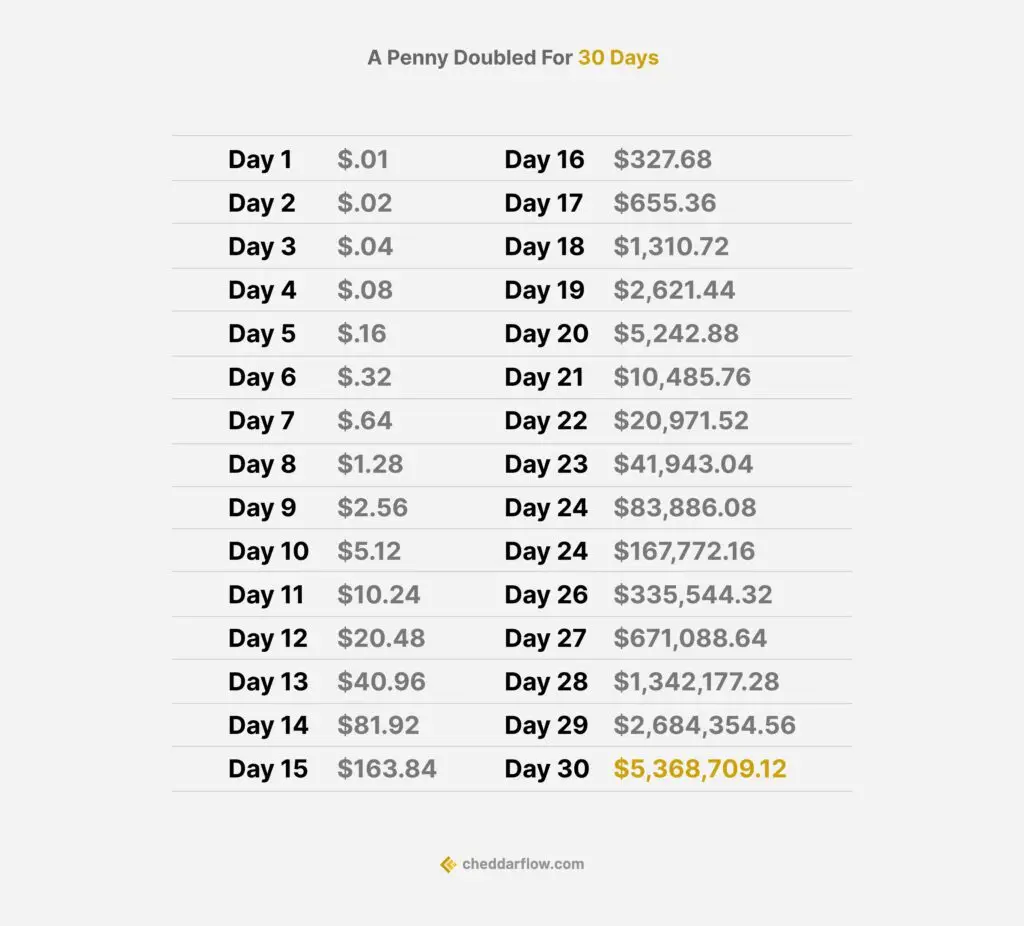
- Day 21: $10,485.76
- Day 22: $20,971.52
- Day 23: $41,943.04
- Day 24: $83,886.08
- Day 25: $167,772.16
- Day 26: $335,544.32
- Day 27: $671,088.64
- Day 28: $1,342,177.28
- Day 29: $2,684,354.56
- Day 30: $5,368,709.12
In the final ten days, the sum explodes from just over $10,000 to more than $5 million. The daily increase on Day 30 alone is over $2.6 million. This dramatic finale underscores why time is the most valuable asset when it comes to compounding. The longer money has to grow, the more it benefits from this exponential acceleration, especially in its later stages.
Beyond the Penny: Real-World Applications of Compounding
The penny doubling exercise is more than just a theoretical curiosity; it’s a fundamental principle that underpins nearly every aspect of personal finance, from wealth creation to debt management. Understanding this concept can profoundly influence financial decisions.
Investing for Retirement
The most prominent application of compounding is in long-term investing, particularly for retirement. Contributions to 401(k)s, IRAs, and other investment vehicles grow over decades, not just 30 days. Imagine the penny doubling for 30 years instead of 30 days! While investment returns are not a guaranteed doubling and fluctuate, the principle remains: money invested early and allowed to grow over a long period can achieve remarkable appreciation. Reinvesting dividends and capital gains amplifies this effect, as those returns themselves start earning returns. This is why financial advisors universally recommend starting retirement savings as early as possible, even with small amounts.
Savings Accounts and Emergency Funds
Even in lower-interest environments, the concept of compounding applies to savings. High-yield savings accounts, while not offering exponential doubling, still allow your interest to earn more interest. Over time, an emergency fund, for instance, won’t just sit stagnant; it will slowly but steadily grow through compounded interest, providing an extra layer of financial security. For those saving for a down payment or a child’s education, regular contributions combined with even modest compound interest can significantly accelerate reaching their goals.
The Dark Side: Compound Interest on Debt
While powerful for wealth building, compound interest has a sinister inverse when it comes to debt. High-interest debts, such as credit card balances, work against you with the same exponential force. If you carry a balance month after month, the interest you owe is added to your principal, and then you pay interest on that new, larger principal. This can quickly lead to a spiral where minimum payments barely cover the interest, and the original debt seems impossible to reduce. Understanding the “penny doubled” concept from this negative perspective highlights the urgency of paying off high-interest debt quickly to prevent it from consuming your financial future.
Harnessing Compounding for Financial Freedom
Armed with the knowledge of how powerful compounding truly is, individuals can strategically apply these principles to build lasting wealth and achieve financial freedom. It requires discipline, patience, and a long-term perspective.
Start Early, Start Small
The most critical takeaway from the penny experiment is the supreme value of time. The earlier you begin saving and investing, the more time your money has to compound, particularly during those explosive later stages. Even small, consistent contributions made over decades will likely outperform larger, sporadic contributions made closer to retirement. A twenty-something consistently saving $100 a month will likely accumulate more wealth than a forty-something saving $500 a month, assuming similar returns, simply because of the extended compounding period.
Consistency is Key
The power of compounding isn’t solely about time; it’s also about consistency. Just as the penny doubles every single day, regular contributions to your savings and investment accounts are crucial. Automating these contributions, whether through direct deposit or scheduled transfers, ensures that you are continuously feeding your financial future. This removes the temptation to skip contributions and builds a disciplined habit that pays dividends (literally) over time.
Reinvesting Returns
To maximize the effects of compounding, it is essential to reinvest any returns your investments generate. Whether it’s dividends from stocks, interest from bonds, or capital gains from mutual funds, letting that money flow back into your investments allows it to start earning its own returns. This is the financial equivalent of the penny doubling itself each day – your earnings are generating further earnings, creating a virtuous cycle of wealth accumulation.
Common Misconceptions and the Long-Term View
Despite its incredible power, compounding is often misunderstood or undervalued due to common misconceptions and a focus on short-term results.
The Myth of Quick Riches
The penny doubling story might tempt some to think that wealth can be built overnight. However, real-world compounding, while powerful, rarely matches the geometric perfection of a daily doubling. Investment returns are not guaranteed, they fluctuate, and they average around 7-10% annually for diversified portfolios, not 100% daily. The “quick riches” aspect of the penny experiment’s final days comes after a very long period of seemingly slow growth. Financial freedom is a marathon, not a sprint, built on consistent, disciplined efforts over years, not days.

The Imperative of Patience
Perhaps the greatest lesson of the penny experiment is the imperative of patience. The vast majority of the wealth is generated in the latter stages of the compounding period. This means that those who give up early, discouraged by slow initial growth, miss out on the most significant gains. Understanding this natural progression of exponential growth empowers individuals to stay the course, trust the process, and remain patient even when immediate results aren’t dramatic. It’s the steadfast commitment to a long-term financial plan that ultimately unlocks the full, astonishing potential of compound interest.
aViewFromTheCave is a participant in the Amazon Services LLC Associates Program, an affiliate advertising program designed to provide a means for sites to earn advertising fees by advertising and linking to Amazon.com. Amazon, the Amazon logo, AmazonSupply, and the AmazonSupply logo are trademarks of Amazon.com, Inc. or its affiliates. As an Amazon Associate we earn affiliate commissions from qualifying purchases.