
California is often viewed through two distinct lenses: as the land of unparalleled economic opportunity—home to Silicon Valley, Hollywood, and the world’s fifth-largest economy—and as one of the most expensive places to inhabit on the planet. For residents and those considering a move to the Golden State, the question of a “livable wage” is not merely academic; it is a critical component of financial planning and personal stability. Unlike the “minimum wage,” which is a statutory floor set by the government, a “living wage” is the theoretical income level that allows an individual or family to afford adequate shelter, food, healthcare, and other basic necessities without falling into poverty or requiring public assistance.

In California, the gap between these two figures is often vast. To understand the financial reality of living in California, one must look beyond the gross salary and dive into the granular costs of housing, taxation, and regional economic disparities.
The Mathematics of Survival: Breaking Down the Cost of Living
To define a livable wage in California, we must first quantify the essential expenses that dictate the flow of capital out of a household. For most Californians, the financial landscape is dominated by three major pillars: housing, transportation, and taxes.
Housing: The Largest Financial Hurdle
In most personal finance models, it is recommended that individuals spend no more than 30% of their gross income on housing. In California, this benchmark is increasingly difficult to meet. The state suffers from a chronic housing shortage that has driven both home prices and rents to record highs. In metropolitan hubs like San Francisco, San Jose, and Los Angeles, even a “modest” one-bedroom apartment can command upwards of $2,500 to $3,500 per month.
To satisfy the 30% rule for a $3,000-a-month apartment, an individual would need a gross monthly income of $10,000, or $120,000 annually. When housing costs consume 40% or 50% of a paycheck—a common occurrence for “rent-burdened” Californians—it leaves significantly less capital for investing, retirement savings, or emergency funds.
Transportation and the “Car Tax”
While some parts of San Francisco or downtown Los Angeles are walkable, the vast majority of California is designed for vehicles. This introduces a “hidden tax” on residents. California consistently has the highest gasoline prices in the United States due to environmental regulations and specific fuel blends. Furthermore, vehicle registration fees and insurance premiums are significantly higher than the national average. For a worker in the Inland Empire commuting to Orange County, the monthly cost of fuel, insurance, and maintenance can easily exceed $600, further raising the threshold of what constitutes a livable wage.
Healthcare and Basic Necessities
Despite having a robust state-run healthcare exchange, the cost of medical care and insurance premiums remains high. For a single adult, healthcare might cost $400 a month in premiums and out-of-pocket expenses. When you add the rising cost of groceries—influenced by California’s complex supply chains and high labor costs—the baseline for survival continues to shift upward.
Regional Variations: A Tale of Two Californias
One cannot discuss a singular livable wage for the entire state because the economic requirements of San Diego are vastly different from those of Modesto. The state is effectively divided into high-cost coastal enclaves and relatively more affordable inland regions.
The Coastal Economic Powerhouses
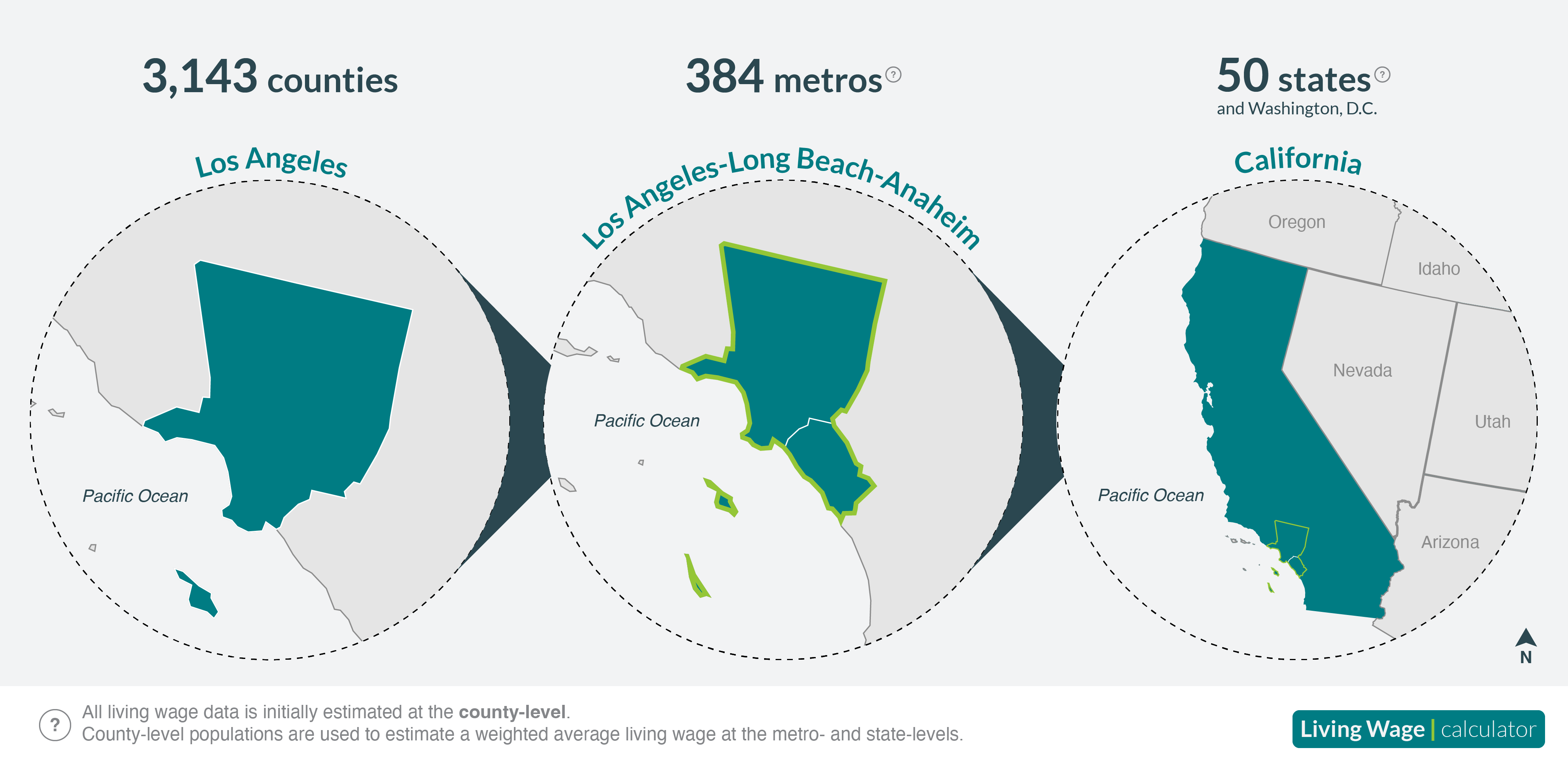
In the San Francisco Bay Area and the Greater Los Angeles region, the livable wage is among the highest in the country. According to the MIT Living Wage Calculator, a single adult with no children in the San Francisco-Oakland-Hayward metro area needs to earn approximately $30.00 to $35.00 per hour just to cover basic needs. If that individual has one child, the required wage nearly doubles to cover childcare—one of the most significant expenses in a family budget, often rivaling the cost of rent.
The Central Valley and Inland Empire
Inland regions like Fresno, Bakersfield, and Sacramento offer a lower barrier to entry. In these areas, a livable wage for a single adult might hover between $20.00 and $24.00 per hour. While housing is more affordable here, these regions often see lower average salaries and higher utility costs, particularly during the extreme heat of the summer months when air conditioning becomes a non-negotiable expense.
The Impact of Remote Work and “Zoom Towns”
The rise of remote work has slightly blurred these regional lines. As high-earners from the tech and finance sectors move to traditionally lower-cost areas like Lake Tahoe or the Central Coast, they bring “coastal” price inflation with them. This “gentrification of the interior” has raised the livable wage requirement in areas that were once considered affordable, as local service workers find themselves priced out by newcomers with Silicon Valley salaries.

Income Benchmarks: What You Actually Need to Earn
When we move from hourly wages to annual salaries, the numbers provide a clearer picture for career planning and wealth management. To live comfortably in California—meaning the ability to pay bills, save for the future, and enjoy occasional discretionary spending—the benchmarks are higher than many expect.
Single Adults vs. Families
For a single adult in California, a gross annual income of $65,000 to $75,000 is often the baseline for a “livable” lifestyle in mid-tier cities. However, in the high-cost coastal tier, that number jumps to $90,000 or $100,000.
For a family of four (two working adults, two children), the financial requirements escalate dramatically. Childcare in California can easily cost $1,500 to $2,500 per month per child. When combined with a three-bedroom rental or mortgage, a family often needs a combined household income of $150,000 to $180,000 to achieve a standard of living that would be considered “middle class” in other states.
The Impact of State Taxation
It is impossible to discuss California wages without addressing the tax implications. California has a highly progressive income tax system, with brackets ranging from 1% to 13.3%. For a middle-income earner making $100,000, the effective state tax rate, combined with federal taxes, FICA, and Social Security, can take a significant bite out of take-home pay.
When calculating a livable wage, financial professionals emphasize “net income” rather than “gross income.” A $100,000 salary might sound substantial, but after taxes and healthcare deductions, the monthly “spendable” cash might only be $5,500 to $6,000. In a city where rent is $3,000, the margin for error is razor-thin.
The “Squeezed” Middle Class
California’s economic structure has created a phenomenon often referred to as the “missing middle.” While the state has many high-income earners and many subsidized low-income residents, those in the middle—teachers, nurses, and mid-level managers—often struggle. They earn too much to qualify for state assistance programs but not enough to easily afford a home or save aggressively for retirement. For this group, the “livable wage” is a moving target that requires constant budgetary adjustments.
Strategies for Navigating California’s Financial Landscape
Given the high threshold for a livable wage, residents must employ sophisticated financial strategies to maintain and grow their wealth. In California, passive income and tax efficiency are not just for the wealthy; they are survival tools for the prudent.
Budgeting for the 50/30/20 Rule
To survive California’s high costs, many financial advisors recommend a modified version of the 50/30/20 rule: 50% of income for needs, 30% for wants, and 20% for savings and debt repayment. However, in high-cost counties, “needs” (housing and utilities) often consume 60% or more. To compensate, residents must often drastically reduce the “wants” category or find ways to move their “savings” into tax-advantaged accounts like 401(k)s or IRAs to lower their taxable income.
Maximizing Side Hustles and Diversified Income
The “gig economy” was born in California, and for many, it is a necessity. Earning a livable wage often involves diversifying income streams. This could include freelance consulting, real estate investing, or participating in the creator economy. By creating multiple “buckets” of income, residents can offset the high cost of living and build a buffer against the state’s occasionally volatile job market.
Leveraging State-Specific Financial Tools
California offers certain tools to help residents manage their finances. For those without employer-sponsored retirement plans, the “CalSavers” program provides a state-facilitated way to save. Additionally, understanding California-specific tax credits, such as the California Earned Income Tax Credit (CalEITC), can provide much-needed relief for those on the lower end of the living wage spectrum.
The Long-Term Wealth Outlook
Despite the high costs, California remains a premier destination for wealth creation. The state’s real estate market, while difficult to enter, has historically provided immense equity growth for homeowners. Furthermore, the proximity to venture capital and high-growth industries provides a “career beta” that is hard to find elsewhere. The key to navigating the California economy is recognizing that while the “livable wage” is high, the ceiling for potential earnings is also significantly higher than in most other regions.
Ultimately, a livable wage in California is a dynamic figure, shaped by geography, family size, and lifestyle expectations. It requires a proactive approach to personal finance, a keen understanding of tax implications, and a strategic view of career growth. While the “Golden State” demands a high price for entry, those who can master the mathematics of its economy find themselves in one of the most vibrant financial ecosystems in the world.
aViewFromTheCave is a participant in the Amazon Services LLC Associates Program, an affiliate advertising program designed to provide a means for sites to earn advertising fees by advertising and linking to Amazon.com. Amazon, the Amazon logo, AmazonSupply, and the AmazonSupply logo are trademarks of Amazon.com, Inc. or its affiliates. As an Amazon Associate we earn affiliate commissions from qualifying purchases.