
Defining the Nautical Phenomenon
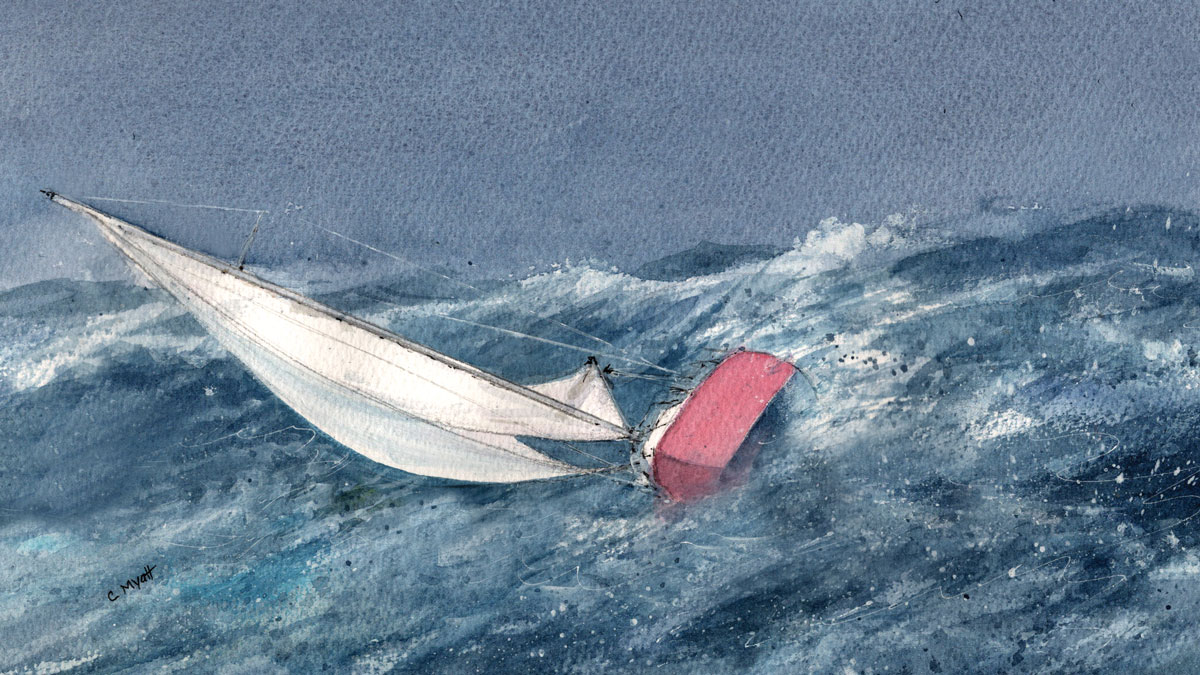
A knockdown in sailing refers to an event where a sailing vessel is pushed over onto its side by a strong gust of wind or a large wave, causing the mast to touch or dip significantly into the water. While severe, it’s crucial to distinguish a knockdown from a full capsize, where the boat completely inverts, typically becoming upside down. In a knockdown, the vessel usually retains some degree of buoyancy and, crucially, the ability to right itself, provided its stability characteristics are adequate and external forces subside. Understanding the mechanics and contributing factors to a knockdown is fundamental, especially when considering the technological solutions designed to mitigate or manage such occurrences.

The Mechanics of a Knockdown
The primary force at play in a knockdown is an overwhelming heeling moment. This occurs when the lateral force of the wind on the sails (or the impact of a breaking wave) exceeds the boat’s righting moment – the natural tendency of the boat to return to an upright position. Modern sailing yachts are designed with ballast, typically a heavy keel, which provides stability. When a boat heels, the center of gravity shifts, creating a lever arm that generates the righting moment. However, beyond a certain angle (the angle of vanishing stability), the righting moment diminishes rapidly, and if the external force persists, a knockdown or even a capsize can occur. The speed and direction of the wind, the sail plan deployed, the boat’s design (specifically beam, draft, and ballast ratio), and the sea state all contribute to this complex dynamic.
Distinction from Capsize
While often used interchangeably by novices, the distinction between a knockdown and a capsize is critical for safety protocols and technological responses. A knockdown is generally considered a temporary, recoverable event. The boat is on its side, but not fully inverted. Crew may be swept overboard, gear may be damaged, and water ingress can be significant, but the boat’s structural integrity, including the mast and rigging, often remains largely intact, allowing for self-recovery. A capsize, conversely, means the boat has inverted (or turned turtle), rendering it largely uncontrollable and presenting a much more severe life-threatening scenario. Modern offshore yachts are often designed to be self-righting from a 180-degree capsize, but this recovery process can be slow and puts immense strain on all systems. The immediate response technology and crew training differ significantly between these two events.
Factors Contributing to a Knockdown
Several interwoven factors increase the likelihood of a knockdown. High winds are the most obvious culprit, especially sudden, powerful gusts that can catch a sailor off guard. The condition of the sails – being over-canvassed for the prevailing conditions (i.e., too much sail area up) – significantly amplifies the heeling force. Steep, breaking waves can also exert immense lateral pressure on the hull and rigging. Crew inexperience, fatigue, or poor judgment in reefing sails or adjusting course can exacerbate these natural forces. Furthermore, the boat’s load distribution and trim can influence its stability; improperly stowed gear or excessive weight aloft reduces stability and makes a knockdown more probable.
Leveraging Technology for Prevention and Prediction
The maritime industry increasingly relies on sophisticated technology to enhance safety and prevent catastrophic events like knockdowns. From advanced meteorological tools to real-time vessel monitoring, digital solutions play a pivotal role in informing decision-making and mitigating risks.
Advanced Weather Forecasting Systems
Modern sailing relies heavily on highly accurate and localized weather forecasting. Satellite imagery, high-resolution numerical weather prediction (NWP) models, and buoy data are integrated into user-friendly apps and marine navigation software. These tools provide detailed wind speed and direction forecasts, wave height and period predictions, and crucial alerts for squalls, thunderstorms, and other severe weather phenomena. Sailors can access GRIB files (Gridded Binary) that offer a graphical representation of forecast data, allowing them to plan routes, identify potential high-risk zones, and make timely decisions about sail changes or seeking shelter, thereby proactively avoiding conditions conducive to a knockdown.
Hull Design and Stability Analysis Software
The design phase of any sailing vessel now heavily utilizes specialized software for hydrodynamic and hydrostatic analysis. Programs like Maxsurf, Orca3D, and SolidWorks enable naval architects to meticulously model a hull’s stability characteristics under various loading conditions and angles of heel. These tools can simulate dynamic responses to wave action and wind pressure, calculate the angle of vanishing stability, and optimize keel and rudder designs for maximum righting moment and directional stability. This computational fluid dynamics (CFD) approach allows designers to predict a boat’s behavior in extreme conditions, ensuring that the vessel is inherently more resistant to knockdowns from its inception.
Real-time Instrumentation and Sensor Integration
Modern yachts are equipped with an array of sensors that provide real-time data crucial for preventing knockdowns. Anemometers measure apparent and true wind speed and direction, while accelerometers and gyroscopes track heel angle, pitch, and roll rates. Barometers monitor atmospheric pressure changes, often signaling impending weather shifts. GPS and electronic compasses provide precise positional and directional information. This data is often integrated into a centralized network (e.g., NMEA 2000) and displayed on multi-function displays (MFDs) in the cockpit or at the nav station. This immediate feedback allows the crew to continuously monitor the boat’s attitude relative to environmental conditions, enabling swift adjustments to sail trim, course, or speed to reduce heeling and maintain stability, thus averting a knockdown before it fully develops.
Digital Tools for Enhanced Safety and Recovery
Even with the best preventative measures, knockdowns can occur. When they do, technology shifts from prevention to enhancing safety, communication, and facilitating recovery.

Navigation Software and Chartplotters
In the immediate aftermath of a knockdown, particularly if there’s damage or injury, precise navigation is paramount. Digital chartplotters and navigation apps (like Navionics, C-MAP, or OpenCPN) provide instant access to electronic charts, GPS position, depth soundings, and collision avoidance data. This allows the crew to quickly assess their location, identify safe havens, and plot a course for recovery or assistance. Many systems can also integrate AIS (Automatic Identification System) transponders, displaying nearby vessel traffic and improving situational awareness, which is vital for communicating distress and coordinating rescue efforts in a compromised state.
Communication Systems and Emergency Beacons (EPIRBs, PLBs)
Reliable communication is the lifeline in an emergency. VHF radios (both fixed and handheld DSC-enabled models) allow for short-range communication with other vessels and coast guard stations. Satellite communication systems (like Iridium or Inmarsat) provide global voice and data connectivity for long-distance cruising, enabling contact with shore support or emergency services from anywhere on the planet.
Crucially, Emergency Position Indicating Radio Beacons (EPIRBs) and Personal Locator Beacons (PLBs) are indispensable digital security gadgets. These devices transmit a distress signal to orbiting satellites, relaying the vessel’s or individual’s precise location to search and rescue authorities worldwide. Once activated, they dramatically reduce the search area and time, significantly improving survival chances after a severe incident like a knockdown, especially if the crew is separated from the vessel or the vessel itself is severely compromised.
Autonomous and Remote Monitoring Solutions
Emerging technologies are introducing autonomous monitoring capabilities to further enhance safety. Remote monitoring systems, often utilizing IoT (Internet of Things) sensors, can track critical boat parameters like bilge water levels, battery voltage, and even internal temperature, sending alerts to owners via satellite or cellular networks. While primarily for unattended vessels, future iterations could provide vital diagnostic information to shore-based teams or rescue coordination centers during a prolonged incident. Furthermore, advancements in drone technology hold potential for rapid aerial assessment of a vessel’s status and surrounding conditions after a severe event, aiding rescue efforts and damage assessment without putting additional personnel at risk.
Training and Simulation: Virtualizing High-Stress Scenarios
Effective crew response to a knockdown is as critical as the technology deployed. Training and simulation tools are revolutionizing how sailors prepare for and react to extreme situations.
Marine Simulators for Crew Training
Full-motion marine simulators, similar to flight simulators, provide a safe and controlled environment for sailors to experience and practice responses to knockdowns and other emergencies. These high-fidelity systems replicate various sea states, wind conditions, and vessel behaviors, allowing crews to train on critical maneuvers like reefing in heavy weather, handling helm in breaking seas, and managing sail trim during sudden squalls. The ability to repeatedly practice these scenarios under virtual stress conditions significantly improves crew competence, decision-making under pressure, and coordination, reducing the likelihood of a real-world knockdown and improving recovery efforts if one occurs.
Augmented and Virtual Reality in Sailing Education
Augmented Reality (AR) and Virtual Reality (VR) are transforming sailing education by offering immersive training experiences. VR headsets can place trainees directly into a virtual cockpit experiencing a simulated knockdown, allowing them to identify critical data points, practice emergency procedures, and understand the boat’s dynamic response without any physical risk. AR applications can overlay instructional graphics onto real-world equipment, guiding users through complex rigging adjustments or emergency repairs. These tools make advanced training more accessible and engaging, fostering a deeper understanding of vessel dynamics and emergency protocols that are crucial for preventing and managing knockdowns.
The Future of Maritime Resilience: AI and Data Analytics
The next frontier in preventing and responding to knockdowns lies in the intelligent application of AI and sophisticated data analytics.
Predictive Analytics for Vessel Stability
The continuous stream of data from a vessel’s sensors (wind, waves, heel angle, speed, rudder angle, engine RPM) offers immense potential for predictive analytics. AI algorithms can learn the unique stability characteristics of a specific boat under various conditions. By analyzing historical data and real-time inputs, these systems could provide highly accurate predictions of potential knockdown scenarios minutes or even seconds before they occur. This early warning system could recommend specific actions – such as immediate reefing, altering course, or reducing speed – with a precision that human intuition alone cannot match, offering a crucial window for intervention.
AI-Powered Autonomous Recovery Systems
Looking further ahead, AI could play a role in autonomous recovery. While current systems focus on reporting, future AI-powered autopilots, integrated with stability sensors and propulsion systems, might be capable of executing intelligent recovery maneuvers after a partial knockdown. This could involve automatically adjusting the rudder to bring the boat into a more stable heading, reducing sail area via automated furling systems, or even engaging auxiliary power to assist in righting the vessel. Such systems would act as an additional layer of safety, intervening rapidly when human reaction times might be compromised by surprise, injury, or severe conditions, fundamentally enhancing the resilience of sailing vessels against extreme events.
aViewFromTheCave is a participant in the Amazon Services LLC Associates Program, an affiliate advertising program designed to provide a means for sites to earn advertising fees by advertising and linking to Amazon.com. Amazon, the Amazon logo, AmazonSupply, and the AmazonSupply logo are trademarks of Amazon.com, Inc. or its affiliates. As an Amazon Associate we earn affiliate commissions from qualifying purchases.