
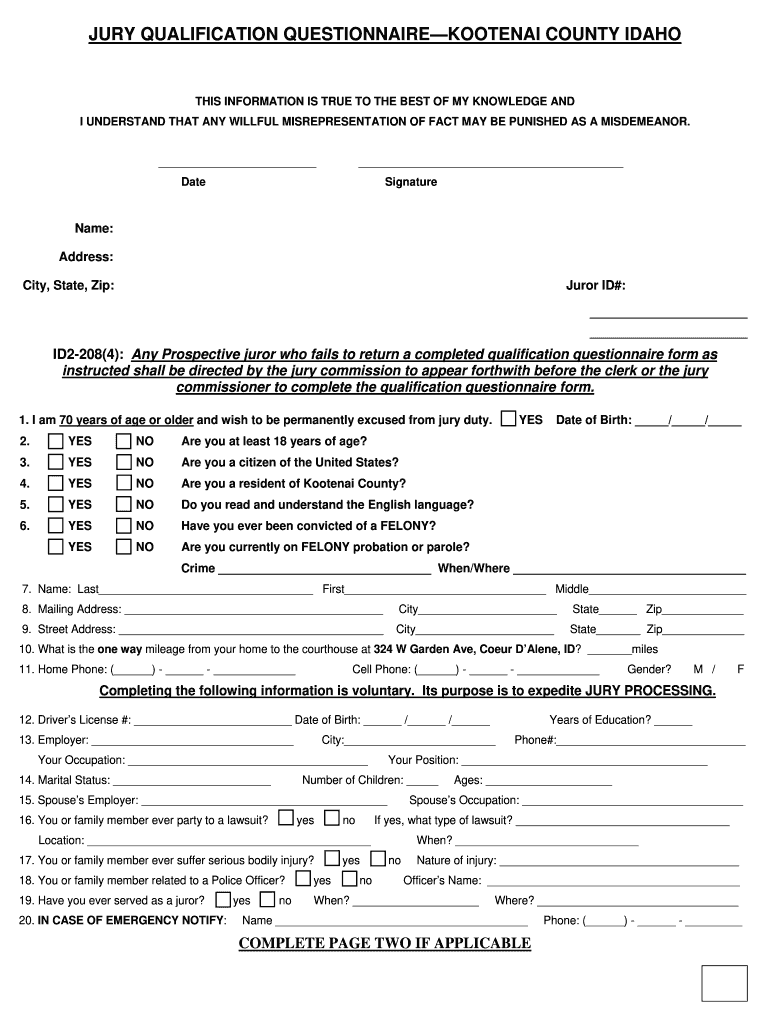
A juror qualification questionnaire serves as an initial, critical gateway to civic participation in the justice system. While its primary purpose is to assess a potential juror’s eligibility based on legal criteria such as citizenship, age, and English proficiency, its role extends significantly into the realm of financial considerations. This seemingly administrative document plays a pivotal part in identifying individuals who, despite meeting basic requirements, might face severe financial hardship by serving on a jury, thereby influencing the economic realities of both the individual and the broader judicial process. Understanding the nuances of this questionnaire reveals its profound connection to personal finance, business finance, and the economic integrity of legal proceedings.

Assessing Financial Capacity and Hardship for Jury Service
The juror qualification questionnaire is often the first formal interaction a citizen has with the judicial system regarding jury duty. Beyond standard demographic questions, it frequently delves into areas that directly impact a prospective juror’s financial well-being and their ability to serve without undue economic burden. This aspect is crucial for ensuring a fair and representative jury pool, as neglecting financial considerations could disproportionately exclude certain segments of the population.
Identifying Potential Financial Hardship
One of the most significant functions of the questionnaire, from a financial perspective, is to identify potential financial hardship. Courts understand that jury service, while a civic duty, can impose substantial economic strain on individuals, especially those with fixed incomes, critical self-employment responsibilities, or significant financial dependents. Questions may probe:
- Employment Status: Are you employed, self-employed, a business owner, or unemployed? This helps the court understand potential income disruption. For instance, a small business owner might face the complete cessation of their business operations, leading to severe financial loss, if called away for an extended trial.
- Income Dependence: Do you have dependents whose financial well-being relies on your income? This can include children, elderly parents, or individuals with disabilities requiring care that you provide or fund.
- Unique Financial Burdens: Are there specific financial circumstances, such as significant medical expenses, mortgage payments that cannot be missed, or the inability to afford childcare, that would make jury service an insurmountable burden?
The answers to these questions are not designed to automatically exempt an individual. Instead, they provide the court with a basis to evaluate a request for deferral or exemption due to hardship. This careful consideration prevents jury service from becoming a punitive financial measure, ensuring that the jury pool remains diverse and representative of the community’s economic landscape, rather than comprising solely those who can easily afford the time off.
The Economic Impact of Jury Duty on Individuals and Small Businesses
Jury duty, particularly for lengthy trials, can carry substantial direct and indirect financial costs. For individuals, these include lost wages (especially if their employer does not provide paid jury leave), transportation costs (fuel, public transit, parking), and potential childcare or eldercare expenses that may not otherwise be incurred. The daily stipend offered to jurors, while a token of appreciation, rarely covers these full costs, often leaving a financial gap.
For small business owners, the economic impact can be even more severe. Their presence is often integral to the daily operations, client relations, and revenue generation of their enterprise. A prolonged absence can lead to:
- Loss of Revenue: Inability to service clients, complete projects, or make sales.
- Operational Disruption: Delay in critical business decisions or production processes.
- Employee Burden: Overburdening remaining staff, potentially impacting morale and productivity.
- Client Attrition: Clients may seek services elsewhere if the business owner is unavailable for an extended period.
The juror qualification questionnaire provides the initial platform for individuals, particularly business owners, to articulate these potential economic disruptions. By acknowledging and assessing these financial realities, the judicial system attempts to balance civic duty with the economic stability of its citizens, preventing widespread financial distress that could undermine public trust in the justice system itself.
The Financial Integrity of the Justice System and Juror Selection
Beyond individual financial implications, the juror qualification questionnaire plays a crucial role in safeguarding the financial integrity of the broader justice system. By meticulously screening potential jurors, the questionnaire helps ensure that trials, especially those involving complex financial matters, are heard by an impartial and competent panel, ultimately leading to more just and economically sound outcomes.
Ensuring Impartiality in Financial and Business Disputes

Many civil and criminal cases revolve around financial matters: contract disputes, fraud, embezzlement, intellectual property theft, and corporate litigation. In such cases, the financial backgrounds and potential biases of jurors become critically important. The questionnaire helps identify conflicts of interest by asking about:
- Financial Relationships: Do you have any financial interests in the parties involved in a case (e.g., owning stock in a company that is a plaintiff or defendant)?
- Employment and Industry Affiliations: Are you employed in an industry that is directly relevant to the financial subject matter of a case (e.g., banking, accounting, insurance, real estate)? This helps identify potential expertise or, conversely, pre-existing biases related to the industry.
- Prior Experience with Financial Issues: Have you or a close family member been involved in a lawsuit involving financial disputes, bankruptcy, or debt collection?
By eliciting this information, the court can identify jurors who might have a personal financial stake in the outcome of a case or whose professional experience might lead to an inability to remain impartial. A jury free from such financial conflicts is essential for rendering fair verdicts, which, in turn, underpins confidence in the legal system’s ability to resolve financial disagreements justly and without undue influence. The financial cost of a biased or compromised verdict – from appeals to reputational damage – can be immense, making the questionnaire’s role in establishing impartiality invaluable.
The Cost-Effectiveness of a Qualified Jury Pool
A comprehensive juror qualification questionnaire contributes significantly to the overall cost-effectiveness and efficiency of the legal system. A well-vetted jury pool, consisting of individuals who meet all legal requirements and can serve without debilitating financial hardship or significant bias, leads to:
- Reduced Mistrials: Juries composed of individuals who are fully qualified and capable of serving are less likely to lead to mistrials, which are extremely costly, requiring the entire legal process to restart.
- More Efficient Deliberations: Jurors who are engaged and not unduly distracted by personal financial stress are more likely to focus on the evidence, leading to more productive and timely deliberations.
- Increased Finality of Judgments: Judgments rendered by truly qualified and impartial juries are less likely to be overturned on appeal, providing greater finality to legal disputes and reducing subsequent legal costs.
- Prevention of Wasted Resources: The time and resources invested in preparing for and conducting a trial are substantial. Ensuring that the jury is qualified from the outset prevents the waste of these resources on processes that may be compromised by unqualified jurors.
In essence, the initial investment of time and effort in the juror qualification questionnaire acts as a preventative measure, saving significant financial resources down the line by fostering a more reliable and effective judicial process. The integrity of the justice system, which is paramount for a stable economy, depends on the capacity of its juries to make sound, unbiased financial judgments.
Navigating Financial Disclosure and Implications within the Questionnaire
For prospective jurors, understanding the financial questions within the questionnaire and their implications is crucial. While privacy is respected, certain financial disclosures are necessary for the court to fulfill its duty of assembling a fair and impartial jury. Navigating these sections thoughtfully can inform personal financial planning should one be selected for service.
What Financial Information May Be Requested and Why
The specific financial questions on a juror qualification questionnaire vary by jurisdiction, but generally aim to capture information relevant to hardship and impartiality. Common requests might include:
- Employer and Occupation: This helps gauge the potential impact of absence from work and identifies possible industry-specific biases. For instance, an accountant might bring specific expertise to a financial fraud case, but also potential biases based on their professional experiences.
- Self-Employment Status: As discussed, this is critical for assessing potential severe financial disruption to a business.
- Household Income and Dependents: While not always explicitly asked, questions regarding the number of dependents or the primary source of household income can indirectly illuminate financial responsibilities.
- Financial Interests in Litigation: Direct questions about ownership of stocks, bonds, or other financial instruments in parties involved in litigation, or close financial ties to them.
The rationale behind these questions is twofold: to identify genuine hardship that would preclude effective service and to prevent conflicts of interest that could compromise the fairness of the trial, especially in cases with significant financial ramifications. Providing honest and complete answers is a legal requirement and serves the greater good of ensuring a just outcome for all parties involved in a financial dispute.
The Financial Decisions Post-Questionnaire: Compensation and Planning
If selected for jury service, individuals face the practical financial realities of fulfilling their duty. Most jurisdictions offer a modest daily stipend for jurors, which is intended to cover basic expenses like meals and travel but rarely replaces lost income. Understanding this limited compensation is vital for financial planning.
- Personal Financial Assessment: Before appearing for jury selection, it can be prudent for individuals, particularly those not receiving paid leave, to assess their short-term financial stability. How would an absence of several days or weeks impact their budget?
- Communication with Employer: Employees should understand their company’s policy on jury duty leave and compensation. Some employers offer full pay, others partial, and some none at all, making a significant difference in personal financial impact.
- Emergency Fund Utilization: For those who anticipate significant income loss, tapping into an emergency fund might become necessary.
- Managing Small Business Finances: Small business owners might need to delegate tasks, postpone projects, or communicate proactively with clients to mitigate financial damage during their absence.
Ultimately, the juror qualification questionnaire is more than just a legal formality; it’s an initial filter that, through its financial inquiries, helps to construct a jury that is not only legally qualified but also financially capable of serving without undue personal burden, thereby upholding the economic integrity and efficiency of the judicial system.
aViewFromTheCave is a participant in the Amazon Services LLC Associates Program, an affiliate advertising program designed to provide a means for sites to earn advertising fees by advertising and linking to Amazon.com. Amazon, the Amazon logo, AmazonSupply, and the AmazonSupply logo are trademarks of Amazon.com, Inc. or its affiliates. As an Amazon Associate we earn affiliate commissions from qualifying purchases.