
In the intricate landscape of digital design, computational geometry, and algorithmic problem-solving, foundational concepts often underpin complex systems. While some geometric principles might seem abstract, their practical applications extend across various technological domains, providing elegant solutions to challenging engineering and computing tasks. One such concept, the incenter, derived from classical geometry, serves as a powerful tool in numerous tech-driven scenarios, from optimizing graphics to enhancing robotic navigation.
The Geometric Anchor in Digital Realms
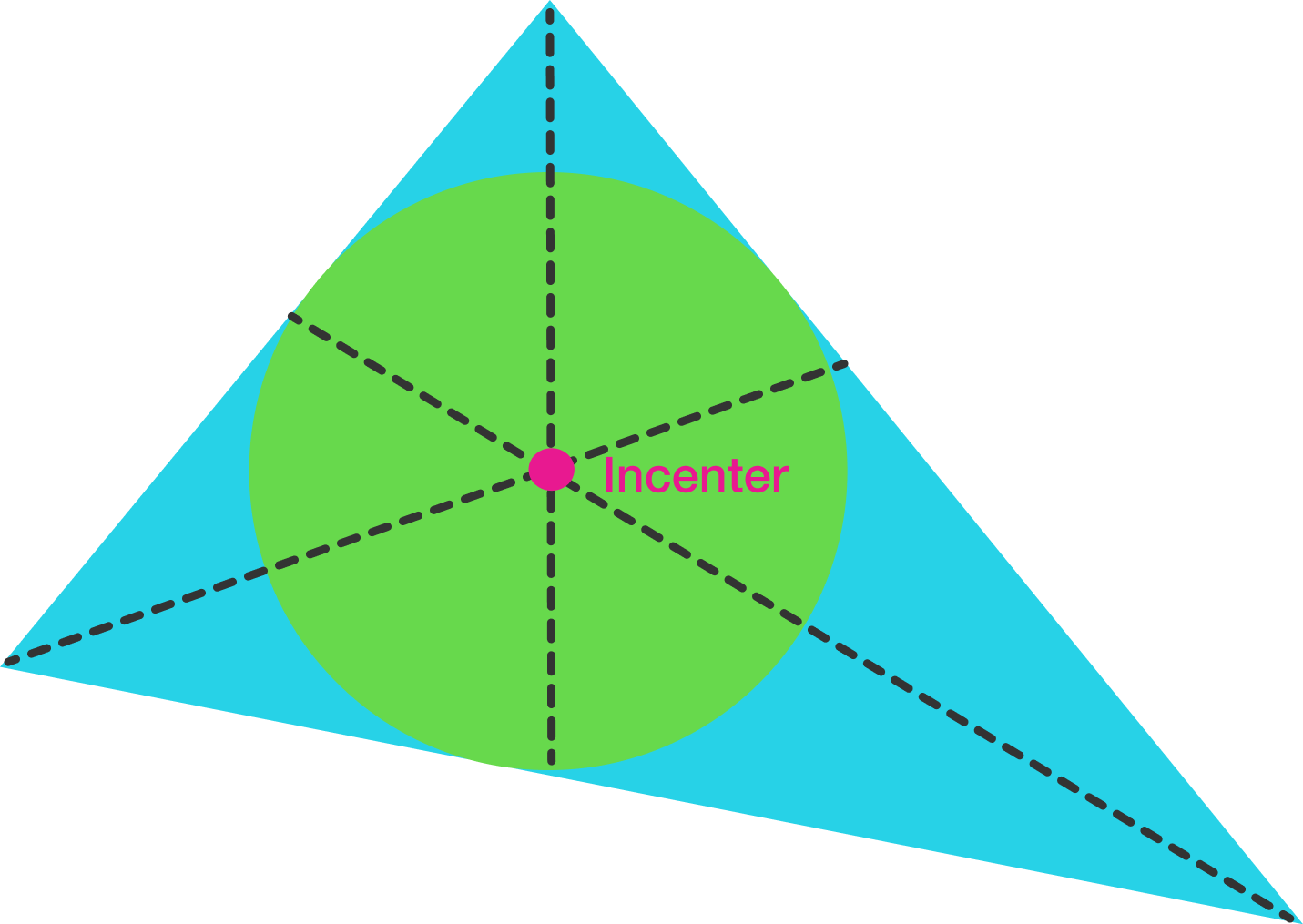
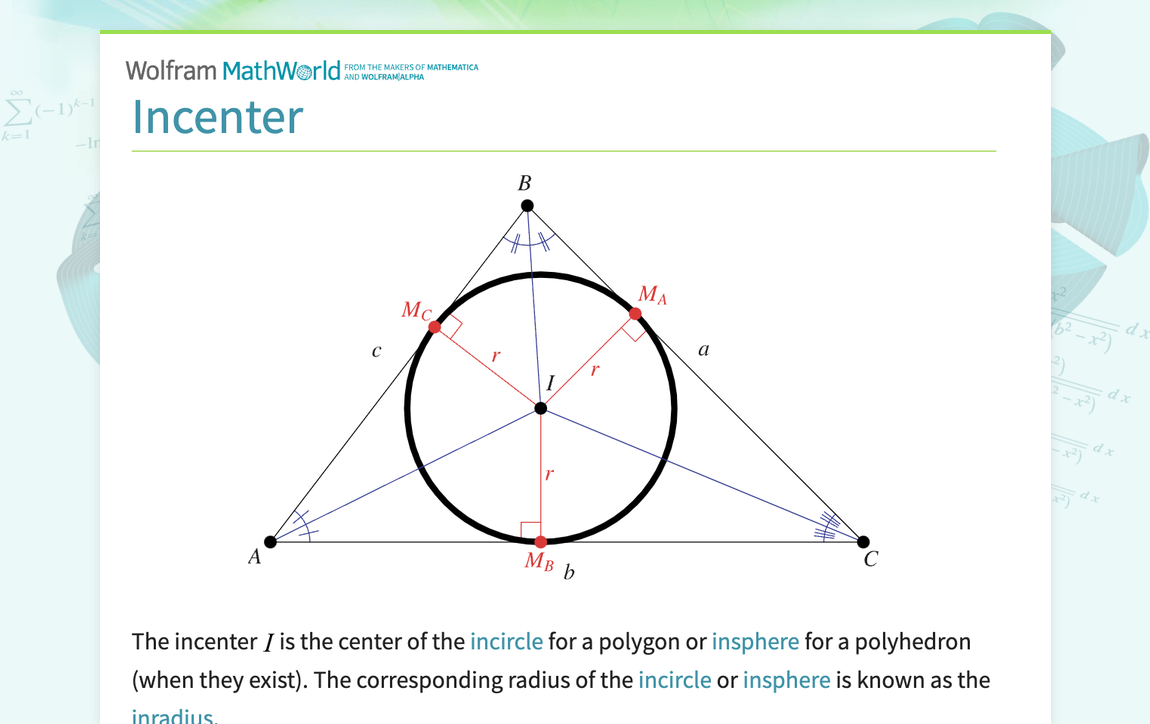
At its core, an incenter is a fundamental property of a triangle. Geometrically, it is defined as the point where the three angle bisectors of a triangle intersect. This unique point holds a special characteristic: it is equidistant from all three sides of the triangle. This equidistance means the incenter is also the center of the triangle’s inscribed circle (incircle), which touches each side of the triangle exactly once.
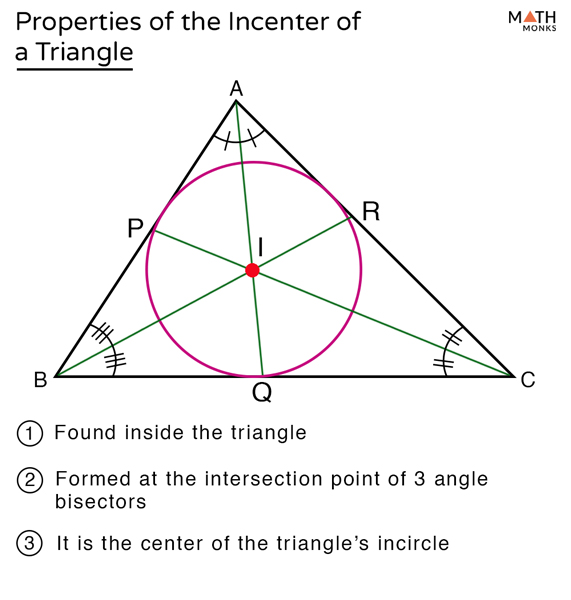
While this definition might sound like a relic from a geometry textbook, its implications for technology are profound. In the digital world, where shapes, spaces, and relationships are constantly being calculated and manipulated, the incenter provides a computationally efficient way to identify a “most central” point within a triangular region. This central point offers a basis for stability, optimal positioning, and efficient resource allocation in algorithms, software design, and hardware development, transcending its purely mathematical origin to become a versatile tool in a technologist’s arsenal.
Incenters in Computer Graphics and Visualization
Computer graphics, the bedrock of digital media, gaming, and simulation, relies heavily on geometric principles. Triangles are the fundamental building blocks of almost all 3D models and scenes. Understanding and utilizing properties like the incenter within these triangular primitives can lead to significant improvements in rendering quality, performance, and interaction.
Mesh Optimization and Triangulation
Complex 3D objects, from characters in a video game to architectural models, are constructed from vast networks of interconnected triangles known as meshes. For efficient rendering and processing, these meshes often need to be optimized. The incenter plays a role in techniques like mesh simplification or tessellation. By identifying the incenter within individual triangles, algorithms can intelligently refine or reduce the polygon count, ensuring that new vertices or sub-triangles are positioned optimally. This helps in maintaining visual fidelity while reducing computational overhead, especially crucial for Level of Detail (LOD) systems where objects farther from the viewer use simpler meshes. Moreover, using incenters can help ensure “well-behaved” triangles (e.g., non-degenerate, less acute angles), which are preferred for stable numerical computations and aesthetic rendering.
Collision Detection and Spatial Partitioning
In interactive 3D environments, collision detection is paramount for realistic physics, user interaction, and game mechanics. Determining if two complex objects intersect can be computationally expensive. One approach is to simplify objects using bounding volumes, which can often be represented or approximated by triangular regions. The incenter, or related geometric centers, can be used to define the core of such a bounding volume. By using incenters as reference points within triangular regions, algorithms can perform faster preliminary checks for potential overlaps, thereby partitioning space more efficiently. If the incenters of two bounding triangles are far apart, complex intersection tests might be avoided altogether, significantly speeding up simulations and real-time applications.
Toolpath Generation and Animation
In computer-aided manufacturing (CAM) and animation, incenters can provide crucial reference points. For machining a triangular pocket, a CAM system might use the incenter to determine the optimal starting or finishing point for a cutting tool, ensuring that the tool path is equidistant from the boundaries and minimizes stress on the material. Similarly, in animation, if an object needs to follow a path within a constrained triangular space, the incenter can serve as a central guidepost, ensuring smooth movement that avoids collision with the boundaries.
Engineering, Robotics, and Autonomous Systems
Beyond the virtual realm of graphics, the practical advantages of incenters extend into physical engineering, robotics, and the burgeoning field of autonomous systems, where precise spatial reasoning is critical.
CAD/CAM for Precision Manufacturing
Computer-Aided Design (CAD) and CAM systems are at the heart of modern manufacturing. In designing parts, engineers often work with triangular facets. When designing for structural integrity or thermal distribution, identifying a point equidistant from three critical edges or surfaces can be essential. The incenter provides this exact solution. For instance, in drilling operations or the placement of reinforcing elements within a triangular section of a component, the incenter can guide optimal positioning, ensuring balanced stress distribution or efficient material removal. In additive manufacturing (3D printing), understanding these geometric centers can influence how support structures are generated or how material deposition paths are optimized for strength and efficiency.
Sensor Placement and Network Optimization
For robotics, IoT deployments, or environmental monitoring, the strategic placement of sensors is vital. Imagine a robotic arm needing to operate within a triangular workspace, or a drone monitoring a specific triangular land parcel. Placing a sensor or a communication node at the incenter of such a triangular zone ensures that it is maximally distant from all three boundaries. This guarantees the broadest possible unobstructed line of sight or signal reach within that specific area, optimizing coverage and reducing blind spots. In an IoT network, placing repeaters or base stations using incenter logic could enhance signal strength and connectivity across a distributed triangular array of devices.
Path Planning and Navigation
Autonomous vehicles, drones, and mobile robots constantly compute paths through complex, often dynamic, environments. These environments are frequently simplified into navigable regions, which can often be represented by polygons, including triangles. For a robot to navigate safely and efficiently, it needs to maintain a safe distance from obstacles. If a triangular region represents a safe passage, the incenter within that triangle offers a maximally safe waypoint, being equidistant from the boundaries (obstacles). This principle helps in generating robust path plans, allowing the autonomous system to traverse crowded or complex spaces with an optimal safety margin, minimizing the risk of collision while moving through the center of available free space.
Algorithmic Foundations and Future Prospects
The utility of the incenter extends beyond direct geometric applications, subtly influencing the design of various algorithms and data structures. Its underlying principle of finding a central, equidistant point within a polygon is a recurring theme in computational problem-solving.
Spatial Analysis and Geometric Algorithms
In areas like Geographic Information Systems (GIS), the incenter can be used for spatial analysis. For example, analyzing triangular land parcels to identify central access points, or in hydrology for watershed analysis where identifying central flow points within triangular drainage areas might be relevant. More broadly, fundamental data structures in computational geometry, such as Delaunay triangulations and Voronoi diagrams, which are critical for spatial analysis and proximity queries, often rely on properties of centers and circumcircles (a related concept to incenters), highlighting the deep integration of geometric centers in efficient algorithmic design.
Beyond Direct Application: Conceptual Contributions
While not every algorithm explicitly names or computes an “incenter,” the core idea—identifying a central point that is equidistant from boundaries—is a powerful heuristic in optimization problems. Whether it’s balancing load across a distributed system within conceptual triangular constraints or designing resilient networks, the incenter provides a conceptual framework for achieving equilibrium and maximum separation from potential points of failure or congestion. It serves as an excellent pedagogical tool for understanding computational geometry and the importance of geometric primitives in computer science education.
The Evolving Role of Geometric Primitives
As technology advances, particularly in fields like artificial intelligence, machine learning, and augmented reality, the interaction with physical space and complex datasets becomes ever more sophisticated. Algorithms are increasingly required to understand, interpret, and generate geometry. From computer vision systems recognizing objects in 3D space to generative AI designing novel structures, the foundational understanding of geometric properties like the incenter will remain indispensable. It ensures that systems can make intelligent decisions about spatial relationships, optimize designs, and navigate environments with precision and efficiency, underscoring the enduring relevance of classical geometry in shaping the future of technology.
aViewFromTheCave is a participant in the Amazon Services LLC Associates Program, an affiliate advertising program designed to provide a means for sites to earn advertising fees by advertising and linking to Amazon.com. Amazon, the Amazon logo, AmazonSupply, and the AmazonSupply logo are trademarks of Amazon.com, Inc. or its affiliates. As an Amazon Associate we earn affiliate commissions from qualifying purchases.