
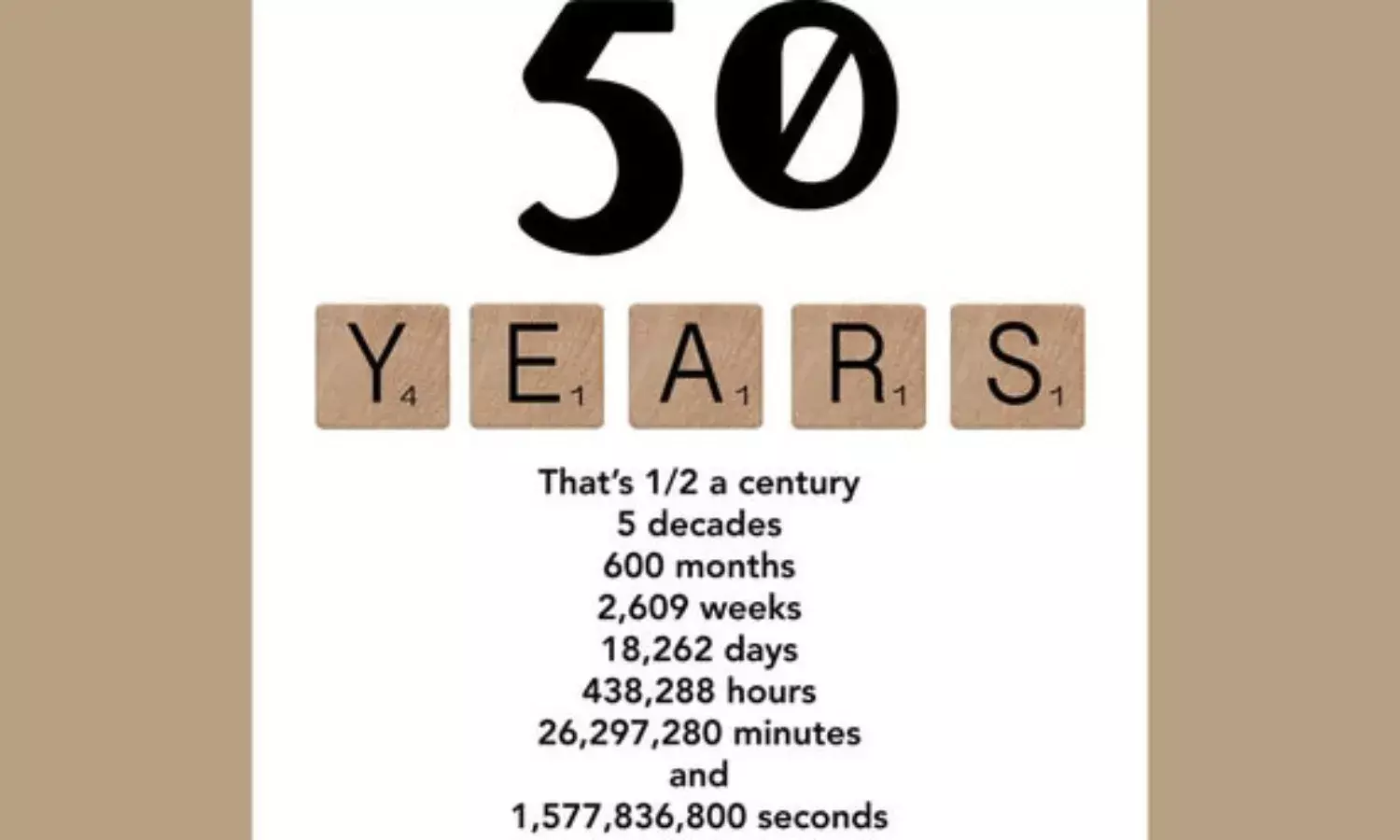
In the world of finance, time is the most potent lever available to an investor. While the “quarterly report” or the “fiscal year” dominates the news cycle, the truly transformative power of capital is best observed through the lens of a half century. A half century—fifty years—represents more than just a chronological milestone; it is the ultimate lifecycle for wealth creation, the standard duration for a professional career, and the primary window through which compound interest performs its most significant work.
Understanding what a half century means in a financial context allows investors to move beyond the noise of market volatility and focus on the structural growth of their net worth. Whether you are twenty years old looking toward your future or fifty years old looking toward your legacy, the fifty-year horizon is the gold standard for strategic financial planning.
The Mathematics of the 50-Year Investment Horizon
When we discuss a half century in money management, we are primarily discussing the exponential curve of compound interest. Most investors understand the basics of compounding, but few truly grasp the radical difference between a twenty-year horizon and a fifty-year horizon. The final decade of a half-century investment period often generates more absolute wealth than the previous four decades combined.
The Power of Compounding over Five Decades
To visualize the impact of a half century, consider a one-time investment of $10,000 in a diversified index fund yielding an average annual return of 7% (after inflation). After ten years, that sum grows to roughly $19,671. After twenty-five years—a quarter century—it reaches approximately $54,274. However, if that same investment is left to mature for a full half century, the final balance balloons to nearly $294,570.
The “half century” is the “tipping point” of wealth. In the first thirty years, the investor is doing the heavy lifting by contributing principal. In the final twenty years of that fifty-year span, the money begins to “work” harder than the person ever did. This mathematical reality highlights why starting early is not just a suggestion, but a fundamental law of high-level wealth building.
Inflation’s Impact: Purchasing Power Across a Half Century
A critical component of the fifty-year perspective is understanding the erosion of purchasing power. While $1 million sounds like a substantial sum today, its value fifty years ago was vastly different, and its value fifty years from now will be equally altered. Historically, the U.S. inflation rate averages around 3%. At this rate, prices double approximately every 24 years.
Over a half century, an investor can expect the cost of living to quadruple. Therefore, a “half-century” financial plan cannot merely focus on nominal dollar amounts; it must prioritize “real” returns. This necessitates a heavy tilt toward equities and productive assets rather than “safe” cash holdings, which lose the battle against the fifty-year inflationary crawl.
Reaching the 50-Year Age Milestone: Financial Realignment
In personal finance, the “half century” mark also refers to the age of fifty. This is a psychological and structural turning point in an individual’s financial life. In many jurisdictions, including the United States, reaching fifty unlocks specific financial mechanisms designed to accelerate retirement readiness.
Catch-up Contributions and Retirement Velocity
Once an individual hits their half-century birthday, the government often allows “catch-up contributions” to tax-advantaged accounts like the 401(k) and IRA. This is a recognition that the final fifteen to twenty years of a career are the “peak earning years.”
Strategic use of these catch-up provisions can fundamentally alter a retirement outcome. For someone who may have started late, the period between age fifty and sixty-five is a high-velocity window where they can aggressively shield income from taxes while benefiting from a condensed version of the compounding mentioned earlier. It is the time to transition from a “growth-only” mindset to a “maximum efficiency” mindset.
Shifting from Growth to Preservation
A half century of living also brings a necessary shift in risk tolerance. When an investor has fifty years of life ahead of them, they can afford to weather a 40% market crash. When they have fifty years of life behind them, the sequence of returns risk becomes a paramount concern.
The half-century realignment involves auditing asset allocation to ensure that a market downturn doesn’t force a liquidation of assets at the bottom. This doesn’t mean exiting the market—since many people will live another thirty to forty years past fifty—but it does mean introducing “buffers” such as bond ladders or increased cash reserves to protect the portfolio’s core.

Legacy Planning: The Intergenerational Half Century
True wealth is rarely built in a single decade; it is often the result of a “half-century” mindset that extends beyond the individual’s own life. When we look at the most successful financial dynasties or long-term endowments, they view the half century as the basic unit of time for asset management.
Building a 50-Year Family Trust
One of the most effective ways to utilize the half-century timeframe is through the creation of a multi-generational trust. These legal structures are designed to protect assets from mismanagement, divorce, or litigation while allowing the principal to grow uninterrupted for fifty years or more.
By setting a fifty-year horizon for a family trust, a grantor can ensure that their grandchildren benefit from the “back end” of the compounding curve—the period where growth is most explosive. This perspective shifts the focus from “how much can I spend?” to “how much can I steward?” It transforms money from a medium of consumption into a tool for long-term family stability.
Sustainable Withdrawal Rates for Multi-Decade Security
A common question in finance is: “How much can I take out without running out?” The famous “4% Rule” was designed to ensure a portfolio lasts at least thirty years. However, for those retiring early or looking to build a perpetual fund, a half-century withdrawal rate must be more conservative, often closer to 3% or 3.25%.
The half-century perspective requires a “stress test” against various economic cycles, including periods of stagflation, depression, and hyper-growth. By planning for a fifty-year depletion rate rather than a twenty-year one, an individual builds a margin of safety that protects against the “black swan” events that inevitably occur over such a long timeline.
Macro-Cycles: Understanding 50-Year Economic Waves
On a broader scale, “what is a half century” can be answered through the study of long-wave economic cycles. Investors who understand these 50-year patterns are better equipped to position their portfolios for the “big shifts” in the global economy.
The Kondratiev Wave and Long-Term Market Trends
Economist Nikolai Kondratiev proposed that modern capitalist economies experience “long waves” of boom and bust that last approximately 45 to 60 years. These “K-Waves” are driven by technological revolutions—such as the steam engine, the railway, electricity, and the internet.
Each half-century cycle typically consists of four phases:
- Spring (Expansion): New technology drives productivity.
- Summer (Stagflation): The limits of growth are reached; debt increases.
- Autumn (Plateau): A period of “false” prosperity fueled by credit.
- Winter (Depression): A period of debt purging and structural resetting.
An astute investor uses the half-century framework to identify where we are in these long-term cycles. For instance, if we are in the “Winter” phase of a 50-year cycle, the strategy should shift toward capital preservation and liquidity. If we are at the beginning of a “Spring” phase driven by a new technological paradigm (like AI or green energy), the strategy should be aggressively long-biased.
The Psychology of the Long Game
Perhaps the most difficult aspect of the half-century financial view is the psychological discipline it requires. Humans are biologically wired for immediate gratification and short-term survival. Modern financial apps, with their flashing red and green lights and second-by-second updates, exploit this biological bias.
To master the half-century, one must develop “temporal distancing.” This is the ability to view a current market crash not as a disaster, but as a minor blip on a fifty-year chart. History shows that despite world wars, pandemics, and financial crises, the global economy has consistently trended upward over any fifty-year period. Embracing the “half century” means trading the anxiety of the “now” for the certainty of the “eventually.”
Conclusion: The Ultimate Asset is Time
What is a half century? In the realm of money, it is the difference between a comfortable retirement and generational wealth. It is the time it takes for a modest monthly contribution to transform into a self-sustaining fortune. It is the age where financial strategy shifts from accumulation to legacy. And finally, it is the macro-cycle that defines the rise and fall of industries.
By adopting a fifty-year mindset, you remove the power of the “market noise” to influence your decisions. You stop being a gambler and start being a steward. Whether you are managing your own 401(k) or overseeing a corporate endowment, the half-century perspective is the most reliable path to financial mastery. In the end, wealth is not just about the money you make; it is about the time you allow that money to grow.
aViewFromTheCave is a participant in the Amazon Services LLC Associates Program, an affiliate advertising program designed to provide a means for sites to earn advertising fees by advertising and linking to Amazon.com. Amazon, the Amazon logo, AmazonSupply, and the AmazonSupply logo are trademarks of Amazon.com, Inc. or its affiliates. As an Amazon Associate we earn affiliate commissions from qualifying purchases.