
In the dynamic world of business, achieving sustained growth often feels like pushing a massive, immovable object. Yet, some companies seem to gain an unstoppable momentum, accelerating their progress with seemingly less effort over time. This phenomenon is best understood through the lens of the “business flywheel”—a powerful metaphor that describes a self-reinforcing loop where each success fuels the next, creating a virtuous cycle of sustained financial growth and market dominance.
First popularized by Jim Collins in his seminal work, Good to Great, the flywheel concept challenges the traditional linear view of business growth. Instead of seeing growth as a series of disconnected initiatives, the flywheel illustrates how strategic, interconnected actions build upon each other, compounding their effect over time. For businesses striving for long-term financial viability and exponential returns, understanding, designing, and meticulously nurturing their unique flywheel is not just an advantage—it’s a fundamental blueprint for compounding success. It’s about identifying the core drivers that, once set in motion, reduce friction and amplify momentum, translating directly into improved profitability, efficient resource allocation, and sustained shareholder value.
The Core Mechanics of the Business Flywheel for Financial Growth
At its heart, the business flywheel is a strategic framework that explains how a series of individual successes, when strategically linked, generate cumulative momentum. This isn’t just about operational efficiency; it’s about building a financial engine that consistently delivers returns and self-funds its expansion.
Understanding Momentum and Compounding Financial Gains
Think of a physical flywheel: a heavy disc that requires significant effort to get moving. But once it starts spinning, its inertia keeps it going, and subsequent pushes require less effort while adding more speed. In business, this translates to initial investments and efforts creating small wins that, when reinvested or leveraged, lead to larger wins, which in turn generate even greater returns.
This compounding effect is where the true financial power of the flywheel lies. Instead of pursuing disparate, one-off projects with limited impact, a business focuses its capital and energy on activities that directly feed into the next stage of the cycle. For example, investing in a superior product (initial push) leads to satisfied customers. Satisfied customers generate positive word-of-mouth and repeat purchases, reducing customer acquisition costs (CAC) and increasing customer lifetime value (LTV). This expanded customer base and improved financial metrics then attract further investment or allow for reinvestment into product enhancement, further strengthening the flywheel. Each revolution amplifies the financial benefit, creating an escalating rate of return on invested capital.
Identifying Your Business’s Unique Financial Cycle
Every business has a unique set of activities that drive its success. The challenge is to identify the critical 4-6 components that form your company’s specific financial flywheel. These are the sequence of actions that, when executed well, naturally lead to the next, creating an inevitable flow of momentum and value.
For an e-commerce business, a potential flywheel could be:
-
Offer low prices: Attracts budget-conscious customers.
-
More customers: Drives higher sales volume.
-
Scale economies: Allows for better bulk purchasing and operational efficiencies, reducing costs.
-
Lower costs: Enables even lower prices or higher margins.
This cycle, exemplified by Amazon, shows how each step financially reinforces the next. Identifying these specific drivers requires a deep understanding of your business model, customer value proposition, and how each operational area contributes to the overall financial health and growth trajectory. It’s not about doing more; it’s about identifying the most impactful sequence of actions that generate positive financial feedback loops.
The Virtuous Cycle vs. Vicious Cycle: Financial Implications
The concept of the flywheel is inherently tied to feedback loops—how the output of one step becomes the input for the next. When these loops are positive, they create a virtuous cycle, where success begets more success, driving exponential financial growth. This is the goal of a well-designed business flywheel. Positive financial feedback loops might include:
-
Increased revenue leading to greater investment in R&D, resulting in better products, leading to higher customer satisfaction and more sales.
-
High customer retention leading to reduced marketing spend (lower CAC), which improves profit margins, allowing for competitive pricing or dividends.
Conversely, if the interconnected actions are poorly executed or misaligned, they can create a vicious cycle, where negative outcomes reinforce each other, leading to financial decline. Examples of vicious cycles include:
-
Poor product quality leading to customer churn, resulting in decreased revenue, which then forces cost-cutting measures (e.g., reduced R&D, poorer customer service), further eroding product quality and customer satisfaction.
-
Excessive debt leading to high interest payments, which drain cash flow, restricting investment in growth initiatives, ultimately leading to stagnant revenue and further financial strain.
Understanding and deliberately designing for a virtuous financial cycle is paramount. It’s about ensuring that every push of the flywheel leads to a positive financial return that fuels the subsequent push, rather than draining resources.
Building Your Business Flywheel for Sustainable Financial Growth
Constructing a robust business flywheel is a strategic exercise in identifying leverage points and allocating resources where they will generate the greatest compounding returns. It’s about engineering your business for inherent financial strength and perpetual momentum.
Identifying and Prioritizing Your Key Financial Drivers
The first step in building your flywheel is to clearly identify the 4-6 most crucial interconnected activities that drive your core financial metrics—revenue, profit, cash flow, and market share. These are not merely tasks; they are strategic levers that, when pushed, propel the entire system forward.
For a software-as-a-service (SaaS) company, key drivers might include:
-
Product innovation: Developing features that solve customer pain points.
-
Customer acquisition: Efficiently bringing in new users.
-
Customer success/retention: Ensuring users derive value and stay subscribed.
-
Upselling/Cross-selling: Expanding revenue from existing customers.
-
Data analytics/Feedback loop: Using insights to refine product and marketing.
Once identified, these drivers must be prioritized based on their impact and sequence. Where should capital be invested first to initiate the greatest momentum? Which driver, if optimized, will have the most significant ripple effect across the entire financial ecosystem of the business? This often involves a rigorous financial analysis of potential returns on investment (ROI) for each component.
Accelerating the Flywheel: Investment and Reinvestment Strategies
To accelerate the flywheel, a business must strategically invest and reinvest its capital. This isn’t about haphazard spending, but about targeted allocation of financial resources to strengthen each “spoke” of the flywheel.
-
Seed Investment: Initial capital is used to get the first few turns of the flywheel moving. This might involve funding initial product development, establishing a market presence, or building a strong foundational team. The goal is to generate initial traction and prove the viability of the cycle.
-
Profit Reinvestment: As the flywheel gains momentum and generates profits, a significant portion should be reinvested directly back into strengthening its drivers. This could mean allocating a portion of earnings to enhanced R&D for product improvement, scaling marketing efforts, expanding customer support infrastructure, or improving operational efficiencies. Each reinvestment makes the flywheel spin faster, generating even larger profits in the next cycle. This strategic capital allocation ensures that financial gains aren’t just distributed but actively contribute to the engine of future growth.
-
ROI Focus: Every investment decision within the flywheel context should be evaluated for its long-term return on investment. It’s about understanding how each dollar spent contributes to the overall compounding financial effect, rather than just isolated gains.

Measuring and Optimizing Financial Performance with the Flywheel
A flywheel approach demands meticulous measurement and continuous optimization of financial performance. Key performance indicators (KPIs) must be aligned with each stage of the flywheel to identify bottlenecks and areas for improvement.
Relevant financial metrics include:
-
Customer Acquisition Cost (CAC): How much does it cost to acquire a new customer? A healthy flywheel aims to reduce CAC over time as referrals and organic growth increase.
-
Customer Lifetime Value (LTV): The total revenue a business can expect from a single customer account. An effective flywheel increases LTV through retention, upsells, and delighted customers.
-
Churn Rate: The percentage of customers who stop using your service. Lower churn signifies a more robust and satisfying customer experience, directly impacting recurring revenue.
-
Profit Margins: Gross and net profit margins indicate the financial health of each transaction and the overall business.
-
Cash Flow: The liquidity of the business is crucial for continuous investment and smooth operations.
-
Return on Capital Employed (ROCE): Measures how efficiently capital is being used to generate profits.
By closely monitoring these metrics, businesses can pinpoint where the flywheel is experiencing friction—perhaps CAC is too high, or LTV is stagnant. This data-driven insight allows for precise financial adjustments and strategic resource reallocation, ensuring the flywheel spins as efficiently and profitably as possible. Regular financial modeling can project the impact of various investments and optimizations, helping leaders make informed decisions that accelerate the flywheel’s momentum.
Real-World Applications and Financial Success Stories
The power of the business flywheel is best illustrated by companies that have masterfully implemented it, transforming their industries and achieving unprecedented financial success.
Amazon’s Classic Flywheel Example
One of the most widely cited examples of a successful business flywheel is Amazon’s strategy, often attributed to Jeff Bezos. Its simplified model looks something like this:
-
Offer low prices: Attracts a large customer base.
-
Increased customer traffic: Leads to higher sales volume.
-
Expanded selection for third-party sellers: More customers attract more sellers to the platform.
-
Economies of scale: High volume allows Amazon to negotiate better deals with suppliers, invest in efficient logistics, and develop cutting-edge technology (like AWS).
-
Lower operating costs: Efficiency gains from scale lead to reduced costs.
-
Ability to offer even lower prices: The cycle reinforces itself, allowing Amazon to pass savings onto customers.
The financial outcomes of this flywheel are staggering. Amazon leveraged this cycle to achieve market dominance in e-commerce, consistently grow its revenue at an incredible pace, and build significant shareholder value. The reinvestment of profits into logistics, technology, and global expansion has continuously fueled this flywheel, creating a self-sustaining financial machine that has diversified into numerous other profitable ventures, all interconnected through its core operational efficiencies and customer focus.
HubSpot’s Inbound Marketing Flywheel
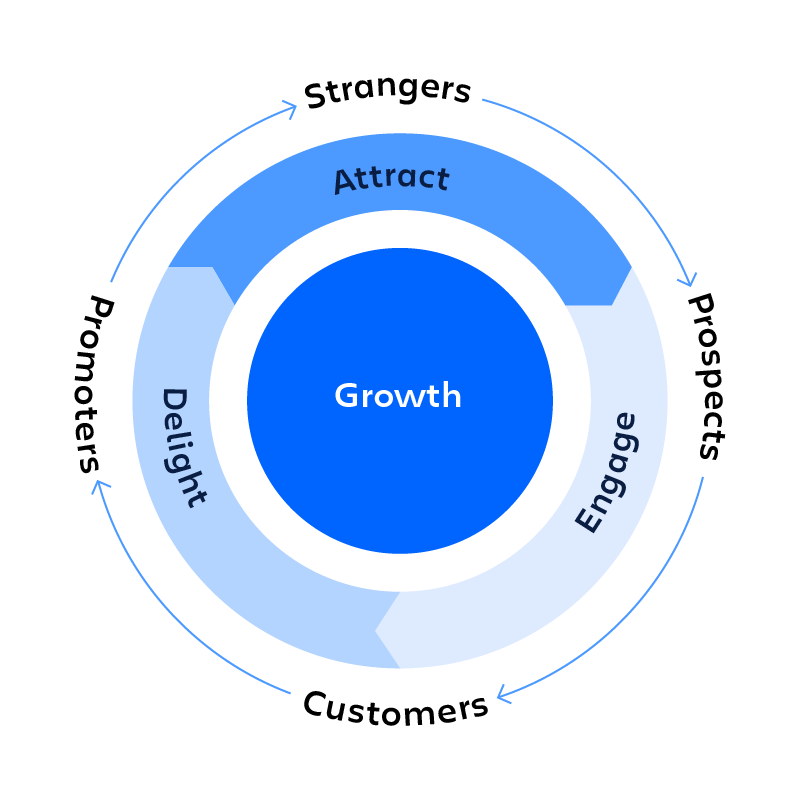
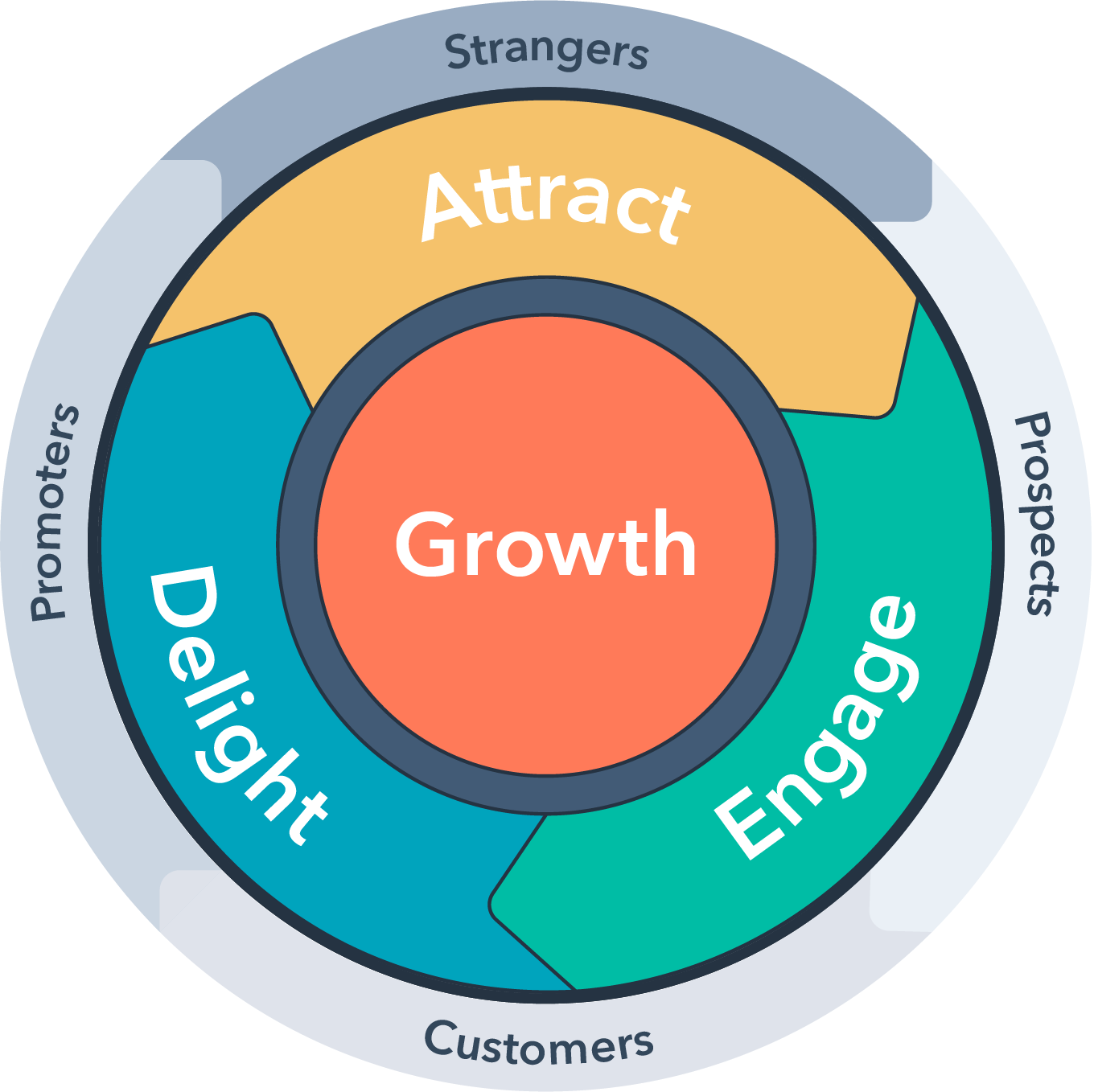
While Amazon’s flywheel emphasizes operational and pricing advantages, HubSpot provides an excellent example of a flywheel centered around customer experience and marketing efficiency, with clear financial implications. HubSpot evolved its inbound marketing strategy into a “flywheel” model that replaced the traditional sales funnel:
-
Attract: Content marketing, SEO, and social media draw visitors to the website.
-
Engage: CRM, email marketing, and sales tools help convert visitors into leads and customers.
-
Delight: Customer service, support, and community building ensure customers are satisfied and become advocates.
-
Advocates: Delighted customers refer new customers, provide testimonials, and contribute to word-of-mouth marketing.
From a financial perspective, this flywheel significantly reduces Customer Acquisition Cost (CAC) over time. As delighted customers become advocates, they generate organic leads, lessening the reliance on paid advertising. This leads to a healthier LTV:CAC ratio, improved profitability, and more efficient use of marketing budgets. The inbound flywheel generates a steady stream of high-quality leads that are pre-qualified by their interest in HubSpot’s content, making sales cycles shorter and conversion rates higher—all translating directly into improved financial performance and sustainable growth without continually escalating marketing spend.
Avoiding Flywheel Friction and Ensuring Long-Term Financial Viability
Even the most well-designed flywheel can encounter friction, slowing its momentum or even bringing it to a halt. Proactive identification and mitigation of these issues are critical for long-term financial viability and sustained growth.
Identifying and Mitigating Financial Bottlenecks
Friction in a business flywheel often manifests as financial bottlenecks. These can include:
-
Cash flow issues: Insufficient liquidity to fund the next stage of investment or cover operational costs.
-
Overspending on non-core activities: Diverting capital to areas that don’t directly contribute to the flywheel’s primary drivers.
-
Inefficient resource allocation: Mismanaging human or financial capital, leading to suboptimal returns.
-
Poor unit economics: If the cost of serving a customer exceeds the revenue generated, the flywheel will eventually grind to a halt.
Regular, rigorous financial health checks are essential. This means scrutinizing income statements, balance sheets, and cash flow projections to identify early warning signs. Implementing robust financial controls, prudent budgeting, and a clear understanding of the return on investment for every significant expenditure are crucial to keeping the flywheel spinning smoothly and profitably.
Adapting to Market Shifts and Maintaining Financial Momentum
The business environment is rarely static. Economic downturns, technological disruptions, new competitors, and evolving customer preferences can all introduce friction to a previously efficient flywheel. A static flywheel will eventually lose momentum and become obsolete.
Maintaining momentum requires:
-
Continuous Market Research: Understanding changing customer needs and competitive landscapes.
-
Financial Agility: The ability to quickly reallocate capital and adjust investment strategies in response to new information.
-
Strategic Re-evaluation: Periodically reassessing whether the current drivers of the flywheel are still the most impactful or if new drivers need to be incorporated. This might involve investing in new technologies, diversifying product lines, or exploring new markets.
-
Scenario Planning: Developing financial models for various future scenarios helps build resilience and prepare for potential disruptions.
A truly sustainable flywheel is one that can adapt and evolve, continually seeking new ways to reduce friction and enhance its compounding financial returns.
The Role of Leadership in Sustaining the Flywheel
Ultimately, the sustained success of a business flywheel hinges on strong leadership. Leaders are responsible for:
-
Defining the Flywheel: Articulating a clear, compelling vision for the company’s unique flywheel and its financial objectives.
-
Resource Allocation: Disciplined and strategic allocation of financial capital, talent, and time to the core drivers. This often means saying “no” to enticing opportunities that don’t directly feed the flywheel.
-
Consistent Execution: Ensuring that each component of the flywheel is executed with excellence, consistently and over a long period.
-
Culture of Accountability: Fostering a culture where teams understand their role in the flywheel and are accountable for their contribution to its financial performance.
-
Long-Term Perspective: Resisting the temptation of short-term gains that might undermine the long-term compounding effects of the flywheel.
Leaders who embody this discipline and vision are the true architects of enduring financial success, transforming initial pushes into an unstoppable force of business growth and value creation.
In conclusion, the business flywheel is far more than a catchy metaphor; it’s a profound strategic framework for achieving sustainable financial growth and market leadership. By identifying a business’s unique cycle of interconnected activities, deliberately building momentum through strategic investment, and continuously optimizing its performance, companies can move beyond linear growth to achieve exponential returns. For any business focused on long-term financial viability, maximizing shareholder value, and efficient resource utilization, mastering the art of the flywheel is not just an option—it’s an imperative for compounding success.
aViewFromTheCave is a participant in the Amazon Services LLC Associates Program, an affiliate advertising program designed to provide a means for sites to earn advertising fees by advertising and linking to Amazon.com. Amazon, the Amazon logo, AmazonSupply, and the AmazonSupply logo are trademarks of Amazon.com, Inc. or its affiliates. As an Amazon Associate we earn affiliate commissions from qualifying purchases.