
In the complex landscape of personal and business finance, few mathematical concepts are as universally applied and critically important as percentages. From understanding interest rates on loans and returns on investments to analyzing profit margins and budgeting expenses, percentages serve as the fundamental language of financial comparison and growth. More than just a simple calculation, mastering how to find and interpret percentages empowers individuals and organizations to make informed decisions, track progress, and strategically plan for the future. This comprehensive guide will demystify the process of finding percentages, placing it firmly within the context of money management and showing you exactly why this skill is invaluable for financial success.
The Core Mechanics: Calculating Percentages for Financial Clarity
At its heart, a percentage is a way of expressing a number as a fraction of 100. It’s a standardized method for comparing quantities, making proportional changes, and understanding rates. In finance, this standardization is crucial for benchmarking, evaluating performance, and forecasting. Understanding the basic formulas is the first step toward financial literacy.
Basic Percentage Calculation: Part-to-Whole in Your Finances
The most fundamental application of percentages is determining what portion a specific amount represents of a larger total. This “part-to-whole” calculation is ubiquitous in personal finance, particularly when analyzing how your income is allocated or how a specific expense compares to your overall spending.
The formula is straightforward:
Percentage = (Part / Whole) * 100
Example for Personal Finance:
Imagine your monthly take-home income is $4,000. Your rent payment is $1,200. To find out what percentage of your income goes to rent, you would calculate:
( $1,200 / $4,000 ) * 100 = 0.30 * 100 = 30%
This tells you that 30% of your income is allocated to rent, a critical piece of information for budgeting and evaluating financial health. Similarly, you might want to know what percentage of your budget is spent on groceries or entertainment, allowing you to categorize and control your spending effectively.
Calculating Percentage Increase or Decrease: Tracking Financial Changes
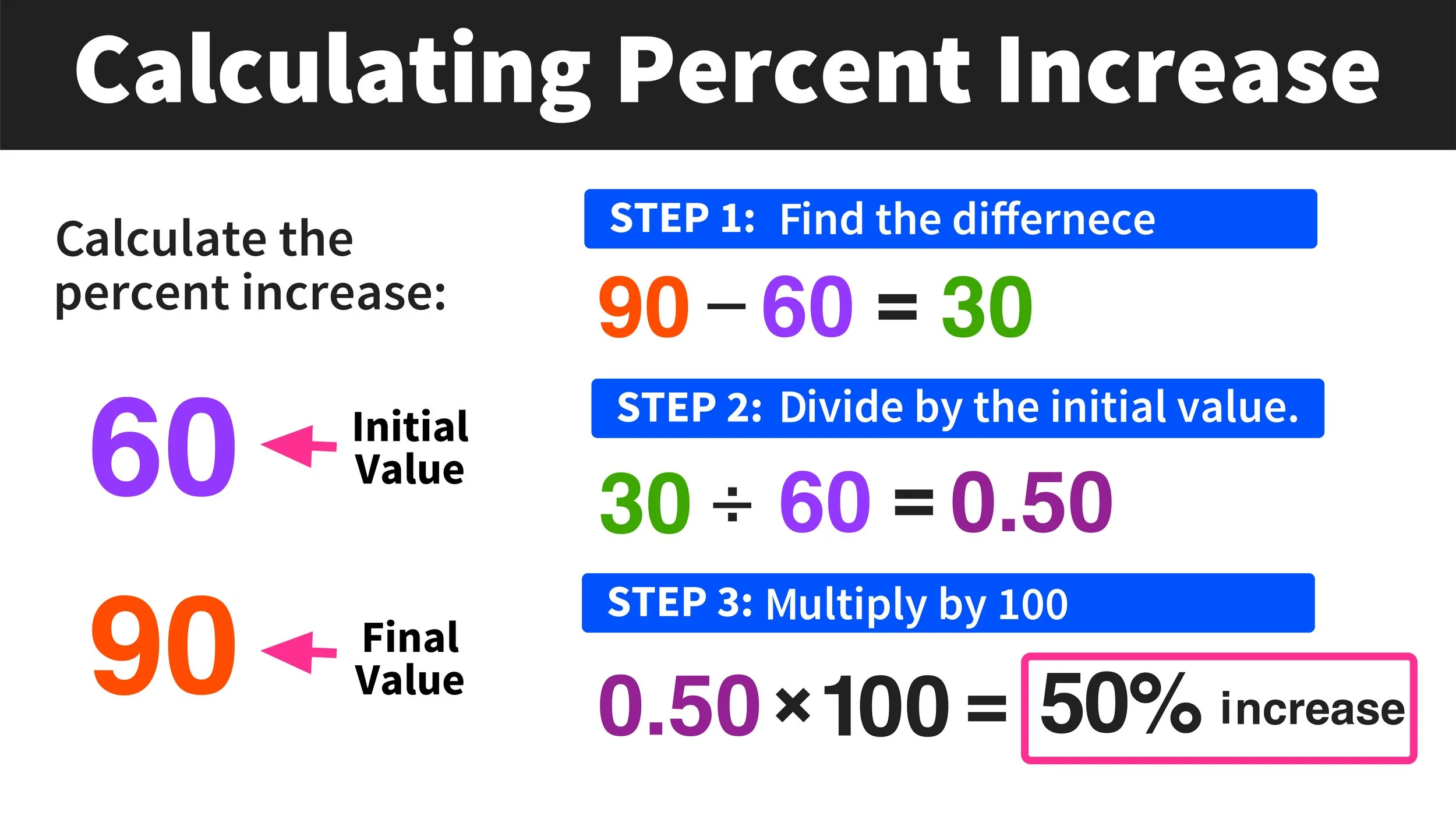
Financial life is dynamic, with values constantly changing. Whether you’re tracking investment growth, evaluating a price discount, or monitoring inflation, understanding percentage increase or decrease is vital. This calculation quantifies the magnitude of change relative to the original amount, providing context that absolute numbers alone cannot.
The formula for percentage change is:
Percentage Change = ((New Value – Old Value) / Old Value) * 100
If the result is positive, it’s a percentage increase; if negative, it’s a percentage decrease.
Example for Investing:
You invested $5,000 in a stock, and it grew to $5,750 over a year. To find your percentage return:
( ($5,750 – $5,000) / $5,000 ) * 100 = ( $750 / $5,000 ) * 100 = 0.15 * 100 = 15% increase.
Conversely, if the stock fell to $4,500:
( ($4,500 – $5,000) / $5,000 ) * 100 = ( -$500 / $5,000 ) * 100 = -0.10 * 100 = -10% decrease.
This metric, often referred to as Return on Investment (ROI), is fundamental for assessing the performance of your investments.
Finding a Percentage of a Number: Applying Rates and Discounts
Often, you’ll need to determine a specific percentage of a given amount. This is common when calculating sales tax, applying discounts, or figuring out interest earned or paid.
The formula is:
Amount = (Percent / 100) * Whole Number
Example for Personal and Business Finance:
You want to buy an item priced at $150, and there’s an 8% sales tax. To find the tax amount:
( 8 / 100 ) * $150 = 0.08 * $150 = $12
The total cost would be $150 + $12 = $162.
Similarly, if you’re taking out a loan with a 5% interest rate on a principal of $10,000 for one year, the annual interest would be:
( 5 / 100 ) * $10,000 = 0.05 * $10,000 = $500.
For businesses, this formula is crucial for calculating discounts offered to customers, determining sales commissions for employees, or applying various levies and charges.
Percentages in Personal Finance Management
Beyond basic calculations, percentages form the backbone of sound personal financial management. They provide a standardized way to evaluate your financial health, make budgeting decisions, and plan for your future.
Budgeting and Expense Allocation: The Percentage Rule
Budgeting effectively often involves allocating specific percentages of your income to different categories. One popular guideline is the 50/30/20 Rule, which suggests:
-
50% of your income for Needs: Housing, utilities, groceries, transportation.
-
30% of your income for Wants: Dining out, entertainment, hobbies, travel.
-
20% of your income for Savings & Debt Repayment: Emergency fund, investments, paying down high-interest debt.
By calculating the percentage of your income going into each category, you can quickly assess if your spending aligns with your financial goals and adjust as necessary. If your ‘Wants’ category is consistently exceeding 30%, percentages immediately highlight where adjustments are needed.
Understanding Loans, Interest, and Debt: APR and Interest Accrual
When you borrow money, percentages dictate the cost. The Annual Percentage Rate (APR) is the yearly rate charged for borrowing, or earned by investing, expressed as a percentage. Understanding how APR translates into actual dollar amounts paid or received is critical. For credit cards, mortgages, and personal loans, interest accrues as a percentage of your outstanding balance. Calculating the interest payment for a specific period often involves finding a percentage of the principal amount or the remaining balance. A 20% APR on a credit card balance can quickly compound into a significant debt, making a basic understanding of percentage calculation crucial for debt management.
Savings and Investment Growth: Compounding and ROI
For long-term financial security, saving and investing are paramount, and percentages are at the core of their growth. Compound interest, often called the “eighth wonder of the world,” means earning interest on your initial principal and on the accumulated interest from previous periods. This exponential growth is purely a function of percentages. Similarly, your Return on Investment (ROI), expressed as a percentage, is the primary metric for evaluating how well your investments are performing. Setting savings goals, such as saving 15% of your income for retirement, gives you a clear, actionable target, measurable through percentage-based calculations.
Percentages in Business and Investing
For entrepreneurs, business owners, and serious investors, percentages shift from personal guidance to strategic imperatives. They are essential for assessing profitability, evaluating market performance, and making critical resource allocation decisions.
Profit Margins and Revenue Analysis: Business Health Indicators
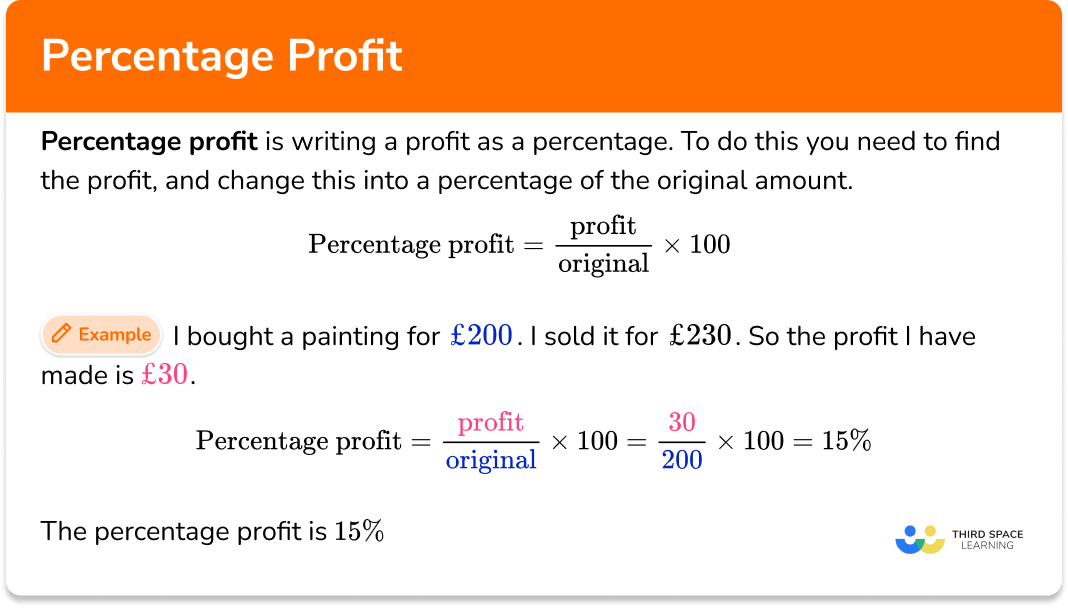
Businesses rely heavily on percentages to understand their financial health and operational efficiency. Gross Profit Margin and Net Profit Margin are key indicators, calculated as percentages.
-
Gross Profit Margin = ((Revenue – Cost of Goods Sold) / Revenue) * 100
-
Net Profit Margin = ((Net Income / Revenue) * 100
These percentages tell a company how much profit it makes from its sales after covering direct costs (gross) and all operating expenses (net). A declining percentage margin can signal pricing problems, increasing costs, or operational inefficiencies, prompting management to investigate and take corrective action. Businesses also analyze revenue growth year-over-year in percentage terms to gauge market performance and expansion.
Investment Performance and Risk Assessment: Portfolio Strategy
Investors use percentages to dissect the performance and risk of their portfolios. Calculating percentage gains or losses on individual assets or an entire portfolio helps determine actual returns. Furthermore, asset allocation—deciding what percentage of your portfolio to put into stocks, bonds, real estate, etc.—is a core risk management strategy. For example, a common recommendation for younger investors might be “80% stocks, 20% bonds,” shifting to “60% stocks, 40% bonds” as they approach retirement. These percentage-based allocations are crucial for managing volatility and aligning investments with an investor’s risk tolerance and time horizon.
Sales, Discounts, and Commissions: Driving Commercial Activity
In the commercial world, percentages are the lifeblood of transactions and incentive structures. Retailers frequently offer discounts (e.g., “20% off all items”) to attract customers, requiring a calculation of a percentage of the original price. Sales teams often earn commissions based on a percentage of their sales revenue, directly linking performance to compensation. Understanding these percentage calculations is vital for both businesses setting their pricing and commission structures and consumers navigating sales and promotions.
Common Pitfalls and Misinterpretations of Percentages
Despite their apparent simplicity, percentages can be deceptively tricky. Misinterpretations can lead to poor financial decisions or a misunderstanding of financial data.
The Difference Between Percentage and Percentage Point
One of the most common confusions arises between a “percentage” and a “percentage point.” If an interest rate increases from 5% to 6%, it’s an increase of 1 percentage point. However, in terms of percentage change, it’s a ((6-5)/5) * 100 = 20% increase in the interest rate itself. This distinction is crucial in finance, particularly when discussing changes in rates, market share, or economic indicators. Confusing the two can significantly distort the perceived magnitude of a change.
Cumulative Percentages and Compounding Effects
Applying multiple percentages sequentially can also be a source of error. For example, a 20% discount followed by an additional 10% off does not equate to a 30% discount. If an item costs $100:
-
First discount: 20% of $100 = $20. Price becomes $80.
-
Second discount: 10% of $80 = $8. Price becomes $72.
The total discount is $28, which is 28% of the original $100, not 30%. Understanding this sequential application is vital when calculating combined discounts, tax on discounted items, or multi-year investment returns.
Base Value Matters: Contextualizing Percentage Changes
The context and base value upon which a percentage is calculated are paramount. A “10% raise” sounds great, but a 10% raise on a $30,000 salary ($3,000) is vastly different from a 10% raise on a $100,000 salary ($10,000). While both are “10%,” their absolute impact on personal finance differs significantly. Similarly, a 50% increase in sales for a small startup is a different scale of achievement than a 50% increase for a multinational corporation. Always consider the base from which the percentage is derived to truly understand its financial significance.
Leveraging Financial Tools for Percentage Calculations
While the underlying math is essential, modern financial tools have made calculating and tracking percentages easier than ever. These tools not only expedite calculations but also help visualize and analyze data in percentage terms.
Spreadsheets and Budgeting Software
Spreadsheets like Microsoft Excel and Google Sheets are powerful allies for financial analysis. They allow users to set up formulas for percentage calculations (e.g., = (A2/B2)*100 for part-to-whole) and apply them across large datasets. Budgeting software and apps (like Mint, YNAB, or Quicken) automatically categorize expenses and often display spending breakdowns as percentages of income or total budget, providing instant insights into financial allocation without manual calculation.
Online Calculators and Financial Platforms
The internet abounds with specialized calculators that perform complex percentage-based financial computations. From mortgage amortization calculators that break down principal and interest payments over time, to investment growth calculators that project returns based on percentage rates and compounding, these tools simplify intricate financial planning. Many online banking and brokerage platforms also present account activity and investment performance using percentages, offering clear, concise summaries of your financial standing.
Conclusion
Understanding how to find a percent is not merely an academic exercise; it is a foundational skill for financial literacy and empowerment. From the everyday task of budgeting and saving to the strategic decisions of investing and running a business, percentages provide the universal language for measuring, comparing, and projecting financial outcomes. By mastering the core mechanics, recognizing their diverse applications, and being aware of common pitfalls, you equip yourself with an invaluable tool for navigating the financial world with confidence and making smarter, more informed decisions that lead to greater financial well-being. Embrace the power of the percent, and unlock a clearer, more controlled financial future.
aViewFromTheCave is a participant in the Amazon Services LLC Associates Program, an affiliate advertising program designed to provide a means for sites to earn advertising fees by advertising and linking to Amazon.com. Amazon, the Amazon logo, AmazonSupply, and the AmazonSupply logo are trademarks of Amazon.com, Inc. or its affiliates. As an Amazon Associate we earn affiliate commissions from qualifying purchases.