
An eye prescription, often referred to as a “script,” is a doctor’s written order that details the specific lenses needed to correct your vision. It’s a critical document, acting as a blueprint for opticians and lens manufacturers to craft eyewear that precisely addresses your refractive errors, such as myopia (nearsightedness), hyperopia (farsightedness), astigmatism, and presbyopia. Beyond these basic corrections, a prescription can also incorporate solutions for eye conditions like strabismus (crossed eyes) or amblyopia (lazy eye), and even include tinted lenses for light sensitivity or prism correction for eye alignment issues. Understanding your eye prescription is not just about knowing the numbers; it’s about understanding how your eyes function and how technology is leveraged to enhance your vision and quality of life.
1. Deciphering the Components of Your Prescription
The language of an eye prescription can appear intimidating at first glance, filled with abbreviations and numerical values. However, each element plays a vital role in communicating the exact optical requirements for your lenses. Breaking down these components is the first step to demystifying this essential document.
1.1 Understanding Refractive Errors
The primary purpose of an eye prescription is to correct refractive errors, which occur when the shape of your eye doesn’t allow light to focus properly on the retina. The most common refractive errors are:
- Myopia (Nearsightedness): Difficulty seeing distant objects clearly. Light focuses in front of the retina instead of on it.
- Hyperopia (Farsightedness): Difficulty seeing near objects clearly, and sometimes distant objects as well. Light focuses behind the retina.
- Astigmatism: An irregular curvature of the cornea or lens that causes blurred or distorted vision at all distances. It’s like looking through a warped window.
- Presbyopia: Age-related farsightedness, typically starting around age 40, making it difficult to focus on close-up objects. This is due to the natural stiffening of the eye’s lens.
1.2 Key Prescription Terms and Their Meanings
Your prescription will typically include several key terms and numerical values. Understanding these will empower you to have more informed conversations with your eye care professional and optician.
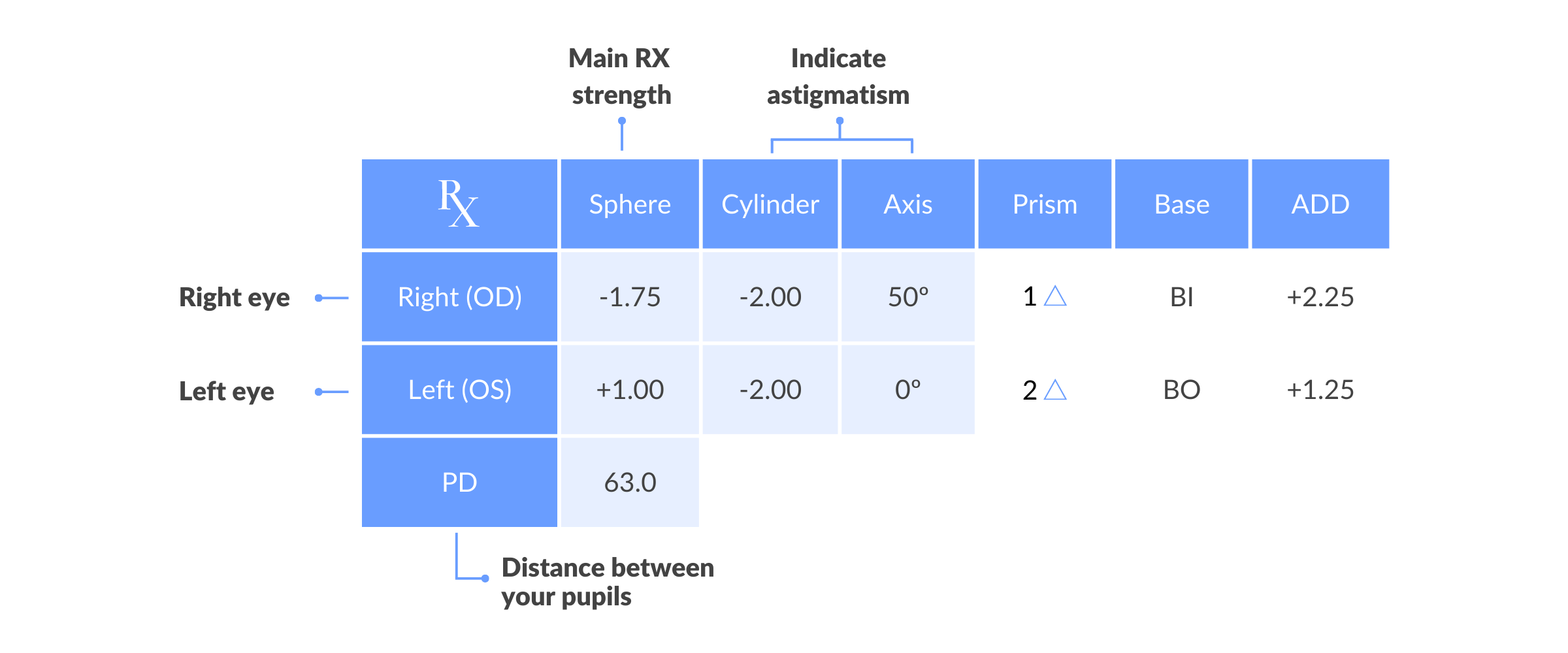
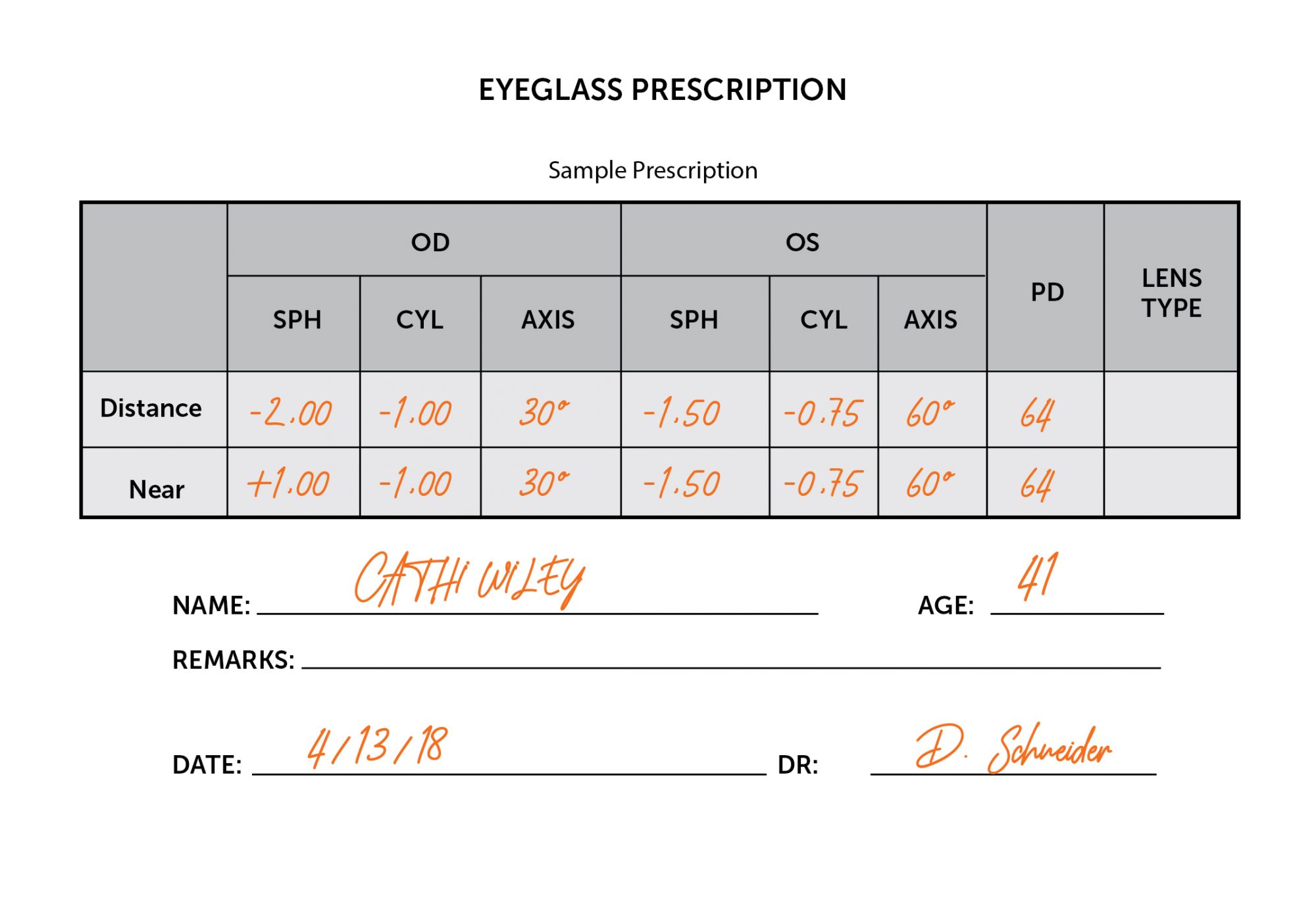
- OD (Oculus Dexter): This Latin abbreviation refers to your right eye.
- OS (Oculus Sinister): This Latin abbreviation refers to your left eye.
- OU (Oculus Uterque): This abbreviation means both eyes. It’s used when the prescription is the same for both eyes.
- Sphere (SPH): This indicates the primary correction for nearsightedness or farsightedness.
- A minus (-) sign indicates correction for myopia (nearsightedness). The higher the number, the stronger the lens needed to push the focal point back onto the retina.
- A plus (+) sign indicates correction for hyperopia (farsightedness). The higher the number, the stronger the lens needed to pull the focal point forward onto the retina.
- Cylinder (CYL): This measures the degree of astigmatism. It’s always accompanied by an axis.
- If there’s no astigmatism, this field will be blank or marked “SPH.”
- The numbers here will be a minus (-) value, indicating the power needed to correct the irregular curvature.
- Axis: This specifies the orientation of the astigmatism correction, measured in degrees from 1 to 180. If you have astigmatism, the axis tells the optician where to place the cylindrical correction in the lens.
- Add (Addition): This is a separate prescription power added to the distance prescription for reading or near-vision correction, typically for presbyopia. It’s usually indicated by a “plus” (+) number.
- The Add power is often the same for both eyes, but can vary.
- Prism: If prescribed, this indicates a correction for eye alignment issues or double vision. Prism lenses bend light to help the eyes work together more effectively.
- Base: Indicates the direction in which the prism is oriented (e.g., Base In, Base Out, Base Up, Base Down).
- Diopters (Δ): The unit of measurement for the strength of the prism.
- Base Curve (BC): This refers to the curvature of the back surface of a contact lens, designed to fit the shape of your eye.
- Diameter (DIA): The size of a contact lens.
- Expiration Date: Eye prescriptions have an expiration date, usually one or two years from the date of issue, as vision can change over time.
2. The Technology Behind Vision Correction
The accuracy and efficacy of an eye prescription are directly linked to the technological advancements in optometry and lens manufacturing. From the diagnostic tools used to measure your eyes to the sophisticated processes that create your lenses, technology plays an indispensable role.
2.1 Advanced Diagnostic Tools
The journey to an eye prescription begins with a comprehensive eye exam. Modern optometry employs a range of sophisticated instruments to precisely measure various aspects of your eye’s health and refractive properties:
- Autorefractor: This automated device provides an initial estimate of your refractive error by measuring how your eye focuses light. While not a substitute for a manual refraction, it gives the optometrist a starting point.
- Phoropter: This phoropter is the “big machine” with all the lenses that the optometrist uses during a manual refraction. By presenting a series of lenses to your eyes and asking you which one provides the clearest vision, the optometrist fine-tunes the prescription to achieve optimal visual acuity.
- Digital Eye Exams: Increasingly, eye care professionals are using advanced digital refraction systems that combine multiple diagnostic steps into a single, efficient process. These systems often offer higher precision and a more comfortable patient experience.
- Optical Coherence Tomography (OCT): While not directly used for prescription generation, OCT is a vital imaging tool that provides cross-sectional views of the retina and optic nerve. It helps diagnose and monitor various eye diseases, which can influence prescription decisions and overall eye health management.
- Corneal Topography: This technology maps the surface of the cornea, providing detailed information about its shape. It’s particularly important for identifying and fitting specialized contact lenses for conditions like keratoconus, as well as for understanding astigmatism.
2.2 Precision Lens Manufacturing
Once the prescription is finalized, the technology shifts to the manufacturing of the lenses themselves. This is a highly precise process that ensures the lenses perfectly match the prescribed specifications.
- Computer Numerically Controlled (CNC) Machining: This is a core technology in lens fabrication. Sophisticated machines use computer-generated designs to precisely cut and shape lens blanks to match the exact curvature, power, and thickness required by the prescription.
- Digital Surfacing (Freeform Technology): This advanced manufacturing technique allows for the creation of highly customized lenses. Instead of traditional molds, digital surfacing uses computer-controlled tools to generate complex lens surfaces with unprecedented accuracy. This is especially beneficial for progressive lenses, where different powers are seamlessly integrated across the lens surface.
- Anti-Reflective (AR) Coatings: Applied through vacuum deposition, AR coatings reduce reflections from the lens surface, improving light transmission, reducing glare, and enhancing visual clarity and comfort.
- Scratch-Resistant Coatings: These hardened coatings are applied to protect the lens surface from minor abrasions, extending the life and appearance of the eyewear.
- UV Protection Coatings: Essential for eye health, these coatings block harmful ultraviolet (UV) rays from the sun, which can contribute to cataracts and other eye damage.
- Photochromic Technology: Lenses with this technology darken automatically in sunlight and become clear indoors, offering convenience and protection from varying light conditions. This is achieved by embedded molecules that react to UV light.
The integration of these diagnostic and manufacturing technologies ensures that your eye prescription translates into eyewear that provides the clearest, most comfortable, and protective vision possible.
3. Beyond Basic Correction: Advanced Prescription Applications
While the primary function of an eye prescription is to correct common refractive errors, technology also enables its use in addressing more complex visual needs and enhancing visual performance in various scenarios.
3.1 Specialized Contact Lenses
Contact lenses have evolved significantly, offering a range of specialized options beyond standard soft lenses:
- Toric Contact Lenses: These lenses are specifically designed to correct astigmatism. They have different curvatures on different meridians of the lens to compensate for the irregular shape of the cornea.
- Multifocal Contact Lenses: Similar to progressive eyeglass lenses, these allow individuals with presbyopia to see clearly at multiple distances. They incorporate different zones for near, intermediate, and distance vision.
- Rigid Gas Permeable (RGP) Lenses: These lenses are made of a rigid material that provides sharper vision for many individuals with significant astigmatism or certain corneal conditions. Their custom fit can offer superior visual acuity.
- Scleral Lenses: These large-diameter lenses vault completely over the cornea and rest on the white part of the eye (the sclera). They are often prescribed for severe dry eye, irregular corneas (like in keratoconus), or other complex eye conditions, creating a smooth optical surface over the damaged cornea.
3.2 Ophthalmic Lens Technologies
Eyeglass lenses also benefit from technological innovations that go beyond simple spherical and cylindrical correction:
- Progressive Lenses (No-Line Bifocals): These lenses seamlessly blend different prescriptions for distance, intermediate, and near vision without visible lines. Advanced digital surfacing has made these lenses more personalized and easier to adapt to, with wider fields of clear vision.
- Bifocal and Trifocal Lenses: These lenses have distinct segments for different viewing distances, with visible lines separating them. While less common now due to the popularity of progressives, they remain effective solutions for presbyopia.
- Computer Lenses: These lenses are specifically designed for the intermediate distances typically used when working at a computer. They can incorporate features to reduce eye strain and blue light exposure.
- Occupational Lenses: Tailored for specific professions, these lenses offer optimized vision for tasks requiring particular working distances and visual demands.

3.3 Prescription Integration with Digital Devices and Vision Therapy
The digital age has introduced new considerations for eye prescriptions. Screen time and the prevalence of digital devices have led to an increased focus on managing digital eye strain.
- Blue Light Filtering: Many lenses now incorporate technology to filter out a portion of the high-energy blue light emitted from digital screens. While research is ongoing regarding its long-term effects, many users report reduced eye strain and improved sleep patterns with blue light filtering.
- Vision Therapy: In some cases, an eye prescription may be part of a broader vision therapy program. Vision therapy is a type of physical therapy for the eyes, using a series of eye exercises and visual stimuli to improve visual skills such as eye tracking, focusing, and binocular coordination. The prescription may provide a foundation upon which these therapies build.
Understanding the nuances of your eye prescription, coupled with the remarkable technological advancements in eye care, empowers individuals to achieve and maintain optimal vision throughout their lives. It’s a testament to how scientific innovation directly impacts our ability to perceive and interact with the world around us.
aViewFromTheCave is a participant in the Amazon Services LLC Associates Program, an affiliate advertising program designed to provide a means for sites to earn advertising fees by advertising and linking to Amazon.com. Amazon, the Amazon logo, AmazonSupply, and the AmazonSupply logo are trademarks of Amazon.com, Inc. or its affiliates. As an Amazon Associate we earn affiliate commissions from qualifying purchases.