
In the intricate tapestry of language, every thread, no matter how small, plays a pivotal role in creating a cohesive and compelling narrative. Among these, the conjunction word often goes unnoticed, diligently working behind the scenes to weave ideas together, establish relationships, and ensure the smooth flow of communication. For brands, understanding and mastering the subtle power of conjunctions is not merely a matter of grammatical correctness; it is a strategic imperative that directly impacts clarity, professionalism, and ultimately, brand perception.
A conjunction is a part of speech that connects words, phrases, clauses, or sentences. It acts as a linguistic bridge, creating logical connections and indicating the relationship between different parts of a message. Without conjunctions, our communication would be a series of disconnected, choppy statements, severely hindering our ability to convey complex ideas, build persuasive arguments, or craft engaging stories – all critical elements for effective branding. In the realm of brand communication, where every word is an investment in identity and influence, conjunctions are the silent architects of coherence, allowing brands to articulate their values, benefits, and unique selling propositions with precision and impact.
The Foundational Role of Conjunctions in Cohesive Brand Messaging
Effective brand communication hinges on the ability to convey a consistent, clear, and compelling message across all touchpoints. Conjunctions are fundamental to achieving this coherence, allowing brands to construct narratives that resonate and persuade. They are the mortar between the bricks of a brand’s story, ensuring stability and seamless transitions.
Weaving Ideas Together: How Conjunctions Create Flow
Imagine trying to explain a complex product feature or a nuanced brand philosophy using only short, disconnected sentences. It would be an arduous task, leading to listener fatigue and misunderstanding. Conjunctions enable brands to link related ideas smoothly, guiding the audience through their message without abrupt stops or disjointed thoughts. Words like “and,” “but,” “because,” “while,” and “therefore” transform a series of isolated facts into a flowing explanation or a compelling argument. For instance, instead of saying “Our software is powerful. It is easy to use,” a brand can communicate more effectively by stating, “Our software is powerful and easy to use,” immediately conveying a dual benefit that is both concise and impactful. This seamless flow is crucial for maintaining audience engagement, whether in marketing copy, a corporate presentation, or a customer service interaction.
Ensuring Clarity and Conciseness in Brand Voice
Clarity is paramount in branding. Ambiguous or convoluted messages can dilute a brand’s identity and confuse its target audience. Conjunctions, when used correctly, contribute significantly to clarity by explicitly stating the relationship between ideas. They remove guesswork and ensure the audience understands the intended connection. Moreover, they often facilitate conciseness. By merging related clauses or phrases, conjunctions can help reduce wordiness while enhancing meaning. Consider the difference between “We developed this product. We listened to customer feedback. So, this product meets your needs” versus “We developed this product because we listened to customer feedback, thereby ensuring it meets your needs.” The latter is more efficient, professional, and clear, reflecting a brand that values precision in its communication.
Beyond Simple Sentences: Crafting Complex Brand Narratives
Modern brands often need to communicate more than just basic facts. They need to tell stories, articulate complex values, differentiate themselves in crowded markets, and build emotional connections. This requires the ability to construct sophisticated sentences and paragraphs that can carry intricate narratives. Conjunctions are indispensable for this task. They allow for the creation of compound and complex sentences, enabling brands to present nuanced arguments, explain causal relationships, highlight contrasts, and detail sequences of events. A brand might explain its commitment to sustainability by saying, “Although our production methods are complex, we strive for zero waste because environmental stewardship is a core value, and we believe in responsible innovation.” This single sentence, rich with conjunctions, conveys a multi-faceted brand philosophy far more effectively than a series of simple declarations.
Different Types of Conjunctions and Their Strategic Brand Applications
While all conjunctions serve to connect, they do so in distinct ways, each offering unique strategic advantages for brand communication. Understanding these differences allows brands to select the most appropriate connector to achieve specific messaging goals.
Coordinating Conjunctions: Unifying Equal Brand Elements
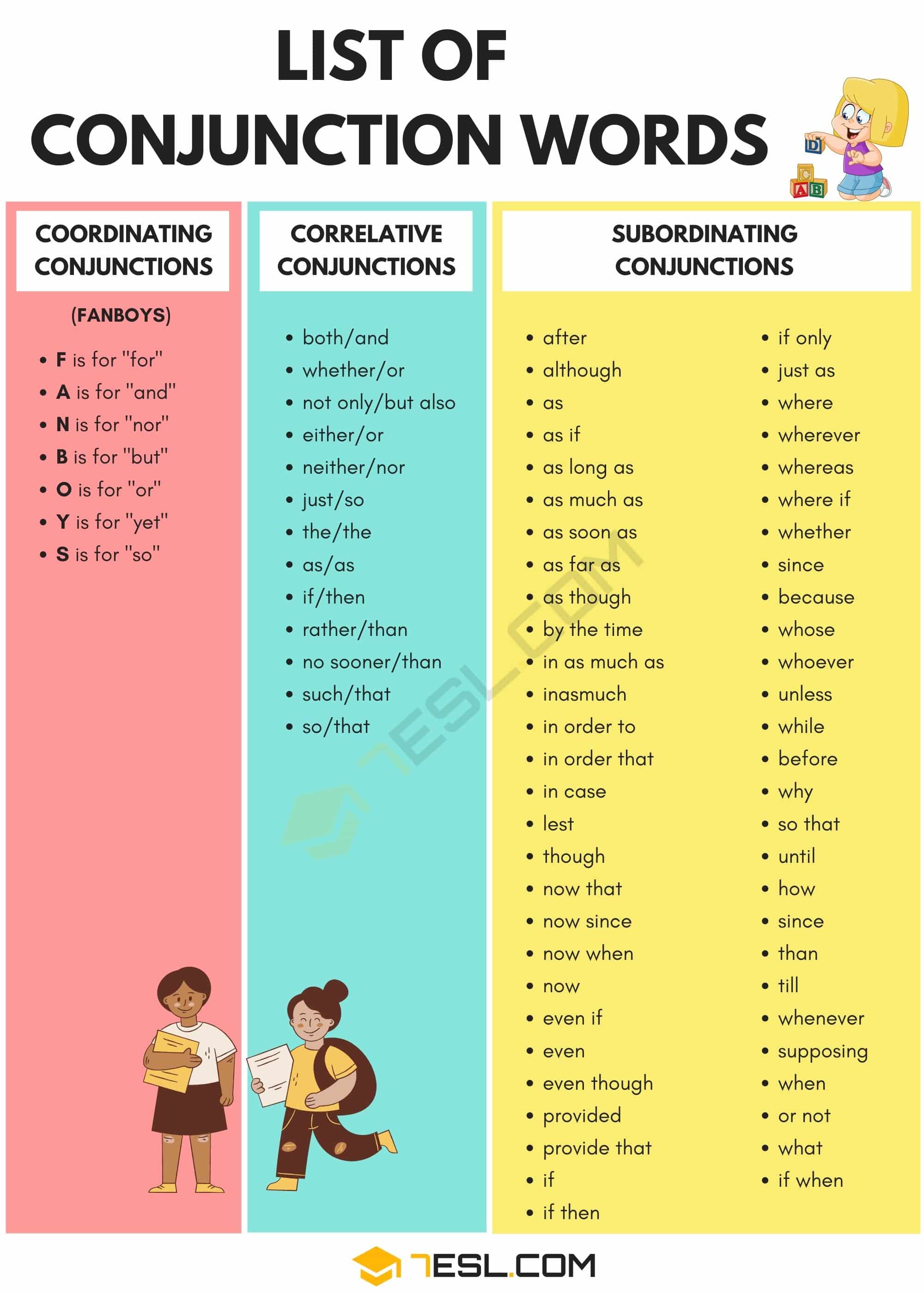
Coordinating conjunctions connect words, phrases, or clauses of equal grammatical rank. The most common are often remembered by the acronym FANBOYS: For, And, Nor, But, Or, Yet, So. These are crucial for presenting balanced information, offering choices, or highlighting direct relationships.
-
For (cause/reason): “Our service is reliable, for we prioritize rigorous testing.” (Explains the reason behind a claim)
-
And (addition): “Our product is innovative and user-friendly.” (Adds an equally important feature)
-
Nor (negative alternative): “We will nor compromise on quality nor on customer service.” (Emphasizes dedication to both)
-
But (contrast): “It’s a premium product, but surprisingly affordable.” (Highlights a positive contrast)
-
Or (alternative/choice): “You can choose the standard package or customize your solution.” (Offers options)
-
Yet (contrast, stronger than ‘but’): “The challenge was immense, yet our team delivered exceptional results.” (Conveys resilience despite difficulty)
-
So (result): “Our customers demand excellence, so we continuously innovate.” (Shows a direct consequence)
Using coordinating conjunctions strategically helps brands present multiple attributes, choices, or outcomes in a clear, balanced, and digestible manner, reinforcing a perception of thoughtful and comprehensive offerings.
Subordinating Conjunctions: Establishing Hierarchy and Cause-Effect
Subordinating conjunctions connect a dependent clause to an independent clause, creating a complex sentence. They establish a hierarchical relationship, indicating that one idea is less important or dependent on the other. Common examples include “because,” “although,” “if,” “while,” “since,” “unless,” “when,” “where,” “after,” “before,” and “until.” These are invaluable for explaining rationale, setting conditions, or detailing temporal relationships within a brand narrative.
-
Because (reason): “Because we value transparency, all our pricing is upfront.” (Explains the underlying reason for a brand value)
-
Although/Though (concession): “Although new to the market, our technology is already industry-leading.” (Acknowledges a potential drawback while highlighting strength)
-
If (condition): “If you’re looking for unparalleled support, look no further.” (Sets a condition for a benefit)
-
While (contrast/time): “While competitors cut corners, we invest in durable materials.” (Highlights differentiation or simultaneous action)
-
Since (reason/time): “Since our inception, we’ve focused on user experience.” (Indicates a duration and a consistent focus)
Subordinating conjunctions allow brands to articulate nuanced arguments, justify decisions, or preemptively address concerns, building trust and demonstrating a deeper understanding of their market and customers.
Correlative Conjunctions: Highlighting Balance and Choice
Correlative conjunctions are pairs of conjunctions that work together to connect grammatically equal elements. Examples include “both…and,” “either…or,” “neither…nor,” “not only…but also,” and “whether…or.” They emphasize balance, choice, or a dual nature, making the connection more emphatic.
-
Both…and: “Our solutions are both innovative and sustainable.” (Emphasizes two equally important positive attributes)
-
Either…or: “You can either contact us by phone or email.” (Clearly presents two distinct options)
-
Neither…nor: “We compromise on neither quality nor integrity.” (Strongly denies two undesirable traits)
-
Not only…but also: “Our product not only solves your problem but also enhances your workflow.” (Highlights a primary benefit alongside an additional, significant advantage)
-
Whether…or: “Whether you’re a startup or a large enterprise, our platform scales with you.” (Emphasizes adaptability regardless of the situation)
Correlative conjunctions are powerful tools for rhetoric in branding, drawing attention to complementary aspects, presenting clear choices, or emphatically stating what a brand is (or isn’t).

Conjunctive Adverbs: Enhancing Nuance and Professionalism
Conjunctive adverbs (e.g., “however,” “therefore,” “moreover,” “consequently,” “furthermore,” “meanwhile,” “nonetheless”) connect two independent clauses, often preceded by a semicolon and followed by a comma. They provide a more sophisticated way to show relationships between ideas, adding nuance and a formal tone. They don’t just connect; they also modify the meaning of the second clause.
-
However (contrast): “Our initial market entry was challenging; however, our persistent innovation led to success.” (Introduces a contrasting idea with a professional tone)
-
Therefore (result): “Customer feedback is crucial; therefore, we actively solicit and incorporate it.” (Indicates a logical consequence)
-
Moreover (addition): “Our product offers cutting-edge features; moreover, it comes with unparalleled support.” (Adds an additional point of emphasis)
-
Nonetheless (stronger contrast): “The economic climate was uncertain; nonetheless, we expanded our global reach.” (Highlights achievement despite significant obstacles)
Conjunctive adverbs are particularly useful in formal brand communications like whitepapers, annual reports, press releases, or thought leadership articles, where a professional and authoritative voice is essential.
Conjunctions in Action: Elevating Marketing & Branding Copy
The theoretical understanding of conjunctions finds its most impactful application in the practical execution of marketing and branding copy. From succinct slogans to detailed articles, their correct usage is a hallmark of a polished and persuasive brand.
Crafting Compelling Slogans and Taglines
Even in the brevity of a slogan, conjunctions play a role in creating impact and clarity. While often implied or minimalist, a well-placed “and” or “but” can add depth. Think of “Quality and Reliability” – a simple “and” connects two desirable traits powerfully. Or, a brand could subtly imply a conjunction: “Innovation. Performance. Trust.” (implying “Innovation, and Performance, and Trust”). While not always overtly present, the underlying principle of connection is vital.
Enhancing Website Copy and User Experience
Website copy needs to be digestible, engaging, and clear. Conjunctions are essential for creating logical flow between sections, paragraphs, and calls to action. A product description might read: “Discover features and benefits that transform your workflow. Because we understand your needs, our intuitive interface makes adoption seamless. Sign up now or explore our demo.” Each conjunction guides the user through the information, connecting different aspects of the product and its value proposition, ultimately improving the user’s journey and understanding.
Strengthening Social Media Engagement and Storytelling
Social media thrives on concise, engaging content. Conjunctions help brands tell miniature stories, explain promotions, or interact meaningfully within character limits. “New product launch! Fast and powerful. Get yours today!” or “We faced challenges, but emerged stronger. Here’s our story…” They allow brands to link an event to its cause, a problem to its solution, or a product to its benefit, enabling richer narratives even in short formats, driving higher engagement.
Professionalism in Internal Communications and Brand Guidelines
Beyond outward-facing marketing, conjunctions are critical for internal brand consistency. Clear internal communication, brand guidelines, and corporate messaging rely heavily on precise language. Conjunctions ensure that instructions are unambiguous, values are clearly articulated, and strategic objectives are logically connected. For instance, “Employees must adhere to brand guidelines, and any deviation requires prior approval,” ensures clarity on policy and process, preventing misinterpretation that could harm brand image.
Common Pitfalls and Best Practices for Brand Communication
While invaluable, conjunctions can also be misused, leading to awkward phrasing, redundancy, or even grammatical errors that detract from a brand’s professionalism. Awareness of these pitfalls and adherence to best practices are key.
Avoiding Overuse and Redundancy
An excess of conjunctions can make sentences clunky and verbose. For example, “We offer a great product, and it is innovative, and it is also affordable” can be streamlined. A better approach might be, “Our product is innovative, affordable, and great.” Similarly, avoid using conjunctions where a simple comma or rephrasing would suffice, ensuring that each conjunction serves a clear purpose rather than merely adding length.
Maintaining Tone and Voice Consistency
Conjunctions, particularly conjunctive adverbs, can significantly impact tone. Using overly formal conjunctive adverbs (“furthermore,” “henceforth”) in casual social media posts, or conversely, using informal coordinating conjunctions (“so,” “but”) in a formal whitepaper, can create a dissonant brand voice. Brands must ensure their choice of conjunctions aligns with their established tone and voice guidelines, maintaining consistency across all communication channels.
The Impact of Grammatical Errors on Brand Perception
Incorrect use of conjunctions – such as misplaced subordinating conjunctions or faulty correlative conjunction pairings – can lead to grammatical errors. These errors, even minor ones, can erode trust and diminish a brand’s credibility. A brand that consistently makes grammatical mistakes in its communication appears careless, unprofessional, and less trustworthy. In a competitive landscape, even subtle errors can sway customer perception negatively, suggesting a lack of attention to detail that might extend to their products or services. Proofreading and leveraging grammar-checking tools are crucial safeguards.
The AI and Future of Conjunctions in Brand Language
As artificial intelligence continues to reshape communication, the role of conjunctions remains central, even as the tools we use to craft language evolve. AI-powered solutions can both assist in and analyze the effective use of these connectors.
AI-Powered Grammar Tools for Brand Teams
Modern AI-driven grammar checkers and writing assistants (like Grammarly, Google Docs suggestions, etc.) are adept at identifying incorrect or awkward conjunction usage. They can suggest more precise alternatives, help streamline sentences, and ensure grammatical correctness, thereby enhancing the quality and professionalism of brand communications. These tools act as virtual editors, empowering brand teams to maintain high linguistic standards, even when under tight deadlines.

Ensuring Natural Language Processing in Chatbots and Virtual Assistants
For brands deploying AI chatbots or virtual assistants, the AI’s ability to correctly understand and use conjunctions is paramount for natural and effective interaction. A chatbot must process “I want both the blue and the red shirt” differently from “I want the blue shirt or the red shirt.” Similarly, when generating responses, AI must employ conjunctions correctly to provide coherent, helpful, and brand-consistent answers. This ensures that AI-driven brand touchpoints maintain a human-like flow and clarity, crucial for positive customer experiences and reinforcing the brand’s intelligent and helpful image.
In conclusion, the humble conjunction word is far more than a grammatical technicality; it is a powerful tool in the arsenal of effective brand communication. By understanding its types, strategic applications, and common pitfalls, brands can craft messages that are not only grammatically sound but also clear, cohesive, compelling, and consistent. In an age where every word contributes to a brand’s identity and resonance, mastering the art of connecting ideas is an indispensable skill for building a strong, trustworthy, and enduring brand presence.
aViewFromTheCave is a participant in the Amazon Services LLC Associates Program, an affiliate advertising program designed to provide a means for sites to earn advertising fees by advertising and linking to Amazon.com. Amazon, the Amazon logo, AmazonSupply, and the AmazonSupply logo are trademarks of Amazon.com, Inc. or its affiliates. As an Amazon Associate we earn affiliate commissions from qualifying purchases.