
The Fundamental Role of Decimals in Financial Acumen
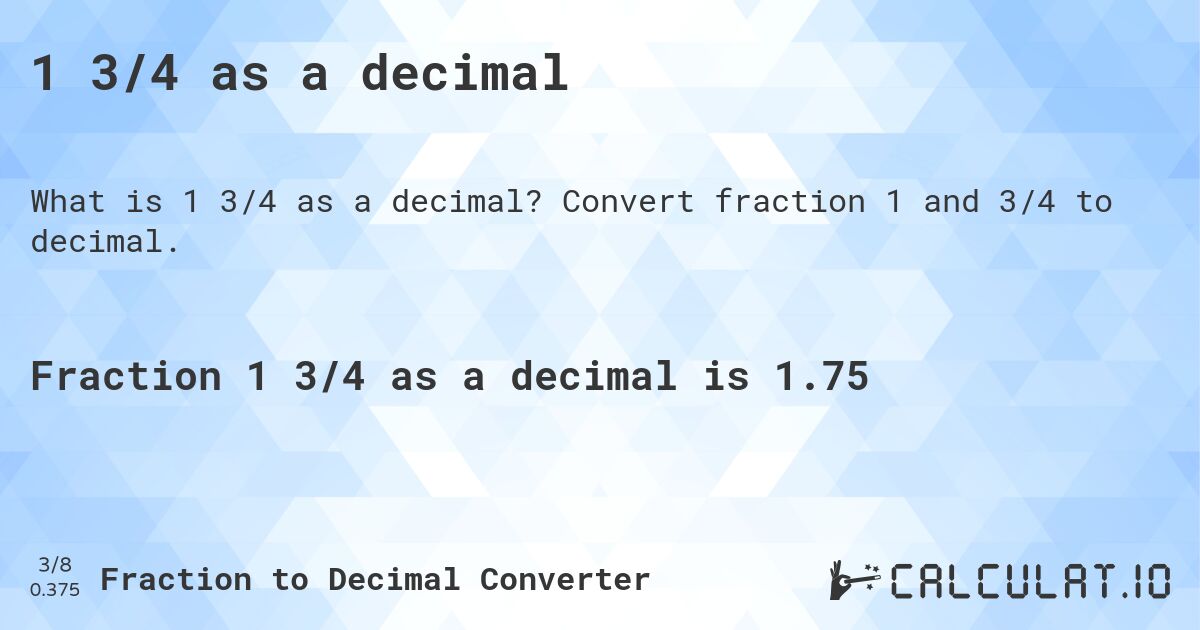
Understanding how to convert fractions to decimals is a cornerstone of financial literacy, even in an age dominated by digital calculators. While “4 1/3 as a decimal” might seem like a simple arithmetic problem, its implications span across personal budgeting, investment analysis, and complex business valuations. The ability to fluidly translate between these numerical formats ensures precision and clarity in financial calculations, helping individuals and businesses make informed decisions.
Beyond Whole Numbers: Why Fractions and Decimals Matter
The number 4 1/3 is a mixed number, combining a whole number (4) with a proper fraction (1/3). To express this as a decimal, we first convert the fractional part. Dividing 1 by 3 yields a repeating decimal: 0.3333… When combined with the whole number 4, 4 1/3 becomes 4.3333… (with the 3 repeating infinitely). This seemingly straightforward conversion is fundamental because financial figures rarely adhere to neat whole numbers. Whether it’s an interest rate, a stock price, or a growth percentage, decimals often provide the necessary granularity to accurately represent monetary values. The precision afforded by decimals allows for more accurate comparisons, calculations, and ultimately, better financial planning. Ignoring or mishandling these fractional components can lead to significant discrepancies over time, impacting everything from the exact amount owed on a loan to the true return on an investment portfolio.

Historical Context: Fractional Pricing in Markets
Historically, financial markets, particularly stock exchanges, operated on a system of fractional pricing. Until the early 2000s, it was common for stock prices to be quoted in fractions of a dollar, such as 1/8, 1/16, or even 1/32. A share might trade at $4 1/8, meaning $4.125. While the specific fraction 1/3 was less common in stock quoting due to its repeating decimal nature, the general concept of fractional representation was pervasive. The shift from fractions to decimals in major global markets like the New York Stock Exchange (NYSE) was driven by several factors: increased clarity, easier international comparison, and the ability to handle finer price increments (spreads). Decimalization facilitated electronic trading, reduced bid-ask spreads, and made calculations more straightforward for investors, especially as digital tools became prevalent. However, understanding the underlying mathematical principles of converting fractions to decimals remains critical for anyone studying historical market data, or engaging in niche markets that might still employ older conventions or complex fractional relationships.
Practical Applications: Decimals in Personal Finance
In personal finance, the seemingly minor difference that decimals introduce can have a substantial cumulative impact. From managing daily expenses to planning for long-term investments, a solid grasp of decimal conversions ensures accuracy and prevents costly misinterpretations.
Budgeting and Expense Tracking
Every household budget relies on precise figures. When allocating income to different categories, people often think in terms of proportions or percentages. For instance, you might dedicate “one-third” of your income to housing, or “one-quarter” to savings. Converting these mental fractions to decimals (e.g., 1/3 to 0.3333…, 1/4 to 0.25) allows for exact calculations of dollar amounts. If your monthly income is $4,000, setting aside 1/3 for housing means $4,000 * 0.3333 = $1,333.20 (approximately). Without this decimal conversion, estimating or rounding prematurely could lead to an inaccurate picture of your disposable income or overspending in certain categories. Furthermore, many expenses, such as utility bills or recurring subscriptions, do not come in whole dollar amounts, making decimal awareness crucial for accurate tracking.
Interest Rates and Loan Calculations
Perhaps one of the most critical areas where decimal precision reigns is in interest rates and loan calculations. A loan might carry an interest rate of 4.13%, not simply 4%. The difference between 4% and 4.13% might appear insignificant at first glance, but over the life of a mortgage or a large personal loan, those extra decimal points can translate into thousands of dollars in additional interest paid. For instance, a $200,000 loan at 4% interest over 30 years results in total payments of approximately $343,739. At 4.13%, the total payments rise to about $349,603 – a difference of nearly $6,000. Understanding how to calculate interest, especially compound interest, requires a firm grasp of decimals. Annual Percentage Rate (APR) and Annual Percentage Yield (APY) are almost exclusively expressed with decimal places, each conveying critical information about the true cost of borrowing or the real return on savings, highlighting the necessity of precise decimal comprehension.
Investment Returns and Yields
In the investment world, every decimal point can influence your portfolio’s performance. Dividend yields, stock returns, and bond yields are routinely reported with multiple decimal places. For example, a stock might have a dividend yield of 3.85%, not just 3%. When calculating total returns over time, especially with reinvested dividends or fractional share purchases, decimal accuracy is paramount. An expense ratio of 0.13% on an exchange-traded fund (ETF) is considerably better than 0.25%, and understanding these small differences can significantly impact your long-term returns. Investors must be able to convert these percentage-based decimals into their underlying dollar impacts to accurately assess investment opportunities and manage their wealth effectively. Calculating precise returns on uneven investments or managing fractional shares means understanding decimals is not just helpful, but essential for maximizing financial growth.
Decimals in Business Finance and Beyond
Beyond personal finances, decimals play an indispensable role in the broader landscape of business, economics, and international trade, where large sums and critical decisions hinge on fractional precision.
Business Valuation and Profit Margins
For businesses, understanding profitability and valuation relies heavily on accurate decimal calculations. Profit margins, return on investment (ROI), and various financial ratios (like debt-to-equity or current ratio) are often expressed as percentages, which are inherently decimal-based. A net profit margin of 4.13% (akin to our 4 1/3 example) for a large corporation represents millions, if not billions, of dollars in profit. Analyzing these figures requires converting them from percentages to decimals for calculations. For instance, if a company’s revenue is $100 million and its net profit margin is 4.13%, its net profit is $100,000,000 * 0.0413 = $4,130,000. Without precise decimal understanding, businesses risk misrepresenting their financial health, making flawed strategic decisions, or miscommunicating performance to investors and stakeholders.
Economic Indicators and Policy
Governments and economists rely on highly precise decimal figures to track and analyze economic performance. Inflation rates, Gross Domestic Product (GDP) growth, unemployment rates, and interest rates set by central banks are invariably presented with multiple decimal places. A shift in the unemployment rate from 4.1% to 4.3% might seem small, but it represents hundreds of thousands of jobs and can significantly influence monetary policy decisions. Similarly, central banks often adjust benchmark interest rates by a quarter-point (0.25%) or even smaller increments known as “basis points” (0.01%). These seemingly minor decimal adjustments have profound effects on borrowing costs, investment, and overall economic stability, impacting everything from consumer spending to business expansion. Accurate interpretation of these decimal-laden indicators is crucial for effective economic forecasting and policy formulation.
Foreign Exchange and International Transactions
In the global marketplace, foreign exchange (forex) rates are the epitome of decimal precision. Currency exchange rates are typically quoted with four or more decimal places, often referred to as “pips” (point in percentage). For example, the EUR/USD exchange rate might be 1.0825. A small movement, say from 1.0825 to 1.0826, which is just one pip, can have a substantial impact on large international transactions. Businesses engaged in international trade, investors holding foreign assets, or even individuals traveling abroad must understand how these intricate decimal figures influence the value of their money. Calculating conversion fees, understanding cross-currency transactions, and mitigating foreign exchange risk all depend on a rigorous understanding and accurate application of decimal math. Even a fraction of a cent can aggregate into significant gains or losses when dealing with millions in currency conversions.
Tools and Strategies for Mastering Decimal Conversions
While the conceptual understanding of decimal conversion is vital, practical application often benefits from leveraging modern tools and adhering to sound mathematical practices.
Leveraging Technology: Calculators and Spreadsheets
For everyday financial calculations and complex modeling, technology serves as an invaluable aid. Online calculators, dedicated financial calculators (like the HP 12c or Texas Instruments BA II Plus), and spreadsheet software such as Microsoft Excel or Google Sheets are indispensable. These tools can quickly convert fractions, perform multi-step calculations with high precision, and manage rounding rules. Spreadsheet functions like ROUND, ROUNDUP, ROUNDDOWN, and specific formatting options allow users to control the number of decimal places displayed and used in calculations, ensuring accuracy. Learning to use these technological aids effectively not only speeds up calculations but also reduces the risk of human error, allowing individuals and businesses to focus on analysis rather than manual arithmetic.
Building Foundational Math Skills
Despite the availability of sophisticated tools, a solid grasp of foundational mathematical concepts remains paramount. Understanding the relationship between fractions, decimals, and percentages empowers individuals to verify calculations, identify errors, and make sense of the output from automated tools. Reaffirming basic division skills, understanding place value, and practicing mental arithmetic provides a crucial safety net. The ability to quickly recognize that 1/3 is approximately 0.333, or that 1/4 is exactly 0.25, builds confidence and competence in navigating financial data. Regular practice, even with simple conversions like “what is 4 1/3 as a decimal,” reinforces these essential skills, making more complex financial analyses feel less daunting.
The Importance of Precision and Rounding Rules
In finance, precision is non-negotiable, but so is understanding when and how to round. Different financial contexts may require different levels of decimal precision. For instance, interest rates might be quoted to two decimal places, while foreign exchange rates may demand four or even six. Premature rounding during intermediate steps of a multi-part calculation can lead to “rounding errors” that accumulate and result in a significantly inaccurate final figure. It’s often advisable to maintain as much precision as possible throughout a calculation and only round to the required number of decimal places at the very final step. Furthermore, understanding standard rounding conventions (e.g., round half up, round half to even) used in various financial contexts is crucial to ensure consistency and comparability of results. Mastering these nuances of precision and rounding distinguishes robust financial analysis from superficial estimations.
aViewFromTheCave is a participant in the Amazon Services LLC Associates Program, an affiliate advertising program designed to provide a means for sites to earn advertising fees by advertising and linking to Amazon.com. Amazon, the Amazon logo, AmazonSupply, and the AmazonSupply logo are trademarks of Amazon.com, Inc. or its affiliates. As an Amazon Associate we earn affiliate commissions from qualifying purchases.