
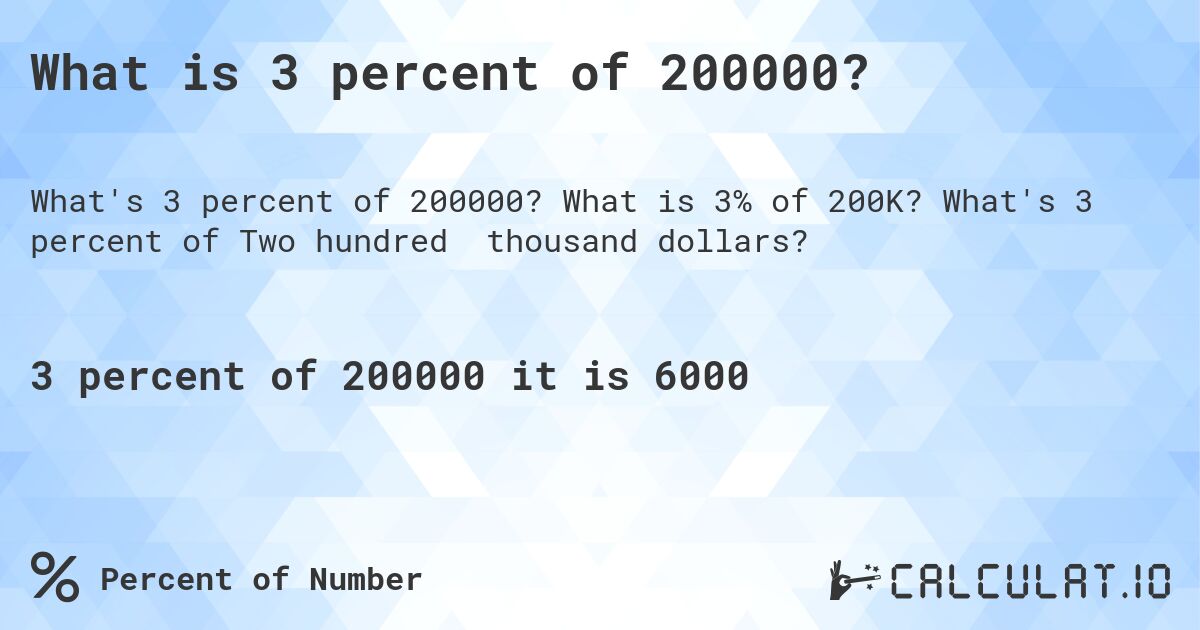
In the world of personal finance and large-scale investing, the difference between a few percentage points can often equate to the cost of a luxury vehicle, a year of college tuition, or a significant down payment on a property. When we ask, “What is 3 percent of 200,000?” the mathematical answer is straightforward: $6,000. However, in the context of wealth management, real estate, and portfolio growth, that $6,000 figure represents much more than a simple calculation. It represents a pivot point where small decisions begin to have outsized consequences on your net worth.
Understanding the weight of this figure requires moving beyond basic arithmetic and exploring how 3% functions as a fee, a yield, a tax, and an inflationary benchmark. Whether you are managing a $200,000 investment portfolio, purchasing a home at that price point, or calculating business overhead, mastering the nuances of this percentage is essential for professional financial literacy.
The Mathematical Foundation and Practical Applications
To calculate 3 percent of 200,000, you simply multiply the principal amount by the decimal equivalent of the percentage (0.03).
200,000 x 0.03 = 6,000
While the math is elementary, the application of this $6,000 figure varies wildly depending on the financial vehicle in question. In business finance, 3% might represent the processing fee for credit card transactions on a $200,000 revenue stream. In the mortgage industry, it might be the required down payment for a first-time homebuyer.
Why Small Percentages Matter in Large Sums
As your capital grows, your sensitivity to percentage shifts must increase. When you are dealing with $1,000, a 3% shift is a negligible $30. But at $200,000—a common milestone for retirement accounts or mid-tier real estate—that same 3% becomes a $6,000 factor. This is the “scale effect” in finance. It is the reason why institutional investors spend millions of dollars to shave fractions of a percentage point off their transaction costs. At scale, the “small” numbers are the ones that determine long-term solvency and growth.
The Psychology of the $6,000 Threshold
For many individuals, $6,000 represents a psychological boundary. It is often the maximum annual contribution limit for an Individual Retirement Account (IRA) for those under age 50. Seeing a 3% fluctuation in a $200,000 portfolio means seeing an entire year’s worth of potential IRA contributions appear or disappear in a single market swing. Recognizing this helps investors maintain perspective during market volatility.
Investment Fees and the Silent Erosion of Capital
One of the most critical areas where 3% becomes a dominant figure is in investment management and advisory fees. While a 3% annual fee is considered high by modern standards, it is not uncommon when combining various layers of costs, such as mutual fund expense ratios, 12b-1 marketing fees, and the wrap fees charged by full-service financial advisors.
The Impact of Asset Under Management (AUM) Fees
If you hold $200,000 in a managed account with a total fee structure of 3%, you are paying $6,000 every year for the privilege of that management. If the market returns 7% in a given year, your net return is only 4%. Over a decade, that 3% fee doesn’t just cost you $60,000 in cash; it costs you the compounded growth that $60,000 would have generated.
The “silent erosion” of capital is the greatest threat to long-term wealth. Many investors focus on “beating the market” while ignoring the fact that their fee structure is acting as a massive drag on their performance. Reducing a 3% fee to a 1% fee on a $200,000 portfolio saves $4,000 annually—capital that can be reinvested to accelerate the path to financial independence.
Comparing Expense Ratios and Advisory Costs
In the modern era of low-cost index funds and robo-advisors, paying 3% of your total assets is increasingly difficult to justify. Most high-quality Exchange Traded Funds (ETFs) have expense ratios below 0.10%. On $200,000, a 0.10% fee is only $200 per year. Comparing this to the $6,000 associated with a 3% fee highlights the massive disparity in costs. This gap—$5,800 per year—is often the difference between a comfortable retirement and one defined by financial constraint.
Real Estate and Transactional Costs
In the real estate sector, $200,000 is a significant benchmark for entry-level to mid-market homes in many regions. Within this industry, 3% is a standard figure that appears in several critical stages of the transaction.

Buyer and Seller Commissions
Traditionally, real estate commissions in the United States have hovered around 5% to 6%, which is typically split between the buyer’s agent and the listing agent. This means that for a $200,000 home sale, each agent often earns 3%, or $6,000.
For the seller, this $6,000 is a direct reduction of their home equity. When calculating the net proceeds of a sale, homeowners must account for these percentages. If you have $40,000 of equity in a $200,000 home, a 3% commission to just one side of the transaction represents 15% of your actual liquid wealth in that asset.
Closing Costs and Hidden Expenses
Beyond commissions, 3% is a common “rule of thumb” for estimating closing costs. When purchasing a $200,000 property, buyers are often advised to set aside approximately $6,000 to cover loan origination fees, title insurance, appraisals, and government taxes. Failing to account for this 3% can derail a closing or leave a new homeowner with zero liquidity immediately after taking possession of the keys.
The Power of 3 Percent in Wealth Building and Inflation
While 3% can represent a cost or a fee, it is also a vital benchmark for growth and the preservation of purchasing power.
Safe Withdrawal Rates in Retirement
Financial planners often discuss the “4% Rule” for retirement withdrawals, but in periods of lower market expectations or higher longevity, many experts advocate for a more conservative 3% safe withdrawal rate.
If you have a $200,000 “bridge fund” or a specific retirement bucket, a 3% withdrawal rate provides you with $6,000 in annual income. Understanding this helps retirees visualize their lifestyle: can you live on $500 a month from this specific asset? If not, the principal must grow, or the withdrawal rate must be adjusted.
Inflationary Pressures and Purchasing Power
Historically, the Federal Reserve targets an inflation rate of approximately 2%, but 3% is often used as a realistic long-term average for consumer price increases. On a $200,000 cash position, a 3% inflation rate means you are losing $6,000 in purchasing power every year.
This is the “hidden tax” on savings. If your $200,000 is sitting in a traditional savings account earning 0.05% interest while inflation is at 3%, you are effectively moving backward. To maintain the wealth you have, your $200,000 must generate at least $6,000 in annual gains just to stay level with the rising cost of goods and services.
Yield and Dividends: Creating a Passive Income Stream
For the income-focused investor, a 3% dividend yield is often considered the “sweet spot.” It is high enough to provide meaningful cash flow but low enough to suggest that the underlying companies are still retaining enough earnings to grow. A $200,000 portfolio yielding 3% results in $6,000 of passive income annually. This is a powerful milestone, as it covers $500 of monthly expenses—potentially paying for a car note, insurance, or utilities—without the investor ever having to sell a single share.
Strategic Allocation: How to Use $6,000 Effectively
When you identify that 3% of your $200,000 capital is $6,000, the next logical step is strategic allocation. If you find yourself with a $6,000 windfall or have successfully saved 3% of your capital, where should it go?
Debt Elimination vs. Reinvestment
The decision to use $6,000 to pay down debt or invest in the market depends entirely on the interest rate environment. If you have high-interest credit card debt at 20%, paying it off with that $6,000 provides a guaranteed “return” that no stock market can consistently match. However, if your debt is a mortgage at 3%, you might be better served by investing that $6,000 into an index fund where the historical average return is closer to 7-10%.
Emergency Funds and Liquidity
For those with $200,000 in total assets, $6,000 represents a solid “tier-one” emergency fund. Financial stability is built on layers. While the majority of a $200,000 net worth might be tied up in home equity or retirement accounts, having that 3% ($6,000) in a high-yield savings account provides the liquidity necessary to handle unexpected repairs or medical bills without having to liquidate long-term investments at an inopportune time.
The Value of Professional Guidance
Finally, it is worth noting that while $6,000 is a significant amount of money, spending a fraction of that on professional tax or legal advice can often save a multiple of that 3% in the long run. Whether it’s optimizing a $200,000 estate plan or structuring a business to save 3% on taxes, the strategic use of that capital is what separates average earners from high-net-worth individuals.
In conclusion, “3 percent of 200,000” is much more than a math problem. It is a metric of efficiency, a benchmark for growth, and a cautionary tale of how fees can erode a legacy. By keeping a sharp eye on this $6,000 figure, you can ensure that your capital is working for you, rather than for the institutions that manage it.
aViewFromTheCave is a participant in the Amazon Services LLC Associates Program, an affiliate advertising program designed to provide a means for sites to earn advertising fees by advertising and linking to Amazon.com. Amazon, the Amazon logo, AmazonSupply, and the AmazonSupply logo are trademarks of Amazon.com, Inc. or its affiliates. As an Amazon Associate we earn affiliate commissions from qualifying purchases.