
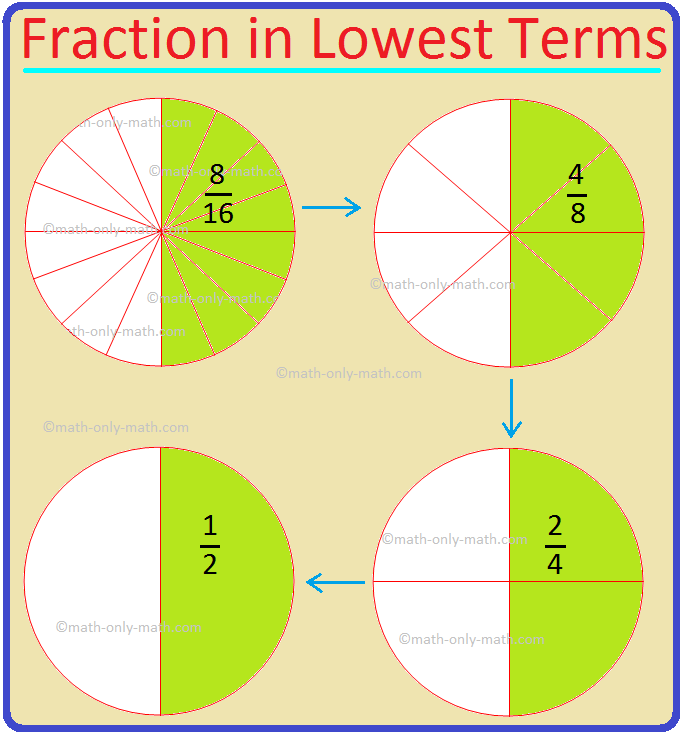
The question “what is 2/4 in the lowest terms?” is a seemingly simple mathematical query, one often encountered in elementary school. The answer, of course, is 1/2. Yet, within this straightforward simplification lies a profound principle, a crucial lens through which to view and master the often complex world of finance. Just as a fraction can be reduced to its simplest, most understandable form, so too can intricate financial data, strategies, and decisions be broken down, revealing underlying truths and enabling clearer, more effective action.
In an era saturated with financial jargon, market volatility, and endless investment opportunities, the ability to discern the essential from the superfluous is not merely a convenience—it is a superpower. Failing to simplify financial concepts can lead to confusion, overwhelm, poor decision-making, and missed opportunities. This article will delve into how the timeless mathematical principle of finding the “lowest terms” translates directly into tangible benefits across personal finance, investing, and business finance, equipping you with a mindset for unparalleled clarity and control over your financial destiny.

The Fundamental Principle of Simplification in Finance
The financial world, with its myriad instruments, regulations, and economic indicators, can often feel like an unsimplified fraction—dense, intimidating, and difficult to parse. But beneath this apparent complexity lies a foundational truth: most financial scenarios can, and should, be broken down into their core components. This isn’t about dumbing down important information; it’s about intelligently revealing the essential relationships and proportions that drive financial outcomes.
From Fractions to Financial Ratios: The Core Concept
Consider the fraction 2/4. It represents a ratio, a comparison of one quantity to another. In finance, we deal extensively with ratios—metrics designed specifically to simplify vast datasets into digestible comparisons. For instance, a debt-to-income ratio compares your total monthly debt payments to your gross monthly income, providing a quick snapshot of your financial leverage. A price-to-earnings (P/E) ratio in investing compares a company’s share price to its earnings per share, offering insight into its valuation relative to its profitability.
These ratios are, in essence, financial “fractions” that aim to be presented in their lowest terms. Understanding what constitutes a healthy or unhealthy ratio, or how to interpret one in its simplest form, is critical for accurate financial assessment. Just as knowing that 2/4 is really 1/2 gives you a clearer picture of proportionality, understanding that a high debt-to-income ratio might signal financial strain—regardless of the absolute numbers—provides actionable insight. The core concept is that complex relationships are made understandable when expressed in their most simplified, comparative form.
Avoiding “Fractional Confusion”: Why Simplification Matters
Unsimplified financial information isn’t just cumbersome; it can be actively misleading. Imagine trying to explain that you’ve completed “2/4 of a project” instead of simply “half.” While mathematically equivalent, the former adds an unnecessary layer of processing and can obscure the straightforward reality. In finance, this “fractional confusion” can manifest as:
-
Overwhelm: Faced with a lengthy bank statement, a complex investment prospectus, or a detailed balance sheet, many individuals become paralyzed by the sheer volume of data, unable to identify the critical takeaways.
-
Misinterpretation: Without simplification, crucial details can be overlooked, or an inaccurate understanding can be formed. For example, a company might report high revenue growth, but if its expenses are growing faster, simplifying to a net profit margin would reveal a less optimistic picture.
-
Missed Opportunities: Key trends, potential savings, or lucrative investments might remain hidden within unsimplified data. The ability to cut through the noise and see the “lowest terms” allows for sharper insights and proactive decision-making.
Simplification, therefore, isn’t a luxury; it’s a necessity for navigating the financial landscape effectively. It strips away the superficial layers, highlighting the true proportions and impacts of various financial elements, empowering individuals and businesses to make informed choices based on clarity, not confusion.
Applying Simplification to Personal Finance
The journey to personal financial well-being often begins with a sense of being overwhelmed. From managing daily expenses to planning for retirement, the sheer scope of personal finance can seem daunting. Yet, by applying the principle of simplification, individuals can transform this complexity into manageable, actionable steps, much like reducing 2/4 to its simple, undeniable form of 1/2.
Budgeting: Deconstructing Your Income and Expenses
Budgeting is perhaps the most direct application of financial simplification in personal finance. At its heart, a budget is about breaking down your total income and total expenses into their lowest, most understandable terms. Instead of viewing your finances as a monolithic entity, simplification encourages you to categorize and quantify every dollar.
What percentage of your income goes towards housing, transportation, food, entertainment, and savings? These percentages are your personal financial ratios, the “lowest terms” that reveal the true distribution of your money. By simplifying your budget, you can easily identify where your money is actually going, pinpoint areas of inefficiency, and optimize your spending habits. For example, if you realize 2/4 (or 50%) of your discretionary income is going to dining out, you can consciously choose to reduce that to 1/4 (25%), freeing up funds for other goals. This deconstruction transforms an amorphous financial flow into a clear, actionable plan.
Debt Management: Understanding Your Financial Proportions
Debt can feel like an oppressive, unyielding burden. However, simplification offers a powerful framework for managing and ultimately conquering it. Instead of just focusing on the large total amount owed, break your debt into its “lowest terms”: individual loan amounts, interest rates, minimum payments, and total interest paid over the life of the loan.
What proportion of your monthly income is consumed by debt payments? What is the true cost of that credit card interest when compounded over time? By simplifying these elements, you can clarify which debts carry the highest interest (your most expensive “fraction”), allowing you to prioritize repayment strategies like the debt snowball or avalanche method. Understanding your debt-to-income ratio in its simplest form can also reveal the extent of your financial leverage and guide decisions on taking on additional liabilities, preventing you from accumulating more than you can realistically manage.
Savings & Investments: Seeing the Real Value of Your Portfolio
The world of savings and investments is notorious for its jargon and perceived complexity. From mutual funds and ETFs to stocks, bonds, and real estate, the options can be overwhelming. Applying simplification here means cutting through the noise to understand the core drivers of your financial growth.
In your investment portfolio, what are the actual expense ratios of your funds? What is your net return after all fees and taxes? What is the true diversification of your portfolio—meaning, what percentage is truly exposed to different asset classes or risk factors, rather than just the number of different funds you own? By reducing these complex structures to their “lowest terms,” you can better understand the actual performance of your investments, identify hidden costs, and ensure your portfolio aligns with your long-term goals. Simplification allows you to focus on the fundamental principles of compounding, asset allocation, and risk management, rather than being swayed by daily market fluctuations or complex product offerings.
Simplification in Business and Investing
Moving beyond personal finance, the principle of simplification becomes even more critical in the realms of business management and investment analysis. Here, vast quantities of data, intricate market dynamics, and strategic considerations demand the ability to distill information down to its most impactful components, much like an analyst reducing 2/4 to 1/2 to grasp its fundamental value instantly.
Business Finance: Ratios and Performance Metrics
For businesses, financial statements—profit & loss, balance sheets, and cash flow statements—are dense documents that can obscure rather than illuminate performance if not properly simplified. This is where financial ratios and key performance indicators (KPIs) become indispensable tools.
KPIs like gross profit margin, net profit margin, current ratio, debt-to-equity ratio, and return on investment are all expressions of financial relationships reduced to their lowest terms. A gross profit margin of 2/4 (50%) indicates that for every dollar of revenue, 50 cents is left after accounting for the direct cost of goods sold. This single simplified ratio can tell an investor or a manager more about a company’s operational efficiency than pages of raw data. By simplifying complex financial data into these actionable ratios, businesses can monitor their health, identify areas for improvement, and benchmark their performance against competitors and industry standards.

Investment Analysis: Cutting Through the Noise
Investors are constantly bombarded with news, analyst reports, market forecasts, and quarterly earnings. The challenge is not a lack of information, but an overabundance of it. Effective investment analysis relies heavily on simplification—the ability to identify the critical variables that truly drive a company’s value or a market’s direction.
This means focusing on fundamental elements like sustainable revenue growth, consistent profitability, market share, competitive advantages, and strong management. Instead of getting lost in every headline, the astute investor simplifies the narrative, asking: “What are the lowest terms of this company’s financial story? What are the core drivers of its success or failure?” This involves looking beyond superficial figures to understand underlying economic realities, industry trends, and strategic positioning. Simplification allows investors to make informed decisions based on substantive factors rather than ephemeral noise.
Identifying “Lowest Terms” in Market Data
Market data, too, often requires simplification to reveal its true implications. Consider economic indicators like inflation. Headline inflation might include volatile components like energy and food prices. To understand the underlying trend, economists often refer to “core inflation,” which removes these volatile elements, simplifying the picture to its “lowest terms”—the persistent, broad-based price changes in the economy.
Similarly, when evaluating market trends, identifying the lowest terms means looking for fundamental shifts rather than day-to-day fluctuations. Are interest rates in a long-term uptrend or merely experiencing short-term volatility? Is a stock price movement due to a fundamental change in the company’s prospects, or merely market sentiment? The ability to strip away the transient and focus on the enduring, simplified drivers is crucial for making strategic investment decisions that stand the test of time.
The Pitfalls of Unsimplified Financial Thinking
While the benefits of financial simplification are clear, the consequences of failing to embrace this mindset can be severe. Just as misunderstanding that 2/4 equals 1/2 could lead to incorrect calculations or flawed perceptions, an inability to simplify financial realities can lead to a cascade of negative outcomes, hindering progress towards financial goals.
The Illusion of Complexity: Overwhelm and Paralysis
When financial information is left unsimplified, it often creates an illusion of greater complexity than actually exists. A dense document, a confusing statement, or a flood of market data can make individuals feel utterly overwhelmed. This feeling of being submerged by information frequently leads to paralysis—a state where no decisions are made, or necessary actions are indefinitely delayed.
Imagine trying to follow a recipe written in a foreign language without knowing how to translate it. The task seems impossible. Similarly, when financial concepts are not reduced to their understandable “lowest terms,” individuals may defer budgeting, postpone investment decisions, or ignore debt problems, simply because they don’t know where to start. This inertia can be incredibly detrimental, causing missed opportunities for growth and allowing problems to fester and grow larger.
Misinterpretation: Making Decisions on Incomplete Information
Without the discipline of simplification, there’s a high risk of misinterpreting financial data, leading to decisions based on incomplete or misunderstood information. An individual might focus on a seemingly high “return” on an investment without simplifying to understand the underlying risks, fees, or illiquidity that might be attached. A business owner might celebrate high gross revenue without simplifying to see the shrinking profit margins.
Such misinterpretations can lead to financially unsound choices that appear favorable on the surface but prove detrimental in the long run. It’s like only seeing the numerator (2) in 2/4 and making a judgment without considering the denominator (4), thus missing the complete picture that it represents half. In finance, this can manifest as buying high-risk assets without understanding the potential for loss, or investing in a company whose apparent growth is unsustainable.
Missed Opportunities: Failing to See the Clear Path
Perhaps one of the most significant drawbacks of unsimplified financial thinking is the failure to identify and capitalize on valuable opportunities. Simplification often reveals clear paths to improvement, savings, or growth that are otherwise obscured by a deluge of data.
For instance, an individual who doesn’t simplify their spending categories might not realize the disproportionate amount of income allocated to discretionary spending, thereby missing the opportunity to significantly increase their savings rate. A business failing to simplify its operational costs might overlook areas where efficiencies can be gained, thus missing opportunities to improve profitability or gain a competitive edge. The clarity that comes from reducing complex scenarios to their “lowest terms” is often the key to unlocking hidden potential and making strategic moves that drive financial success.
Cultivating a “Lowest Terms” Financial Mindset
Embracing the principle of simplification is not just about understanding fractions; it’s about adopting a powerful mental framework for lifelong financial success. Cultivating a “lowest terms” financial mindset is a journey of continuous learning and deliberate practice, equipping you with the tools to navigate any financial landscape with confidence and clarity.
Tools and Techniques for Simplification
Fortunately, a wealth of tools and techniques can aid in simplifying your financial world. For personal finance, budgeting apps (like Mint, YNAB), spreadsheets, and even simply pen and paper can help categorize and visualize your income and expenses. These tools break down complex cash flows into easily digestible segments, revealing patterns and proportions.
In business and investing, learning basic financial ratios and how to calculate them is paramount. Understanding metrics like profit margins, current ratios, and debt-to-equity ratios provides instant “lowest terms” insights into a company’s health. Visual aids such as charts and graphs are also incredibly powerful for simplifying large datasets, making trends and relationships immediately apparent. Additionally, the “5 Whys” technique, borrowed from problem-solving, can be adapted to financial issues, helping you dig deeper to find the root cause of financial challenges by repeatedly asking “why?” until you reach the core issue.
The Power of Financial Literacy
At the heart of a “lowest terms” financial mindset lies a robust foundation of financial literacy. Education is the ultimate simplifier. Understanding the basic building blocks of finance—concepts like interest, compounding, inflation, diversification, and asset allocation—empowers you to strip away jargon and comprehend complex strategies.
When you grasp that compounding is simply interest earning interest, or that diversification is about not putting all your eggs in one basket, intricate investment products become less intimidating. These fundamental concepts, once understood in their “lowest terms,” allow you to evaluate new information critically, make informed judgments, and simplify what otherwise might seem like an impenetrable financial maze. Continuous learning through books, reputable financial news, and expert advice will consistently sharpen your ability to simplify.
Building a Foundation for Sustainable Wealth
Ultimately, cultivating a “lowest terms” financial mindset is about building a robust and resilient foundation for sustainable wealth creation. It’s not about seeking shortcuts or superficial solutions, but about gaining a deep, clear understanding of your financial situation and the forces that influence it.
This mindset fosters clarity, instilling confidence in your financial decisions and giving you greater control over your financial future. It leads to more informed planning, better risk management, and the ability to adapt to changing economic conditions without panic. Just as the seemingly complex fraction 2/4 effortlessly reduces to the clear and fundamental 1/2, so too can the most intricate financial landscapes be distilled into manageable, actionable insights. The power to achieve financial peace and prosperity lies not in avoiding complexity, but in mastering the art of simplification. By continually seeking the “lowest terms” in your financial life, you pave a clear, confident path toward lasting prosperity and financial freedom.
aViewFromTheCave is a participant in the Amazon Services LLC Associates Program, an affiliate advertising program designed to provide a means for sites to earn advertising fees by advertising and linking to Amazon.com. Amazon, the Amazon logo, AmazonSupply, and the AmazonSupply logo are trademarks of Amazon.com, Inc. or its affiliates. As an Amazon Associate we earn affiliate commissions from qualifying purchases.