
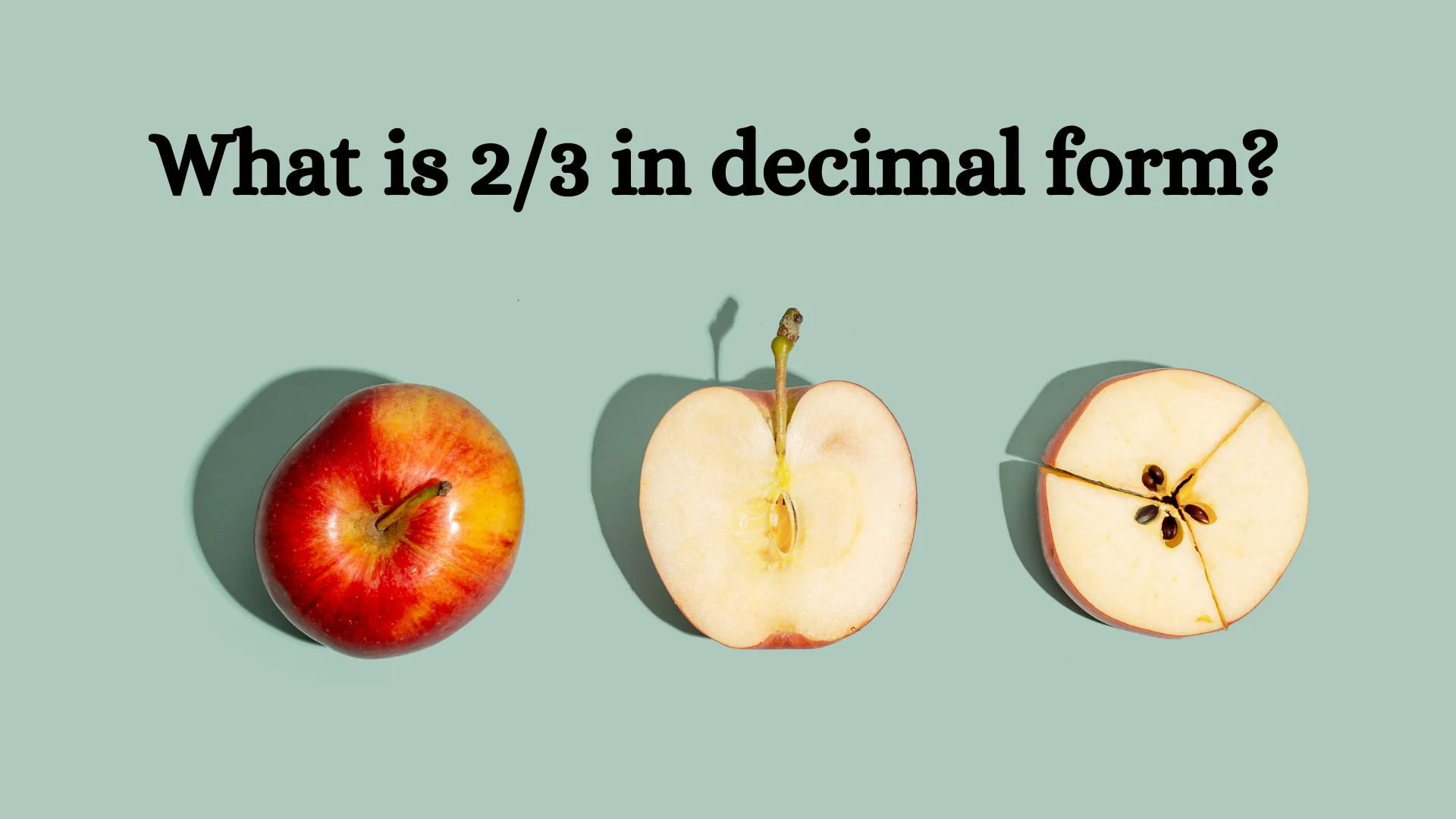
At its surface, the question “what is 2/3 as a decimal” appears to be a simple middle-school math problem. The answer is elementary: 0.666…, a repeating decimal that stretches into infinity. However, in the realm of technology, software engineering, and digital architecture, this simple fraction represents one of the most significant challenges in computational logic.
In a world driven by binary code, representing a value that never ends is not just a mathematical curiosity—it is a technical hurdle that impacts everything from the GPS in your smartphone to the high-frequency trading algorithms on Wall Street. To understand 2/3 as a decimal within a tech context, we must look beyond the digits and explore how hardware and software interpret, store, and manipulate fractional data.
The Mathematical Foundation and Digital Translation
To understand why 2/3 is a unique challenge for technology, we must first look at the translation layer between human-readable mathematics and machine-readable code. While humans use a base-10 (decimal) system, computers operate in base-2 (binary).
The Concept of Repeating Decimals in Binary
In base-10, 2/3 becomes 0.6 with a vinculum (a bar over the 6), signifying that it repeats forever. When we attempt to convert this into binary, we encounter a similar, yet more complex, phenomenon. Just as some fractions cannot be neatly terminated in decimal form (like 1/3 or 2/3), many fractions that can be terminated in decimal form (like 0.1) cannot be terminated in binary.
For a value like 2/3, the binary representation is an infinite sequence: 0.10101010… This means that a computer, which has finite memory and storage, can never truly “know” what 2/3 is. It can only ever know an approximation. This fundamental limitation is the starting point for modern software precision standards.
How Computers Process Fractions
Computers store numbers in “registers.” Whether it is a 32-bit or 64-bit system, there is a hard limit on how many digits can be recorded. When a developer types 2/3 into a script, the compiler or interpreter must decide how to truncate or round that infinite string of binary digits. This process of “quantization” turns a perfect mathematical concept into a “floating-point number,” a digital approximation that is “good enough” for most tasks but potentially dangerous for others.
Floating-Point Arithmetic and the Precision Problem
The most common way modern technology handles the decimal 0.66666666667 is through the IEEE 754 standard for floating-point arithmetic. This standard defines how numbers are packed into bits, balancing the need for a wide range of values with the need for precision.
The IEEE 754 Standard and Its Impact
Under the IEEE 754 standard, a number is divided into three parts: the sign bit, the exponent, and the fraction (or mantissa). When representing 2/3, the computer fills the mantissa with as many 1s and 0s as the architecture allows. In a 64-bit “double precision” format, this gives us about 15 to 17 significant decimal digits.
While 17 digits of 0.66666666666666667 might seem more than enough for everyday use, the “floating” nature of the point means that as the numbers involved in a calculation get larger or smaller, the gaps between representable numbers grow. This is why, in many programming languages, if you add several approximations of 2/3 together, the result might slightly deviate from the expected whole number.
The Rounding Error: Why 0.6666667 Matters
In software development, “Rounding Error” or “Propagation Error” is a persistent shadow. If a system rounds 2/3 to 0.6666667, and that value is then used as a base for an exponential calculation in a physics engine or a 3D rendering suite, the tiny error at the start can manifest as a massive glitch later.
In the tech industry, this is often referred to as “floating-point drift.” For example, in video game development, if a character’s position is calculated using imprecise decimals over a long period, the character might eventually “drift” through a solid wall or fall through the floor because the coordinate 2/3 was rounded differently at step one than it was at step one million.
Practical Applications in Software Development

Because of the inherent inaccuracy of representing 2/3 as a decimal, different sectors of the tech industry have developed specialized tools to handle the math.
High-Precision Libraries for Financial Tech
In Fintech (Financial Technology), a rounding error of 0.000000001 is unacceptable. If a banking app rounds 2/3 of a cent incorrectly across millions of transactions, it results in a discrepancy known as “salami slicing,” where fractional currency disappears or accumulates in error.
To solve this, developers use “Arbitrary-Precision” libraries or “Decimal” data types rather than standard floats. Languages like Python offer the decimal module, and Java provides BigDecimal. These tools do not store the number in binary format; instead, they store each digit as an integer, allowing the computer to represent 0.666… to any arbitrary length the programmer specifies, ensuring that financial balances remain exact.
Frontend Rendering vs. Backend Accuracy
There is also a distinction in tech between “display value” and “logic value.” A frontend developer building a dashboard might use CSS or JavaScript to truncate 2/3 to “66.7%” for the user interface. This is a design choice for readability. However, the backend database must retain the highest possible precision to ensure that when those numbers are pulled for further data analysis, the integrity of the data remains intact. This tension between human-friendly visuals and machine-accurate data is a cornerstone of modern full-stack architecture.
AI and Machine Learning: Interpreting Fractional Data
As we move into the era of Artificial Intelligence, the representation of fractions like 2/3 becomes even more critical. AI models, particularly Large Language Models (LLMs) and Neural Networks, rely on billions of “weights” and “biases”—which are essentially long decimal numbers.
Weights, Biases, and Fractional Normalization
During the training phase of an AI, data is often “normalized” to a range between 0 and 1. A value like 2/3 (0.666…) might represent a specific neuron’s activation strength. In this context, the precision of that decimal influences how the model learns. If the hardware uses “half-precision” (16-bit) to save on energy and processing power, the approximation of 2/3 becomes much coarser. This trade-off between “computational cost” and “decimal precision” is one of the most debated topics in AI hardware today.
The Role of Precision in Large Language Models
When you ask an AI a math question, it isn’t “calculating” in the way a calculator does; it is predicting the next token in a sequence. However, the underlying architecture (Transformers) relies heavily on matrix multiplications involving infinite decimals. Tech giants like NVIDIA and Google are constantly refining how their chips (GPUs and TPUs) handle these fractions to ensure that AI can perform complex reasoning without being tripped up by the digital limitations of 2/3.
Best Practices for Developers and Data Scientists
For those working within the tech ecosystem, handling the decimal version of 2/3 requires a strategic approach to data types and debugging.
Choosing the Right Data Types
The first rule of robust software engineering is choosing the data type that matches the mission.
- Integers: Use these whenever possible by scaling (e.g., store $2.00 as 200 cents).
- Floats: Use these for graphics, physics, and general science where speed is more important than perfect accuracy.
- Decimals/BigNumerics: Use these for money, accounting, and legal requirements.
By understanding that 2/3 is not a static number but a “floating” target, developers can prevent systemic bugs before they are ever compiled.
Debugging Precision-Related Bugs
In the world of Digital Security and software QA (Quality Assurance), testing for “Edge Cases” often involves fractions. A common exploit in older software involved forcing a calculation to result in a repeating decimal that would overflow a buffer or cause a “division by zero” error during a rounding flip. Modern developers use unit testing to ensure that when a system encounters 0.666…, it handles the remainder gracefully rather than crashing the thread.
Conclusion: The Infinite in the Finite
“What is 2/3 as a decimal?” is a question that reveals the beautiful friction between pure mathematics and the reality of silicon-based technology. To a student, it is 0.66… To a software engineer, it is a 64-bit floating-point challenge. To a Fintech architect, it is a potential liability that requires specialized libraries.
As technology continues to evolve—from the binary systems of today to the quantum computers of tomorrow—our ability to represent the infinite within the finite will continue to be a hallmark of digital progress. Understanding the nuances of this simple conversion is not just about getting the right answer; it is about building more stable, secure, and intelligent systems.
aViewFromTheCave is a participant in the Amazon Services LLC Associates Program, an affiliate advertising program designed to provide a means for sites to earn advertising fees by advertising and linking to Amazon.com. Amazon, the Amazon logo, AmazonSupply, and the AmazonSupply logo are trademarks of Amazon.com, Inc. or its affiliates. As an Amazon Associate we earn affiliate commissions from qualifying purchases.