
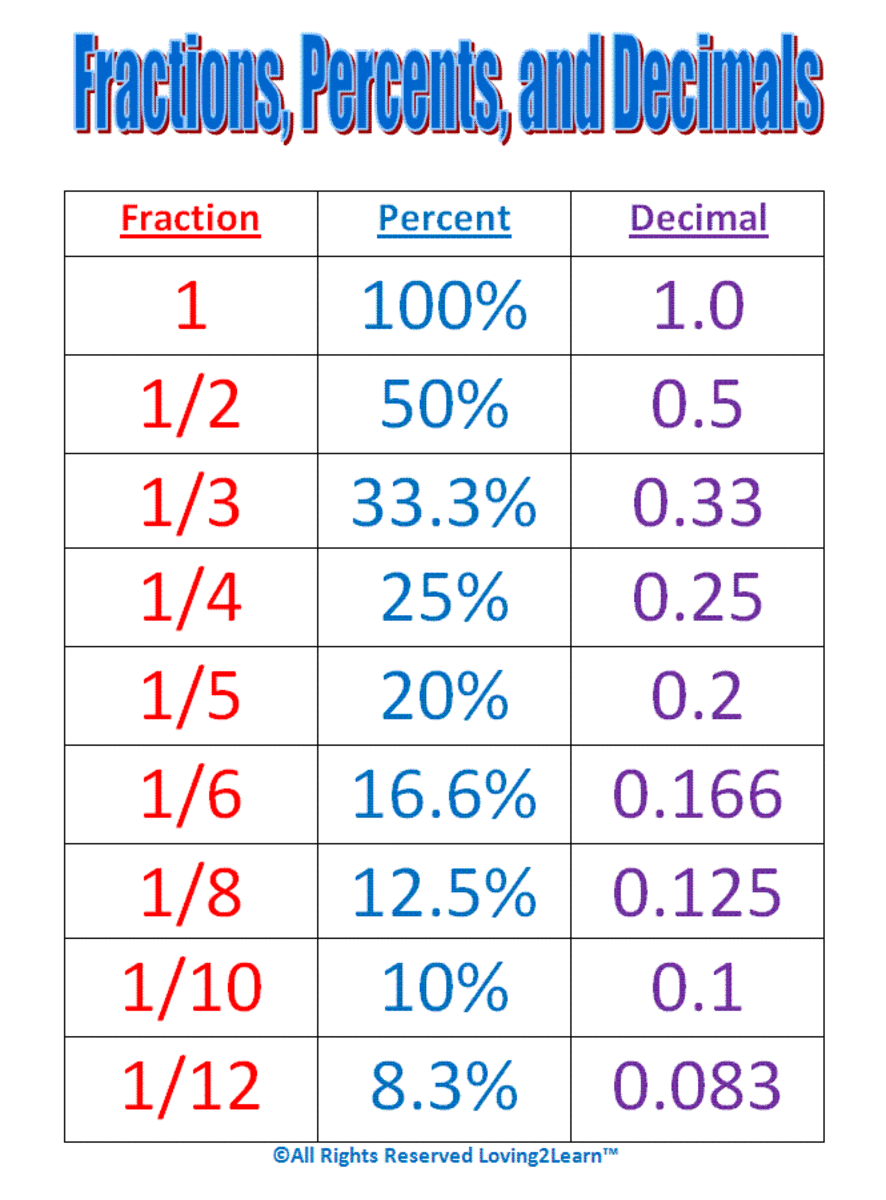
On the surface, the question “what is 1/3 as a decimal?” seems like a simple math problem from a fourth-grade textbook. The answer is elementary: 0.333…, with the three repeating infinitely. However, in the world of technology, software engineering, and digital architecture, this simple repeating decimal represents one of the most significant challenges in computational logic.
When we transition from abstract mathematics to the binary reality of computers, 1/3 is no longer just a fraction; it becomes a test of precision, a potential source of software bugs, and a fundamental hurdle in how AI and financial algorithms process data. Understanding how technology interprets 1/3 provides a fascinating look into the limitations of hardware and the ingenuity of software development.

The Mathematical Foundation: Why 1/3 is a “Problem” Decimal
In our standard base-10 (decimal) system, a fraction can only be expressed as a finite decimal if the prime factors of its denominator are 2 and 5. Because 3 is a prime number that does not divide evenly into 10, the fraction 1/3 results in an infinite repeating sequence.
Infinite Repetition and the Limit of Human Notation
To a human, writing “0.333…” or a 3 with a vinculum (a bar) over it signifies an exact value. We understand that the “3” never ends. However, computer memory is finite. Whether a system is running on a 64-bit processor or a high-end cloud server, it cannot store an “infinite” number of digits. Therefore, every time a computer interacts with 1/3, it must make a choice: where to stop?
Why Base-10 Struggles with Prime Factors
The struggle isn’t unique to the number three, but 1/3 is the most common encounter we have with “non-terminating” decimals. In the context of tech development, this introduces the concept of “representation error.” When we convert 1/3 into 0.3333333333333333, we have already lost a tiny fraction of the original value. While this might seem negligible, in large-scale data processing or complex simulations, these microscopic discrepancies compound, leading to what engineers call “drift.”
How Computers Handle the 1/3 Dilemma: Binary vs. Decimal
While humans use base-10, computers operate in base-2 (binary). This adds a second layer of complexity to the 1/3 problem. In binary, even some fractions that are simple in decimal—like 0.1—become repeating decimals. The fraction 1/3, being problematic in both base-10 and base-2, serves as the ultimate stress test for digital precision.
Floating-Point Arithmetic and the IEEE 754 Standard
Most modern software handles decimals using a method called “floating-point arithmetic,” specifically the IEEE 754 standard. Instead of storing the exact number, the computer stores a sign, an exponent, and a significand (or mantissa).
When you input 1/3 into a spreadsheet or a Python script, the machine converts it into a binary floating-point representation. Because it cannot store an infinite sequence of bits, it rounds the value. Typically, in “double precision” (64-bit), 1/3 is stored as approximately 0.333333333333333314829616256247390992939472198486328125. Notice how the digits eventually deviate from the expected “3.” This is the core of how technology manages the impossible nature of the infinite.
The Conversion Challenge: From Bits to Logic
The conversion from 1/3 to binary involves a process of repeated multiplication. Because 1/3 does not have a finite representation in binary, the computer must truncate the value. This truncation is the “ghost in the machine.” Software developers must constantly account for these tiny errors, ensuring that an operation like (1/3) * 3 actually returns 1.0 rather than 0.9999999999999999.
The Impact of Rounding Errors in Software Engineering
If you are building a simple calculator app, a small rounding error might not matter. But in the broader tech ecosystem—ranging from aerospace software to global financial exchanges—the decimal representation of 1/3 can have massive consequences.
Precision Loss in Financial Applications
In the world of Fintech (Financial Technology), rounding errors are a major liability. Imagine a banking software that must divide a single-interest payout among three equal shareholders. If the system rounds 1/3 down to 0.33, it loses 0.01 per share. Over millions of transactions, these “fractions of a cent” add up to significant sums—a phenomenon famously exploited in the “salami slicing” type of financial fraud, or more commonly, leading to accounting imbalances that take weeks to resolve.
To combat this, tech stacks in finance often avoid floating-point math entirely, opting for “Fixed-Point” arithmetic or specialized “Decimal” data types that store numbers as integers to maintain absolute precision.
Geometric Calculations and AI Modeling
In 3D rendering and CAD (Computer-Aided Design) software, 1/3 often appears in coordinate geometry and vector mathematics. If a software engine rounds 1/3 improperly, it can result in “z-fighting” (where two textures flicker because the computer can’t tell which is in front) or structural gaps in a 3D-printed model.
Similarly, in Artificial Intelligence and Machine Learning, weights in a neural network are often represented as floating-point numbers. While a single rounding error in the decimal representation of 1/3 won’t break an AI model, the cumulative effect of billions of such operations during the training of a Large Language Model (LLM) can impact the model’s convergence and ultimate accuracy.
Tools and Languages for High-Precision Fractions
As technology has evolved, developers have created specialized tools to bypass the limitations of standard decimal representation. If a project requires the absolute truth of 1/3, engineers move away from standard “float” and “double” types.
Arbitrary-Precision Libraries (BigDecimal and More)
Many programming languages offer libraries designed for “arbitrary-precision arithmetic.” In Java, the BigDecimal class allows developers to specify exactly how many decimal places to track and how to handle rounding. In Python, the decimal and fractions modules are the gold standard.
Using the fractions module, a developer can store 1/3 as an actual fraction object: Fraction(1, 3). This tells the computer to keep the number as a ratio of two integers rather than converting it to a messy decimal. This approach maintains perfect precision throughout all intermediate calculations, only converting to a decimal at the very last moment for human readability.
Symbolism vs. Computation: The Role of AI in Mathematical Logic
Modern AI tools and symbolic math engines (like Wolfram Alpha or SymPy) treat “1/3” differently than a standard calculator. Instead of seeing it as 0.333333, they see it as a symbolic entity.
This is a major trend in AI development: moving from purely numerical processing to symbolic reasoning. By treating 1/3 as a symbol, the software can perform algebraic manipulations—such as canceling out the 3 in (1/3) * 3—without ever dealing with the messy, infinite decimal. This leap in “computational intelligence” allows for more robust engineering simulations and scientific research.
Conclusion: The Digital Future of a Simple Fraction
The question “what is 1/3 as a decimal?” serves as a bridge between the perfect world of mathematics and the imperfect world of technology. While the simple answer is 0.333…, the technological reality is a complex dance of binary approximations, floating-point standards, and high-precision libraries.
As we move toward an era of quantum computing and more sophisticated AI, the way we handle these “infinite” numbers will continue to evolve. For now, the humble 1/3 remains a powerful reminder for developers and tech enthusiasts alike: in the digital realm, even the simplest fraction requires intentional design, precise logic, and an understanding of the limits of our machines. Whether you are coding a smart contract, designing a satellite’s navigation system, or simply balancing a digital ledger, the way you handle 0.333… can be the difference between a flawless system and a catastrophic glitch.
aViewFromTheCave is a participant in the Amazon Services LLC Associates Program, an affiliate advertising program designed to provide a means for sites to earn advertising fees by advertising and linking to Amazon.com. Amazon, the Amazon logo, AmazonSupply, and the AmazonSupply logo are trademarks of Amazon.com, Inc. or its affiliates. As an Amazon Associate we earn affiliate commissions from qualifying purchases.