
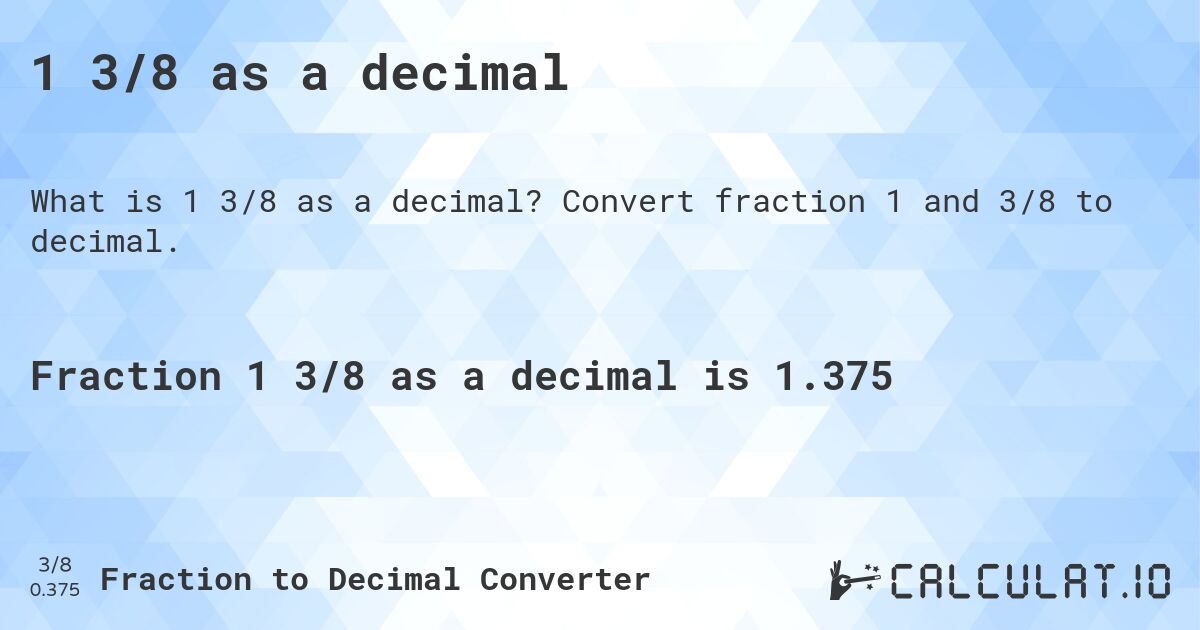
In the world of finance, precision is more than just a mathematical requirement; it is the bedrock of wealth preservation and growth. When we ask the question, “What is 1 3/8 in decimal form?” the immediate mathematical answer is 1.375. However, in the context of personal finance, investing, and business management, that small string of digits represents a critical data point that can influence everything from mortgage interest rates to dividend yields and stock market valuations.
Converting fractions to decimals is a fundamental skill for any savvy investor or business professional. While digital tools often handle these conversions for us, understanding the underlying mechanics—and the financial implications of these figures—is essential for making informed decisions.
Understanding the Conversion: From Fractions to Financial Decimals
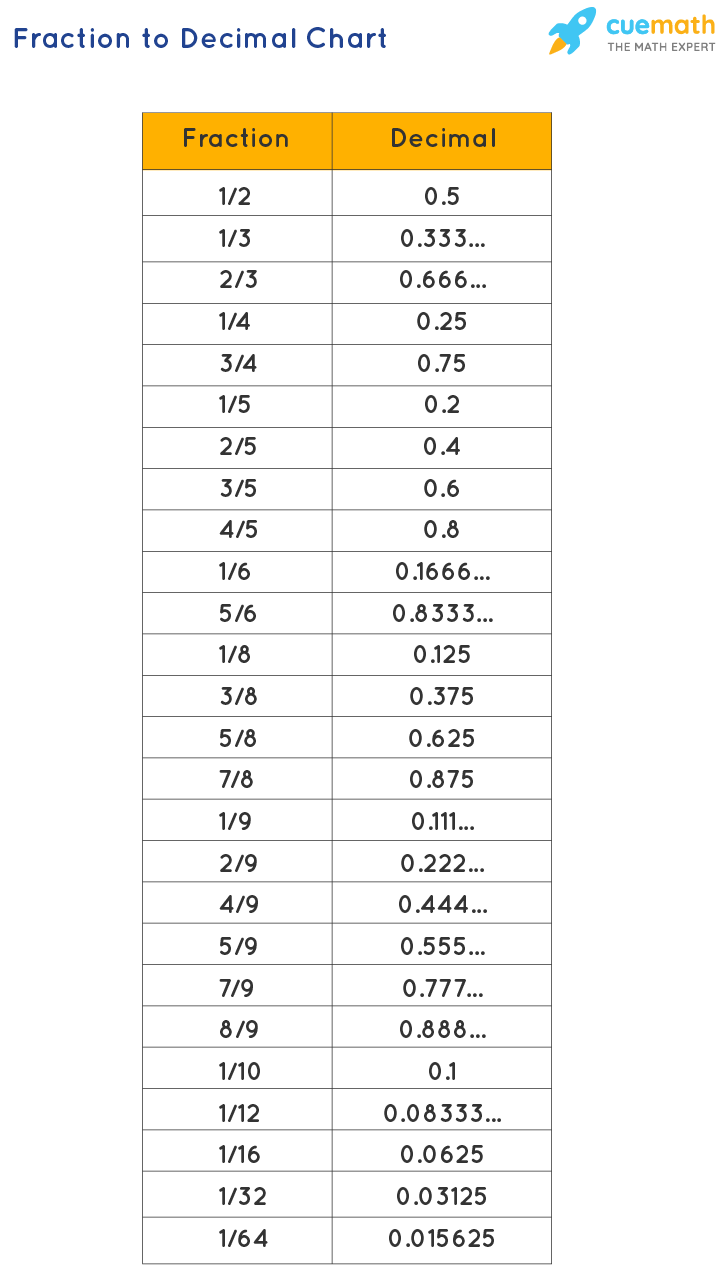
To understand 1 3/8 as a decimal, we must first break down the mixed number. A mixed number consists of a whole number and a proper fraction. In this case, “1” is the whole number, and “3/8” is the fraction. To convert the fraction 3/8 into a decimal, you divide the numerator (3) by the denominator (8).
The Calculation Breakdown
Performing the division $3 div 8$ yields 0.375. When you add this to the whole number 1, you arrive at the final decimal form: 1.375. While this might seem like a simple classroom exercise, this specific value—1.375—frequently appears in financial contexts, often represented as a percentage (1.375%) or a multiple in valuation models.
Why Precision Matters in Personal Finance
In the realm of money, rounding errors are the enemies of compounding interest. If a financial institution were to round 1.375% down to 1.3% or up to 1.4% on a multi-million dollar loan portfolio, the resulting discrepancy could amount to tens of thousands of dollars over time. For the individual investor, being able to parse these numbers ensures that you are comparing “apples to apples” when looking at different financial products. Whether you are evaluating a high-yield savings account or calculating the expense ratio of an index fund, the ability to see the decimal reality behind the fractional representation is a vital part of financial literacy.
1 3/8 in the Context of Interest Rates and Lending
One of the most common places you will encounter the fraction 1 3/8 is in the world of debt and lending. Interest rates on mortgages, auto loans, and corporate bonds are often quoted in increments of an eighth of a percent.
Mortgage Rates and Points
When shopping for a mortgage, a lender might quote a rate change in terms of “basis points.” One basis point is equal to 0.01%. Therefore, a rate of 1 3/8% is equivalent to 137.5 basis points. If a borrower is looking at a fluctuating rate that moves from 1.25% (1 1/4%) to 1.375% (1 3/8%), the difference might seem negligible. However, on a $500,000 mortgage over 30 years, that 0.125% difference results in thousands of dollars in additional interest paid over the life of the loan.
Understanding that 1 3/8 translates precisely to 1.375 allows a borrower to use financial calculators more effectively, ensuring they are looking at the exact cost of their debt rather than a rounded estimate.
The Impact of Small Percentages on Long-Term Debt
For business owners managing lines of credit or “side hustlers” utilizing credit cards for inventory financing, these fractional percentages are equally significant. In a corporate finance setting, the cost of capital is calculated to several decimal places. A shift in the federal funds rate by an eighth of a percentage point (0.125) can trigger massive movements in the bond market. By recognizing 1 3/8 as 1.375, investors can better align their portfolios with the macroeconomic environment, adjusting their risk tolerance as borrowing costs fluctuate by these precise increments.
Investment Mathematics: Trading and Yields

Historically, the stock market operated almost entirely on fractions. Shares were traded in sixteenths, eighths, and quarters—a legacy of the Spanish “pieces of eight” system. While the markets transitioned to decimalization in the early 2000s to improve liquidity and narrow spreads, the conceptual use of fractions like 1 3/8 still persists in certain analytical frameworks and dividend calculations.
Fractional Pricing in Historical Context
Before decimalization, a stock might be quoted at 1 3/8 dollars per share, meaning $1.375. This system was often criticized for making it harder for retail investors to see the true cost of their trades. Today, the transparency of 1.375 allows for high-frequency trading and algorithmic precision. However, understanding the fractional roots of these numbers helps investors appreciate the narrowing of “bid-ask spreads.” When spreads move from a fraction like 1/8 (0.125) to a single cent (0.01), the “cost” of entering a trade for the average person decreases significantly, directly impacting the profitability of short-term trading strategies.
Modern Yield Calculations and Dividend Ratios
When analyzing a company’s dividend yield, you might find that a payout of $1.375 per share on a stock priced at $100 yields exactly 1.375%. For an income-focused investor, this decimal is a key metric. It is used to calculate the “Yield on Cost” and to project future cash flows.
If you are reinvesting dividends (DRIP), the precision of the decimal becomes even more paramount. Most brokerage platforms allow for fractional share ownership. If your dividend of $1.375 is automatically reinvested into a stock trading at $10, you would acquire 0.1375 shares. Over years of compounding, these three decimal places (0.375) contribute to the exponential growth of an investment portfolio. Ignoring the “3/8” or “0.375” would result in a significant underestimation of one’s long-term wealth potential.
Tools for Financial Calculation and Management
In the modern era, the conversion of 1 3/8 to 1.375 is usually handled by software. However, the “garbage in, garbage out” rule of computing means that a user must know which format to input to get the desired result.
Leveraging Digital Spreadsheets
For anyone managing a business budget or a personal investment tracker, Excel and Google Sheets are indispensable. These programs generally default to decimal inputs. If you are trying to calculate the growth of a $10,000 investment at a 1 3/8% interest rate, you cannot simply type “1 3/8” into a standard formula. You must input “0.01375” (the decimal form of the percentage).
Mastering the conversion allows you to build more complex financial models. For instance, if you are calculating the “Internal Rate of Return” (IRR) for a side hustle, your ability to toggle between fractional growth estimates and decimal-based formulas is what will give you a professional-grade understanding of your business’s health.
Fintech Apps and Real-Time Conversions
The rise of Fintech has brought powerful calculation tools to our smartphones. Apps designed for real estate investors, for example, often require the input of mortgage rates or cap rates in decimal form. If you are evaluating a property and the local bank offers a rate of 1 3/8 over the prime rate, you need to quickly identify that as an additional 1.375%. Being fluent in these conversions allows for faster decision-making in competitive markets, where the time taken to search for a conversion table might mean the difference between a successful bid and a missed opportunity.
Mastering Decimal Fluency for Better Wealth Management
Ultimately, the question “What is 1 3/8 in decimal form?” serves as a gateway into the broader world of financial numeracy. Money is a game of numbers, and those who speak the language of decimals fluently are better equipped to win.
Refining your understanding from 1 3/8 to 1.375 is about more than just a math problem; it’s about adopting a mindset of accuracy. In personal finance, this accuracy manifests in better budgeting, more precise investment tracking, and a deeper understanding of how interest works against you in debt or for you in savings.
As you navigate your financial journey—whether that involves scaling a corporate career, building a brand, or managing a diverse investment portfolio—remember that every decimal point matters. The difference between 1.3 and 1.375 might look small on paper, but in the world of compound interest and global markets, it is a margin that defines the savvy investor. By mastering these small conversions, you gain a clearer view of your financial landscape, allowing you to move with confidence toward your long-term wealth goals.
aViewFromTheCave is a participant in the Amazon Services LLC Associates Program, an affiliate advertising program designed to provide a means for sites to earn advertising fees by advertising and linking to Amazon.com. Amazon, the Amazon logo, AmazonSupply, and the AmazonSupply logo are trademarks of Amazon.com, Inc. or its affiliates. As an Amazon Associate we earn affiliate commissions from qualifying purchases.