
The symbol “0 with a line through it,” often rendered as $emptyset$ or $varnothing$, might appear innocuous at first glance. However, within the intricate world of technology, this humble character carries significant weight and a surprisingly diverse range of meanings. Far from being a mere typographical curiosity, it serves as a crucial identifier, a logical operator, and a fundamental concept in fields ranging from programming and data structures to network protocols and digital security. Understanding its various applications is not just about deciphering symbols; it’s about grasping core technological principles that underpin the digital landscape we navigate daily.
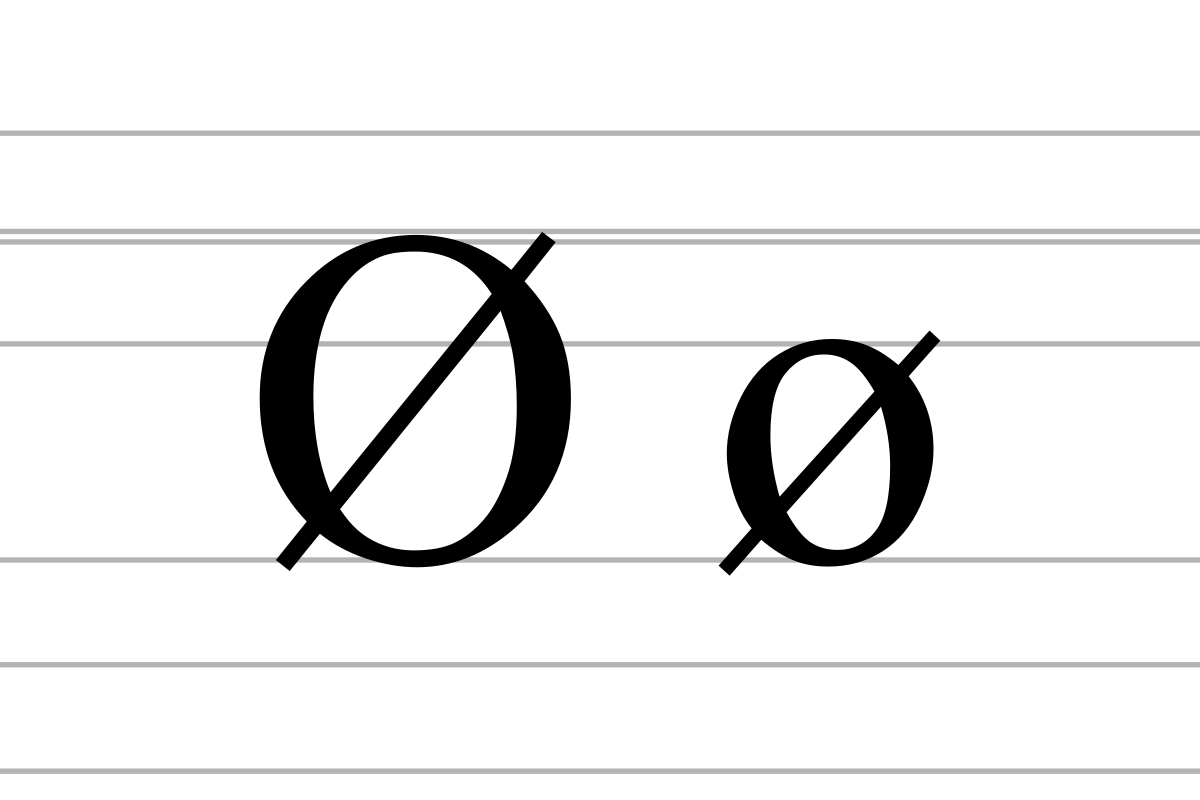
This exploration will delve into the multifaceted roles of the “0 with a line through it” within the technological domain. We will unravel its origins and historical context, dissect its application in programming languages and data representation, and examine its vital function in network communication and security protocols. By the end, the seemingly simple symbol will reveal itself as a powerful and indispensable tool in the technologist’s arsenal.
The Genesis and Evolution of the Ø Symbol
While the precise origin of the “0 with a line through it” is a subject of some historical debate, its presence in modern scientific and technical notation is undeniable. The symbol’s distinctiveness makes it ideal for representing concepts that are either absent, empty, or uniquely defined. Its adoption in various technical fields has been driven by a need for clear and unambiguous representation.
Mathematical and Set Theory Roots
The most prominent and foundational usage of the $emptyset$ symbol lies in mathematics, specifically within set theory. Here, it represents the empty set, a set containing no elements. This concept is fundamental to logic and abstract algebra, forming the basis for many computational theories. For instance, when we consider the solution set to an equation like $x^2 + 1 = 0$ within the real numbers, the empty set is the correct answer, as no real number squared can equal -1. In computer science, the concept of an empty set directly translates to the absence of data, an empty list, or an uninitialized variable. This mathematical foundation is the bedrock upon which many of its technological applications are built.
Linguistic and Pronunciation Considerations
Beyond its mathematical meaning, the symbol $emptyset$ also appears in certain languages, most notably in Scandinavian languages like Danish and Norwegian, where it represents a specific vowel sound, similar to the ‘u’ in “fur” or the ‘i’ in “bird.” While this linguistic origin might seem disparate from technology, it highlights the symbol’s inherent visual distinctiveness. This visual clarity makes it suitable for use in contexts where a unique identifier is required, preventing confusion with standard alphanumeric characters. In technical jargon, this often translates to avoiding ambiguity in code, commands, or configuration files.
Applications in Programming and Data Structures
Within the realm of software development and data management, the “0 with a line through it” plays several critical roles, primarily centered around representing emptiness, nullity, or undefined states. This is crucial for ensuring that programs behave predictably and that data is handled accurately.
Representing Null and Undefined Values
In many programming languages, the concept of a variable that holds no value, or a pointer that points to nowhere, is essential. The $emptyset$ symbol, or a closely related representation, is often used conceptually or even literally to signify these states. For instance, in languages that support nullable types, a variable might be declared to hold an integer or be null. When it’s null, it can be thought of as containing the empty set of values. This prevents programs from attempting to access or manipulate non-existent data, thereby averting crashes and logical errors.
- Null Pointers: A null pointer is a pointer that does not point to any valid memory address. In C and C++, this is often represented by
NULL, which is conceptually equivalent to the empty set of memory locations. Attempting to dereference a null pointer leads to undefined behavior or a segmentation fault. - Optional Types: Modern programming languages often employ “optional” types (e.g.,
Optional<T>in Java,Option<T>in Rust). These explicitly indicate that a value may or may not be present. An instance of an optional type that does not contain a value is analogous to the empty set, clearly communicating the absence of data. - Empty Collections: When dealing with data structures like lists, arrays, or dictionaries, an empty collection is one that contains no elements. This is a direct manifestation of the empty set concept. Programmers must handle empty collections gracefully to avoid errors when iterating or accessing elements that do not exist.
The Empty String and Its Significance
Another crucial application of the “0 with a line through it” concept in programming is the representation of the empty string. An empty string is a sequence of characters with zero length. While it’s not always represented by the $emptyset$ symbol itself, the underlying principle of “nothingness” is the same.
- String Comparisons: In programming, comparing a string to an empty string is a common operation. For example, checking if a user’s input field is empty before submitting a form.
- Text Processing: Many text processing algorithms and functions operate on strings. The empty string is a valid input and can have specific behavioral implications. For instance, concatenating any string with an empty string results in the original string.
- Initialization: Often, when initializing string variables, they are set to an empty string by default, signifying that no text has been assigned yet.

Abstract Data Types and Operations
In the design of abstract data types (ADTs) and their operations, the concept of emptiness is fundamental. For example, a queue or a stack can be empty. Operations that attempt to remove an element from an empty data structure will typically result in an error or return a special value signifying absence, which aligns with the concept of the empty set.
Network Communication and Security Implications
Beyond individual software components, the “0 with a line through it” also finds its way into the robust world of network protocols and digital security, often representing a lack of connection, an unassigned state, or a denial of access.
Network Addresses and Unassigned IPs
In network configurations, addresses that are not assigned or are reserved for special purposes can be conceptually linked to the empty set. While the $emptyset$ symbol isn’t typically used directly as an IP address, the idea of an unassigned or invalid address plays a similar role in network management and security.
- Loopback Addresses: While
127.0.0.1is the standard loopback address, there are discussions and historical contexts where unassigned or intentionally non-routable IP address ranges exist. The absence of a valid assigned IP can be thought of as an “empty” address. - DHCP and Unassigned Leases: When a device requests an IP address via DHCP and no available address can be assigned, it’s effectively an “empty” lease. This state needs to be managed by the DHCP server.
The “Null Route” in Routing Protocols
In the context of internet routing, a null route is a special route that discards all traffic destined for a particular network. This is often used as a security measure to “blackhole” unwanted traffic or to prevent routing loops. Conceptually, a null route signifies that traffic destined for a specific IP range should be sent to an “empty” destination – effectively disappearing.
- Denial of Service (DoS) Mitigation: When a network is under a DoS attack, administrators might implement null routes for the attacking IP addresses or networks to prevent malicious traffic from reaching their servers.
- Route Filtering: Null routes can also be used for route filtering, where specific routes are intentionally dropped to prevent them from being propagated through the network.
Cryptography and Zero-Knowledge Proofs
In advanced cryptographic concepts like zero-knowledge proofs, the idea of proving something without revealing specific information is paramount. While not directly using the $emptyset$ symbol, the underlying principle of demonstrating knowledge of a value (or its absence) without exposing the value itself can be conceptually related to handling an “empty” or unrevealed state. The formalisms used in constructing these proofs often rely on concepts of set theory and logical emptiness.
Access Control and Denied Permissions
In access control systems, a user or process might be denied permission to access a resource. This denial can be seen as a state of “emptiness” of access rights. While not explicitly denoted by $emptyset$, the system is operating under a principle where the requested access is not permitted, akin to trying to retrieve an element from an empty set of allowed operations.

Conclusion: The Pervasive Influence of the “Empty” Concept in Technology
The symbol “0 with a line through it,” $emptyset$, or its conceptual equivalent, permeates the technological landscape in ways that are both profound and practical. From its origins in abstract mathematics, representing the fundamental concept of emptiness, it has evolved into an indispensable tool for expressing nullity, absence, and non-existence in programming languages, data structures, and network protocols.
Understanding the various interpretations of this symbol, or the principles it embodies, is crucial for any technologist. It allows for more robust software development, clearer data management, and more secure network operations. Whether it’s the empty set in set theory, a null pointer in C++, an empty string in Python, or a null route in networking, the idea of “nothingness” or “absence” is a powerful and necessary construct. The $emptyset$ symbol, in its diverse manifestations, serves as a constant reminder that in the digital realm, defining what isn’t can be just as important as defining what is. Its enduring presence underscores the elegance and precision required in building the complex systems that power our modern world, proving that even the simplest-looking symbols can hold immense technical significance.
aViewFromTheCave is a participant in the Amazon Services LLC Associates Program, an affiliate advertising program designed to provide a means for sites to earn advertising fees by advertising and linking to Amazon.com. Amazon, the Amazon logo, AmazonSupply, and the AmazonSupply logo are trademarks of Amazon.com, Inc. or its affiliates. As an Amazon Associate we earn affiliate commissions from qualifying purchases.