
Interest rates are the unseen currents that steer the vast ship of the global economy, influencing everything from the cost of your morning coffee to the stability of nations. For individuals, businesses, and governments alike, understanding “what interest rate” truly means and how it functions is not just financial literacy; it’s a cornerstone of sound decision-making. Far from being a dry, technical concept, interest rates are dynamic, impactful, and deeply personal. They determine the cost of borrowing money, the return on your savings, the profitability of investments, and even the pace of economic growth.
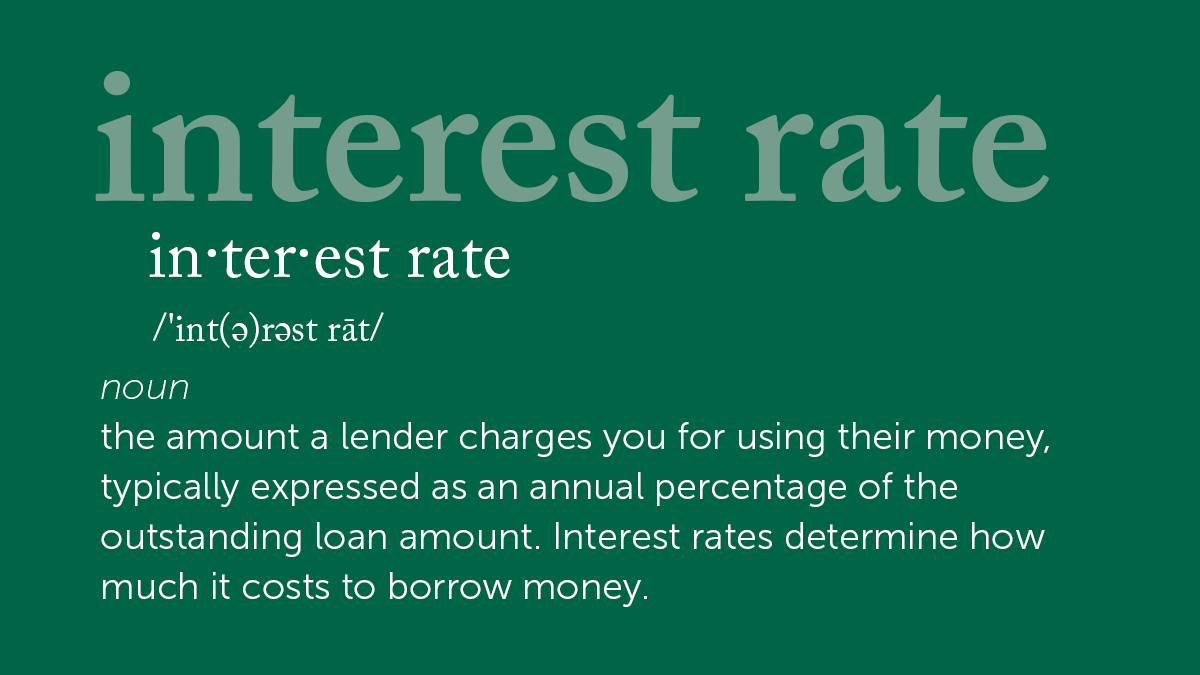
In its simplest form, an interest rate is the charge for borrowing money, expressed as a percentage of the principal. Conversely, it’s also the compensation for lending money. But this seemingly straightforward definition masks a complex interplay of economic forces, policy decisions, and individual circumstances. Navigating the world of finance without a grasp of interest rates is akin to sailing without a compass – you might move, but you won’t know where you’re going or what challenges lie ahead. This article will demystify interest rates, exploring their fundamental nature, their profound impact on personal finances and the broader economy, the myriad factors that drive their fluctuations, and practical strategies for making informed financial choices in a constantly evolving rate environment.
The Fundamentals of Interest Rates: Defining the Core Concept
Before diving into the intricate implications of interest rates, it’s crucial to establish a clear understanding of what they are and the various forms they take. This foundational knowledge empowers individuals to interpret financial news, evaluate loan offers, and strategize their savings.
What Exactly is an Interest Rate?
At its heart, an interest rate represents the price of money over time. When you borrow money, the lender takes a risk that you might not repay it, and they also forgo the opportunity to use that money themselves during the loan term. The interest rate is the compensation for this risk and opportunity cost. For savers, the interest rate is the reward for deferring consumption and allowing a financial institution to use their money. This percentage is typically expressed on an annual basis. For example, a 5% interest rate on a $1,000 loan means you’ll owe $50 in interest for that year, in addition to the principal repayment.
The concept is ubiquitous. It applies to consumer loans like mortgages, car loans, and credit cards; to business loans for expansion and operations; and to government bonds issued to fund public spending. Even short-term borrowing between banks in the interbank market operates on specific interest rates, reflecting the core principle of valuing money over time.
Types of Interest Rates: Fixed vs. Variable
Not all interest rates are created equal. One of the most significant distinctions lies between fixed and variable rates, each carrying its own set of advantages and risks.
Fixed Interest Rates
A fixed interest rate remains constant throughout the entire term of the loan or investment. This predictability is its primary appeal. For borrowers, a fixed-rate mortgage means their monthly principal and interest payment will not change, providing stability and simplifying budgeting, even if market rates rise. For investors, a fixed-rate bond or certificate of deposit (CD) guarantees a steady return for a defined period, offering security against falling market rates. While fixed rates offer certainty, borrowers might miss out if market rates fall significantly, and investors might earn less if market rates rise.
Variable (or Adjustable) Interest Rates
A variable interest rate, also known as an adjustable-rate, can change over the life of the loan or investment. These rates are typically tied to a benchmark interest rate, such as the prime rate or the London Interbank Offered Rate (LIBOR, soon to be replaced by SOFR in many contexts), plus a margin. For borrowers, variable rates often start lower than fixed rates, making them attractive initially. However, their payments can increase if the benchmark rate rises, introducing uncertainty and potential financial strain. For savers, variable-rate savings accounts offer flexibility, with returns increasing when market rates go up, but they also decline when rates fall. Understanding the benchmark and adjustment frequency is critical for anyone considering a variable-rate product.
Annual Percentage Rate (APR) vs. Annual Percentage Yield (APY)
When comparing different financial products, especially loans and savings accounts, two terms frequently appear: APR and APY. While both represent annual rates, they serve different purposes and account for compounding differently.
Annual Percentage Rate (APR)
APR is primarily used for loans and credit products. It represents the total annual cost of borrowing money, including not only the interest rate but also any additional fees or charges associated with the loan (like origination fees, discount points, or mortgage insurance premiums). The APR provides a more comprehensive picture of the true cost of a loan than the nominal interest rate alone, making it a better metric for comparing different loan offers. However, it’s important to note that APR calculations often assume simple interest (no compounding during the year) for comparison purposes.
Annual Percentage Yield (APY)
APY is primarily used for savings accounts, certificates of deposit (CDs), and other interest-bearing investments. It represents the total annual return on an investment, taking into account the effect of compounding interest. Compounding means that interest earned is added to the principal, and then the next interest calculation is based on the new, larger principal. Because APY factors in compounding, it will almost always be higher than the nominal interest rate or APR for savings products. APY is the most accurate way to compare the earning potential of different savings or investment accounts over a year.
How Interest Rates Impact Your Personal Finances
The implications of interest rates extend far beyond abstract economic theories, directly touching the financial well-being of every individual. Whether you’re borrowing to buy a home, saving for retirement, or managing daily expenses, interest rates play a pivotal role in shaping your financial landscape.
Borrowing: Mortgages, Loans, and Credit Cards
The most immediate and often significant impact of interest rates for many individuals is on the cost of borrowing.
Mortgages
For most people, a home is the largest purchase they will ever make, financed through a mortgage. Even a small change in mortgage interest rates can translate into thousands of dollars over the life of a loan. When rates are low, monthly payments are more affordable, increasing purchasing power and stimulating the housing market. Conversely, high rates make homeownership more expensive, potentially cooling demand. For existing homeowners with variable-rate mortgages or those looking to refinance, rate fluctuations directly affect their monthly budget.
Auto Loans and Personal Loans
Similar to mortgages, interest rates dictate the cost of financing vehicles and other significant personal expenditures. Lower rates make new cars or unexpected expenses more accessible, while higher rates can make these purchases more burdensome or even out of reach. The repayment term also interacts with the interest rate; longer terms may have lower monthly payments but accumulate more interest over time, especially with higher rates.
Credit Cards
Credit cards typically carry some of the highest interest rates, and these rates are often variable. Carrying a balance on a credit card can quickly lead to substantial interest charges, making debt repayment challenging. Understanding your credit card’s APR and minimizing interest accrual through prompt payments is crucial for healthy personal finance. Changes in the prime rate, to which most credit card rates are tied, directly affect the cost of credit card debt.
Saving and Investing: Savings Accounts, Bonds, and CDs
While borrowers might dread high interest rates, savers and investors often welcome them. Interest rates dictate the return on various financial products designed to grow your wealth.
Savings Accounts and Money Market Accounts
These foundational banking products offer modest interest rates. When interest rates are low, the return on savings is minimal, potentially making it harder for your money to keep pace with inflation. When rates rise, these accounts become more attractive for parking emergency funds or short-term savings, offering a safer way to earn a return.
Certificates of Deposit (CDs)
CDs offer a fixed interest rate for a specific term, ranging from a few months to several years. They are generally considered low-risk investments. When interest rates are high, CDs become a popular choice for locking in guaranteed returns for a set period. However, if rates continue to rise after you’ve locked in a CD, you might miss out on better opportunities until your CD matures.
Bonds
Bonds are essentially loans made to governments or corporations, which pay back the principal along with regular interest payments (coupons). Bond prices and interest rates have an inverse relationship: when interest rates rise, newly issued bonds offer higher yields, making existing bonds with lower yields less attractive and causing their market price to fall. For investors seeking income, high interest rates can make bonds an appealing part of a diversified portfolio, but they also introduce market risk for those holding existing bonds.
Debt Management Strategies
A keen awareness of interest rates is vital for effective debt management.
In a high-interest-rate environment, prioritizing the repayment of high-interest debt, such as credit card balances, becomes even more critical to minimize the total amount paid. Conversely, when rates are low, opportunities for refinancing existing high-interest loans (like mortgages or student loans) into lower-rate products can significantly reduce monthly payments and overall interest costs, freeing up cash flow for other financial goals. Understanding the fixed vs. variable nature of your debt also guides decisions; refinancing a variable-rate loan to a fixed rate might offer stability, especially if future rate hikes are anticipated.
Interest Rates and the Broader Economy
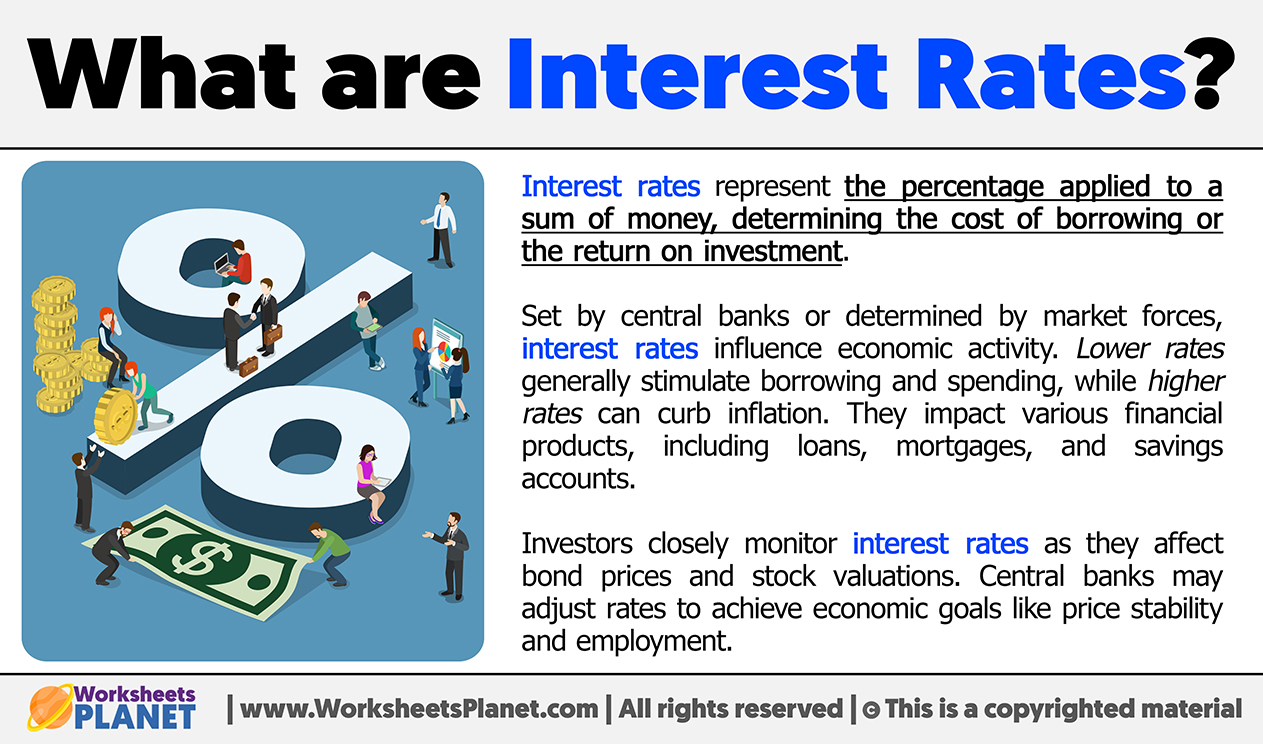
Beyond individual wallets, interest rates serve as powerful levers that influence the overall health and direction of national and global economies. They are a primary tool for central banks to manage inflation, stimulate growth, or curb overheating.
Monetary Policy and Central Banks
Central banks, such as the Federal Reserve in the U.S. or the European Central Bank (ECB), are the primary architects of monetary policy, and interest rates are their most prominent instrument.
Controlling Inflation
When an economy is growing too rapidly, demand outstrips supply, leading to rising prices (inflation). To cool down the economy and bring inflation under control, central banks raise their benchmark interest rates (e.g., the federal funds rate). This makes borrowing more expensive for banks, which in turn pass on higher rates to consumers and businesses. Higher borrowing costs reduce spending, slow down investment, and dampen overall economic activity, thereby reducing inflationary pressures.
Stimulating Economic Growth
Conversely, during economic downturns or recessions, central banks lower interest rates. This makes borrowing cheaper, encouraging businesses to invest in new projects and expand operations, and prompting consumers to spend more (e.g., on homes, cars, and other goods). Lower rates reduce the cost of capital, making it more attractive for companies to hire and innovate, which stimulates job creation and economic growth.
Inflation and Deflation
Interest rates are deeply intertwined with inflation and its opposite, deflation.
High inflation erodes the purchasing power of money over time. Lenders, aware of this, will demand higher nominal interest rates to ensure that the real return on their loans (after accounting for inflation) remains positive. If nominal interest rates are lower than inflation, lenders are effectively losing money. For savers, low interest rates combined with high inflation mean their savings are losing value in real terms.
Deflation, a sustained decrease in the general price level, can be equally problematic. During deflationary periods, consumers and businesses delay spending, anticipating further price drops. Central banks often respond by cutting interest rates to ultra-low levels, even negative rates in some cases, to try and stimulate borrowing and spending, and to avoid a deflationary spiral.
Economic Growth and Recession
The relationship between interest rates and economic growth is cyclical.
Low Interest Rates: Generally foster economic growth by making capital cheaper, which encourages investment in businesses, innovation, and consumer spending. This can lead to increased employment and higher incomes.
High Interest Rates: Can curb excessive growth, prevent inflation from spiraling out of control, and reduce asset bubbles. However, if rates rise too quickly or too high, they can slow the economy too much, potentially leading to a recession as borrowing costs stifle investment and consumption.
The careful balancing act performed by central banks in setting interest rates is critical to maintaining a stable and growing economy, avoiding both overheating and stagnation.
Factors That Influence Interest Rates
Interest rates are not static; they are in constant flux, shaped by a complex interplay of domestic and international forces. Understanding these influencing factors provides insight into market movements and helps predict future trends.
Central Bank Policies
As discussed, central banks are arguably the most influential players in setting the direction of interest rates. Their decisions on benchmark rates ripple through the entire financial system.
For example, the Federal Reserve’s Federal Funds Rate influences all other short-term rates, from interbank lending to consumer credit cards. When the Fed raises or lowers this rate, commercial banks adjust their prime rate, which serves as a base for many consumer and business loans. These policy decisions are driven by the central bank’s mandates, typically price stability (controlling inflation) and maximum sustainable employment.
Inflation Expectations
Expectations about future inflation play a significant role in determining current interest rates. If lenders anticipate higher inflation in the future, they will demand higher interest rates today to compensate for the erosion of their money’s purchasing power. Conversely, if deflation is expected, rates might fall. Financial markets constantly price in these expectations, influencing bond yields and other long-term rates.
Supply and Demand for Credit
Like any commodity, the price of money (interest rate) is influenced by its supply and demand.
Demand for Credit: When businesses are expanding and consumers are confident, the demand for loans (credit) increases, which can push interest rates up, assuming the supply remains constant. Conversely, during economic slowdowns, demand for credit falls, which can put downward pressure on rates.
Supply of Credit: The supply of available money for lending comes from savers (individuals, institutions) and central bank policies (e.g., quantitative easing, which increases the money supply). A greater supply of money relative to demand tends to lower interest rates, while a tighter supply pushes them higher.
Economic Outlook and Geopolitical Events
The overall health and stability of the economy, both domestically and globally, heavily influence interest rates.
Strong Economic Growth: Often leads to higher interest rates as demand for capital increases and inflationary pressures build.
Economic Uncertainty/Recession: Typically results in lower interest rates as central banks try to stimulate activity, and investors seek safe havens, pushing down bond yields.
Geopolitical Events: Wars, trade disputes, political instability, and major global crises can inject uncertainty into markets, prompting investors to seek safety in government bonds, which can temporarily push down their yields. Conversely, perceived risks in a country can lead to investors demanding higher interest rates to lend money to that country.
Navigating Interest Rate Changes and Making Informed Decisions
Interest rates are dynamic, and understanding their movements is key to making astute financial decisions. Proactive planning, rather than reactive responses, can help individuals and businesses optimize their financial positions regardless of the rate environment.
Strategies for Borrowers in Rising Rate Environments
When interest rates are on an upward trend, borrowers face increased costs. Strategic action can mitigate the impact.
- Prioritize High-Interest Debt: Focus on paying down credit card balances and other variable-rate loans with the highest interest rates first. This minimizes the impact of rising rates on your overall debt burden.
- Refinance Variable to Fixed: If you have an adjustable-rate mortgage (ARM) or other variable-rate loans, consider refinancing into a fixed-rate product before rates climb too high. This locks in your monthly payments and provides predictability.
- Lock in Rates for New Loans: If you plan a significant purchase requiring a loan (like a home or car), try to lock in an interest rate as soon as possible, especially if you anticipate further rate hikes.
- Minimize New Borrowing: In a rising rate environment, it’s wise to limit taking on new debt unless absolutely necessary, as the cost of borrowing will be higher.
Optimizing Savings and Investments During Rate Shifts
For savers and investors, shifting interest rates present both challenges and opportunities.
- Rising Rate Environment for Savers: High-yield savings accounts, money market accounts, and Certificates of Deposit (CDs) become more attractive. Consider laddering CDs, where you invest in CDs with staggered maturity dates, allowing you to reinvest at potentially higher rates as they mature.
- Rising Rate Environment for Investors: Short-term bonds become more appealing than long-term bonds, as their prices are less sensitive to interest rate changes. Floating-rate bonds, whose coupon payments adjust with a benchmark rate, can also be beneficial.
- Falling Rate Environment for Savers: Returns on savings accounts and CDs diminish. This might prompt a re-evaluation of investment strategies, potentially shifting some funds to other asset classes for better returns (though with higher risk).
- Falling Rate Environment for Investors: Long-term fixed-income bonds become more valuable as their existing higher yields become more attractive compared to new, lower-yielding issues. This can also be a good time to refinance existing debt.
The Role of Financial Planning
Ultimately, navigating the complexities of interest rates is an ongoing process that benefits immensely from comprehensive financial planning. A well-crafted financial plan considers your specific goals, risk tolerance, and time horizon.
- Regular Review: Periodically review your loans and investments in light of current interest rate trends. Don’t set it and forget it.
- Diversification: A diversified portfolio across different asset classes can help mitigate the impact of interest rate fluctuations on any single investment.
- Professional Advice: Consulting with a financial advisor can provide personalized guidance, helping you understand how interest rate changes specifically affect your financial situation and how to adapt your strategies.

Conclusion
The question “what interest rate” delves into one of the most fundamental concepts in finance, a concept that underpins the entire economic system. From the micro-level decisions of individuals choosing between a fixed or variable mortgage to the macro-level policies of central banks steering national economies, interest rates are omnipresent and profoundly influential. They are not merely abstract numbers but powerful forces dictating the cost of debt, the rewards of saving, and the very pace of economic progress.
Understanding the various types of interest rates, their differential impact on borrowing versus saving, and the intricate factors that drive their constant fluctuations is more than just academic knowledge—it’s a critical life skill. By grasping the mechanics of interest rates, individuals and businesses are better equipped to manage their personal finances, make informed investment decisions, control debt, and plan effectively for their future. In a world where financial conditions are perpetually evolving, a nuanced appreciation for “what interest rate” means empowers us to be proactive, resilient, and ultimately, more financially secure.
aViewFromTheCave is a participant in the Amazon Services LLC Associates Program, an affiliate advertising program designed to provide a means for sites to earn advertising fees by advertising and linking to Amazon.com. Amazon, the Amazon logo, AmazonSupply, and the AmazonSupply logo are trademarks of Amazon.com, Inc. or its affiliates. As an Amazon Associate we earn affiliate commissions from qualifying purchases.