
Navigating the landscape of car loans can feel like a complex journey, but understanding the interest rate you’re likely to receive is a critical first step. An interest rate isn’t just a number; it’s a significant determinant of the total cost of your vehicle and your monthly financial commitments. Securing a favorable rate can save you thousands over the life of the loan, while a high rate can turn an otherwise affordable car into a long-term financial burden. This article will delve into the multifaceted factors that influence car loan interest rates, equip you with strategies to secure the best possible deal, and guide you through the application process to ensure you drive away with not only your dream car but also a smart financial decision.
Understanding the Fundamentals of Car Loan Interest Rates
Before you even begin shopping for a car, it’s crucial to grasp the basics of interest rates and how they impact your finances. This foundational knowledge empowers you to make informed decisions and approach lenders with confidence.
What is an Interest Rate and Why Does It Matter?
At its core, an interest rate is the cost of borrowing money, expressed as a percentage of the principal loan amount. When you take out a car loan, the lender provides you with a sum of money to purchase a vehicle, and in return, you agree to pay back that sum plus an additional amount—the interest—over a specified period. This percentage dictates how much extra you’ll pay beyond the car’s sticker price. A higher interest rate means a larger portion of your monthly payment goes towards interest, increasing the total cost of the loan and reducing your purchasing power. Conversely, a lower rate translates to less money spent on interest, making the loan more affordable and freeing up funds for other financial goals.
Fixed vs. Variable Rates: Choosing Your Path
Car loans typically come with one of two interest rate structures: fixed or variable. Understanding the difference is vital for predicting your future payments.
-
Fixed-Rate Loans: With a fixed-rate loan, your interest rate remains constant throughout the entire loan term. This means your monthly principal and interest payments will not change, providing predictability and stability in your budget. The vast majority of car loans are fixed-rate, offering consumers peace of mind against fluctuating market conditions.
-
Variable-Rate Loans: A variable-rate loan, though less common for auto financing, has an interest rate that can change over time based on an underlying benchmark rate (like the prime rate). While they might start lower than fixed rates, they carry the risk of increasing, which would raise your monthly payments. For the security of predictable payments, fixed-rate loans are almost always preferred for car purchases.
APR vs. Interest Rate: The True Cost
While often used interchangeably, the Annual Percentage Rate (APR) and the interest rate are distinct, and the APR provides a more comprehensive view of the loan’s total cost.
-
Interest Rate: This is simply the percentage charged on the principal amount borrowed.
-
Annual Percentage Rate (APR): The APR encompasses the interest rate plus any additional fees associated with the loan, such as origination fees, documentation fees, or processing fees. It represents the true annual cost of borrowing. When comparing loan offers, always look at the APR, as it gives you the most accurate comparison of different lenders’ total costs. A loan with a slightly lower interest rate but higher fees might actually have a higher APR than a loan with a slightly higher interest rate but no fees.
Key Factors Influencing Your Car Loan Interest Rate
The interest rate you’re offered isn’t arbitrary; it’s a carefully calculated assessment of your perceived risk as a borrower. Lenders evaluate several key factors to determine the likelihood of you repaying the loan and price the interest accordingly.
Your Credit Score: The Ultimate Predictor
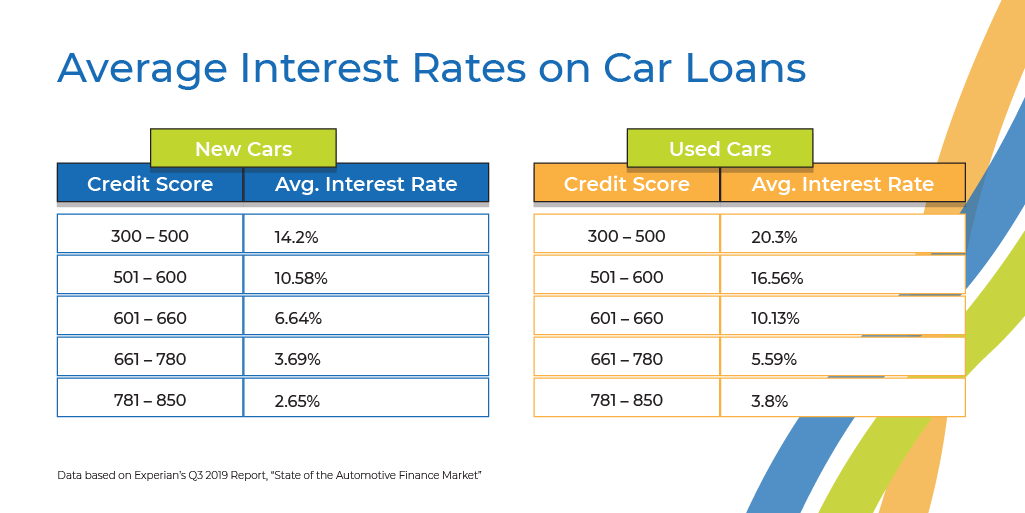
Your credit score is arguably the most significant factor lenders consider. It’s a three-digit number, primarily generated by FICO or VantageScore, that summarizes your creditworthiness based on your payment history, amounts owed, length of credit history, new credit, and credit mix.
-
Excellent Credit (780-850): Borrowers in this range are considered low-risk and typically qualify for the lowest available interest rates.
-
Good Credit (670-739): Still considered reliable, these borrowers can expect competitive rates, though perhaps not the absolute lowest.
-
Fair Credit (580-669): Borrowers with fair credit may face higher interest rates as lenders perceive a moderate risk.
-
Poor Credit (300-579): Individuals with poor credit are seen as high-risk and will likely be offered significantly higher interest rates, if approved at all.
A higher credit score signals to lenders that you have a proven track record of managing debt responsibly, making you a more attractive borrower.
Debt-to-Income Ratio and Employment Stability
Lenders want to ensure you have the capacity to take on new debt. Your debt-to-income (DTI) ratio is a key metric here. It’s calculated by dividing your total monthly debt payments by your gross monthly income. A lower DTI ratio indicates you have more disposable income to cover your new car payments, making you a less risky borrower. Similarly, a stable employment history, especially with the same employer for several years, demonstrates a consistent income stream, further reassuring lenders of your ability to repay.
Loan Term and Down Payment: Short vs. Long, More vs. Less
The structure of your loan also plays a crucial role in the interest rate you receive.
-
Loan Term: Shorter loan terms (e.g., 36 or 48 months) generally come with lower interest rates than longer terms (e.g., 60 or 72 months). This is because a shorter term reduces the lender’s risk exposure over time. While longer terms lead to lower monthly payments, they often result in higher overall interest paid and a higher interest rate.
-
Down Payment: Making a substantial down payment reduces the amount you need to borrow, which, in turn, lowers the lender’s risk. A larger down payment often translates to a lower interest rate, as it demonstrates your financial commitment and reduces the loan-to-value (LTV) ratio of the vehicle.
The Vehicle Itself: New vs. Used, Make and Model
The car you intend to purchase can also influence the interest rate.
-
New Cars: Generally attract lower interest rates than used cars. This is because new cars hold their value better initially, making them lower risk collateral for the lender. Additionally, manufacturers often offer promotional low-interest rates on new vehicles to incentivize sales.
-
Used Cars: Tend to have higher interest rates due to their greater depreciation risk and potentially higher maintenance costs, which can impact a borrower’s ability to pay. The age and mileage of a used car further influence this risk.
-
Make and Model: Luxury or specialty vehicles might have different rates than economy cars, depending on their market value and perceived reliability.
Market Conditions and Lender Type
Broader economic factors and the type of institution you borrow from also play a part.
-
Market Conditions: When the Federal Reserve raises or lowers key interest rates, it impacts the cost of borrowing for lenders, which then trickles down to consumer loan rates. A low-interest-rate environment generally means better deals for borrowers.
-
Lender Type: Different lenders have different risk appetites and funding costs.
-
Banks: Offer competitive rates, especially for prime borrowers, and often have a wide range of loan products.
-
Credit Unions: Known for potentially lower rates and more flexible terms, as they are not-for-profit organizations.
-
Dealership Financing: Convenient, but rates can vary widely. While some offer enticing manufacturer incentives, others might mark up rates.
-
Online Lenders: Often provide quick approvals and competitive rates, especially for those with good credit.
-
Strategies to Secure the Best Possible Interest Rate
Knowing what influences interest rates is only half the battle. Proactively implementing strategies to improve your position as a borrower can significantly impact the rate you ultimately receive.
Boost Your Credit Score

Before applying for a car loan, take steps to improve your credit score. Pay down existing debts, especially credit card balances, to reduce your credit utilization. Make all payments on time, and avoid opening new credit accounts in the months leading up to your car purchase. Regularly check your credit report for errors and dispute any inaccuracies.
Save for a Larger Down Payment
A larger down payment not only reduces the amount you need to borrow, thereby lowering your monthly payments, but it also signals financial strength to lenders. Aim for at least 10-20% of the vehicle’s price, if possible. This reduces the loan-to-value ratio, making the loan less risky for the lender and potentially qualifying you for a lower interest rate.
Shorten Your Loan Term (If Feasible)
While longer terms mean lower monthly payments, they almost always come with higher interest rates and a greater total cost. If your budget allows, opt for the shortest loan term you can comfortably afford. This will result in a lower interest rate and save you money in the long run.
Get Pre-Approved by Multiple Lenders
This is perhaps one of the most powerful strategies. Before you even set foot in a dealership, apply for pre-approval from several different banks, credit unions, and online lenders. Pre-approval gives you a clear idea of the interest rate you qualify for and acts as leverage when negotiating at the dealership. You’ll know if the dealer’s offer is competitive or if you can do better elsewhere. These inquiries are usually “soft pulls” until you commit, or multiple “hard pulls” within a short window (typically 14-45 days) are often grouped as a single inquiry, minimizing their impact on your score.
Negotiate the Car Price First
When at the dealership, focus on negotiating the vehicle’s purchase price before discussing financing. Dealerships often try to roll negotiations for the car price and loan terms into one, which can obscure the true cost. Get the best possible price on the car itself, then compare financing offers (including the one you pre-qualified for) separately.
Consider a Co-signer (Carefully)
If you have poor or limited credit, a co-signer with excellent credit can help you qualify for a lower interest rate. A co-signer agrees to be legally responsible for the loan if you default. While it can be a valuable tool, it’s a significant commitment for the co-signer and should be approached with extreme caution, as any missed payments will negatively impact both your credit scores.
The Application Process: Navigating Your Options
Once you’ve done your homework and refined your strategy, the application process itself requires attention to detail and careful comparison.
Gathering Necessary Documentation
Regardless of the lender, you’ll need to provide certain documents to verify your identity, income, and creditworthiness. Typically, this includes:
-
Government-issued ID (driver’s license, passport)
-
Proof of income (pay stubs, tax returns, bank statements)
-
Proof of residency (utility bill, lease agreement)
-
Social Security Number
-
Information about the vehicle you intend to purchase
Having these documents ready will streamline the application process and help you secure a swift decision.
Comparing Lender Offers: Banks, Credit Unions, Dealerships, Online Lenders
As mentioned, cast a wide net when seeking financing. Apply to various institutions to get a range of offers. Don’t assume your current bank will offer the best rate, and don’t automatically accept the first offer from a dealership.
-
Banks: Offer traditional loans, good for established credit.
-
Credit Unions: Often have competitive rates and more personalized service due to their member-focused structure.
-
Dealerships: Can be convenient, offering one-stop shopping. However, their rates may sometimes be marked up for profit. Always compare their offer against your pre-approvals.
-
Online Lenders: Known for quick applications, fast approvals, and often competitive rates, catering to a wide range of credit profiles.
Carefully review the APR, loan term, monthly payment, and any associated fees from each offer.
Understanding the Fine Print and Fees
Before signing any loan agreement, meticulously read the fine print. Ensure you understand every clause, including prepayment penalties (rare for auto loans but good to check), late payment fees, and what happens in case of default. Ask questions about anything unclear. Be wary of add-ons presented at the last minute, such as extended warranties or GAP insurance, which can significantly increase the total loan amount if financed. While some add-ons may be beneficial, it’s usually better to purchase them separately if desired.
Beyond the Rate: What Else to Consider
While the interest rate is paramount, a holistic view of your financial health and the loan terms is crucial for a truly smart decision.
Total Cost of the Loan
Focusing solely on the monthly payment can be misleading. Always calculate the total cost of the loan—the principal amount plus all interest paid over the term. A lower monthly payment achieved through a longer loan term might seem appealing, but it invariably leads to paying significantly more interest overall. Use an online car loan calculator to compare total costs across different rates and terms.
Payment Affordability and Budgeting
Ensure the monthly car payment fits comfortably within your budget, leaving room for other expenses, savings, and emergencies. A general rule of thumb suggests your total car expenses (payment, insurance, fuel, maintenance) shouldn’t exceed 10-20% of your net monthly income. Don’t let the excitement of a new car push you into a payment you can’t sustain long-term.

Potential for Refinancing
Even if you don’t secure the absolute lowest rate initially, the possibility of refinancing exists. If your credit score improves significantly after a year or two of on-time payments, or if market interest rates drop, you might be able to refinance your car loan for a lower rate, further reducing your total cost and monthly payment. Keep an eye on market conditions and your credit health.
In conclusion, the interest rate you can get on a car loan is a dynamic figure influenced by a complex interplay of your financial profile, the vehicle you choose, and prevailing market conditions. By understanding these factors, preparing diligently, and strategically comparing offers, you empower yourself to secure a loan that aligns with your financial goals, ensuring your car purchase is an asset, not a burden. Driving off the lot with a new vehicle is exciting, but doing so with a well-researched, financially sound loan is truly smart.
aViewFromTheCave is a participant in the Amazon Services LLC Associates Program, an affiliate advertising program designed to provide a means for sites to earn advertising fees by advertising and linking to Amazon.com. Amazon, the Amazon logo, AmazonSupply, and the AmazonSupply logo are trademarks of Amazon.com, Inc. or its affiliates. As an Amazon Associate we earn affiliate commissions from qualifying purchases.