
The celestial dance of planets around stars, a spectacle that has captivated humanity for millennia, is not a matter of chance or divine intervention. It is, at its core, a testament to a fundamental force of nature, one that underpins the very structure and dynamics of the universe: gravity. While often perceived as a simple pull, gravity is, in fact, a complex and pervasive phenomenon, the underlying “technology” that dictates cosmic order. Understanding this force is crucial not only for astronomers and physicists but also for anyone intrigued by the vastness and mechanics of space. This exploration delves into the nature of gravity, its historical discovery, its mathematical description, and the technological advancements that have allowed us to observe and harness its principles, albeit on a nascent scale.
The Unseen Architect: Understanding Gravitational Force
At its most basic, gravity is an attractive force that exists between any two objects possessing mass. The greater the mass of the objects, and the closer they are to each other, the stronger the gravitational pull. This universal law, often referred to as Newton’s Law of Universal Gravitation, is the bedrock upon which our understanding of orbital mechanics is built. It’s the invisible thread that keeps Earth tethered to the Sun, the Moon to Earth, and the myriad stars within galaxies.
Mass as the Primary Driver
The quantity of matter within an object, its mass, is the primary determinant of its gravitational influence. A celestial body like the Sun, with its immense mass, exerts a far more powerful gravitational pull than a smaller body like Earth. This difference in mass is why planets orbit stars, rather than the other way around. The Sun’s gravitational dominance ensures that the planets, despite their own motion, remain locked in stable orbits, preventing them from drifting off into the cold expanse of interstellar space.
The Sun’s Dominance in Our Solar System
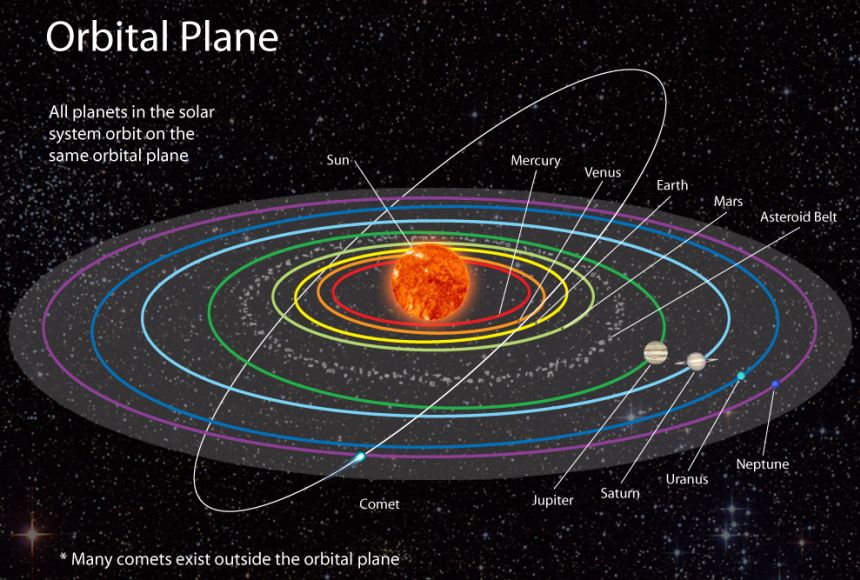
Our own solar system serves as a prime example. The Sun accounts for approximately 99.86% of the total mass of the solar system. This overwhelming mass concentration means that the Sun’s gravitational field dictates the paths of all the planets, dwarf planets, asteroids, and comets. The planets, in turn, have their own gravitational fields, which influence the orbits of their moons and other smaller bodies in their vicinity. This hierarchical structure, governed by mass, creates the predictable and elegant orbits we observe.
Distance: The Inverse Square Law
While mass is crucial, the distance between two objects also plays a significant role in determining the strength of their gravitational interaction. This relationship is described by the inverse square law: the gravitational force decreases with the square of the distance between the centers of the two objects. This means that if you double the distance between two objects, the gravitational force between them becomes four times weaker. Conversely, halving the distance quadruples the force.
Orbital Stability and Escape Velocity
This inverse square relationship is fundamental to orbital stability. If a planet were to move too far from its star, the gravitational pull would weaken considerably, potentially allowing it to escape the star’s orbit altogether. Conversely, if a planet moved too close, the increased gravitational force could cause it to spiral inwards or be torn apart by tidal forces. The concept of escape velocity, the minimum speed an object needs to overcome a gravitational pull, is directly derived from this understanding. For Earth, the escape velocity is approximately 11.2 kilometers per second.
The Evolution of Gravitational Theory: From Observation to Einstein’s Fabric
The understanding of gravity has evolved dramatically over centuries, moving from empirical observations to sophisticated theoretical frameworks. The journey from the classical laws of Newton to the relativistic descriptions of Einstein represents a profound technological and conceptual leap in our understanding of the universe’s fundamental forces.
Newton’s Universal Law: A Revolution in Physics
Sir Isaac Newton’s groundbreaking work in the 17th century provided the first comprehensive mathematical description of gravity. His Law of Universal Gravitation, published in Principia Mathematica, unified terrestrial and celestial mechanics, explaining why an apple falls to the ground and why the Moon orbits the Earth. Newton’s theory, based on the concept of an attractive force acting instantaneously across any distance, was a monumental achievement that dominated physics for over two centuries.
The Mathematical Framework for Orbits
Newton’s laws of motion and his law of universal gravitation provided the mathematical tools necessary to calculate and predict the orbits of celestial bodies with remarkable accuracy. This was a profound technological advancement in observational astronomy, allowing for the prediction of eclipses, the discovery of new planets based on perturbations in known orbits (like Neptune), and the development of sophisticated navigation systems for seafaring.
Einstein’s General Relativity: Gravity as Spacetime Curvature

In the early 20th century, Albert Einstein revolutionized our understanding of gravity with his theory of General Relativity. Einstein proposed that gravity is not a force in the traditional sense, but rather a manifestation of the curvature of spacetime caused by the presence of mass and energy. Massive objects warp the fabric of spacetime around them, and other objects moving through this warped spacetime follow curved paths, which we perceive as gravitational attraction.
Gravitational Lensing and Black Holes
General Relativity has been experimentally verified through phenomena like gravitational lensing, where the gravity of massive objects bends the path of light from more distant sources. It also predicted the existence of black holes, regions of spacetime where gravity is so intense that nothing, not even light, can escape. The technological advancements in telescopes and detectors, particularly those capable of observing gravitational waves, have provided powerful evidence supporting Einstein’s theory.
Technological Innovations: Observing and Understanding Gravity’s Reach
Our ability to understand and study gravity has been intrinsically linked to technological advancements. From the earliest telescopes to sophisticated space probes and gravitational wave detectors, technology has been the key to unlocking the secrets of this fundamental force.
Telescopes and Observational Astronomy
The invention of the telescope marked a paradigm shift in our ability to observe the cosmos and, by extension, to study gravitational interactions. Early telescopes allowed astronomers to see planets, moons, and distant stars with unprecedented clarity, providing the raw data needed to test and refine gravitational theories. Modern optical and radio telescopes, as well as space-based observatories like the Hubble Space Telescope and the James Webb Space Telescope, continue to push the boundaries of our observational capabilities.
Mapping the Gravitational Landscape
These advanced telescopes allow us to map the distribution of mass in the universe, observe the gravitational lensing effects of galaxy clusters, and study the orbits of exoplanets around distant stars. This data is crucial for understanding the formation and evolution of planetary systems and galaxies, all governed by the principles of gravity.
Space Exploration and Probes
Space probes and missions have provided direct, in-situ measurements of gravitational forces and their effects. Missions like the Voyager probes, which used gravity assists to gain speed and alter their trajectories, are a testament to our practical application of gravitational mechanics. Orbiters and landers around planets and moons provide detailed gravitational maps, helping us understand their internal structure and geological history.
Gravitational Wave Detection: A New Frontier
One of the most significant recent technological breakthroughs has been the development of gravitational wave detectors, such as LIGO (Laser Interferometer Gravitational-Wave Observatory) and Virgo. These instruments are designed to detect the faint ripples in spacetime caused by cataclysmic cosmic events, like the merger of black holes or neutron stars. The detection of gravitational waves opens a new window into observing the universe, providing direct evidence of phenomena that were previously only theorized and allowing us to study gravity in its most extreme manifestations.
The Future of Gravitational Technology: From Prediction to Potential Manipulation
While we have made immense strides in understanding gravity, the future holds even more exciting possibilities. Research continues into the nature of dark matter and dark energy, which exert gravitational influence but are not directly observable, and theoretical exploration into manipulating gravitational fields is an ongoing endeavor.
Unraveling Dark Matter and Dark Energy
The discrepancies between the observed gravitational effects in galaxies and galaxy clusters and the amount of visible matter suggest the existence of dark matter and dark energy. Understanding these enigmatic components is a primary focus of modern cosmology, and their gravitational influence is the primary way we infer their presence. Advanced observational techniques and theoretical models are continually being developed to shed light on these mysteries.
Gravitational Propulsion and Future Exploration
The theoretical possibility of manipulating gravitational fields, while still firmly in the realm of science fiction, represents the ultimate frontier of gravitational technology. Concepts like warp drives and artificial gravity, though far-fetched, are born from our deepening understanding of General Relativity. While practical applications remain distant, ongoing research into the fundamental nature of spacetime and gravity may one day lead to revolutionary advancements in propulsion and space exploration, allowing us to truly harness the unseen architect of the cosmos.
aViewFromTheCave is a participant in the Amazon Services LLC Associates Program, an affiliate advertising program designed to provide a means for sites to earn advertising fees by advertising and linking to Amazon.com. Amazon, the Amazon logo, AmazonSupply, and the AmazonSupply logo are trademarks of Amazon.com, Inc. or its affiliates. As an Amazon Associate we earn affiliate commissions from qualifying purchases.