
The age-old question of whether beer or wine contains more alcohol is often posed in casual conversation, usually around a dinner table or at a social gathering. While the immediate answer hinges on the specific type of beer or wine, delving deeper into this seemingly simple query reveals a surprisingly intricate relationship with personal finance and consumer choices. From a financial standpoint, understanding the alcohol content of these beverages isn’t just about the buzz; it’s about maximizing value, making informed purchasing decisions, and managing the overall cost of enjoyment. This article will explore the financial implications of alcohol content in beer versus wine, examining how factors like price per unit of alcohol, potential for bulk purchasing, and the economic impact of varying strengths influence our wallets.
The Economics of Alcohol By Volume (ABV)
The core of the beer versus wine alcohol debate lies in their respective Alcohol By Volume (ABV) percentages. However, translating these percentages into a financially sound decision requires understanding how ABV directly impacts the cost per unit of pure alcohol.
Understanding Alcohol By Volume (ABV)
Alcohol By Volume, or ABV, is the standard international measure of how much pure alcohol (ethanol) is contained in a given volume of an alcoholic beverage. It’s expressed as a percentage. For example, a beer with 5% ABV means that 5% of the liquid’s volume is pure alcohol. Similarly, a wine with 12% ABV means 12% of its volume is alcohol.
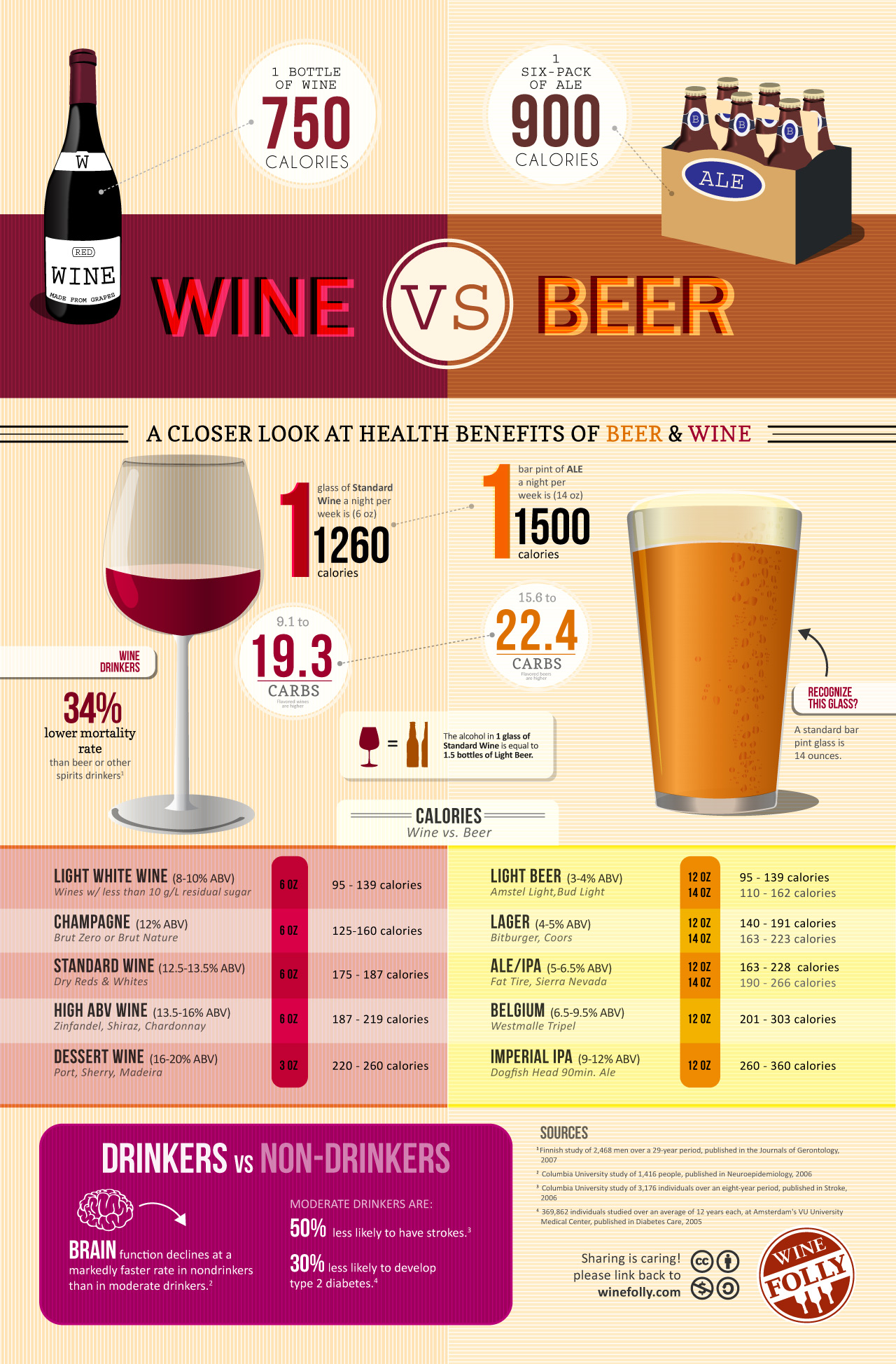
Generally speaking, the ABV for beer ranges from a low of around 3-4% for light beers to 8-10% or even higher for craft or specialty brews like imperial stouts or barleywines. Standard lagers and ales typically fall between 4.5% and 6%. Wine, on the other hand, usually has a higher ABV, with most table wines ranging from 11% to 14.5%. Fortified wines, such as port or sherry, can have even higher ABVs, often exceeding 15% and sometimes reaching 20% or more.
Calculating Cost Per Unit of Alcohol
To make a financially savvy decision, we must move beyond simply noting the ABV and calculate the cost per unit of alcohol. This involves understanding how much you are paying for the actual alcohol content, rather than just the liquid volume.
Let’s consider a simplified scenario. Imagine a 12-ounce bottle of beer costing $2.00 with an ABV of 5%. The volume of pure alcohol in this bottle is 12 ounces * 0.05 = 0.6 ounces. The cost per ounce of alcohol is $2.00 / 0.6 ounces = approximately $3.33 per ounce of alcohol.
Now, consider a standard 750ml bottle of wine costing $15.00 with an ABV of 12%. First, we need to convert the volume to ounces. 750ml is approximately 25.4 fluid ounces. The volume of pure alcohol in this bottle is 25.4 ounces * 0.12 = approximately 3.05 ounces. The cost per ounce of alcohol is $15.00 / 3.05 ounces = approximately $4.92 per ounce of alcohol.
In this particular example, the beer offers a more cost-effective way to consume pure alcohol. However, this is a simplified calculation and doesn’t account for many other financial factors.
The Role of Price and Volume
The price and volume of the containers in which beer and wine are sold significantly influence the cost per unit of alcohol. Beer is often sold in smaller, more frequent purchases (cans, bottles, six-packs), while wine is typically purchased in larger bottles.
For instance, a 12-pack of 12-ounce cans of beer at 5% ABV for $20 would mean you’re paying $20 / (12 * 12 ounces) = $0.14 per ounce of liquid, and $20 / (12 * 12 * 0.05) = $0.46 per ounce of alcohol.
A single 750ml bottle of wine at 12% ABV for $15 means you’re paying $15 / (25.4 ounces) = $0.59 per ounce of liquid, and $15 / (25.4 * 0.12) = $0.49 per ounce of alcohol.
In this revised comparison, the beer is still slightly more cost-effective per ounce of alcohol, but the difference is smaller. This highlights how the perceived value can shift depending on the specific pricing and packaging. The ability to buy beer in larger formats, like kegs, can further reduce the cost per unit of alcohol, making it a more economical choice for parties or frequent consumption. Conversely, while wine is sometimes sold in larger formats like magnums, the per-bottle price is often higher, making the cost per unit of alcohol less competitive unless significant discounts are available.
Strategic Purchasing and Consumption: Maximizing Value
Beyond simple calculations, strategic purchasing and consumption habits can significantly impact the financial outlay for alcoholic beverages. This involves leveraging sales, understanding brand value, and considering the intended consumption occasion.
Bulk Buying and Discounts
The principle of bulk buying, a cornerstone of cost savings in many consumer goods, also applies to alcoholic beverages. While wine is more commonly associated with discounts for purchasing multiple bottles (e.g., “buy five, get one free”), beer also offers opportunities for savings.
For wine, purchasing a case (typically 12 bottles) can often yield a discount of 10-20% compared to buying individual bottles. If a bottle of wine is $15, a case might cost $150 before discount, but with a 15% discount, it drops to $127.50. This means the effective cost per bottle is $10.63, a substantial saving that directly translates to a lower cost per unit of alcohol.
Beer discounts are often seen in multi-packs, such as 24-packs or 30-packs, which offer a lower per-can or per-bottle price than smaller assortments. Furthermore, bars and liquor stores may offer daily or weekly specials on specific brands or types of beer, incentivizing larger purchases. The key for the financially astute consumer is to compare the per-unit price across different pack sizes and sales events. For example, a 24-pack of 12-ounce cans at 5% ABV for $30 translates to a cost of $30 / (24 * 12 ounces) = $0.10 per ounce of liquid, and $30 / (24 * 12 * 0.05) = $0.35 per ounce of alcohol. This is significantly cheaper than the earlier individual can example.

Brand Value vs. Cost
Brand perception plays a significant role in the pricing of both beer and wine, and understanding this allows for more strategic purchasing. Premium brands, whether craft beers with artisanal branding or fine wines from renowned vineyards, invariably command higher prices. However, their ABV might not be significantly higher than less expensive alternatives.
A 750ml bottle of a high-end Napa Valley Cabernet Sauvignon, costing $50 with 13.5% ABV, provides approximately 3.4 ounces of alcohol. The cost per ounce of alcohol is $50 / (25.4 * 0.135) = approximately $14.70. Compare this to a $15 bottle of table wine with 12% ABV, where the cost per ounce of alcohol was $4.92. The premium wine is over three times more expensive per unit of alcohol, with the difference largely attributable to brand, reputation, and perceived quality rather than just alcohol content.
Similarly, a 12-ounce bottle of a limited-edition craft IPA, costing $8 with an ABV of 7.5%, provides 12 * 0.075 = 0.9 ounces of alcohol. The cost per ounce of alcohol is $8 / 0.9 = approximately $8.89. This is significantly more expensive per unit of alcohol than a standard lager.
From a purely financial perspective focused on maximizing alcohol intake per dollar, investing in lesser-known but quality brands, or opting for value-oriented options during sales, can be a more efficient strategy. This doesn’t diminish the enjoyment of premium beverages but acknowledges that for budget-conscious consumers, the financial return on investment in terms of alcohol content is often lower.
Occasion and Consumption Goals
The intended occasion and personal consumption goals are critical financial considerations. If the goal is to unwind after a long day with a single drink, the cost per unit of alcohol might be less of a concern than the nuanced flavor profile or the experience the beverage offers. In such cases, the enjoyment derived from a more expensive, high-quality beverage can justify the higher price.
However, for events like parties, social gatherings, or regular weeknight consumption, the financial impact of alcohol purchases can escalate quickly. For these situations, a lower cost per unit of alcohol becomes a more significant factor. Beer, due to its generally lower ABV and frequent promotional pricing, can be a more budget-friendly option for providing alcohol to a group. For instance, purchasing several cases of a moderately priced lager for a party can be significantly more economical than stocking the same event with bottles of wine.
Consider a scenario where 20 guests are expected, and the host aims to provide enough alcohol for a few drinks each. If each guest consumes an average of 2 standard drinks (approximately 1 ounce of pure alcohol per drink), this equates to 40 ounces of pure alcohol needed.
- Using the cheaper beer example: At $0.35 per ounce of alcohol, 40 ounces would cost 40 * $0.35 = $14.00.
- Using the cheaper wine example: At $0.49 per ounce of alcohol, 40 ounces would cost 40 * $0.49 = $19.60.
In this simplified model, the beer is demonstrably more cost-effective for a larger group. This illustrates how aligning purchasing decisions with consumption goals—whether it’s a single indulgence or providing for many—can lead to significant financial savings.
The Financial Implications of High-ABV Beverages
The allure of higher alcohol content, while potentially offering a quicker path to intoxication, can often come with a hidden financial cost. This is particularly relevant when comparing highly concentrated alcoholic beverages to their less potent counterparts.
The “Bang for Your Buck” Illusion
While it might seem intuitive that a higher ABV beverage offers more “bang for your buck” in terms of alcohol per dollar, this is not always the case when considering the actual price point. As demonstrated earlier, a craft beer with a very high ABV can still be more expensive per ounce of alcohol than a standard lager or even a moderately priced wine.
For example, a 4-pack of 16-ounce cans of imperial stout at 10% ABV costing $18 provides 4 * 16 ounces * 0.10 = 6.4 ounces of alcohol. The cost per ounce of alcohol is $18 / 6.4 = $2.81. This is actually more cost-effective per ounce of alcohol than our initial beer example ($3.33/oz) and even our initial wine example ($4.92/oz).
However, the caveat here is that such high-ABV beverages are often consumed in smaller quantities due to their potency. One stout might be equivalent to two or three standard beers in terms of alcohol. If the goal is simply to achieve a certain level of intoxication for the lowest cost, then these high-ABV options can be financially advantageous. But for moderate consumption or for those who appreciate sipping over extended periods, the total expenditure might still be higher due to the higher per-unit price of the beverage itself.
Tax Structures and Pricing
Government taxation on alcoholic beverages can also play a role in the perceived and actual cost. In many jurisdictions, excise taxes are levied based on the alcohol content. This means that higher ABV beverages often carry a higher tax burden, which is then passed on to the consumer.
For instance, wine might be taxed at a different rate than beer, and within beer, lighter beers might be taxed differently than stronger ones. These tax structures can influence pricing and make certain categories of alcoholic beverages more or less economically attractive. Understanding these local tax policies can provide an additional layer of insight for financially conscious consumers. For example, if a particular region taxes wine at a significantly higher rate than beer, this might make beer a more attractive option from a cost-per-alcohol perspective, even if the ABV is comparable.

Health and Financial Well-being
While not directly about purchasing decisions, it’s crucial to acknowledge the broader financial implications of alcohol consumption related to health. Excessive alcohol consumption, regardless of the type of beverage, can lead to significant health problems. The cost of treating these conditions, from doctor’s visits and medications to long-term care, can far outweigh any perceived savings from purchasing cheaper alcohol.
Therefore, a truly financially responsible approach to alcohol consumption involves moderation and prioritizing overall well-being. The “cheapest” way to consume alcohol might not be the healthiest, and the financial burden of poor health can be a devastating long-term consequence. Responsible consumption, whether it’s choosing lower-ABV options, limiting intake, or prioritizing quality over quantity, is ultimately the most financially sound decision for overall personal finance.
In conclusion, the question of whether beer or wine has more alcohol is a starting point for a deeper financial analysis. By understanding ABV, calculating cost per unit of alcohol, strategically purchasing, and considering the broader implications of consumption, consumers can make more informed decisions that align with their financial goals and personal well-being.
aViewFromTheCave is a participant in the Amazon Services LLC Associates Program, an affiliate advertising program designed to provide a means for sites to earn advertising fees by advertising and linking to Amazon.com. Amazon, the Amazon logo, AmazonSupply, and the AmazonSupply logo are trademarks of Amazon.com, Inc. or its affiliates. As an Amazon Associate we earn affiliate commissions from qualifying purchases.