
In the vast landscape of software engineering and distributed systems, few concepts are as fundamental yet as invisible to the end-user as RPC. If you have ever wondered “what does RPC stand for,” the answer is Remote Procedure Call. While the name might sound like dry technical jargon, it represents one of the most critical breakthroughs in how computers talk to one another.
At its core, RPC is a protocol that allows a program to execute a piece of code—a “procedure”—on a different computer or a different address space as if it were a local call. It abstracts the complexity of network communication, allowing developers to build massive, interconnected applications without having to manually manage the intricate details of sockets, data serialization, and network protocols every time they want to send a command.

Understanding the Core Concept: What is a Remote Procedure Call?
To appreciate RPC, one must first understand the environment in which it lives: distributed computing. In a traditional, monolithic application, all functions and data reside on a single machine. If “Function A” needs information from “Function B,” it simply calls that function within the same memory space. However, in modern tech, applications are rarely contained on a single server. They are spread across data centers, cloud providers, and edge devices.
The Definition and Origin of RPC
RPC stands for Remote Procedure Call. It is a form of Inter-Process Communication (IPC). The concept was popularized in the early 1980s, most notably by Bruce Jay Nelson and later implemented by Sun Microsystems. The goal was simple: make a remote service request look exactly like a local function call in the code.
When a developer uses RPC, they write code that says GetUserData(UserID). In a local environment, the computer finds that function in its own memory. In an RPC environment, the computer realizes that GetUserData actually lives on a different server. It packages the request, sends it over the internet, gets the result from the remote server, and hands it back to the developer’s code.
How RPC Simplifies Distributed Systems
Without RPC, developers would have to manually handle the “plumbing” of the internet for every single interaction. They would need to open a connection, format the data into a stream of bytes, handle network timeouts, manage retransmissions, and parse the response.
RPC provides a layer of abstraction. By hiding the “remoteness” of the call, it allows software engineers to focus on the business logic—what the application actually does—rather than the mechanics of how data moves through a fiber-optic cable. This abstraction is the bedrock of modern cloud architecture and microservices.
The Mechanics of RPC: How It Works Behind the Scenes
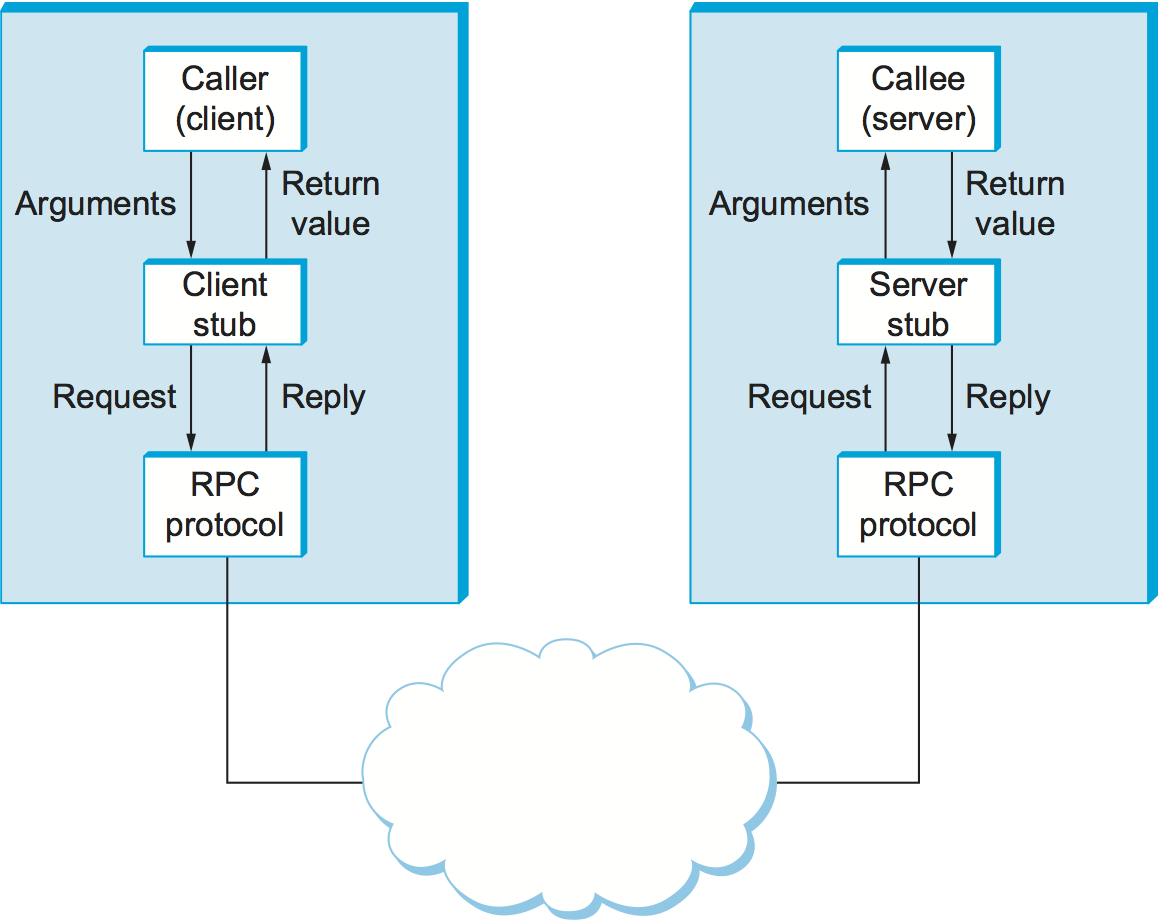
While RPC makes a remote call look local, the process happening under the hood is complex. This process is often described through the interaction of “stubs” and “skeletons.”
The Role of the Client and Server Stubs
Because the client and the server are on different machines, they don’t share memory. To bridge this gap, RPC uses stubs.
- The Client Stub: When the program calls a remote procedure, it is actually calling a local “proxy” or stub. This stub acts as a representative for the remote function. It gathers the parameters required for the call.
- The Server Stub (Skeleton): On the receiving end, another stub waits for incoming requests. It receives the data, unpacks it, and calls the actual function residing on the server.
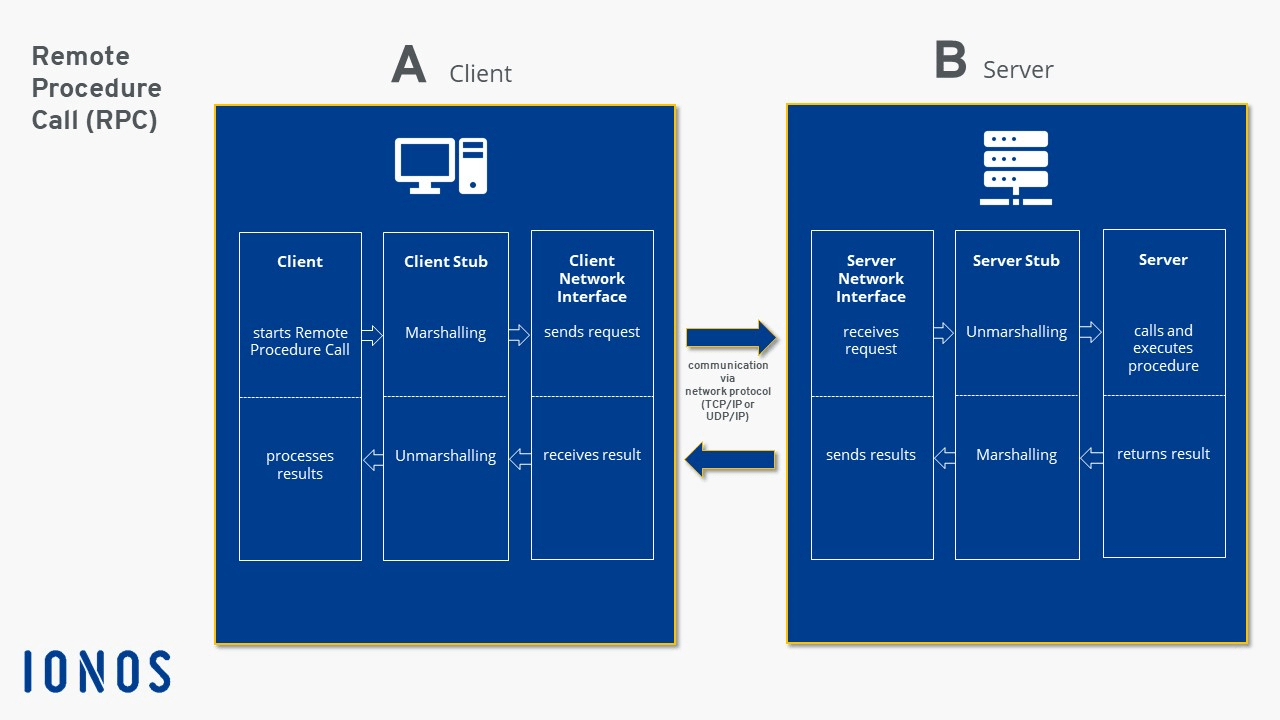
Marshalling and Data Serialization
One of the most technical hurdles in RPC is Marshalling. Computers can have different architectures; for instance, one might read integers from left to right (Big-endian) while another reads them right to left (Little-endian).
Marshalling is the process of packaging the procedure’s parameters into a standard, compressed format that can be transmitted over a network. This is also known as serialization. Once the data arrives at the destination, the server stub performs unmarshalling to translate those bytes back into a format the server’s CPU can understand.
The Request-Response Cycle
The typical RPC flow follows these steps:
- The client application calls the client stub.
- The stub packs the parameters (Marshalling).
- The local Operating System sends the message to the remote node.
- The remote OS passes the message to the server stub.
- The server stub unpacks the parameters (Unmarshalling).
- The server stub calls the actual local procedure.
- The procedure executes and returns a result to the server stub.
- The server stub packs the result and sends it back across the network.
- The client stub receives, unpacks, and delivers the result to the application.
Different Types and Protocols of RPC
As technology has evolved, so have the implementations of RPC. From the early days of networked workstations to today’s high-speed AI clusters, different versions of RPC have emerged to solve specific problems.
Traditional RPC (ONC RPC and DCE/RPC)
In the 1980s and 90s, ONC RPC (Open Network Computing) and DCE (Distributed Computing Environment) were the standards. These were often used in Unix environments for things like Network File Systems (NFS). While powerful, they were often tied to specific operating systems and were difficult to use across different programming languages.
The Evolution to XML-RPC and JSON-RPC
With the rise of the web, developers needed RPC protocols that could work over standard web ports (like HTTP).
- XML-RPC: This version used XML to encode its calls. It was human-readable but very “verbose,” meaning the files were large and slow to transmit.
- JSON-RPC: A lighter alternative to XML. By using JSON (JavaScript Object Notation), it became much easier for web browsers and modern apps to communicate with servers. It remains popular for its simplicity and ease of debugging.
The Modern Gold Standard: gRPC
Developed by Google, gRPC (Google Remote Procedure Call) is the modern evolution of this technology. It is designed for high-performance, large-scale environments. Unlike JSON-RPC, gRPC uses Protocol Buffers (protobuf) as its interface description language.
Protocol Buffers are a binary format, meaning they are much smaller and faster than text-based formats like JSON or XML. Furthermore, gRPC leverages HTTP/2, which allows for “streaming”—where the client and server can send a continuous flow of data to each other simultaneously. This is essential for modern AI tools and real-time data streaming.
RPC vs. REST: Choosing the Right Architectural Pattern
In the world of Tech, you will often hear RPC compared to REST (Representational State Transfer). While both allow for communication between systems, they represent different philosophies.
Key Differences in Methodology
The primary difference lies in their focus.
- REST is resource-oriented. It uses standard HTTP “verbs” (GET, POST, PUT, DELETE) to act upon “nouns” (like
/usersor/orders). It is designed to be stateless and is very easy for third-party developers to understand. - RPC is action-oriented. It focuses on “verbs” or commands (like
runAnalysis()orcalculateTax()). Instead of manipulating a resource, you are telling a remote system to perform a specific task.
Performance and Latency Considerations
Because REST usually relies on JSON and standard HTTP/1.1, it carries more “overhead.” Every request includes headers and text-based data that can slow things down.
RPC, especially gRPC, is built for speed. Its binary nature means it consumes less bandwidth and requires less CPU power to encode and decode. For internal communications—such as two servers in a data center talking to each other—RPC is almost always the faster choice.
Use Cases: When to Pick One Over the Other
- Use REST when: You are building a public API that other developers will use, or when you need a system that is easily cacheable by web browsers.
- Use RPC when: You are building a microservices architecture where internal speed is the priority, or when you are working with low-power IoT devices that need to minimize data usage.
The Future of RPC in Microservices and Cloud Computing
As we move deeper into the era of AI and massive-scale cloud computing, RPC’s importance continues to grow. The shift from monolithic software to “Microservices”—where a single application is broken into hundreds of tiny, independent services—has made robust RPC protocols a necessity.
Scalability in Distributed Architectures
In a microservices environment, a single user click might trigger a chain reaction of 50 different RPC calls across 20 different servers. If these calls are slow, the user experience suffers. Modern RPC implementations are designed to handle this “east-west traffic” (server-to-server communication) with sub-millisecond latency. This scalability is what allows platforms like Netflix, Uber, and Google to handle millions of concurrent requests.
Security Challenges and Best Practices
When you allow a remote machine to execute code on your server, security becomes a paramount concern. Modern RPC frameworks integrate advanced security features:
- Authentication: Using TLS (Transport Layer Security) to ensure that only authorized clients can make calls.
- Deadlines and Timeouts: Ensuring that a “hung” remote call doesn’t freeze the entire system.
- Strict Typing: Protocols like gRPC require strict definitions of what data can be sent, preventing many types of injection attacks that plague more flexible protocols.
Conclusion
So, what does RPC stand for? While it literally stands for Remote Procedure Call, in the broader context of technology, it stands for connectivity and efficiency. It is the invisible thread that sews together the fragmented pieces of the modern cloud.
From the early days of simple networked files to the high-performance demands of today’s AI-driven microservices, RPC has remained a cornerstone of software architecture. By abstracting the complexity of the network, it allows developers to build more ambitious, faster, and more reliable applications. Whether you are a seasoned developer or a tech enthusiast, understanding RPC is key to understanding how the modern digital world truly functions.
aViewFromTheCave is a participant in the Amazon Services LLC Associates Program, an affiliate advertising program designed to provide a means for sites to earn advertising fees by advertising and linking to Amazon.com. Amazon, the Amazon logo, AmazonSupply, and the AmazonSupply logo are trademarks of Amazon.com, Inc. or its affiliates. As an Amazon Associate we earn affiliate commissions from qualifying purchases.