
In the vast digital landscape of Facebook, where billions of interactions occur daily, the concept of user-generated content moderation is paramount. While algorithms play a significant role in identifying problematic content, the human element—specifically, a user’s ability to report a post—remains a cornerstone of the platform’s safety and integrity protocols. Reporting a post isn’t just a click of a button; it initiates a sophisticated chain of events designed to uphold Facebook’s Community Standards, protect its users, and maintain a healthier online environment. Understanding this intricate process illuminates Facebook’s commitment to digital security and the collective responsibility shared by its global community.
The User’s Role in Digital Citizenship: Why Reporting Matters
The power to report a post on Facebook positions every user as an active participant in maintaining the platform’s ecosystem. Far from being a passive consumer of content, users are empowered to act as digital citizens, contributing to the well-being of the broader online community. This capability is not merely a feature; it is a fundamental pillar supporting Facebook’s efforts to combat misinformation, hate speech, harassment, and other forms of harmful content.
Maintaining Community Standards
Facebook operates under a comprehensive set of “Community Standards” that outline what is and isn’t allowed on the platform. These standards cover a wide array of content types, from hate speech and incitement to violence to nudity and bullying. When a user reports a post, they are essentially flagging content that they believe violates one or more of these established guidelines. This act is crucial because, despite advancements in AI and automated detection systems, the sheer volume and nuance of human communication mean that many violations still require human identification. Users often encounter content that automated systems might miss due to context, sarcasm, or evolving trends in harmful expression. By reporting, users help Facebook enforce its rules consistently and effectively across its diverse global user base.
Empowering Users to Curate Their Feed
Beyond enforcing rules, reporting also empowers individual users to shape their personal online experience. While content filtering preferences and unfollowing can tailor a user’s feed, reporting takes a more direct approach against content that crosses a line. It provides a mechanism for users to actively remove content they find offensive, distressing, or harmful from not only their own view but potentially from others’ as well. This sense of agency is vital for user satisfaction and safety, allowing individuals to curate a more positive and respectful digital space for themselves and their connections. It fosters a feeling of control over one’s digital environment, which is increasingly important in an age of information overload and potential digital toxicity.
A Shared Responsibility for a Safer Platform
The act of reporting cultivates a shared responsibility among all Facebook users. It shifts the burden of content moderation from being solely on the platform to a collaborative effort. This collaborative model is essential for a platform of Facebook’s scale. No single entity, regardless of its technological prowess, can police billions of posts, comments, and messages daily without significant user input. By encouraging and facilitating reporting, Facebook leverages the collective intelligence and vigilance of its community, turning millions of users into potential watchdogs. This collective action helps Facebook respond more swiftly to emerging threats, identify new forms of abuse, and adapt its moderation strategies more dynamically than an entirely top-down approach could ever achieve. It’s an acknowledgment that the strength of a community lies in its members’ willingness to protect one another.
Navigating the Reporting Mechanism: A Step-by-Step Guide
Understanding the user interface and options available when reporting a post is crucial for ensuring that the report is accurate, effective, and leads to the appropriate action. Facebook has refined its reporting tools over time to make the process as intuitive and comprehensive as possible, allowing users to provide context and specificity.
Identifying Reportable Content
Before initiating a report, users must first identify content that warrants such action. This could range from hate speech targeting a specific group, harassment directed at an individual, misinformation about public health, graphic violence, or fraudulent activity. Facebook’s Community Standards page is an invaluable resource for users to familiarize themselves with what constitutes a violation. When encountering a piece of content, users should consider if it falls into one of these prohibited categories. It’s important to differentiate between content one dislikes or disagrees with and content that actually violates platform rules. Disagreement falls under freedom of expression, while violations directly harm the community.
The Reporting Interface: Options and Specificity
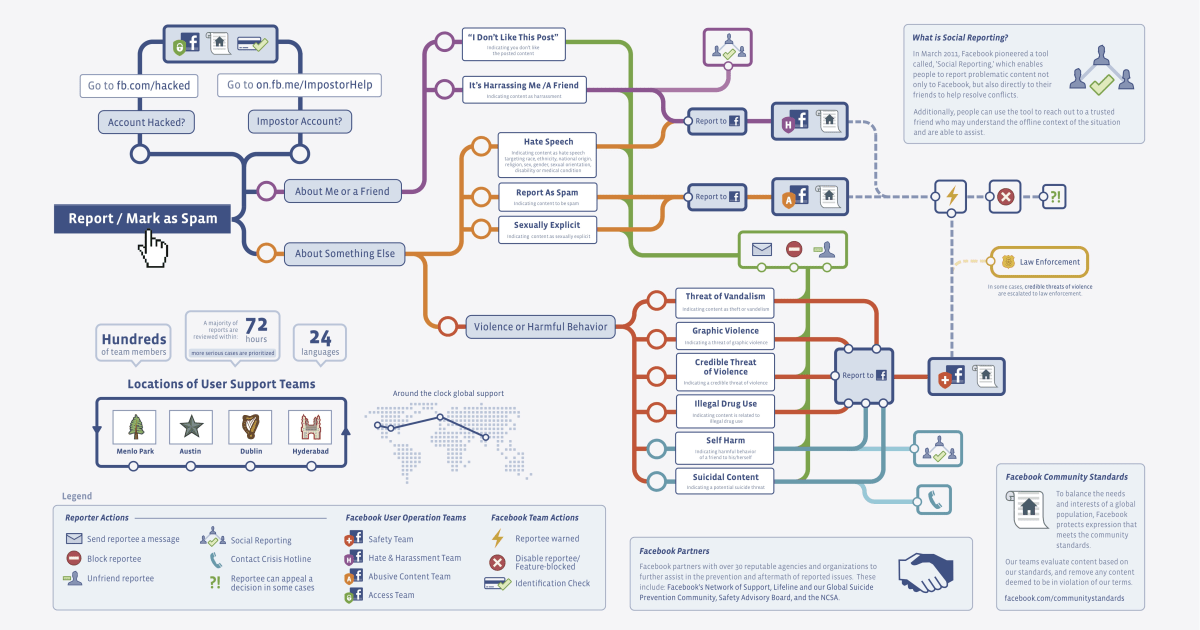
Once potentially problematic content is identified, the reporting process typically begins by clicking the three-dot menu icon, usually located in the top-right corner of a post. This action opens a dropdown menu that includes an option such as “Find support or report post.” Clicking this leads to a series of prompts where the user must select the specific reason for their report. Options might include: “Hate Speech,” “Harassment,” “Nudity or Sexual Activity,” “Violence,” “False Information,” “Scam or Fraud,” and more. The more specific the user can be about the violation, the better Facebook’s review team can understand the context and take appropriate action. For instance, if reporting hate speech, the system might then ask which protected characteristic (e.g., race, religion, sexual orientation) is being targeted. Providing this level of detail is critical for efficient and accurate moderation.
Anonymity and User Protection
A key aspect of Facebook’s reporting mechanism is the emphasis on user anonymity and protection. When a user reports a post, the identity of the reporter is kept strictly confidential. The person who posted the content, or anyone else, will not be informed about who initiated the report. This protection is vital for encouraging users to report without fear of retaliation, harassment, or social repercussions. It ensures that individuals can act as digital citizens without compromising their personal safety or privacy within the platform. This anonymity strengthens the reporting system by removing a significant barrier that might otherwise deter users from flagging harmful content.
Facebook’s Internal Review Process: Behind the Scenes
Once a report is submitted, it doesn’t just disappear into a void. It triggers a multi-layered internal review process that combines cutting-edge artificial intelligence with human judgment to assess the reported content against Facebook’s Community Standards. This sophisticated pipeline is designed to be efficient, accurate, and scalable to handle the immense volume of reports received daily.
AI and Machine Learning’s Initial Scan
Upon submission, the reported content often undergoes an initial analysis by Facebook’s advanced AI and machine learning systems. These algorithms are trained on vast datasets of previously moderated content and identified violations. Their role is to quickly scan the reported item for clear violations, patterns associated with known harmful content (e.g., specific hate speech phrases, visual identifiers of graphic content), and to gauge the severity or urgency of the report. AI can rapidly identify obvious breaches, such as images of child exploitation or clear instances of terrorist propaganda, and automatically remove them or escalate them for immediate human review. This automated layer acts as a crucial first line of defense, significantly speeding up the moderation process for high-priority or unambiguous cases. Furthermore, AI helps in prioritizing reports, pushing those deemed most severe or likely to be a violation to the front of the queue for human moderators.
Human Moderation: Expertise and Nuance

While AI is powerful, it lacks the nuanced understanding of human language, cultural context, sarcasm, and evolving online trends. This is where human moderators become indispensable. Reports that aren’t immediately resolved by AI, or those that require deeper contextual understanding, are escalated to a global team of human content reviewers. These moderators, often proficient in multiple languages and trained extensively on Facebook’s Community Standards, meticulously examine the reported content. They consider the full context: the words used, accompanying images or videos, the profile of the poster, and any additional information provided by the reporter. Their expertise is vital for making accurate decisions on complex cases, such as identifying subtle forms of harassment, determining intent behind ambiguous statements, or understanding culturally specific forms of hate speech that AI might misinterpret.
Prioritization and Severity Assessment
Facebook’s review system prioritizes reports based on several factors, including the severity of the alleged violation, the number of reports against a particular piece of content, and sometimes the virality or reach of the post. Content related to child safety, incitement to violence, or credible threats is typically prioritized for immediate review. Reports coming from trusted partners or containing specific legal concerns may also receive expedited attention. This prioritization ensures that the most harmful content is addressed as quickly as possible, mitigating its potential impact on users and the wider community.
The Role of Community Standards
Throughout the entire review process, both AI and human moderators consistently refer back to Facebook’s Community Standards. These guidelines serve as the bedrock for all moderation decisions. They provide clear definitions and examples of prohibited content categories, ensuring consistency and fairness across all moderation actions. The standards are regularly updated to reflect evolving societal norms, legal requirements, and new forms of online abuse, making the moderation process a dynamic and adaptive system.
The Outcomes and User Feedback Loop
After the intensive review process, the reported content’s fate is decided, and crucially, the reporter is informed of the outcome. This feedback loop is essential for transparency and for reinforcing the user’s role in the moderation ecosystem. It closes the circle of action and consequence, providing clarity on the impact of their report.
Decision Notification and Transparency
Once Facebook’s review team has made a decision, the user who reported the post receives a notification. This notification typically appears in their Support Inbox within the Facebook app or website. It clearly states whether the reported content was found to violate Community Standards and what action was taken. If a violation was found, the notification confirms the removal of the content. If no violation was found, it explains that the content remains visible, offering an opportunity for the reporter to understand why. This transparency, though sometimes frustrating if the outcome isn’t what was expected, is vital for building trust in the moderation system.
Post Removal, Warnings, and Account Sanctions
The actions Facebook takes vary significantly depending on the nature and severity of the violation, as well as the poster’s history.
-
Post Removal: For clear violations, the most common action is the removal of the offending post, comment, image, or video.
-
Warnings: For less severe or first-time offenses, Facebook might issue a warning to the account holder. This serves as an educational notice about the Community Standards and explains what type of content is prohibited.
-
Account Sanctions: Repeated violations, or a single severe violation (e.g., hate speech, graphic violence, harassment), can lead to more stringent account sanctions. These can include temporary restrictions on posting or commenting, being unable to use certain features, or in extreme and persistent cases, permanent account suspension. Facebook also employs “strikes,” where multiple violations accrue over time, leading to escalating penalties.
-
No Action: If the content is found not to violate the Community Standards, despite being reported, no action is taken against the post or the poster. This can happen if the content is distasteful but not explicitly prohibited, or if the context clarifies an ambiguous situation.
Appealing a Decision: When Disagreement Arises
Facebook recognizes that moderation decisions are complex and can sometimes be contested. If a reporter disagrees with Facebook’s decision not to remove content, or if a content creator believes their post was removed in error, an appeals process is typically available. Users can usually find an “Appeal” button within the decision notification. During an appeal, the content is reviewed again, often by a different team, to ensure fairness and accuracy. This mechanism provides an important safeguard against errors and allows users a chance for their case to be re-evaluated, strengthening the overall integrity of the moderation system. Facebook has also established the Oversight Board, an independent body that reviews challenging content decisions, offering an even higher level of appeal for significant cases.
The Impact on Content Creators
For individuals or pages whose content is removed, the impact can range from a minor inconvenience to significant consequences, especially for those who rely on Facebook for their livelihood or public engagement. A single warning might not severely impact reach, but repeated violations leading to temporary bans or account suspensions can significantly disrupt their ability to connect with their audience. It underscores the importance for all content creators to thoroughly understand and adhere to Facebook’s Community Standards, as ignoring them carries tangible risks to their presence on the platform.
The Broader Implications of Content Moderation
The process of reporting and moderating content on Facebook extends beyond individual posts and users; it touches upon fundamental debates about free speech, platform responsibility, and the future of digital governance. The technical mechanisms behind content moderation are deeply intertwined with complex societal issues, making it a perpetually evolving challenge for tech companies.
Balancing Freedom of Expression and Safety
At the heart of content moderation lies a delicate balance between upholding users’ freedom of expression and ensuring a safe, respectful environment for all. Facebook strives to be a platform where diverse voices can be heard, but not at the expense of allowing hate speech, incitement to violence, or harassment to flourish. This balance is challenging, as the definition of “harmful” can be subjective and vary across cultures and legal systems. Facebook’s technology attempts to draw clear lines, but the ongoing debate highlights the societal tension between open discourse and protection from abuse. The reporting mechanism is a direct reflection of this tension, as users are asked to identify content that crosses the line from protected speech to harmful content.
The Challenge of Scale and Cultural Context
Managing content for billions of users in hundreds of languages across nearly every country in the world presents an unprecedented challenge of scale. What might be offensive in one culture could be innocuous in another, and local laws and customs often conflict. Facebook must navigate these cultural nuances while applying a universal set of Community Standards. This necessitates a global team of moderators with diverse backgrounds and language capabilities, further supported by AI trained to understand subtle linguistic and contextual differences. The reporting system plays a role here too, as reports from local users often provide crucial context that global AI might initially miss.

The Future of AI in Content Governance
The ongoing evolution of AI and machine learning promises to further transform content governance. Future systems will likely become even more adept at understanding context, detecting nuances in language and imagery, and predicting potential violations before they occur. AI-powered tools are already being developed to proactively identify harmful content before it’s even reported, significantly reducing its spread. However, human oversight will remain critical. The goal isn’t to replace human judgment entirely but to augment it, allowing human moderators to focus on the most complex, ambiguous, or severe cases where empathy, cultural understanding, and critical thinking are indispensable. The interplay between human reporting, human moderation, and advanced AI will continue to define what happens when a post is reported on Facebook, shaping the digital public square for years to come.
aViewFromTheCave is a participant in the Amazon Services LLC Associates Program, an affiliate advertising program designed to provide a means for sites to earn advertising fees by advertising and linking to Amazon.com. Amazon, the Amazon logo, AmazonSupply, and the AmazonSupply logo are trademarks of Amazon.com, Inc. or its affiliates. As an Amazon Associate we earn affiliate commissions from qualifying purchases.