
The cellular environment is a complex landscape of equilibrium and gradients. At the heart of cellular survival lies the principle of osmosis—the movement of water across a semipermeable membrane. When a cell is introduced to a hypertonic solution, the external environment exerts a profound influence on the internal mechanics of the cell. Understanding this process is not merely a task of biological rote memorization; it is an exploration of the fundamental laws of thermodynamics and structural stability that govern all living systems.

The Physics of Osmotic Pressure and Solute Gradients
Osmosis is a passive transport mechanism that requires no energy, driven instead by the random movement of water molecules seeking to equalize solute concentrations on either side of a lipid bilayer. A hypertonic solution is defined as any external medium where the solute concentration is higher than that found within the cytosol of the cell itself.
The Role of the Semi-Permeable Membrane
The cell membrane acts as the gatekeeper. While it is selectively permeable, water molecules traverse this membrane with relative ease through specialized protein channels known as aquaporins. When the external solution is hypertonic, the water molecules inside the cell find themselves in a state of lower solute concentration (a hypotonic environment relative to the outside). Nature, in its drive toward entropy, dictates that water must migrate from an area of high water concentration (inside the cell) to an area of low water concentration (outside the cell).
The Mathematical Balance
The pressure exerted by the movement of water into or out of a cell is known as osmotic pressure. In a hypertonic scenario, the net flow of water is outward. The rate of this efflux is determined by the magnitude of the difference in solute concentration, often referred to as the osmotic gradient. As the cell loses water, the internal solute concentration increases, theoretically slowing the rate of water loss until a new, often detrimental, equilibrium is reached.
Morphological Consequences: The Plasmolysis Phenomenon
The structural response of a cell to a hypertonic environment depends heavily on the presence or absence of a rigid cell wall. This leads to vastly different outcomes in plant cells versus animal cells, illustrating the divergence in evolutionary structural strategies.
The Animal Cell: Crenation
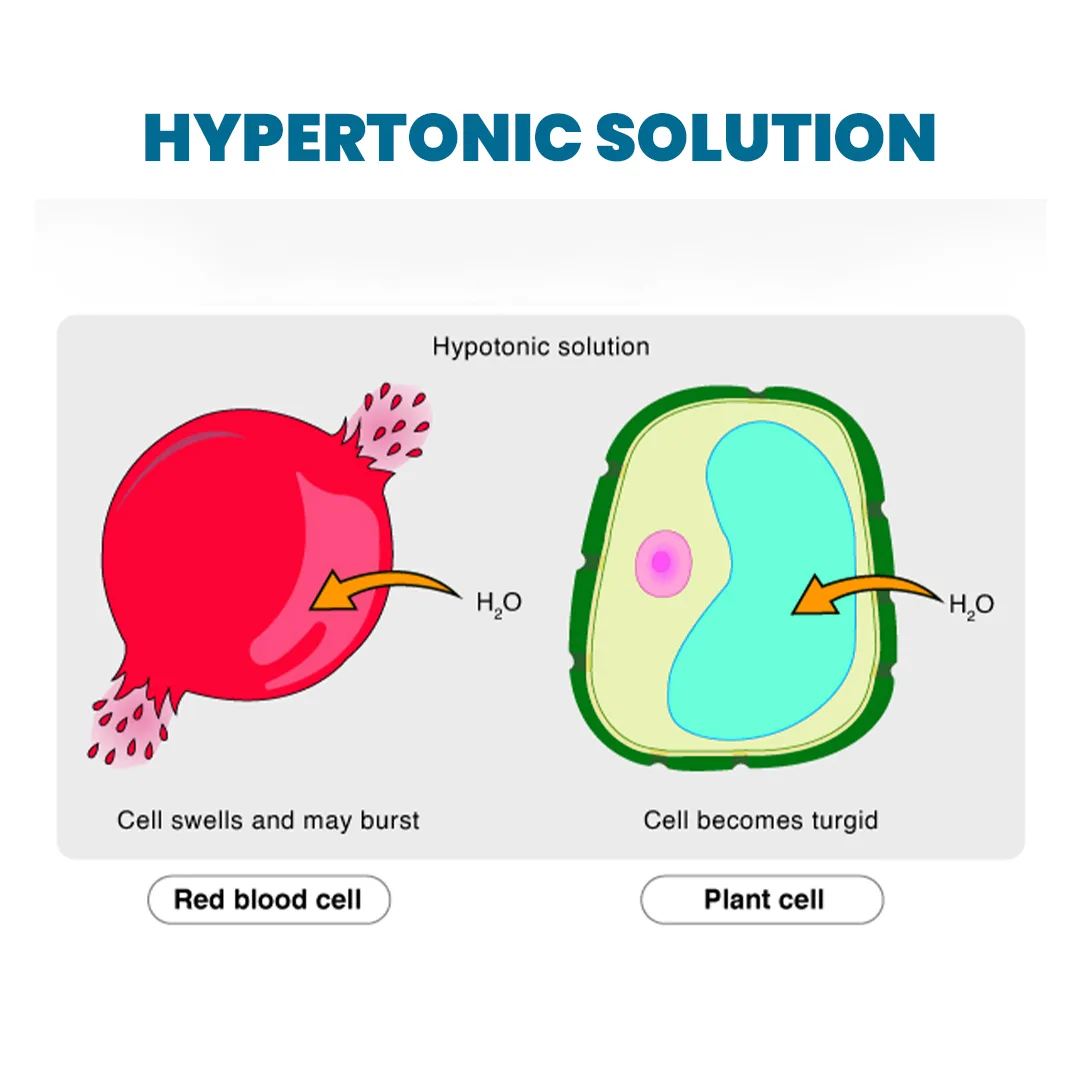
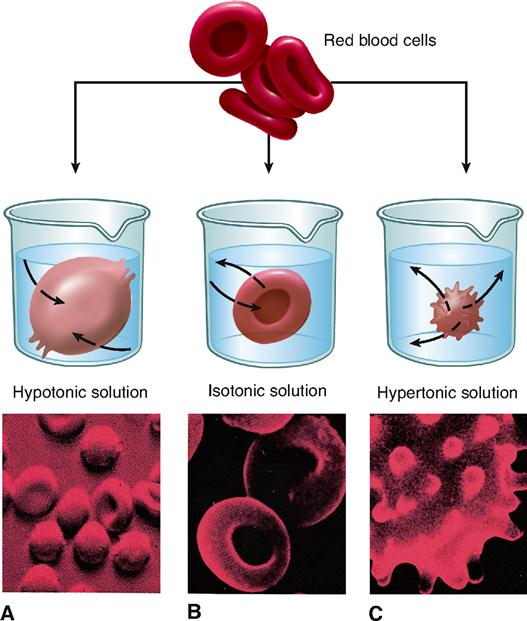
In animal cells, which lack a cell wall, the plasma membrane is the sole structural boundary. As water exits the cell in a hypertonic environment, the volume of the cytoplasm decreases rapidly. The membrane loses its turgor and begins to shrivel, a process called crenation. Under a microscope, crenated red blood cells appear jagged and irregular, losing their characteristic biconcave shape. If the exposure to the hypertonic solution persists, the cell may suffer irreversible damage, as the plasma membrane eventually pulls away from its internal cytoskeleton, leading to cell death.
The Plant Cell: Plasmolysis and Turgor Loss
Plant cells present a more complex scenario due to the presence of a rigid cellulose cell wall. As water leaves the central vacuole, the cell volume shrinks. However, because the cell wall is rigid, it does not collapse inward. Instead, the plasma membrane peels away from the cell wall, a process known as plasmolysis. This is the primary reason why a plant wilts when it is not watered or when soil salinity becomes too high. The cell is technically still “alive” in a state of plasmolysis, but it has lost the turgor pressure required to remain rigid and upright.
Homeostatic Regulation and Cellular Defense Mechanisms
Cells are not entirely passive victims of their environment. Through billions of years of evolution, they have developed sophisticated mechanisms to sense and counteract osmotic stress, attempting to maintain internal homeostasis even when placed in challenging hypertonic surroundings.
Compatible Solutes and Osmolyte Accumulation
Many microorganisms and plant cells have the ability to synthesize or accumulate “compatible solutes”—organic molecules like proline, sorbitol, or betaine. These molecules increase the internal solute concentration without interfering with the cell’s metabolic processes. By increasing their internal osmolarity to match or exceed the external environment, these cells can prevent water loss even in highly hypertonic conditions. This strategy is commonly observed in halophilic (salt-loving) bacteria and drought-resistant plant species.
The Ion Pump Response
Cells also employ active transport mechanisms to manage osmotic stress. By utilizing ATP-driven ion pumps, such as the sodium-potassium pump, cells can move ions across the membrane against their concentration gradient. By pumping specific ions out of the cytosol or sequestering them into internal organelles, a cell can influence its osmotic potential. While this process is energy-intensive, it provides a vital lifeline for cells operating in fluctuating marine or terrestrial environments.
Broader Biological Implications of Hypertonicity
The effects of hypertonic solutions extend far beyond the single-cell level, impacting entire ecosystems and medical applications. The delicate balance of osmotic pressure is a cornerstone of physiological health and biotechnology.
Medical Significance in Intravenous Therapy
In clinical settings, the principles of osmosis are critical. Medical professionals must ensure that fluids administered intravenously are isotonic to the patient’s blood plasma. If a hypertonic saline solution were administered incorrectly, it would cause the patient’s own red blood cells to crenate, potentially leading to widespread tissue damage and circulatory collapse. Conversely, hypertonic solutions are sometimes used therapeutically to reduce intracranial pressure or manage severe edema by drawing excess fluid out of swollen tissues and into the bloodstream for excretion.
Food Preservation and Microbial Inhibition
The human use of hypertonicity dates back to ancient food preservation methods. Salting meat or curing fruit in high-sugar syrups effectively creates a hypertonic environment for any spoilage-causing bacteria. When bacteria land on salted meat, the hypertonic environment causes the microbial cells to lose water and undergo plasmolysis, rendering them unable to reproduce or perform metabolic functions. This simple application of osmotic principles has served as a cornerstone of human survival and food security for millennia.
Environmental Stress and Global Ecology
On a macro level, rising soil salinity due to over-irrigation or climate change poses a significant threat to global agriculture. When soil becomes hypertonic, crops struggle to extract water from the earth, essentially suffering from a drought despite the physical presence of soil moisture. This “physiological drought” underscores the necessity of agricultural innovation, such as the development of salt-tolerant crop varieties and more sustainable water management practices.
Conclusion: The Dynamic Equilibrium
The placement of a cell in a hypertonic solution serves as a window into the core mechanisms of life. Whether observed through the lens of a collapsing red blood cell, a wilting plant leaf, or the survival strategies of extremophile bacteria, the interplay between solute concentration and water movement remains constant. Life, at its most fundamental level, is an ongoing negotiation between internal structure and external reality. By mastering the movement of water across membranes, cells prove that survival is as much about the ability to adapt to gradients as it is about the structural integrity of the individual. Understanding this relationship provides the essential foundation for grasping everything from the complexities of human physiology to the resilience of our natural world.
aViewFromTheCave is a participant in the Amazon Services LLC Associates Program, an affiliate advertising program designed to provide a means for sites to earn advertising fees by advertising and linking to Amazon.com. Amazon, the Amazon logo, AmazonSupply, and the AmazonSupply logo are trademarks of Amazon.com, Inc. or its affiliates. As an Amazon Associate we earn affiliate commissions from qualifying purchases.