
Changing jobs is a milestone often marked by excitement, new challenges, and a significant shift in your daily routine. However, amidst the flurry of signing new contracts and meeting new colleagues, a critical financial component often falls through the cracks: your 401(k) account. For many Americans, a 401(k) represents their largest source of retirement savings. Leaving a company means making a pivotal decision about what to do with those accumulated funds.
How you handle your 401(k) during a job transition can have a multi-decade impact on your net worth. It is not merely an administrative task; it is a strategic financial move that requires an understanding of tax implications, investment flexibility, and long-term growth potential. This guide explores the four primary paths you can take, the nuances of each, and how to ensure your hard-earned money continues to work for you.

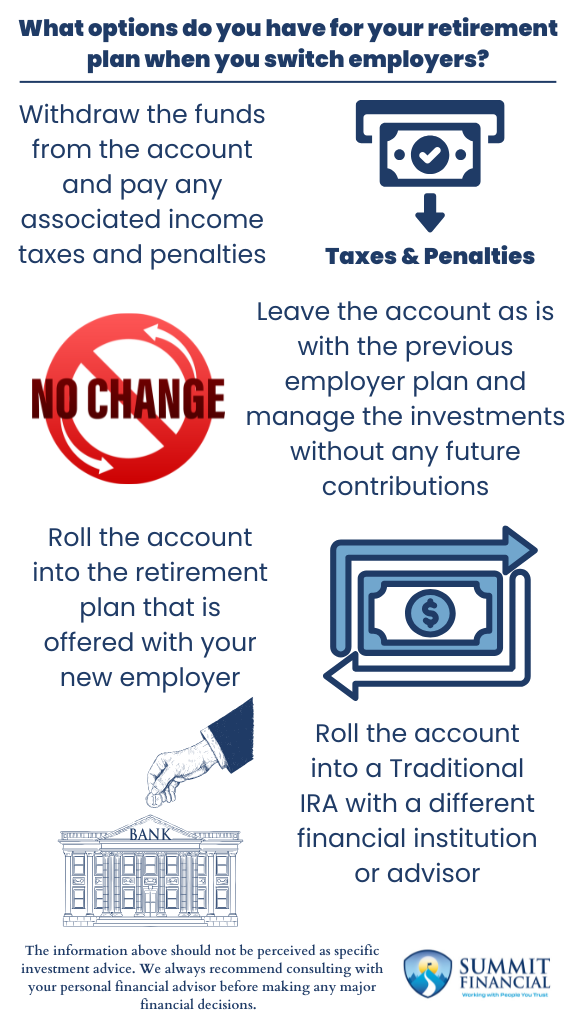
Understanding Your Four Primary Options
When you exit a company, you generally have four choices regarding your 401(k) balance. Each path has distinct advantages and drawbacks depending on your current financial health and your long-term retirement goals.
Leaving the Funds in Your Former Employer’s Plan
If your account balance is above a certain threshold (typically $5,000 to $7,000), most employers allow you to leave your money exactly where it is. This is often the path of least resistance. You maintain your current investment allocations, and the tax-deferred status of the account remains intact. However, if your balance is low—specifically under $1,000—the employer may have the right to “force out” your funds, sending you a check that could trigger taxes and penalties if not handled correctly.
Rolling Over to Your New Employer’s 401(k)
If your new employer offers a 401(k) or 403(b) plan, you may be able to transfer your old balance into the new plan. This process, known as a “roll-in,” allows you to consolidate your retirement savings into a single account. This makes tracking your progress significantly easier and ensures that you are managing one cohesive investment strategy rather than managing fragmented accounts across various institutions.
Rolling Over into an Individual Retirement Account (IRA)
A popular choice for seasoned investors is the “Rollover IRA.” By moving your 401(k) funds into an IRA held at a brokerage of your choice, you gain complete control over your investment options. While 401(k) plans are often limited to a curated menu of mutual funds, an IRA allows you to invest in individual stocks, bonds, ETFs, and even alternative assets.
Taking a Cash Distribution
The final, and generally least advisable, option is to simply cash out the account. While receiving a lump sum of cash may feel like a windfall, it is often a catastrophic financial mistake. For most people under the age of 59½, taking a cash distribution triggers immediate federal and state income taxes, plus a 10% early withdrawal penalty from the IRS. This can instantly evaporate 30% to 50% of your savings.
The Strategic Power of the IRA Rollover
For many professionals, the Rollover IRA offers the highest level of financial sophistication and flexibility. When you leave an employer, you are no longer bound by the specific plan rules or the limited investment lineup chosen by that company’s benefits committee.
Expanded Investment Horizons
Most 401(k) plans offer between 15 and 30 investment options, often consisting of target-date funds and a handful of index or actively managed funds. In contrast, a Rollover IRA opens the door to the entire universe of the financial markets. If you are a proponent of low-cost ETFs or if you prefer to hold specific dividend-paying stocks, the IRA is the superior vehicle. This allows for a more granular approach to asset allocation and risk management that a standard employer plan simply cannot match.
Fee Transparency and Reduction
401(k) plans often carry layers of fees that are not always obvious to the participant. These can include administrative fees, record-keeping fees, and the internal expense ratios of the mutual funds offered. Large employers often negotiate lower institutional rates, but smaller companies may have plans with high overhead. By rolling over to an IRA at a major discount brokerage, you can often eliminate administrative fees entirely and select ultra-low-cost investment products, potentially saving you tens of thousands of dollars over your investing career.

Direct vs. Indirect Rollovers: Avoiding the 20% Withholding
When executing a rollover to an IRA, the method matters. In a “Direct Rollover,” the funds move directly from your old 401(k) provider to your IRA custodian. This is the cleanest method. An “Indirect Rollover,” however, involves the provider sending a check to you, which you must then deposit into an IRA within 60 days. The danger here is that the IRS requires the 401(k) provider to withhold 20% for federal taxes. To complete the rollover and avoid penalties, you would have to come up with that 20% out of your own pocket to deposit into the IRA, waiting until tax season to get the withheld amount back. Always opt for the Direct Rollover to avoid this liquidity trap.
Consolidation and Convenience: Moving to a New Employer Plan
While the IRA offers flexibility, there are compelling reasons to move your old funds into your new employer’s 401(k) plan. This is often the best choice for those who prefer a “set it and forget it” approach to their personal finance.
Simplifying Your Financial Footprint
“Orphaned” 401(k) accounts are a major problem in the United States. Many workers change jobs every three to five years, and by the time they reach mid-career, they may have four or five different accounts scattered across different providers. This fragmentation makes it difficult to calculate your total asset allocation or to rebalance your portfolio effectively. Consolidating into your current employer’s plan ensures that your retirement strategy is unified and easier to monitor through a single login.
Loan Provisions and Legal Protections
One unique advantage of 401(k) plans over IRAs is the ability to take a 401(k) loan. Most plans allow you to borrow up to 50% of your vested balance (up to $50,000) for any reason, with the interest being paid back into your own account. IRAs do not allow for loans. Furthermore, 401(k) plans generally offer stronger federal protection from creditors under the Employee Retirement Income Security Act (ERISA). If you work in a high-liability profession or are concerned about asset protection, keeping your money within the 401(k) ecosystem may be advantageous.
Evaluating the Quality of the New Plan
Before moving your money, you must perform due diligence on your new employer’s plan. Are the fees reasonable? Does the plan offer institutional-class shares of funds with low expense ratios? If the new plan is poorly managed or has high fees, you are better off rolling your old 401(k) into an IRA rather than “infecting” your old savings with the high costs of the new plan.
The Long-Term Impact of Early Withdrawals
The temptation to cash out a 401(k) when changing jobs is real, especially if you are facing a period of unemployment or have high-interest debt. However, from a personal finance perspective, this is almost always a move of last resort.
The Immediate Tax Hit and Penalties
If you choose to take the cash, the IRS views that distribution as ordinary income. If you are in the 22% tax bracket and live in a state with a 5% income tax, you are already losing 27% of your balance. Add the 10% early withdrawal penalty, and nearly 40% of your savings disappears before the check even clears. For a $50,000 account, you might only take home $31,000.
The Opportunity Cost of Lost Compounding
The real tragedy of cashing out is not the taxes paid today, but the wealth lost tomorrow. Retirement accounts thrive on the principle of compounding interest. A $50,000 balance left to grow at an average annual return of 7% would be worth approximately $193,000 in 20 years without adding another penny. By cashing out, you are not just spending $50,000; you are effectively robbing your future self of nearly $200,000 in purchasing power.
Making the Decision: A Strategic Framework
Deciding what to do with your 401(k) should be a calculated step in your broader financial plan. As you transition between roles, use the following framework to guide your choice:
- Assess the Fees: Compare the administrative costs of your old plan, your new plan, and a self-directed IRA.
- Analyze the Investments: Does your new employer offer the funds you need to maintain your desired risk profile? If not, the IRA is the clear winner.
- Check for “Net Unrealized Appreciation” (NUA): If you hold a significant amount of highly appreciated company stock in your 401(k), speak to a financial advisor before doing a rollover. There are specific tax strategies (NUA) that could save you a fortune, but they are forfeited once the money is moved to an IRA.
- Consider Your Timeline: If you are nearing retirement, you might want the flexibility of an IRA. If you are early in your career, the simplicity of a new 401(k) might be more beneficial.
Changing jobs is the perfect time to perform a “financial audit” of your retirement strategy. By taking proactive control of your 401(k) rather than leaving it to chance, you ensure that your career transition is not just a step up in title, but a significant leap forward in your journey toward financial independence.
aViewFromTheCave is a participant in the Amazon Services LLC Associates Program, an affiliate advertising program designed to provide a means for sites to earn advertising fees by advertising and linking to Amazon.com. Amazon, the Amazon logo, AmazonSupply, and the AmazonSupply logo are trademarks of Amazon.com, Inc. or its affiliates. As an Amazon Associate we earn affiliate commissions from qualifying purchases.