
In the traditional view of the consumer lifecycle, the journey ends at the curb. Once a waste management vehicle hauls away a bin, the contents transition from “personal property” to “refuse.” However, in the world of high-stakes business and personal finance, garbage does not simply disappear; it enters a complex, multi-billion-dollar financial ecosystem. To understand what happens to garbage in a landfill is to understand one of the most resilient, recession-proof revenue models in the modern economy.
From a financial perspective, a landfill is not a hole in the ground; it is a long-term asset characterized by high barriers to entry, predictable cash flows, and a unique ability to convert environmental liabilities into energy commodities. This article explores the financial lifecycle of waste, the investment profile of the waste management industry, and how “garbage” is being rebrandished as a vital resource in the global energy market.

The Revenue Model of Modern Landfills
The primary financial driver of any landfill operation is the “tipping fee.” This is the price paid by anyone—municipalities, private contractors, or individuals—to dispose of waste at the site. This revenue model is remarkably stable because waste production is decoupled from many traditional economic fluctuations; even in a downturn, society continues to generate refuse.
Tipping Fees: The Primary Income Stream
Tipping fees are usually calculated per ton. These rates are influenced by regional demand, local regulations, and the remaining “airspace” or capacity of the landfill. In regions where land is scarce, such as the Northeast United States or Western Europe, tipping fees can exceed $100 per ton. For a facility processing several thousand tons a day, this represents a massive daily cash inflow. From a business finance perspective, this is a “toll booth” model: you cannot participate in modern society without paying the gatekeeper of the waste stream.
Operational Costs and Margin Analysis
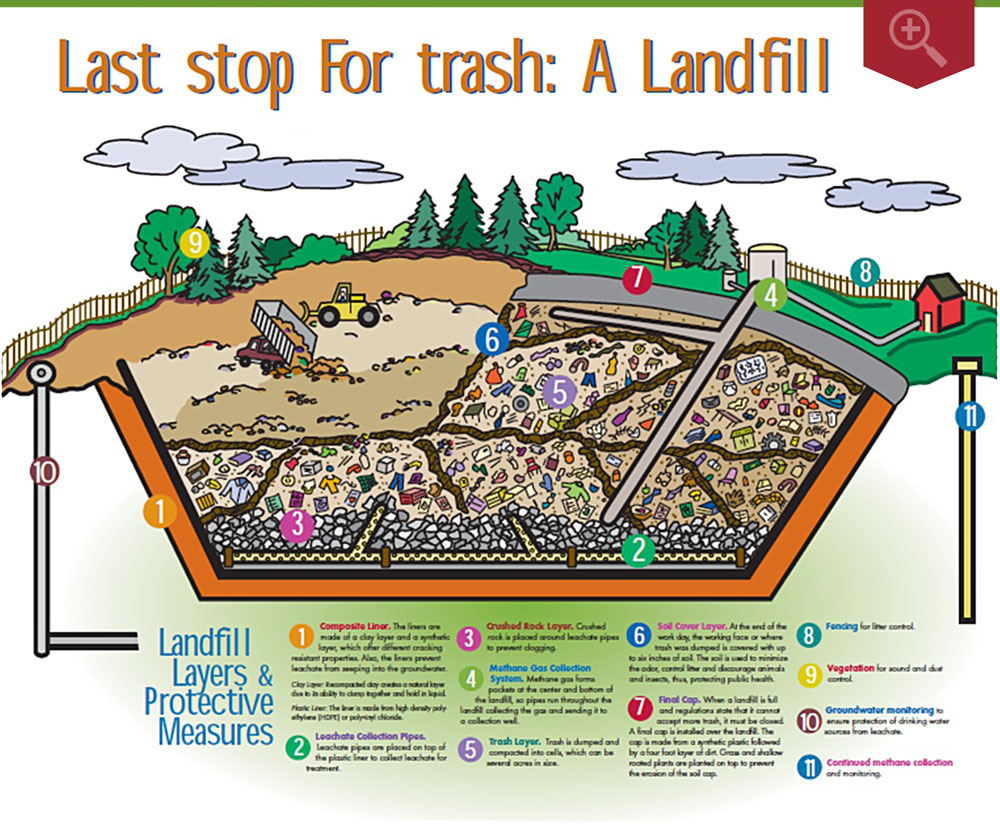
While the revenue is consistent, the cost of managing a landfill is significant. Operators must account for daily cover (soil or foam used to reduce odors), leachate collection (treating the liquid that filters through the waste), and rigorous environmental monitoring. However, because the primary asset—the land—is often purchased decades in advance or inherited through corporate acquisitions, the EBITDA margins for major waste players like Waste Management (WM) or Republic Services (RSG) are often impressively high, frequently hovering between 25% and 30%. The “garbage” effectively becomes a high-margin inventory that never needs to be marketed to a consumer to be sold.
Turning Waste into Wealth: Energy Recovery and Resource Reclamation
What happens to garbage once it is buried? In a modern, “sanitary” landfill, it begins a biological process of anaerobic decomposition. For the savvy investor or corporate strategist, this process represents a transition from a physical liability to a gaseous asset.
The Monetization of Landfill Gas (LFG)
As organic waste breaks down, it produces landfill gas, which is roughly 50% methane. Methane is the primary component of natural gas. Instead of merely venting this gas—which is a potent greenhouse gas—operators capture it via a network of pipes. This captured gas can be sold as Renewable Natural Gas (RNG) or burned on-site in turbines to generate electricity. This creates a secondary revenue stream that transforms a disposal site into a localized power plant. For an investor, this represents “found money”—profit generated from a byproduct of the primary business activity.
Carbon Offsets and Renewable Energy Credits (RECs)
In the current financial landscape, the ability to capture methane is not just an energy play; it is a “green” financial play. By preventing methane from entering the atmosphere, landfill operators can generate carbon credits. These credits are sold on the open market to corporations looking to offset their own carbon footprints. Additionally, electricity generated from landfill gas often qualifies for Renewable Energy Credits (RECs), which trade at a premium. This layered financial structure allows “garbage” to pay dividends three times over: first as a tipping fee, second as a fuel source, and third as a tradable environmental instrument.
Landfill Real Estate and Long-term Investment Profiles
In the world of investing, landfills represent some of the most valuable “moats” in the industrial sector. You cannot simply open a new landfill; the “Not In My Backyard” (NIMBY) sentiment and stringent environmental zoning make permitting a new site a process that can take decades and millions of dollars in legal fees. This creates an inherent scarcity that protects the value of existing landfills.
The Scarcity Principle in Waste Real Estate
For a financial analyst, the “airspace” within a landfill is the inventory. As a landfill fills up, the value of the remaining space increases. This is a rare example of an asset that becomes more valuable as its supply diminishes. Major waste corporations trade at high price-to-earnings (P/E) multiples because their market position is virtually unassailable. Unlike tech startups that face constant disruption, a landfill company owns a physical, regulated location that is essential to the functioning of its surrounding city.
Post-Closure Financial Assurance and Liability
A critical component of landfill business finance is the “Post-Closure” fund. When a landfill reaches capacity, the operator is legally required to maintain and monitor the site for 30 years or more. From a balance sheet perspective, this is a long-term liability. Companies must set aside “financial assurance” in the form of trust funds or surety bonds. Intelligent management of these funds—investing them in low-risk, interest-bearing vehicles—is essential to ensuring that the landfill does not become a financial drain once it stops accepting new waste. The transition from an active revenue generator to a managed liability is a masterclass in long-term fiscal planning.
The Financial Future: Circular Economy Disruptions
As we look toward the next decade, the “money” in garbage is shifting. The rise of ESG (Environmental, Social, and Governance) investing is forcing waste companies to move beyond simple burial. The goal is now “resource recovery,” and this shift is opening up new avenues for online income, tech-integrated waste management, and venture capital.
Risk Management in an Era of Zero-Waste Goals
Municipalities and corporations are increasingly setting “Zero Waste” goals. On the surface, this looks like a threat to the landfill business model. However, the dominant financial players are diversifying. They are investing heavily in Materials Recovery Facilities (MRFs)—highly automated plants that use AI and robotics to sort recyclables. By controlling both the landfill and the recycling center, these companies ensure that whether the “garbage” is buried or reused, the revenue stays within their ecosystem.
The Rise of Waste-to-Value Startups
There is a growing “side hustle” and startup culture centered around landfill diversion. Companies are finding ways to turn specific waste streams—like food scraps or plastic—into high-value products like bio-fertilizers or construction materials. For the individual investor, looking at “Waste-to-Value” stocks or private equity funds is a way to capitalize on the inefficiency of current landfill models. We are seeing a shift where the “garbage” in a landfill is increasingly viewed as a failure of the supply chain—and every failure in a supply chain represents a massive financial opportunity for the person who can fix it.
Conclusion: The Enduring Value of the Disposal Sector
What happens to garbage in a landfill is far more than a biological or environmental story; it is a financial one. From the moment the tipping fee is collected, the waste begins a journey of value extraction. It serves as a defensive wall for large-cap stocks, a source of renewable energy, a generator of carbon credits, and eventually, a long-term managed asset.
For those focused on personal finance and investing, the lesson is clear: essential services with high barriers to entry and multiple revenue streams are the bedrock of a stable portfolio. While the contents of a landfill may be discarded by society, they remain a cornerstone of the global economy, proving that in the world of money, one man’s trash is quite literally another man’s treasure. As technology advances and the pressure for sustainability grows, the way we monetize these sites will evolve, but the fundamental economic value of managed waste is here to stay.
aViewFromTheCave is a participant in the Amazon Services LLC Associates Program, an affiliate advertising program designed to provide a means for sites to earn advertising fees by advertising and linking to Amazon.com. Amazon, the Amazon logo, AmazonSupply, and the AmazonSupply logo are trademarks of Amazon.com, Inc. or its affiliates. As an Amazon Associate we earn affiliate commissions from qualifying purchases.