
The Academy Awards, often referred to as the Oscars, represent the pinnacle of achievement in the film industry. For aspiring filmmakers and seasoned industry veterans alike, a golden statuette is the ultimate recognition of creative and technical excellence. While individual awards for acting, directing, or screenwriting are highly coveted, the true measure of a film’s widespread impact and critical acclaim can often be gauged by its overall Oscar haul. Some films have managed to transcend individual categories, achieving near-sweeping victories that cement their place in cinematic history. Examining these record-breaking successes offers a fascinating glimpse into the films that have resonated most profoundly with the Academy voters and, by extension, the broader cultural landscape.

This exploration delves into the films that have achieved the highest number of Oscar wins, understanding that such triumphs are not merely about accumulating hardware but also reflect a confluence of exceptional storytelling, masterful direction, groundbreaking technical execution, and compelling performances. These are the cinematic titans that have not only captured the imagination of audiences but have also been unequivocally validated by the industry’s most prestigious accolades.
The Unrivaled Champions: Films with 11 or More Wins
When we speak of films that have dominated the Academy Awards, a select group stands head and shoulders above the rest. These are the films that have achieved an unprecedented level of recognition, securing a staggering number of wins that speak volumes about their all-encompassing excellence. These titles are not just successful; they are legendary, marking a watershed moment in cinematic history and setting benchmarks that continue to inspire and challenge filmmakers today.
Ben-Hur (1959): A Spectacle of Epic Proportions
MGM’s epic historical drama, Ben-Hur, directed by William Wyler, stands as a monumental achievement in filmmaking and a testament to the power of grand-scale storytelling. Released in 1959, the film was a massive undertaking, both technically and artistically, and its impact was immediately recognized by the Academy.
A Sweep of 11 Oscars
Ben-Hur achieved a remarkable clean sweep, winning an astounding 11 Academy Awards out of its 12 nominations. This remains one of the highest Oscar counts for any single film. Its victories spanned across numerous key categories, demonstrating a rare instance of unanimous critical acclaim for nearly every aspect of its production. The film secured:
- Best Picture: A testament to its grand vision and successful execution.
- Best Director: William Wyler’s masterful handling of the epic scope and intimate drama was widely lauded.
- Best Actor: Charlton Heston’s iconic performance as Judah Ben-Hur earned him the lead actor Oscar.
- Best Supporting Actor: Hugh Griffith won for his memorable portrayal of Sheik Ilderim.
- Best Art Direction (Color): The lavish sets and costumes were a visual feast.
- Best Cinematography (Color): Robert L. Surtees’ breathtaking cinematography captured the grandeur of ancient Rome and the Holy Land.
- Best Costume Design (Color): Elizabeth Haffenden’s intricate and historically inspired costumes were a significant part of the film’s visual identity.
- Best Film Editing: Ralph E. Winters and John D. Macedo’s seamless editing kept the nearly three-and-a-half-hour film engaging.
- Best Music (Scoring of a Dramatic or Comedy Picture): Miklós Rózsa’s powerful and memorable score became synonymous with the film.
- Best Sound Recording: The film’s impressive sound design contributed significantly to its immersive experience.
- Irving G. Thalberg Memorial Award: While not a competitive win for the film itself, this prestigious award was given to producer Sam Zimbalist posthumously, acknowledging his visionary work on Ben-Hur.
The film’s success was fueled by its groundbreaking chariot race sequence, which was a marvel of filmmaking for its time, requiring immense planning, technical ingenuity, and sheer bravery. Beyond the spectacle, Ben-Hur resonated with audiences and critics for its powerful themes of betrayal, redemption, and faith, all set against a meticulously recreated historical backdrop. The film’s triumph demonstrated that a well-crafted epic, with compelling performances and impeccable technical artistry, could capture the hearts of the Academy.
The Lord of the Rings: The Return of the King (2003): A Fantasy Epic’s Triumphant Conclusion
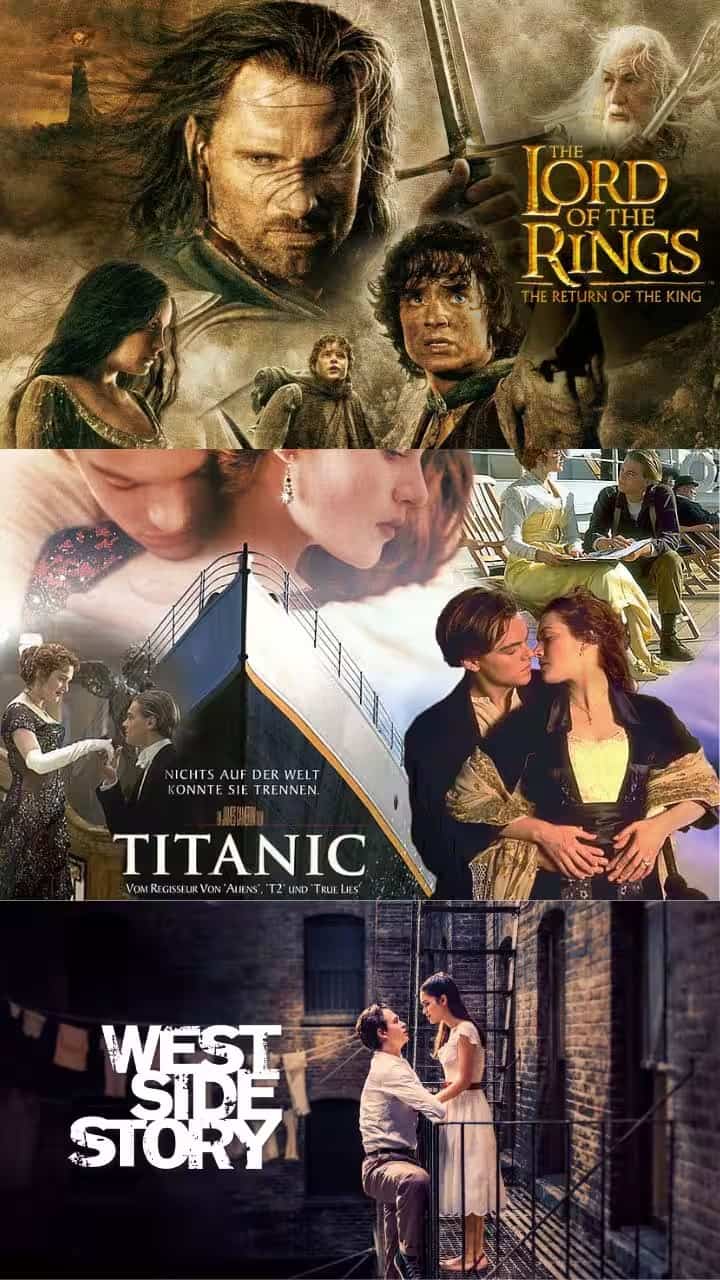
Peter Jackson’s ambitious adaptation of J.R.R. Tolkien’s beloved fantasy novels reached its breathtaking conclusion with The Lord of the Rings: The Return of the King. This 2003 film not only concluded a cinematic trilogy but also achieved a historic feat at the Academy Awards, matching the record set by Ben-Hur.
A Perfect Sweep of 11 Oscars
Remarkably, The Return of the King achieved a perfect sweep, winning all 11 Academy Awards for which it was nominated. This flawless victory was unprecedented for a fantasy film and solidified its status as a cinematic masterpiece. The film’s wins included:
- Best Picture: A groundbreaking win for a fantasy film, signifying a major shift in Academy perception.
- Best Director: Peter Jackson’s visionary direction and his ability to wrangle such a massive production were recognized.
- Best Adapted Screenplay: Fran Walsh, Philippa Boyens, and Peter Jackson were lauded for their skillful adaptation of Tolkien’s complex narrative.
- Best Film Editing: Jamie Selkirk and Michael J. Horton’s intricate editing wove together multiple storylines seamlessly.
- Best Art Direction: Grant Major, Dan Hennah, and Alan Lee were celebrated for creating the visually stunning worlds of Middle-earth.
- Best Costume Design: Ngila Dickson and Richard Taylor’s extraordinary costume designs brought the diverse cultures of Middle-earth to life.
- Best Makeup: Richard Taylor and Peter Jackson’s team were recognized for their incredible creature design and prosthetics.
- Best Original Score: Howard Shore’s epic and emotive score became an integral part of the film’s success.
- Best Original Song: “Into the West,” performed by Annie Lennox, won for its poignant and fitting lyrics.
- Best Sound Mixing: Christopher Boyes, Michael Semanick, Michael Hedges, and Hammond Peek were recognized for their immersive sound design.
- Best Visual Effects: Jim Rygiel, Joe Letteri, Randall William Cook, and Alex Funke were awarded for their groundbreaking visual effects that brought Middle-earth to life.
The success of The Return of the King was particularly significant as it demonstrated that a genre often perceived as less “serious” could achieve the highest levels of critical acclaim. The film’s ability to balance sweeping spectacle with profound emotional depth, coupled with the sheer dedication of its cast and crew, resonated deeply with voters. It was a culmination of years of hard work and a testament to the power of ambitious storytelling and technological innovation. The perfect sweep served as a powerful statement about the artistic merit and cultural significance of the fantasy genre.
The Elite Group: Films with 10 Wins
While 11 wins is the ultimate benchmark, achieving 10 Oscar wins places a film in an incredibly exclusive echelon of cinematic excellence. These films, though falling just short of the absolute record, are still considered among the greatest films ever made, having garnered widespread acclaim across a multitude of categories.
West Side Story (1961): A Musical Revolution

Robert Wise and Jerome Robbins’ groundbreaking musical, West Side Story, remains a powerful and enduring work of art. This 1961 adaptation of the classic Broadway musical brought Shakespeare’s Romeo and Juliet to the gritty streets of New York, using song, dance, and drama to tell a compelling story of love and prejudice.
A Decade of Accolades
West Side Story garnered an impressive 10 Academy Awards from its 11 nominations. This made it one of the most awarded musicals in Oscar history and a significant cultural touchstone. The film’s victories included:
- Best Picture: Recognizing its overall excellence as a cinematic achievement.
- Best Director: Robert Wise received the award for his visionary direction.
- Best Supporting Actor: George Chakiris won for his dynamic portrayal of Bernardo.
- Best Supporting Actress: Rita Moreno triumphed for her vibrant and memorable performance as Anita.
- Best Art Direction (Color): Victor A. Gangelin and Leo K. Kuter were honored for their immersive set designs.
- Best Costume Design (Color): Irene Sharaff’s iconic costumes are still celebrated today.
- Best Film Editing: Thomas Stanford’s energetic editing captured the film’s dynamic pace.
- Best Music (Scoring of a Musical Picture): Saul Chaplin, Johnny Green, Sid Ramin, and Irwin Kostal won for their masterful musical arrangements.
- Best Sound Recording: For its exceptional audio quality.
- Best Cinematography (Color): Daniel L. Fapp’s vibrant cinematography brought the urban landscape to life.
West Side Story‘s success was a testament to its innovative approach to musical filmmaking. The integration of Jerome Robbins’ groundbreaking choreography into the narrative, combined with Leonard Bernstein’s iconic score and Stephen Sondheim’s poignant lyrics, created a truly immersive and emotionally resonant experience. The film’s daring exploration of social issues within the framework of a tragic love story resonated deeply with audiences and critics alike, solidifying its place as a classic.
The English Patient (1996): A Masterpiece of Romance and War
Anthony Minghella’s sweeping romantic drama, The English Patient, captured the hearts of Academy voters in 1996, earning a remarkable number of accolades. Set against the backdrop of World War II, the film is a beautifully crafted tale of love, loss, and memory.
Ten Oscars for a Powerful Narrative
The English Patient achieved a significant triumph by winning 9 Academy Awards out of 12 nominations. This near-perfect score underscored its profound impact and critical appreciation. The film’s major wins included:
- Best Picture: A testament to its sweeping narrative and masterful production.
- Best Director: Anthony Minghella’s sensitive and artful direction was widely praised.
- Best Supporting Actress: Juliette Binoche won for her moving portrayal of Hana.
- Best Art Direction: Stuart Craig and Stephenie McMillan were honored for their evocative set designs.
- Best Cinematography: John Seale’s breathtaking visuals painted a vivid portrait of the desert landscape.
- Best Costume Design: Ann Roth and Jenny Beavan received accolades for their period-accurate attire.
- Best Film Editing: Walter Murch’s masterful editing skillfully wove together the film’s complex narrative threads.
- Best Original Dramatic Score: Gabriel Yared’s haunting score perfectly complemented the film’s emotional resonance.
- Best Sound: Walter Murch and John Michael Smith were recognized for their exceptional sound work.
The English Patient‘s success was a testament to its potent blend of grand romance, historical context, and profound emotional depth. The film’s exquisite cinematography, rich musical score, and compelling performances created a cinematic experience that was both visually stunning and deeply moving. It demonstrated the enduring appeal of character-driven dramas that explore universal themes of love, sacrifice, and the human condition.
The Significance of Multiple Wins
The films that consistently appear on lists of most Oscar wins share several common threads, revealing a blueprint for cinematic success recognized by the Academy. These are not merely films that excel in one or two areas; they are comprehensive achievements that demonstrate mastery across the board.
A Symphony of Excellence: Technical Prowess and Artistic Vision
The films that achieve multiple Oscar wins invariably showcase exceptional technical execution. This encompasses a wide range of departments, from breathtaking cinematography that captures the essence of a story’s setting to meticulously crafted production design that builds immersive worlds. Costume design plays a crucial role in establishing character and historical context, while editing ensures a cohesive and engaging narrative flow. Sound design and mixing contribute to the overall atmosphere and emotional impact, and groundbreaking visual effects, especially in modern cinema, can redefine what is possible on screen. The awards in these technical categories often reflect the sheer effort, innovation, and attention to detail that go into creating a truly cinematic experience.
However, technical brilliance alone is rarely enough. The most awarded films also possess a strong artistic vision, driven by compelling storytelling and masterful direction. A powerful screenplay, whether original or adapted, provides the foundational narrative. Best Director awards recognize the guiding hand that shapes the film’s tone, pace, and performances. Acting awards, particularly for Best Actor, Best Actress, Best Supporting Actor, and Best Supporting Actress, highlight the performances that bring characters to life and resonate emotionally with audiences. The Best Picture award, the most prestigious of all, signifies the Academy’s overall endorsement of a film’s complete package – its ability to entertain, provoke thought, and leave a lasting impression.
The Impact of Genre and Scale
Historically, epic films, musicals, and dramas have often been the most successful at the Academy Awards. This is partly due to their inherent scale, which allows for greater opportunities to showcase technical achievements in areas like set design, costumes, and cinematography. Musicals, by their nature, require excellence in music, acting, and choreography, often leading to multiple wins in related categories. Dramas, with their focus on character and emotion, tend to earn accolades for writing and acting.
However, the success of The Lord of the Rings: The Return of the King marked a significant moment, demonstrating that fantasy films, previously often overlooked for major awards, could achieve the highest levels of recognition. This broadened the Academy’s scope and highlighted a growing appreciation for the creative and technical artistry involved in even the most fantastical genres. The scale of production, the complexity of the narrative, and the emotional depth of such films can, when executed effectively, capture the attention and admiration of Academy voters.
In conclusion, the films that have won the most Oscars are more than just popular movies; they are benchmarks of cinematic excellence. They represent a rare confluence of artistic vision, technical mastery, and compelling storytelling that has captivated both critics and audiences. Examining their achievements provides valuable insights into what constitutes a truly remarkable film and continues to inspire filmmakers to push the boundaries of what is possible in the art of cinema.
aViewFromTheCave is a participant in the Amazon Services LLC Associates Program, an affiliate advertising program designed to provide a means for sites to earn advertising fees by advertising and linking to Amazon.com. Amazon, the Amazon logo, AmazonSupply, and the AmazonSupply logo are trademarks of Amazon.com, Inc. or its affiliates. As an Amazon Associate we earn affiliate commissions from qualifying purchases.