
Lipids, a diverse group of organic compounds essential for life, are primarily characterized by their insolubility in water and solubility in organic solvents. While often associated with fats and oils, the lipid family encompasses a broader spectrum of molecules, including phospholipids, steroids, and waxes. Understanding the elemental composition of lipids is fundamental to comprehending their vast array of biological functions, from energy storage and cell membrane structure to signal transduction and insulation. This article delves into the elemental building blocks of lipids and explores how their unique compositions contribute to their critical roles within biological systems.
The Fundamental Building Blocks: Carbon, Hydrogen, and Oxygen
At the most basic level, lipids, like carbohydrates and proteins, are organic molecules. This means their structure is built around a backbone of carbon atoms. The unique properties of carbon, such as its ability to form stable single, double, and triple bonds, and its capacity to link with up to four other atoms, allow for the creation of a vast array of molecular structures.
The Carbon Backbone: A Versatile Framework
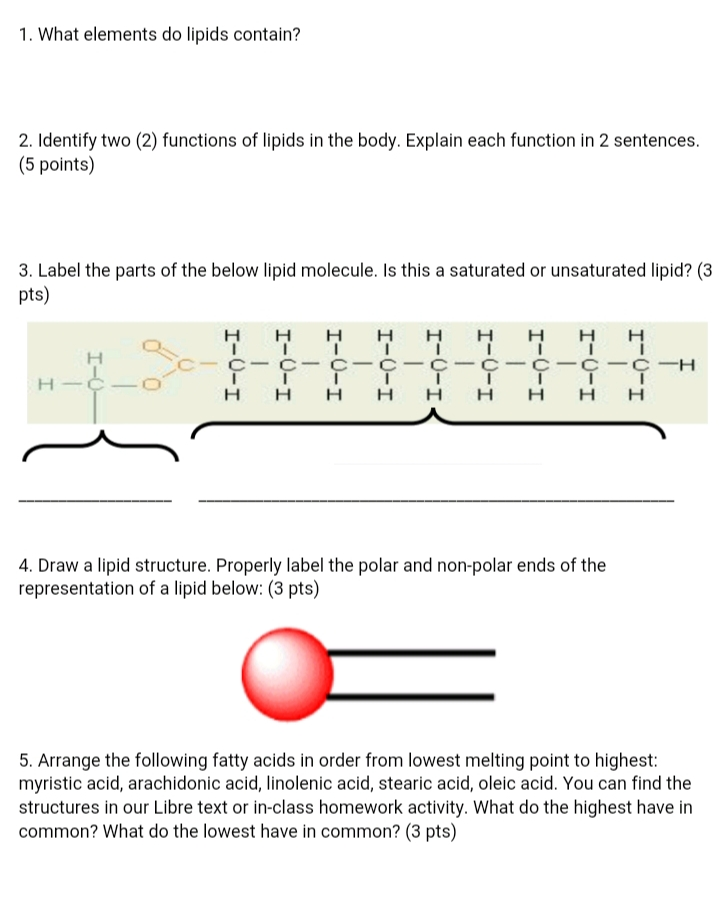
The core of every lipid molecule is a chain or ring of carbon atoms. The length and degree of saturation of these carbon chains are key determinants of a lipid’s properties. For instance, fatty acids, which are the building blocks of many common lipids, consist of a long hydrocarbon chain (a chain of carbon atoms bonded to hydrogen atoms) with a carboxyl group (-COOH) at one end.
- Hydrocarbon Chains: These chains are composed solely of carbon-carbon and carbon-hydrogen single bonds (saturated fatty acids) or can contain one or more carbon-carbon double or triple bonds (unsaturated fatty acids). The presence of double bonds introduces kinks or bends into the molecule, affecting how tightly the lipid molecules can pack together. This, in turn, influences their physical state at room temperature – longer, saturated chains tend to be solid (fats), while shorter or unsaturated chains are more likely to be liquid (oils).
- Carboxyl Group: This functional group, consisting of a carbon atom double-bonded to one oxygen atom and single-bonded to another oxygen atom which is also bonded to a hydrogen atom, gives fatty acids their acidic nature. In biological systems, this group is typically ionized, carrying a negative charge, which further contributes to the polarity of the molecule’s “head.”
The Role of Hydrogen: Defining Saturation and Energy Content
Hydrogen atoms play a crucial role in defining the saturation of the carbon chain and, consequently, the lipid’s properties. In saturated fatty acids, every carbon atom in the chain is bonded to the maximum possible number of hydrogen atoms. This leads to straight, linear molecules that can pack closely together, resulting in higher melting points and solid states at room temperature. Examples include stearic acid and palmitic acid, commonly found in animal fats.
Unsaturated fatty acids, on the other hand, contain one or more carbon-carbon double bonds. Each double bond reduces the number of hydrogen atoms bonded to the carbon chain, as carbon can only form four bonds. This creates “kinks” or bends in the hydrocarbon chain, preventing close packing and leading to lower melting points and liquid states at room temperature. Monounsaturated fatty acids have one double bond (e.g., oleic acid, found in olive oil), while polyunsaturated fatty acids have two or more double bonds (e.g., linoleic acid and alpha-linolenic acid, essential fatty acids found in vegetable oils and fish oil). The degree of unsaturation significantly impacts the physical and physiological properties of lipids.
Oxygen: Introducing Polarity and Functionality
While carbon and hydrogen form the bulk of the lipid molecule, oxygen atoms are essential for conferring specific functional groups and introducing a degree of polarity. The carboxyl group (-COOH) in fatty acids is a prime example. The presence of electronegative oxygen atoms within this group draws electron density away from the carbon and hydrogen atoms, creating a partial positive charge on the hydrogen and partial negative charges on the oxygen atoms. This polarity makes the carboxyl end of a fatty acid molecule hydrophilic (water-attracting) to some extent, while the long hydrocarbon chain remains hydrophobic (water-repelling). This amphipathic nature, possessing both hydrophilic and hydrophobic regions, is critical for the function of many lipids, most notably phospholipids in cell membranes.
Oxygen atoms also feature prominently in other important lipid functional groups, such as ester linkages, hydroxyl groups, and phosphate groups, which are central to the structure and function of more complex lipids.
Beyond the Basics: Introducing Phosphorus and Nitrogen
While carbon, hydrogen, and oxygen are the ubiquitous elements in all lipids, certain classes of lipids incorporate additional elements, most notably phosphorus and, less commonly, nitrogen. These elements significantly alter the properties and functions of the lipids they are incorporated into, leading to specialized roles within biological systems.
Phosphorus: The Key to Phospholipids

Phospholipids are a cornerstone of cell membranes, forming the lipid bilayer that encloses all living cells. Their unique structure is derived from a glycerol backbone, two fatty acid chains, and a phosphate group. The presence of phosphorus in the phosphate group is a defining characteristic of phospholipids and is crucial for their amphipathic nature.
- The Phosphate Head: The phosphate group (-PO₄³⁻) is highly polar and negatively charged at physiological pH. This strong hydrophilicity makes the “head” of the phospholipid molecule readily interact with water molecules.
- Glycerol Backbone: This three-carbon alcohol serves as the central structural unit to which the fatty acid chains and the phosphate group are attached.
- Ester Linkages: The fatty acid chains are attached to the glycerol backbone via ester linkages, formed through a condensation reaction between the carboxyl group of the fatty acid and a hydroxyl group of the glycerol.
- Varied Head Groups: The phosphate group is often further modified by the attachment of other small, polar molecules, such as choline, ethanolamine, serine, or inositol. These additional head groups, while not containing phosphorus themselves, are attached to the phosphate and can further influence the charge and chemical properties of the phospholipid’s head, impacting membrane fluidity, signaling pathways, and interactions with other cellular components. The presence of the phosphate group, however, remains the defining feature that imbues phospholipids with their essential membrane-forming capabilities.
The amphipathic nature of phospholipids, with their hydrophobic fatty acid tails and hydrophilic phosphate heads, drives them to spontaneously arrange into a bilayer in aqueous environments. The hydrophobic tails face inwards, away from the water, while the hydrophilic heads face outwards, interacting with the surrounding aqueous medium. This forms the fundamental structure of cell membranes, regulating the passage of substances into and out of the cell.
Nitrogen: A Component of Sphingolipids and Sterols
Nitrogen is another element that can be found in certain lipid classes, although it is less universally present than phosphorus. Its incorporation often imparts specialized structural or signaling functions.
- Sphingolipids: This class of lipids, structurally distinct from glycerophospholipids, utilizes a long-chain amino alcohol called sphingosine as its backbone. Sphingosine contains an amino group (-NH₂), which introduces nitrogen into the molecule. Fatty acids are attached to sphingosine via an amide linkage. Sphingolipids, particularly ceramides (sphingosine linked to a fatty acid), are important components of cell membranes, especially in nerve tissue, and play roles in cell signaling and recognition. Glycosphingolipids, where carbohydrates are attached to ceramides, are involved in cell surface interactions and immune responses.
- Steroids: Steroids are characterized by a unique four-ring carbon structure. While the core steroid structure itself is composed solely of carbon and hydrogen, some steroid derivatives can contain nitrogen. For instance, certain steroid hormones and bile acids, which are derived from cholesterol, may undergo modifications that incorporate nitrogen-containing groups. However, the fundamental elemental composition of the steroid ring system itself does not include nitrogen. The most prominent example of a nitrogen-containing lipid is likely found within certain signaling molecules derived from lipids.
The inclusion of nitrogen, particularly in sphingolipids, highlights the diverse structures and functional adaptations that lipids can achieve, extending their roles beyond mere energy storage and structural integrity to intricate cellular communication and recognition processes.
The Significance of Lipid Element Composition
The specific elements present in a lipid molecule, and their arrangement, dictate its physical properties, chemical reactivity, and biological function.
Hydrophobicity and Amphipathicity: The Driving Force of Membrane Formation
The dominance of carbon and hydrogen in the long hydrocarbon chains of lipids results in their hydrophobic nature. These chains are nonpolar, meaning the electrons are shared relatively equally between the carbon and hydrogen atoms, creating no significant partial charges. This lack of polarity prevents interaction with polar water molecules, causing lipids to repel water. However, the presence of oxygen in functional groups like carboxyls, phosphates, and hydroxyls introduces areas of polarity. When these polar regions are coupled with hydrophobic tails, the molecule becomes amphipathic. As discussed, this amphipathicity is the fundamental principle behind the formation of lipid bilayers, the structural basis of all cellular membranes.
Energy Storage: The Power of Hydrocarbon Bonds
The strong carbon-carbon and carbon-hydrogen bonds in the hydrocarbon chains of lipids are rich in energy. The oxidation of these bonds during metabolic processes releases a substantial amount of energy, making lipids an incredibly efficient form of energy storage for organisms. Gram for gram, lipids store more than twice the energy of carbohydrates. The prevalence of these energy-rich covalent bonds, formed between carbon and hydrogen, is a direct consequence of the elemental composition of lipids.

Signaling and Regulation: The Role of Functional Groups
Beyond structural and energy roles, lipids are deeply involved in cell signaling and regulation. The specific arrangement of elements, particularly the presence and type of functional groups containing oxygen, phosphorus, and sometimes nitrogen, determines a lipid’s ability to interact with cellular receptors and trigger specific biochemical pathways. For example, phospholipids like phosphatidylinositol phosphates (PIPs) are crucial signaling molecules that can recruit specific proteins to the cell membrane, initiating cascades of cellular events. Steroid hormones, with their characteristic four-ring structure, are lipid-soluble signaling molecules that can easily cross cell membranes and bind to intracellular receptors, influencing gene expression. The precise elemental makeup allows for this intricate molecular recognition and communication.
In conclusion, the elemental composition of lipids, fundamentally carbon, hydrogen, and oxygen, provides the versatile framework for their diverse functions. The addition of phosphorus and nitrogen in specific lipid classes unlocks specialized roles, from the formation of cellular boundaries to intricate signaling pathways. A thorough understanding of these elemental constituents is paramount for appreciating the fundamental importance of lipids in all living organisms.
aViewFromTheCave is a participant in the Amazon Services LLC Associates Program, an affiliate advertising program designed to provide a means for sites to earn advertising fees by advertising and linking to Amazon.com. Amazon, the Amazon logo, AmazonSupply, and the AmazonSupply logo are trademarks of Amazon.com, Inc. or its affiliates. As an Amazon Associate we earn affiliate commissions from qualifying purchases.