
The chilling world of criminal psychology has captivated audiences for decades, and few shows have brought its intricacies to the forefront quite like Criminal Minds. At the heart of every episode, driving the relentless pursuit of justice by the FBI’s elite Behavioral Analysis Unit (BAU), lies a single, ominous acronym: UNSUB. More than just a simple label, “UNSUB” represents the quintessential mystery, the unseen antagonist whose dark deeds necessitate a deep dive into the human psyche. It is the blank slate upon which a complex psychological portrait is meticulously painted, guiding investigators through the labyrinthine corridors of motive, opportunity, and signature.

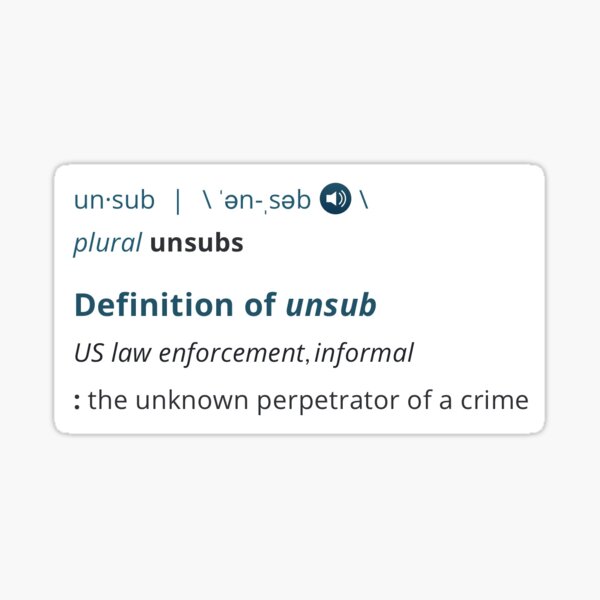
In the realm of Criminal Minds, “UNSUB” stands for “Unknown Subject” or “Subject Unknown.” It is the initial, critical designation for the perpetrator of a crime who has not yet been identified. This term is not unique to the fictional world of television; it is a standard abbreviation used by law enforcement agencies, including the FBI, when referring to an individual whose identity remains a mystery, but whose actions are clearly delineated by the evidence at hand. For the BAU, the UNSUB is more than just a person; it’s a puzzle that must be solved through behavioral analysis, forensic psychology, and an understanding of human depravity. Their mission is to peel back the layers of the crime itself, not just to find out who did it, but why they did it, and what kind of person would commit such acts. This process transforms a nameless entity into a discernible pattern, ultimately leading to identification and apprehension. The concept of the UNSUB, therefore, is the very foundation upon which the show’s dramatic tension and intellectual appeal are built, illustrating the profound challenge and equally profound satisfaction of bringing a hidden criminal to light.
The Core Concept: Decoding “UNSUB” in Criminal Minds
The journey of an “UNSUB” from a mere placeholder to a fully identified criminal is the narrative backbone of Criminal Minds. For the BAU, the term encapsulates the initial void of information, a vacuum that must be filled with insights derived from the crime scene, victimology, and forensic evidence. It’s a deliberate strategy to depersonalize the perpetrator initially, allowing the profilers to focus purely on the behavioral patterns and psychological implications of the crimes themselves, rather than getting sidetracked by potential suspects or biases. This systematic approach is what differentiates the BAU’s methodology from conventional detective work, emphasizing the ‘why’ and ‘how’ over the immediate ‘who.’
From “Unknown Subject” to Behavioral Blueprint
The essence of profiling an UNSUB lies in constructing a “behavioral blueprint.” This isn’t about guesswork; it’s a rigorous process of inferring psychological traits from observed behaviors. Every detail at a crime scene, from the weapon used to the victim selection, the method of attack, and even the post-offense behavior, contributes to this blueprint. The BAU scrutinizes these elements to deduce the UNSUB’s motivations, fantasies, habits, and even their likely demographic characteristics. For instance, the type of force used might suggest a power fantasy, while specific rituals could point to an organized vs. disorganized personality. This transforms the “unknown” into a set of probable characteristics: age range, socio-economic status, intelligence level, occupation, and even potential relationship status. The goal is not to find “a person” but to define “the kind of person” capable of such acts, thereby narrowing the search parameters dramatically. This intellectual exercise is a blend of art and science, relying heavily on the psychological expertise of the profilers.
The BAU’s Approach: Crafting the Profile
Crafting an UNSUB profile in Criminal Minds is a multi-stage process that leverages diverse areas of expertise within the BAU team. It typically begins with a thorough analysis of the crime scene and evidence, where forensic details are interpreted through a psychological lens. This is followed by victimology, understanding why a particular victim or type of victim was chosen, as this often reflects the UNSUB’s underlying needs or fantasies. The profilers then look for patterns and signatures – unique, unnecessary behaviors that fulfill a psychological need for the perpetrator, distinct from the modus operandi (the functional actions needed to commit the crime). These signatures are crucial because they are often more indicative of the UNSUB’s personality than the crime itself.
Finally, the team works to develop a psychological profile that includes potential motives (power, sexual gratification, financial gain, revenge), personality traits (narcissistic, psychopathic, antisocial), and behavioral characteristics (socially awkward, meticulously organized, impulsive). This comprehensive profile is then used to guide local law enforcement, helping them sift through thousands of potential leads, prioritize suspects, and ultimately identify the specific individual responsible. The process is a testament to the idea that even in the face of the unknown, human behavior leaves discernible patterns that, when expertly analyzed, can lead to justice.
Beyond the Basics: Technology’s Role in Identifying the Unknown
While the human element of psychological profiling remains paramount in Criminal Minds and real-world investigations, the increasing sophistication of technology has irrevocably transformed how “UNSUBs” are identified and apprehended. The website’s focus on Tech – including AI tools, software, and digital security – finds direct relevance in the modern pursuit of an unknown subject. Technology doesn’t replace the profiler’s intuition or understanding of human behavior, but it vastly amplifies their capabilities, allowing for unprecedented levels of data analysis and digital tracking.
Digital Footprints and AI-Driven Analysis
In today’s interconnected world, almost every individual leaves a vast digital footprint. This digital breadcrumb trail, encompassing online activities, communication logs, financial transactions, and even location data from mobile devices, offers a goldmine of information for investigators. For an UNSUB, their digital presence, no matter how carefully concealed, can become their undoing. Modern law enforcement leverages sophisticated software and AI tools to sift through this enormous volume of data. Algorithms can identify patterns in communication, analyze social media interactions for behavioral indicators, and cross-reference multiple databases to link seemingly disparate pieces of information. For instance, an AI might detect unusual purchasing patterns, search histories related to the crime, or even unusual travel routes that, when combined, begin to paint a picture of the unknown subject. This “big data” approach to criminal investigation allows profilers to augment their psychological insights with empirical, data-driven evidence, accelerating the process of narrowing down potential suspects and providing concrete leads where human analysis alone might falter. The ability of AI to process and correlate information at speeds and scales impossible for humans is a game-changer in the hunt for the UNSUB.
Enhancing Investigations with Advanced Tech
Beyond direct digital footprint analysis, a range of other advanced technologies significantly enhances the identification of UNSUBs. Forensic technology has evolved to include advanced DNA sequencing, rapid fingerprint identification systems, and sophisticated ballistics analysis that can link weapons to crimes with incredible precision. Geographic Information Systems (GIS) software can map crime scenes, victim residences, and dump sites to identify geographical patterns, revealing potential home or work locations of the UNSUB.
Moreover, tools related to digital security become critical. When an UNSUB attempts to mask their identity online, investigators employ specialized software and techniques to penetrate encryption, trace IP addresses, and uncover hidden digital identities. This involves understanding the latest cyber security protocols and vulnerabilities, essentially fighting fire with fire. Facial recognition technology, albeit controversial, can be deployed with caution to compare images from surveillance footage against databases. These technological advancements not only streamline investigations but also provide robust, admissible evidence for prosecution once the UNSUB is identified. The continuous evolution of these tools means that the hunt for the unknown subject is becoming ever more data-driven and technologically empowered, transforming the landscape of criminal investigation.
The Brand of the Beast: Signatures, Motives, and Public Perception
The website’s emphasis on “Brand” — encompassing strategy, corporate identity, marketing, and reputation — might seem incongruous with the grim topic of an “UNSUB.” However, a deeper look reveals fascinating parallels, particularly in how consistent patterns of behavior can constitute a “brand” for both the perpetrator and the investigative unit, albeit in vastly different contexts. Understanding these ‘branding’ elements can be crucial in profiling.
The UNSUB’s “Signature” and Psychological Branding
In the world of criminal profiling, an UNSUB’s “signature” is their psychological brand. Unlike the modus operandi (the practical method of committing the crime), the signature refers to the unique, often ritualistic, behaviors that are not necessary for the crime but fulfill a psychological need for the offender. This could be a specific type of victim mutilation, leaving a particular object at the scene, or a consistent communication style in taunting messages. These actions are a form of perverse self-expression, effectively “branding” their crimes. This “psychological brand” reveals deeper aspects of the UNSUB’s personality, fantasies, and motivations. It’s how they leave their unique mark, a morbid form of personal branding that allows profilers to connect seemingly disparate crimes and build a consistent profile of the individual behind them. Just as a corporate brand creates a recognizable identity through consistent messaging and design, an UNSUB’s signature behavior creates a discernible, albeit terrifying, identity that speaks volumes about their internal world and psychological drivers. Understanding this “brand” is often the key to unlocking the identity of the unknown subject.
The BAU’s Brand of Justice: Building Trust and Deterrence
On the other side of the coin, the BAU itself cultivates a powerful “brand” – a corporate identity built on unparalleled expertise, unwavering dedication, and a distinct methodology for solving the most complex criminal cases. This “brand of justice” is not just internal; it’s projected externally, influencing public perception, fostering trust among local law enforcement agencies, and even serving as a deterrent to potential offenders. The BAU’s reputation for psychological insight, meticulous profiling, and eventual apprehension of even the most elusive UNSUBs enhances the overall “brand” of the FBI.
Through their success stories, often dramatized in Criminal Minds, the BAU reinforces the idea that no criminal is truly beyond reach. This creates a powerful narrative: that skilled behavioral analysis, combined with cutting-edge technology, will ultimately bring justice. For agencies needing assistance, the BAU’s established brand as the premier psychological profiling unit makes them the go-to resource. For the public, their consistent success builds confidence in law enforcement and potentially creates a psychological barrier for would-be offenders, knowing that a specialized unit is capable of understanding and predicting their behavior. Thus, the “brand” of the BAU is a vital asset, influencing both operational effectiveness and the broader societal perception of justice and security.
Following the Money Trail: Economic Dimensions of Criminal Profiling
The pursuit of an “UNSUB” in Criminal Minds isn’t solely a psychological or technological endeavor; it frequently intersects with the world of finance, tapping into the website’s “Money” topic. Financial motives often lie at the heart of criminal behavior, and understanding an UNSUB’s economic circumstances, spending habits, or financial crimes can provide critical clues for profiling. The adage “follow the money” holds true even when the subject is unknown, as financial data can illuminate aspects of an individual’s lifestyle, capabilities, and motivations.
Financial Motives as a Key to the UNSUB’s Identity
While many of the crimes profiled in Criminal Minds are driven by psychological needs like power or sexual gratification, a significant portion still have a strong financial motive. Robbery, extortion, fraud, kidnapping for ransom, or even murders committed to inherit wealth or eliminate debt are all rooted in economic considerations. For the BAU, analyzing the financial aspects of a crime can be just as crucial as understanding the psychological signature. Does the crime involve high-value targets? Are there signs of a sophisticated financial scheme? The presence or absence of financial gain can help determine the UNSUB’s background – are they struggling financially, driven by greed, or engaging in these acts as a “side hustle” to fund other illicit activities?
Financial profiling involves scrutinizing bank records (if accessible), analyzing spending patterns, identifying illicit income streams, and even looking into a potential UNSUB’s economic status within their community. For example, a perpetrator targeting wealthy individuals might be motivated by envy or a desire for quick financial gain. Conversely, an UNSUB living beyond their apparent means could be using their crimes to support an expensive lifestyle. Understanding these financial drivers helps complete the picture of the unknown subject, providing practical leads that complement the psychological profile and guide the investigation toward individuals with specific economic characteristics or illicit financial activities.

The Economic Impact of Unsolved Crimes and Investigative Costs
Beyond the UNSUB’s personal finances, the broader economic dimensions of crime and investigation are significant. Unsolved crimes impose substantial economic costs on society. These include direct costs such as property damage, medical expenses for victims, and the lost productivity of individuals affected by crime. Indirect costs are even more pervasive, including increased insurance premiums, decreased property values in affected areas, and a general decline in community trust and economic activity due to fear. When an UNSUB remains at large, the economic drain on a community intensifies, as resources are continuously allocated to investigations, security measures are heightened, and psychological trauma impacts public well-being.
Furthermore, the process of investigating and apprehending an UNSUB involves considerable financial investment. The advanced technology discussed earlier – AI tools, sophisticated forensic labs, extensive databases, and specialized software – all require significant funding. The personnel costs for highly trained profilers, forensic specialists, and support staff are also substantial. Travel expenses for the BAU, overtime for local law enforcement, and the ongoing maintenance of complex investigative infrastructure represent a continuous financial outlay. Understanding these financial pressures highlights the urgency and resourcefulness required to identify the UNSUB quickly. It underscores that while justice is the primary goal, the economic ramifications of protracted investigations and unresolved cases are a powerful motivator for efficient and effective law enforcement, making the financial aspect an undeniable, if often overlooked, component of the hunt for the unknown subject.
In conclusion, “UNSUB” in Criminal Minds is far more than a simple abbreviation; it is the ultimate challenge for the BAU, representing the embodiment of unknown criminal intent. The process of moving from an “Unknown Subject” to a fully identified perpetrator is a masterful blend of deep psychological understanding, cutting-edge technological prowess, strategic brand management, and astute financial analysis. The show brilliantly illustrates how every facet of human existence, from our deepest desires to our digital footprints and our economic realities, can leave clues that, when expertly pieced together, reveal the identity of the most elusive criminals. As technology continues to evolve and our understanding of human behavior deepens, the hunt for the UNSUB will undoubtedly continue to integrate these diverse fields, pushing the boundaries of criminal investigation further into the unknown.
aViewFromTheCave is a participant in the Amazon Services LLC Associates Program, an affiliate advertising program designed to provide a means for sites to earn advertising fees by advertising and linking to Amazon.com. Amazon, the Amazon logo, AmazonSupply, and the AmazonSupply logo are trademarks of Amazon.com, Inc. or its affiliates. As an Amazon Associate we earn affiliate commissions from qualifying purchases.