
In the world of forensic science and criminal psychology, few terms have captured the public imagination as effectively as “Unsub.” Popularized by the long-running television series Criminal Minds, the term is an abbreviation for “Unknown Subject.” While the show utilizes it as a narrative device to keep the antagonist shrouded in mystery, the reality of the “Unsub” in modern law enforcement is deeply rooted in sophisticated technology, digital security, and advanced data analytics.
Understanding what an Unsub is requires moving beyond the television screen and into the high-tech landscape of modern behavioral analysis. Today, identifying an unknown subject is less about intuition and more about the integration of software, artificial intelligence, and digital forensics. As the line between physical and digital crime blurs, the methodology used to unmask these individuals has evolved into a complex ecosystem of technological tools designed to decode human behavior through data.

The Technological Evolution of the Unknown Subject
The concept of the Unknown Subject originated with the FBI’s Behavioral Science Unit (BSU) in the 1970s. Originally, the process involved manual analysis of crime scene photos and physical evidence to build a psychological profile. However, in the 21st century, the definition of an Unsub has shifted. We are no longer just looking for a person; we are looking for a digital signature.
From Paper Files to ViCAP and Beyond
In the early days of profiling, investigators relied on physical filing systems. Today, the identification of an Unsub is powered by the Violent Criminal Apprehension Program (ViCAP). This is a national repository managed by the FBI that uses complex database software to link unsolved crimes. ViCAP allows investigators to input specific “mo” (modus operandi) markers and signatures. The software then runs cross-referenced queries to find patterns that a human analyst might miss.
This transition from analog to digital has allowed for “link analysis,” a tech-driven approach that visualizes relationships between different data points. When an Unsub commits a crime in one state and another crime three states away, link analysis software can flag the similarities in real-time, effectively narrowing down the geographical and behavioral parameters of the suspect.
The Role of Digital Traces
Every modern Unsub leaves a digital footprint. Whether it is through GPS data from a smartphone, search histories on a laptop, or interactions on social media, the “unknown” part of the subject is increasingly temporary. Digital forensics tools like Cellebrite or EnCase allow investigators to extract deleted data and reconstruct a subject’s movements and intentions. In the context of Criminal Minds, we often see high-speed hacking and data retrieval; in reality, this process involves meticulous data recovery and the use of cryptographic tools to bypass security measures.
Advanced Software and AI in Behavioral Profiling
The most significant shift in identifying an Unsub today is the implementation of Artificial Intelligence (AI) and Machine Learning (ML). These technologies allow law enforcement to move from reactive profiling to predictive modeling.
Predictive Analytics and Pattern Recognition
Modern investigative software uses predictive analytics to determine where an Unsub might strike next. This is known as geographic profiling. Using algorithms like Rossmo’s Formula, software can analyze the locations of a series of crimes to determine the most probable “anchor point,” or residence, of the subject.
AI takes this a step further by processing “unstructured data”—such as social media posts, forum comments, and video footage. Natural Language Processing (NLP) can analyze the tone and sentiment of an anonymous manifesto or a series of threats to determine the subject’s age, education level, and psychological state. This tech-driven linguistic profiling provides a level of accuracy that manual analysis simply cannot match.
Biometrics and Facial Recognition
One of the most powerful tools in unmasking an Unsub is facial recognition technology. Programs like Clearview AI or the FBI’s Next Generation Identification (NGI) system use biometric data to scan millions of images across the internet and public records. If an Unsub is caught on a low-quality CCTV camera, AI-driven image enhancement software can sharpen the resolution, while facial recognition algorithms compare the nodal points of the face against vast databases.
This technology has transformed the “Unsub” from a shadowy figure into a quantifiable data set. By mapping the unique geometry of a face or even the gait of a person’s walk (gait analysis), technology provides a fingerprint that is nearly impossible to alter or hide.
The Cyber-Unsub: Digital Security and Threat Actors
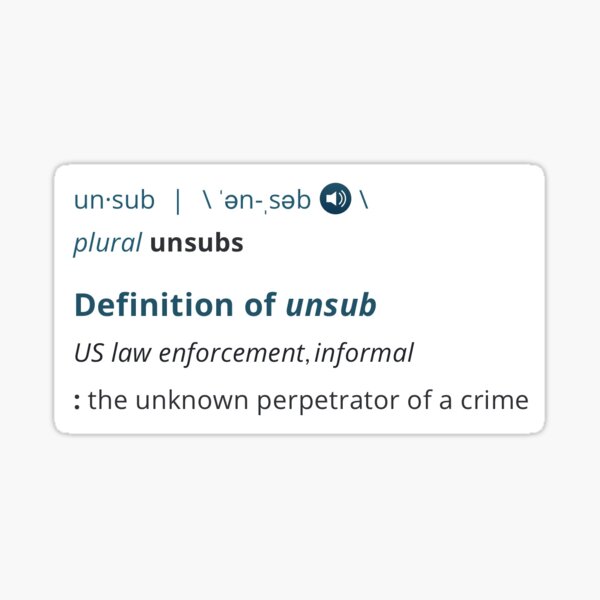
While Criminal Minds often focuses on violent physical crimes, the term Unsub is increasingly relevant in the realm of digital security. In cybersecurity, an “Unknown Subject” is often a “Threat Actor”—an anonymous individual or group responsible for a data breach, ransomware attack, or cyberespionage.
Tracking Tactics, Techniques, and Procedures (TTPs)
In the world of IT security, we profile cyber-Unsubs by analyzing their TTPs. Just as a physical offender has a “signature,” a hacker has a unique coding style, a preference for specific malware, and a distinct methodology for infiltrating a network. Cybersecurity platforms use AI to monitor network traffic for anomalies. When a breach occurs, incident response teams use digital forensics to “profile” the attacker.
For instance, if an attack utilizes a specific strain of “zero-day” exploit previously seen in Eastern Europe, the software flags the Unsub’s origin. This is behavioral analysis applied to code. We are not looking for a physical description, but a digital one: what time of day do they work? What programming languages do they prefer? Which vulnerabilities do they exploit?
The Dark Web and Anonymity Tools
The hunt for the modern Unsub often leads to the Dark Web. Threat actors use tools like Tor (The Onion Router) and VPNs (Virtual Private Networks) to mask their IP addresses and encrypt their communications. To counter this, digital investigators use specialized “crawlers” and “scrapers” that monitor the Dark Web for mentions of stolen data or illegal transactions.
Identifying an Unsub in this environment requires advanced traffic analysis. By observing the entry and exit nodes of encrypted traffic, security researchers can sometimes perform “de-anonymization” attacks. This is the high-tech equivalent of a stakeout, where data packets are followed until a lapse in security reveals the subject’s true location.
Ethical Implications of Investigative Technology
As our ability to identify an Unsub through technology grows, so do the ethical concerns surrounding digital privacy and algorithmic bias. The tools used to unmask criminals are the same tools that can be used for mass surveillance, leading to a complex debate within the tech community.
The Problem of Algorithmic Bias
One of the major criticisms of AI-driven profiling is the potential for bias. If the data used to train a predictive policing algorithm is skewed or reflects historical prejudices, the software will disproportionately target certain demographics as potential “Unsubs.” This is a significant challenge for software developers who must ensure that their algorithms are transparent and fair. In the tech world, “garbage in, garbage out” is a fundamental rule; if the input data is flawed, the profile of the Unsub will be equally flawed, leading to wrongful accusations.
Privacy vs. Public Safety
The use of facial recognition and mass data scraping has led to calls for stricter digital security regulations. While these tools are invaluable for catching an Unsub, they also infringe upon the privacy of the general public. Modern digital security frameworks, such as the GDPR in Europe, aim to balance the need for investigative power with the right to personal data protection.
For developers and tech professionals, the challenge lies in creating “Privacy-Preserving Data Mining” (PPDM) tools. These allow investigators to search for patterns and identify subjects without compromising the personal information of innocent individuals. The future of profiling will likely involve “Zero-Knowledge Proofs” and other cryptographic methods that protect the identity of the masses while still allowing the “Unknown Subject” to be identified.
The Future of Unmasking the Unsub
Looking ahead, the identification of an Unsub will become even more integrated with emerging technologies. We are moving into an era of “Neurometric” profiling and “Internet of Things” (IoT) forensics.
IoT Forensics: The Silent Witnesses
In a modern smart home, every device is a potential witness. From smart refrigerators to voice assistants like Alexa, the IoT ecosystem generates a constant stream of data. Future investigators will use “IoT Forensics” software to reconstruct the events of a crime by analyzing the timestamps of smart lights, the logs of smart locks, and even the heart rate data from a fitness tracker. The Unsub of the future will find it nearly impossible to remain “unknown” when the environment itself is recording their every move.

AI and Real-Time Threat Detection
The ultimate goal of modern investigative tech is to identify an Unsub before a crime is even committed. Through the use of “Computer Vision” and real-time behavioral analysis, AI can monitor public spaces for “pre-incident indicators.” This includes identifying suspicious patterns of movement or recognizing the “signature” of a weapon through thermal imaging.
In conclusion, while “Unsub” remains a popular term in television fiction, its reality is firmly anchored in the most advanced sectors of technology. From the databases of ViCAP to the AI-driven analytics of cybersecurity firms, the quest to identify the unknown subject is a testament to the power of digital innovation. As we continue to develop more sophisticated software and more secure digital frameworks, the “Unsub” is becoming an endangered species in an increasingly connected and transparent world. The transition from “Unknown Subject” to “Identified Subject” is no longer a matter of if, but a matter of when, guided by the relentless evolution of the technological landscape.
aViewFromTheCave is a participant in the Amazon Services LLC Associates Program, an affiliate advertising program designed to provide a means for sites to earn advertising fees by advertising and linking to Amazon.com. Amazon, the Amazon logo, AmazonSupply, and the AmazonSupply logo are trademarks of Amazon.com, Inc. or its affiliates. As an Amazon Associate we earn affiliate commissions from qualifying purchases.