
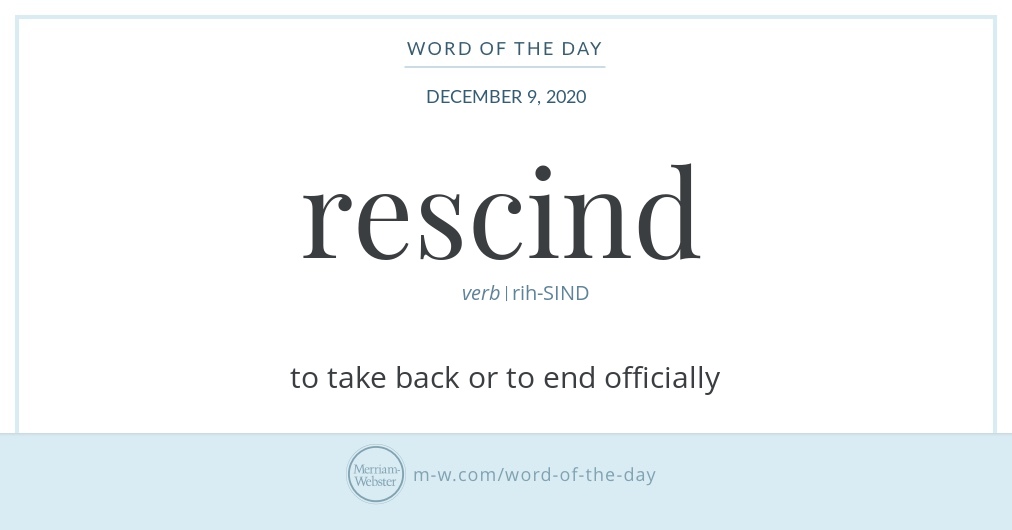
The word “rescind” is a powerful verb, often used in legal, business, and contractual contexts. Understanding its precise meaning is crucial, particularly in the realm of business finance and financial transactions. To rescind an agreement or action is to officially cancel, revoke, or annul it, essentially taking it back as if it never happened. This isn’t merely a disagreement or a change of heart; it signifies a formal undoing of a prior commitment or decision. In the financial world, where agreements and obligations form the bedrock of operations, the ability to rescind can have significant implications, impacting everything from contracts and investments to regulatory approvals and financial instruments.
The Legal and Financial Underpinnings of Rescission
At its core, rescission is a legal remedy. It’s the act of voiding a contract or an agreement, putting the parties back in the position they were in before the contract was made. This is known as status quo ante. The grounds for rescission are typically rooted in issues that undermine the validity or fairness of the original agreement. Understanding these grounds is paramount for businesses to protect themselves from unfavorable outcomes and to understand their rights and obligations.
Grounds for Rescinding Financial Agreements
Several key factors can trigger the right to rescind a financial agreement. These are not arbitrary; they are established principles designed to ensure fairness and prevent exploitation.
Misrepresentation and Fraud
One of the most common grounds for rescission is misrepresentation. This occurs when one party makes a false statement of fact that induces the other party to enter into an agreement. If the misrepresentation is material – meaning it was important enough to influence the decision-making – and the other party relied on it, they may have grounds to rescind.
- Innocent Misrepresentation: This happens when the party making the false statement genuinely believed it to be true. While the intention wasn’t malicious, the impact on the deceived party can still be significant, leading to rescission. For example, if a company mistakenly provides inaccurate financial projections to an investor, and the investor, relying on these false projections, invests in the company, they might seek to rescind the investment agreement.
- Negligent Misrepresentation: This occurs when a party fails to exercise reasonable care in ensuring the truthfulness of their statements. They might not have intended to deceive, but their carelessness led to a false impression. For instance, if a financial advisor provides investment advice based on outdated or improperly researched data, leading to a client’s loss, negligent misrepresentation could be a basis for rescission of their advisory contract.
- Fraudulent Misrepresentation: This is the most serious form of misrepresentation, involving intentional deceit. The party making the false statement knows it is false and intends to deceive the other party. This often involves concealing material facts or making outright lies. In business finance, fraudulent misrepresentation could involve a company deliberately inflating its assets or hiding its liabilities to secure a loan or attract investors. The aggrieved party would undoubtedly seek to rescind such an agreement.
Mistake
A mutual mistake about a fundamental aspect of the contract can also lead to rescission. For a mistake to be grounds for rescission, it must be a mistake of fact, not a mistake of law, and it must be material to the contract.
- Mutual Mistake: This occurs when both parties share the same erroneous belief about a crucial element of the contract. For example, if two parties enter into a contract for the sale of a specific piece of antique art, but it later turns out that the artwork was a forgery and both parties were unaware of this fact, the contract could be rescinded due to mutual mistake. In a financial context, imagine two parties agreeing on a loan with a specific interest rate, but both mistakenly believe the loan is denominated in a different currency, leading to a significant unintended cost difference.
- Unilateral Mistake: Generally, a unilateral mistake (where only one party is mistaken) is not sufficient grounds for rescission, unless the other party was aware of the mistake and took advantage of it, or the mistake is so obvious that it would be inequitable to enforce the contract. For example, if a company submits a bid for a project with a significant mathematical error, making the bid drastically lower than intended, and the other party knowingly accepts the bid without pointing out the obvious error, a court might allow for rescission.
Duress and Undue Influence
These grounds relate to the voluntariness of consent. For a contract to be valid, it must be entered into freely.
- Duress: This involves coercion or threats that force a party into an agreement against their will. The pressure must be significant enough to overcome the free will of the victim. In business finance, this could manifest as a powerful entity threatening to withhold crucial services or engage in damaging legal action unless a smaller business agrees to unfavorable terms. The smaller business, under duress, might later seek to rescind the contract.
- Undue Influence: This occurs when one party has a position of power or trust over another and uses that influence to unfairly persuade them into an agreement. This is common in situations involving fiduciaries or where there’s a significant power imbalance. For example, if a trusted financial advisor unduly influences an elderly client to invest in high-risk schemes that benefit the advisor more than the client, the client might seek to rescind the investment agreements.
Illegality and Impossibility
If the subject matter of the contract is illegal, or if events make performance of the contract impossible, rescission may be warranted.
- Illegality: If a contract is for an illegal purpose, it is void from the outset and can be rescinded. For example, a contract to launder money is inherently illegal and would be subject to rescission if discovered.
- Impossibility/Impracticability: If, after a contract is made, an unforeseen event makes performance impossible or commercially impracticable, the contract may be rescinded. For instance, if a contract for the delivery of specific goods is made, but a natural disaster destroys the only source of those goods, making delivery impossible, the contract could be rescinded.
The Process of Rescission in Business Finance
Rescinding a financial agreement is not a unilateral decision. It typically involves a formal process to ensure fairness and legal validity. The steps involved can vary depending on the nature of the agreement and the jurisdiction, but generally include:
Notice and Demand
The first step for a party wishing to rescind is usually to formally notify the other party of their intention to do so and the grounds for rescission. This notification is often in the form of a written demand, clearly stating the specific agreement to be rescinded and detailing the reasons why. This notice serves as an official record and gives the other party an opportunity to respond or negotiate.

Restitution
A key element of rescission is restitution. Once an agreement is rescinded, both parties are obligated to return any benefits they received under the contract. This aims to restore them to their pre-contractual positions. For example, if an investment is rescinded due to fraud, the investor would return the shares (or their current value), and the company would return the invested capital. In a loan scenario, if a loan agreement is rescinded due to misrepresentation of terms, the borrower would return the principal amount received, and the lender would return any interest or fees paid.
Negotiation or Litigation
Often, the process of rescission involves negotiation between the parties. The party seeking rescission might try to reach a mutual agreement on the terms of undoing the contract. If a mutual agreement cannot be reached, the matter may proceed to litigation. In a legal battle, a court will examine the evidence and determine whether the grounds for rescission are valid. If the court grants rescission, it will issue an order that dictates how restitution should occur.
Implications of Rescission on Financial Statements and Reporting
The act of rescinding a financial transaction can have significant repercussions on a company’s financial statements and its overall financial reporting. These implications need to be carefully managed and disclosed to stakeholders.
Adjusting Past Financials
If a rescinded contract involved revenue that had already been recognized or expenses that had been recorded, these entries will need to be reversed. This may require restating previously issued financial statements, particularly if the rescission occurs in a subsequent accounting period. This process of restatement is a serious matter that can impact investor confidence and requires careful explanation. For instance, if a significant sales contract is rescinded due to fraudulent misrepresentation by the buyer, any revenue recognized from that sale in prior periods would need to be reversed, potentially leading to a reduction in reported profits.
Impact on Assets and Liabilities
Rescission can directly affect a company’s balance sheet. If an asset was acquired under a rescinded contract, it must be returned, reducing the company’s asset base. Conversely, if a company is obligated to return funds or assets due to a rescinded contract, its liabilities might increase. For example, if a company rescinds an agreement to purchase a piece of equipment due to defects, the equipment would be returned, and any payments made would be reclaimed, impacting both asset and cash balances. If a loan agreement is rescinded, the outstanding loan balance would be eliminated.
Disclosure Requirements
Accounting standards (like Generally Accepted Accounting Principles – GAAP or International Financial Reporting Standards – IFRS) mandate specific disclosure requirements when financial statements are restated or when significant events like rescission occur. Companies must clearly explain the nature of the rescinded agreement, the reasons for rescission, and the impact on the financial statements. This transparency is crucial for maintaining the integrity of financial reporting and for informing investors, creditors, and other stakeholders. Failure to disclose adequately can lead to regulatory penalties and further erosion of trust.
Strategic Considerations for Businesses Regarding Rescission
While rescission is primarily a legal recourse, businesses can adopt strategic approaches to minimize their exposure to situations that might lead to rescission and to manage the consequences effectively.
Robust Due Diligence and Contract Review
The most effective way to avoid rescission is to prevent the circumstances that give rise to it in the first place. This involves conducting thorough due diligence on all parties involved in significant financial transactions. Thorough review of contracts by legal counsel is essential to ensure clarity, fairness, and compliance with all applicable laws. Understanding the terms, conditions, and potential risks associated with an agreement before signing can prevent future disputes.
Clear Communication and Documentation
Maintaining clear and open communication with business partners throughout the lifecycle of an agreement is vital. Any issues or potential problems should be addressed promptly and documented meticulously. This can help in resolving misunderstandings before they escalate into grounds for rescission. Comprehensive documentation of all communications, amendments, and performance related to a contract serves as a crucial record should a dispute arise.
Understanding Exit Clauses and Force Majeure
When drafting or entering into financial agreements, businesses should pay close attention to exit clauses and force majeure provisions. These clauses can provide a framework for unwinding agreements under specific, unforeseen circumstances, potentially avoiding the need for a formal rescission process. A well-defined exit clause can outline the conditions under which either party can terminate the agreement and the associated procedures, while a force majeure clause addresses unforeseeable events that might prevent contract fulfillment.

Seeking Expert Advice
In complex financial transactions, engaging with legal and financial experts is not just recommended; it’s often essential. Professionals can help identify potential risks, structure agreements to mitigate those risks, and provide guidance on navigating the complexities of rescission if it becomes necessary. Their expertise can be invaluable in protecting a company’s financial interests.
In conclusion, the word “rescind” signifies a formal cancellation and nullification of an agreement. In the context of business finance, understanding its meaning, the legal grounds for its application, the procedural aspects, and its financial reporting implications is paramount for prudent financial management. By prioritizing due diligence, clear communication, and expert advice, businesses can navigate the landscape of financial agreements with greater confidence, minimizing the risk of costly and disruptive rescission actions.
aViewFromTheCave is a participant in the Amazon Services LLC Associates Program, an affiliate advertising program designed to provide a means for sites to earn advertising fees by advertising and linking to Amazon.com. Amazon, the Amazon logo, AmazonSupply, and the AmazonSupply logo are trademarks of Amazon.com, Inc. or its affiliates. As an Amazon Associate we earn affiliate commissions from qualifying purchases.