
In the world of professional organizations, investment circles, and business-oriented clubs, the role of the Vice President (VP) is frequently misunderstood. While many perceive the position as a mere backup to the President, the reality in a finance-driven environment is far more complex. The Vice President functions as the Chief Operating Officer (COO) and, often, a secondary Chief Financial Officer (CFO). They are the strategic architect responsible for the fiscal health, operational efficiency, and long-term economic viability of the organization.
Whether it is a collegiate investment club, a professional networking guild, or a private equity interest group, the Vice President ensures that the entity operates not just as a social gathering, but as a lean, value-generating machine. This article explores the multifaceted responsibilities of a club Vice President through the lens of business management and financial stewardship.

Financial Stewardship and Budgetary Oversight
At the core of any successful organization lies its ability to manage capital. While a Treasurer handles the day-to-day bookkeeping, the Vice President provides the high-level strategic oversight of the club’s financial resources. This involves a deep understanding of the “cost of operation” versus the “value provided to members.”
Strategic Budget Allocation
The Vice President is responsible for drafting and refining the annual or semi-annual budget. This is not merely an exercise in accounting; it is a declaration of the club’s priorities. In a business-focused club, the VP must analyze previous spending patterns to determine the Return on Investment (ROI) for various initiatives. For instance, if the club spent $5,000 on a networking gala but only saw a 5% increase in member retention, the VP must make the executive decision to reallocate those funds toward more high-impact areas, such as professional certification subsidies or premium financial database subscriptions.
Audit and Fiscal Transparency
In the niche of business and finance, reputation is currency. The Vice President acts as the primary auditor of the club’s internal processes. They ensure that every dollar accounted for by the Treasurer is spent in accordance with the club’s bylaws and tax-exempt status (if applicable). By implementing rigorous financial checks and balances, the VP protects the organization from embezzlement, mismanagement, and “scope creep,” where funds are slowly bled away by unapproved or unnecessary expenditures.
Revenue Generation and Sponsorship Strategy
For a club to grow, it must move beyond simple membership dues. A sophisticated Vice President treats the club as a brand with a marketable audience. They are tasked with developing and executing revenue-generation strategies that ensure the club’s treasury remains robust enough to withstand economic downturns or fluctuations in membership.
Building Corporate Partnerships and Sponsorships
One of the most vital roles of the VP is the acquisition of external funding. This requires a professional approach to “B2B” (Business to Business) sales. The VP identifies potential corporate sponsors—such as brokerage firms, tech companies, or local businesses—and creates a value proposition. They must answer the question: What does the sponsor get in return? This might include access to a talent pipeline of high-achieving members, branding on club materials, or speaking opportunities. Managing these relationships is a high-stakes financial responsibility that directly impacts the club’s ability to host large-scale events or invest in new tools.
Diversifying Income Streams
Beyond sponsorships, the Vice President explores creative ways to monetize the club’s intellectual property or community access. This could involve organizing paid workshops, selling premium research reports generated by members, or creating a “tiered” membership structure that offers advanced financial tools for a higher fee. By diversifying the income streams, the VP ensures that the club remains financially independent and is not overly reliant on a single source of revenue, which is a fundamental principle of sound business finance.

Operational Efficiency and Risk Management
In a professional club, time is as valuable as money. The Vice President is the engine of the organization, ensuring that the operational workflows are optimized to prevent “resource leakage.” This involves a combination of project management and risk assessment.
Streamlining Internal Processes
The VP often manages the various committees or departments within the club (e.g., the marketing committee, the research wing, or the events team). By applying lean management principles, the VP ensures that these sub-units are not duplicating work or wasting the club’s administrative budget. They implement project management software and financial tracking tools to ensure that every project stays within its allotted budget and timeline. This operational rigor is what separates a hobbyist group from a professional-grade organization.
Mitigating Financial and Legal Risks
Every activity a club undertakes carries a degree of risk. Whether it is the liability of hosting an in-person event or the legalities of managing an investment fund, the Vice President is the primary officer tasked with risk mitigation. They ensure the club has the necessary insurance, that contracts with vendors are legally sound, and that the organization remains compliant with local financial regulations. In the context of an investment club, this might also include overseeing the “Investment Policy Statement” to ensure that the group is not taking on uncompensated risk that could lead to a total loss of capital.
Strategic Growth and Long-Term Value Creation
While the President often focuses on the “vision” and public face of the club, the Vice President focuses on the “legacy” and the long-term equity of the organization. This involves looking years into the future to ensure the club’s financial and professional relevance remains intact.
Capital Expenditure and Infrastructure Investment
A forward-thinking Vice President looks for opportunities to invest the club’s surplus capital back into the organization. This might mean purchasing permanent equipment, investing in a long-term website platform that drives lead generation, or even establishing an endowment fund. These “CapEx” decisions are vital for the club’s evolution. The VP must conduct a cost-benefit analysis for each major purchase, ensuring that the expenditure will yield long-term savings or provide a significant enhancement to the member experience.
Succession Planning and Institutional Knowledge
In the world of business, the loss of key personnel can lead to a financial tailspin. The Vice President is responsible for “Institutional Knowledge Management.” They ensure that financial records, sponsorship contacts, and operational manuals are meticulously documented. By mentoring the next generation of leaders, the VP ensures a smooth transition of power. A seamless succession is a form of financial insurance; it prevents the loss of momentum that often occurs during leadership changes, which can lead to a drop in membership and a subsequent loss of revenue.
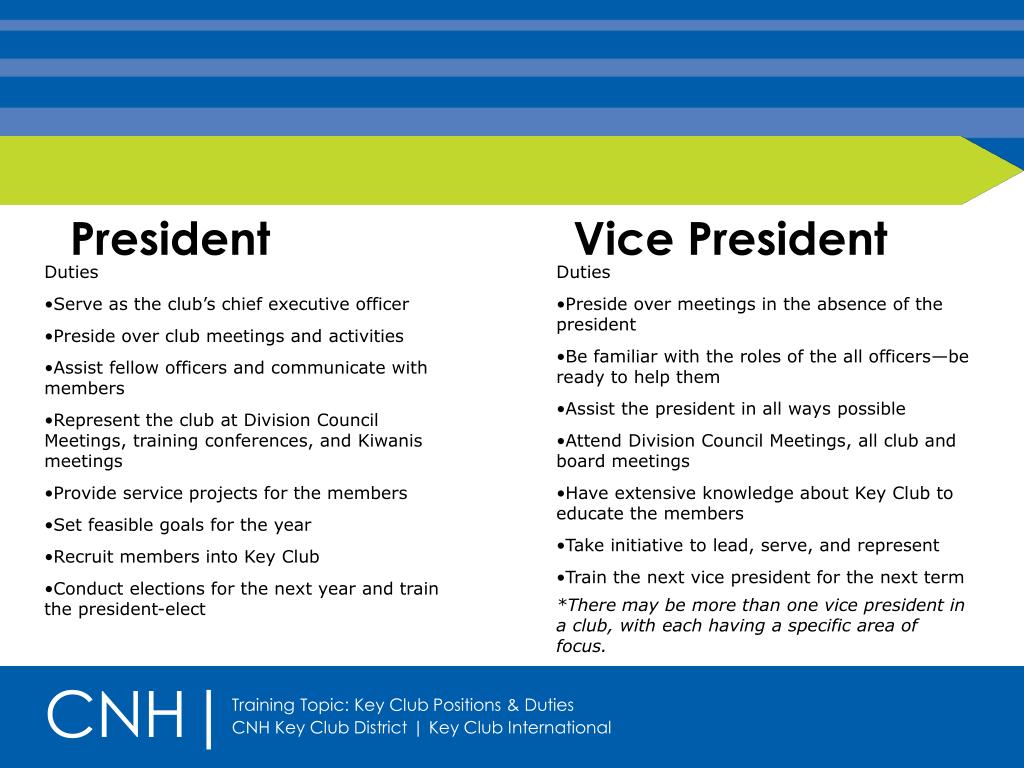
Conclusion: The Vice President as a Business Leader
The role of a Vice President in a club—when viewed through the lens of money and business—is one of the most rigorous training grounds for future executives, entrepreneurs, and financial officers. It is a role defined by the cold reality of budgets, the high stakes of fundraising, and the meticulous nature of risk management.
A successful VP does more than just stand in for the President; they act as the backbone of the organization’s financial house. By mastering the art of resource allocation, revenue generation, and operational efficiency, they transform a simple club into a thriving enterprise. For anyone looking to build a career in finance or business management, the Vice Presidency is not just a title—it is a masterclass in organizational economics. Through their work, the Vice President ensures that the club does not merely exist, but prospers, providing compounding value to its members and stakeholders for years to come.
aViewFromTheCave is a participant in the Amazon Services LLC Associates Program, an affiliate advertising program designed to provide a means for sites to earn advertising fees by advertising and linking to Amazon.com. Amazon, the Amazon logo, AmazonSupply, and the AmazonSupply logo are trademarks of Amazon.com, Inc. or its affiliates. As an Amazon Associate we earn affiliate commissions from qualifying purchases.