
In the modern era of hyper-visibility, where personal branding is often synonymous with “putting a face to the name,” one of the world’s most recognizable brands remains entirely faceless. The question “What does the artist Banksy look like?” has been asked millions of times across search engines, social media platforms, and dinner table conversations. Yet, from a strategic branding perspective, the answer is irrelevant. Banksy’s face is not made of features and skin; it is constructed of stencils, satire, and a masterfully maintained shroud of mystery.
For marketers, designers, and brand strategists, Banksy represents a fascinating case study in “anti-branding.” By choosing to remain anonymous, he has created a corporate identity that is more powerful, more flexible, and more valuable than almost any other contemporary artist. This article explores how the refusal to show a face became the cornerstone of a global brand empire, and what it teaches us about the power of mystique in the digital age.

The Power of the Faceless Brand: Why Mystique Outperforms Visibility
Most brand strategies today focus on transparency and “authenticity” through constant engagement. CEOs are encouraged to be influencers, and creators are told that their faces are their most valuable assets. Banksy flipped this script. By withholding his physical identity, he turned his brand into a collaborative mystery that the public feels compelled to solve.
The Scarcity of Information
In an information-rich world, silence is a luxury good. Banksy’s anonymity creates a vacuum that the media and the public are desperate to fill. This “scarcity of persona” drives organic engagement far more effectively than a multi-million dollar advertising budget. Every time a new mural appears, the conversation isn’t just about the art; it’s about the phantom who left it. This keeps the brand in a state of perpetual “trending” status without the artist ever having to post a selfie or give a live interview.
The Universal Canvas
By not having a specific face, Banksy becomes a universal symbol. A brand with a visible founder is often limited by that founder’s demographics—age, race, gender, and personal lifestyle. Because no one knows what Banksy looks like, he can represent anyone and everyone. He is the “Everyman” of the counter-culture. This neutrality allows his brand to resonate across different cultures and languages, making the Banksy identity a globally scalable asset that isn’t tied to a singular human image.
Identity as Intellectual Property: Navigating the Legalities of an Enigma
From a brand management standpoint, maintaining an anonymous identity presents unique challenges, particularly regarding trademark and copyright law. If you don’t exist in the public eye, how do you protect your intellectual property?
The Pest Control Strategy
Banksy’s brand is managed through a legal entity known as “Pest Control.” This body acts as the gatekeeper for his brand, verifying the authenticity of his works while shielding his identity. This is a sophisticated piece of corporate structuring. It allows the brand to function like a traditional company—issuing certificates of authenticity and taking legal action against counterfeiters—without ever needing to produce the individual at the center of it. For brand strategists, this highlights the importance of building a robust support infrastructure that can sustain a brand’s value independently of the founder’s physical presence.
The Trademark Dilemma
Banksy famously once stated that “copyright is for losers,” but his brand strategy suggests a much more nuanced understanding of intellectual property. He has fought several legal battles to trademark his most famous images, such as the “Flower Bomber.” The irony is that trademark law often requires the owner to be identifiable. Banksy’s legal team has had to navigate the fine line between maintaining his brand’s “outlaw” persona and utilizing the very corporate legal structures he often critiques. This tension is a core part of the brand’s narrative, making it feel edgy and rebellious even as it operates with corporate precision.
Guerilla Marketing and the Art of the Stunt
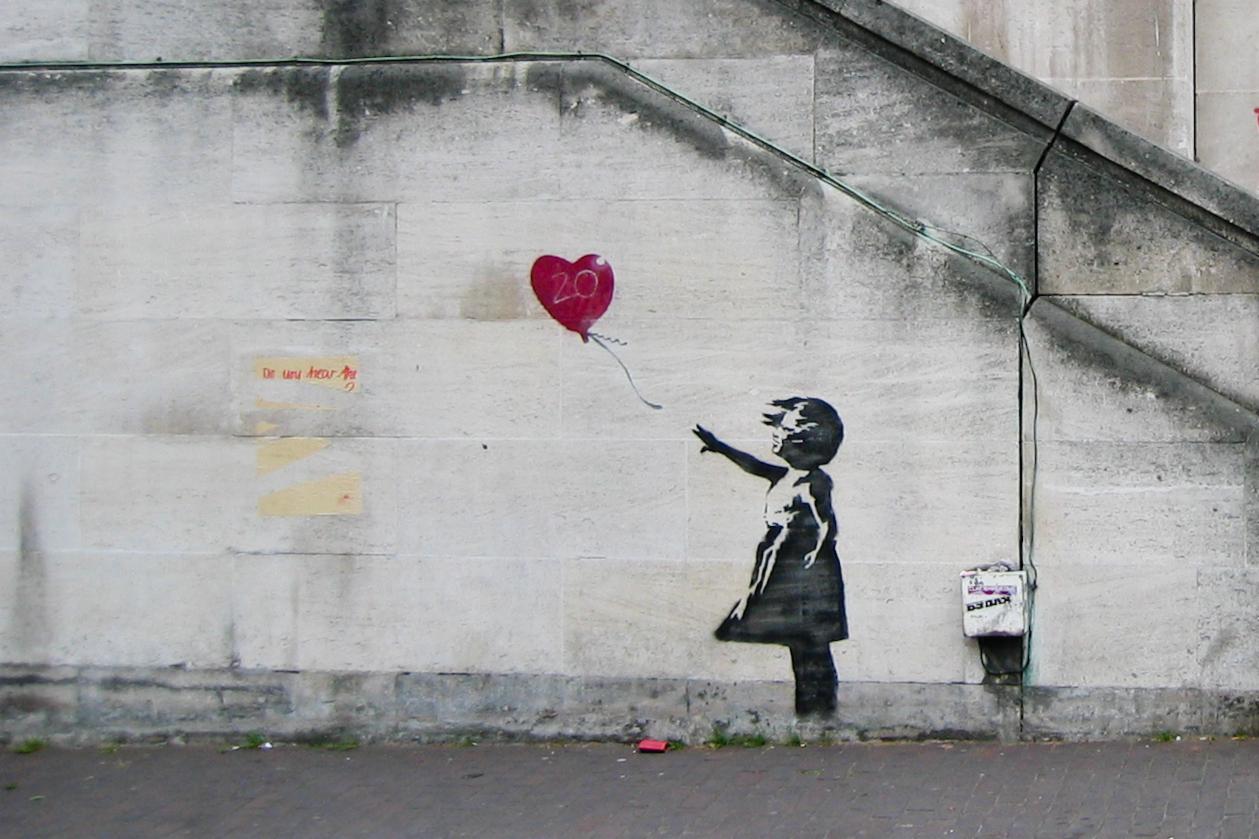
Banksy is arguably the greatest guerilla marketer of the 21st century. His “products” (the art) are delivered through “stunts” that generate massive earned media. His brand doesn’t buy ad space; it hijacks public space, turning the entire world into its showroom.
The Shredded Painting: A Masterclass in Brand Narrative
One of the most significant moments in modern branding history occurred at a Sotheby’s auction in 2018. As the gavel fell on a $1.4 million sale of “Girl with Balloon,” a shredder hidden inside the frame activated, partially destroying the work. In an instant, the “product” changed, and its value skyrocketed. This wasn’t just an art prank; it was a profound brand statement. It reinforced the Banksy brand values: anti-establishment, unpredictable, and immune to the traditional rules of the market. This stunt ensured that the brand’s narrative remained in Banksy’s control, even when his work was being sold by the elite institutions he mocks.
The “Dismaland” Pop-Up
In 2015, Banksy created “Dismaland,” a “bemusement park” that served as a dark parody of Disneyland. This was a massive exercise in experiential branding. By creating a physical space that people could visit, he expanded the brand beyond 2D stencils on walls into a 3D immersive environment. The marketing for the event was almost non-existent; the brand relied entirely on the mystery and the “leak” of information to create a viral sensation. This proved that a faceless brand could create a physical destination and command global attention through sheer conceptual strength.
Lessons in Personal Branding for the Modern Creator
While most of us cannot (and should not) hide our faces behind a mask, there are critical lessons to be learned from the Banksy brand strategy regarding how we manage our own digital identities and corporate images.
Control the Narrative by Saying Less
Banksy’s brand is defined by what he doesn’t do. He doesn’t do sponsored content, he doesn’t appear on talk shows, and he doesn’t explain his work in detail. This silence gives his brand a level of gravitas that is missing in the noisy digital marketplace. For modern brands, the lesson is that “over-sharing” can dilute your value. By being selective about where and how you show up, you increase the impact of your communication when you finally do speak.
Consistency Over Visibility
The “Banksy look” isn’t a face; it’s a style. His high-contrast, black-and-white stencil aesthetic is instantly recognizable. Even without a signature or a face, a consumer knows a Banksy piece when they see one. This is the pinnacle of design-led branding. It suggests that if your visual language is consistent and unique enough, you don’t need a logo or a mascot to be identified. Your work becomes your identity.
Authenticity Through Action
In the world of brand strategy, authenticity is often a buzzword. For Banksy, authenticity is proven through action. He continues to put himself at risk (legally) to create his art, which reinforces the brand’s core promise of being “real” and “anti-system.” A brand’s face is a promise, but its actions are the proof. Banksy’s “look” is effectively his track record of staying true to his subversive roots for over two decades.

Conclusion: The Face of a Revolution
So, what does the artist Banksy look like? To the brand strategist, he looks like a masterfully executed plan. He looks like a high-value asset protected by a sophisticated legal shield. He looks like a viral marketing campaign that never ends.
Banksy has proven that in the age of the “influencer,” the most influential person in the room might be the one who isn’t there. He has redefined the concept of a personal brand from being about a person to being about an idea. By remaining faceless, he has allowed his audience to project their own hopes, fears, and frustrations onto his work. He isn’t a person; he is a mirror.
In the final analysis, Banksy’s anonymity is not a gimmick—it is his most successful product. It is the protective layer that allows his art to travel the world without the baggage of celebrity. It is a reminder that in the world of branding, sometimes the most powerful thing you can show the world is nothing at all.
aViewFromTheCave is a participant in the Amazon Services LLC Associates Program, an affiliate advertising program designed to provide a means for sites to earn advertising fees by advertising and linking to Amazon.com. Amazon, the Amazon logo, AmazonSupply, and the AmazonSupply logo are trademarks of Amazon.com, Inc. or its affiliates. As an Amazon Associate we earn affiliate commissions from qualifying purchases.