
The 14th Amendment to the United States Constitution stands as a cornerstone of civil rights and legal protections, enacted in the aftermath of the Civil War. Its profound impact resonates through American law and society, shaping our understanding of citizenship, equal protection, and due process. Understanding its provisions is crucial for comprehending the fundamental rights and responsibilities of individuals within the United States. This amendment, ratified in 1868, addressed critical issues stemming from slavery and its legacy, fundamentally altering the balance of power and the scope of federal authority in protecting individual liberties.

The 14th Amendment is not a monolithic document but rather a series of distinct clauses, each carrying significant weight and legal precedent. While the amendment as a whole aimed to redefine citizenship and guarantee equal rights, its individual sections have been subject to extensive interpretation and application by the courts over the decades. To fully grasp its meaning and implications, it’s essential to dissect its core components: citizenship, the Privileges or Immunities Clause, the Due Process Clause, and the Equal Protection Clause. These clauses, working in concert, have been instrumental in advancing civil rights and ensuring a more just and equitable society.
Defining Citizenship and its Guarantees
One of the most transformative aspects of the 14th Amendment is its definitive establishment of birthright citizenship. Before its ratification, the status of citizenship was often a point of contention, particularly for formerly enslaved people. The amendment’s first section squarely addresses this by declaring who is considered a citizen of the United States.
Birthright Citizenship: A Foundation of Inclusion
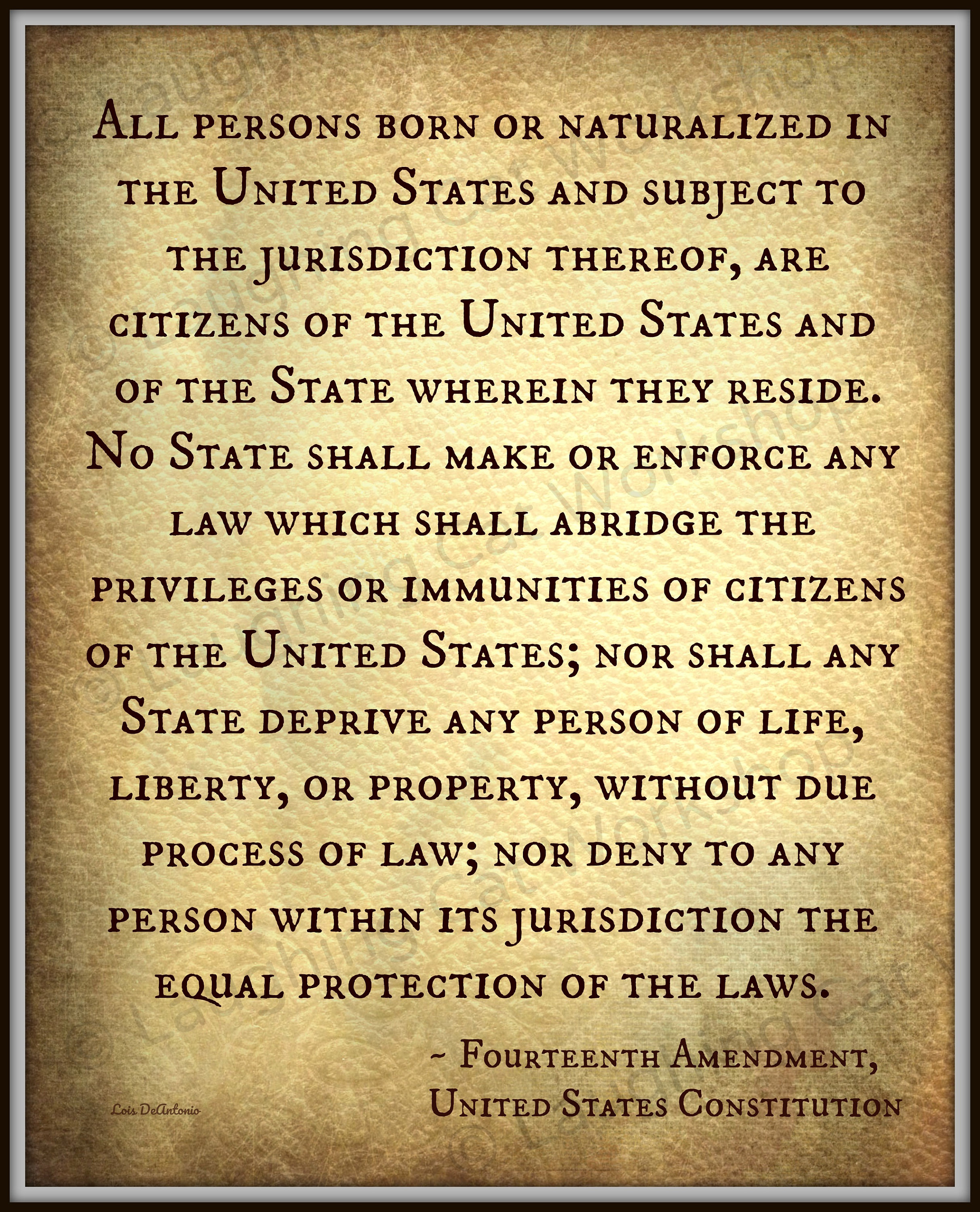
Section 1 of the 14th Amendment famously states: “All persons born or naturalized in the United States, and to the subjects of the powers thereof, are citizens of the United States and of the State wherein they reside.” This clause, often referred to as the “birthright citizenship” clause, was a direct repudiation of the Supreme Court’s infamous Dred Scott decision of 1857, which held that African Americans, whether enslaved or free, could not be citizens.
This provision ensures that anyone born within the geographical boundaries of the United States, regardless of their parents’ immigration status, is automatically granted U.S. citizenship. This principle has been a cornerstone of American identity and a vital mechanism for integrating new populations into the national fabric. While debated in contemporary political discourse, the legal precedent affirming birthright citizenship based on the 14th Amendment remains exceptionally strong. The intent behind this clause was to create a unified nation where loyalty and belonging were tied to birth on American soil, fostering a sense of shared identity and national cohesion. It also provided a clear legal pathway for the millions of formerly enslaved individuals to be recognized as full members of the body politic, with all the rights and responsibilities that entailed. The simplicity and breadth of this declaration have had far-reaching consequences, preventing the creation of a permanent underclass denied basic rights due to the circumstances of their birth.
Privileges and Immunities: Protecting Fundamental Rights
Following the definition of citizenship, Section 1 introduces the Privileges or Immunities Clause. This clause states: “No State shall make or enforce any law which shall abridge the privileges or immunities of citizens of the United States.” While initially intended to be a broad protection of fundamental rights, the Supreme Court’s interpretation in the Slaughter-House Cases (1873) significantly narrowed its scope. The Court held that this clause protected only those rights that were granted by federal citizenship, not those that were inherent to state citizenship.
Despite this initial limitation, the Privileges or Immunities Clause has continued to be a subject of legal scholarship and occasional reinterpretation. Some legal scholars argue that the clause was intended to be a more robust protection of fundamental liberties, encompassing rights beyond those explicitly enumerated in the Bill of Rights. The debate surrounding its original intent and potential application continues to shape discussions about the scope of constitutional protections. The intended purpose of this clause was to prevent states from infringing upon the core rights that defined a U.S. citizen, ensuring a baseline of freedom and autonomy across the nation. Its subsequent reinterpretation, however, shifted the focus of federal protection of individual rights primarily to other clauses within the 14th Amendment, particularly Due Process and Equal Protection. Nevertheless, its historical significance as an attempt to codify and protect fundamental liberties remains undeniable.
Ensuring Fair Treatment: Due Process and Equal Protection
The remaining sections of the 14th Amendment’s first section are arguably its most impactful and frequently litigated: the Due Process Clause and the Equal Protection Clause. These two clauses have served as the bedrock for much of modern civil rights litigation and have expanded protections for individuals against state actions.
The Due Process Clause: A Shield Against Arbitrary Government Action
The Due Process Clause of the 14th Amendment states: “nor shall any State deprive any person of life, liberty, or property, without due process of law.” This clause is a critical safeguard against arbitrary and unfair actions by state governments. It has two primary components: procedural due process and substantive due process.
Procedural Due Process: The Right to a Fair Hearing
Procedural due process ensures that when the government seeks to deprive a person of life, liberty, or property, it must follow fair procedures. This includes rights such as notice of the charges, the opportunity to be heard, the right to present evidence, and the right to legal representation. In essence, it guarantees that individuals will have a fair chance to defend themselves against government accusations or actions that could impact their fundamental interests. For instance, in criminal proceedings, this means rights like a speedy trial, the right to confront witnesses, and protection against self-incrimination are all rooted in the principles of procedural due process. In civil matters, it ensures that individuals have a meaningful opportunity to challenge government decisions that affect their property rights or liberties, such as losing a license or facing eviction. The essence of procedural due process lies in the concept of fairness and the government acting in a predictable and accountable manner.
Substantive Due Process: Protecting Fundamental Liberties
Substantive due process goes beyond fair procedures to protect fundamental liberties from government interference, even if fair procedures are followed. This means that certain rights are so fundamental that the government cannot infringe upon them without a compelling reason and that any law infringing on these rights must be narrowly tailored to serve that compelling interest. The Supreme Court has interpreted this clause to protect a wide range of rights, including the right to privacy, the right to marry, and the right to raise one’s children. The application of substantive due process has been dynamic, evolving with societal understanding of fundamental rights and liberties. Landmark cases have established protections for aspects of personal autonomy and family life that are not explicitly listed in the Bill of Rights but are considered essential to the concept of liberty. This aspect of due process ensures that the government’s power is not absolute and that there are certain zones of individual freedom that are beyond its reach.
The Equal Protection Clause: Guaranteeing Fairness for All
The Equal Protection Clause, also found in Section 1, is perhaps the most celebrated and impactful part of the 14th Amendment. It mandates: “nor shall any State deny to any person within its jurisdiction the equal protection of the laws.” This clause prohibits states from discriminating against individuals or groups. It ensures that all individuals within a state’s jurisdiction are treated equally under the law, regardless of their race, religion, national origin, or other classifications.
The Equal Protection Clause has been the driving force behind many landmark civil rights advancements in the United States. It was instrumental in dismantling segregation through cases like Brown v. Board of Education (1954), which declared state-sponsored segregation in public schools unconstitutional. The clause requires that laws be applied equally and that classifications made by states must have a rational basis, and in cases involving suspect classifications like race, a compelling state interest. This means that governments cannot create laws that unfairly disadvantage specific groups without a very strong justification. The interpretation of “equal protection” has evolved over time, moving from a primary focus on racial discrimination to encompass protections against discrimination based on gender, national origin, and other characteristics. The clause serves as a vital tool for ensuring that the promise of equality embedded in American ideals is realized in practice.
Enforcement and Reconstruction Amendments
Beyond the protections of individual rights, the 14th Amendment also included a crucial enforcement mechanism and played a pivotal role in the broader context of the Reconstruction era.
Section 5: The Power to Enforce Civil Rights
Section 5 of the 14th Amendment grants Congress the power to enforce the amendment’s provisions: “The Congress shall have power to enforce, by appropriate legislation, the provisions of this article.” This grants Congress significant authority to pass laws that protect civil rights and prohibit discrimination by state and local governments. This enforcement power has been crucial in translating the constitutional guarantees of the 14th Amendment into tangible legal protections for citizens. Congressional legislation, such as the Civil Rights Act of 1964 and the Voting Rights Act of 1965, were enacted under this authority, providing robust federal remedies against state-sponsored discrimination. The ability of Congress to proactively legislate in this area ensures that the promises of the 14th Amendment are not left to the vagaries of state action or judicial interpretation alone, providing a direct mechanism for upholding fundamental liberties.
Reconstruction and the Amendment’s Historical Context
The 14th Amendment was one of three Reconstruction Amendments (along with the 13th, which abolished slavery, and the 15th, which prohibited denying the right to vote based on race) passed in the wake of the Civil War. Its primary purpose was to ensure that the formerly enslaved population would be granted full citizenship rights and protections, and to prevent the Southern states from enacting discriminatory “Black Codes” that sought to re-establish a system of racial subjugation. The amendment was a radical departure from the antebellum understanding of federalism, significantly expanding the federal government’s role in protecting individual rights against state infringement. While the promise of Reconstruction was not fully realized, and racial discrimination persisted for many decades, the 14th Amendment laid the essential legal groundwork for future civil rights movements and continues to be the primary constitutional authority for advancing equality and justice in the United States. Its enduring relevance underscores its profound and lasting impact on American law and society.
aViewFromTheCave is a participant in the Amazon Services LLC Associates Program, an affiliate advertising program designed to provide a means for sites to earn advertising fees by advertising and linking to Amazon.com. Amazon, the Amazon logo, AmazonSupply, and the AmazonSupply logo are trademarks of Amazon.com, Inc. or its affiliates. As an Amazon Associate we earn affiliate commissions from qualifying purchases.