
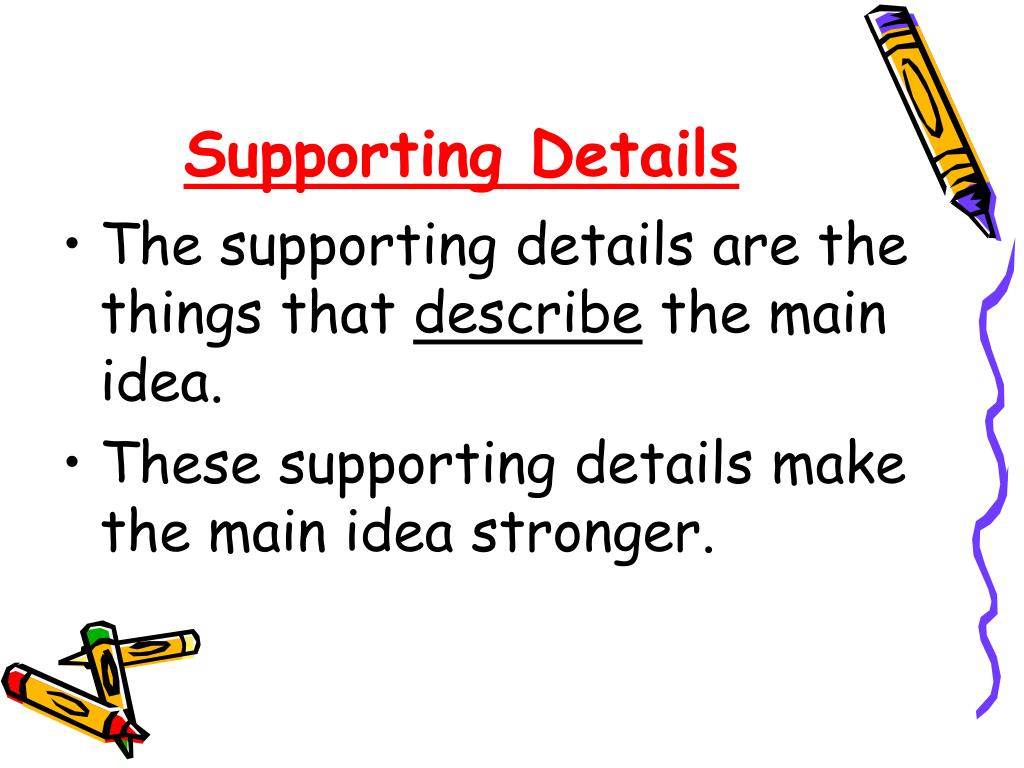
In the architecture of professional communication and brand strategy, a message is only as strong as its foundation. Whether you are crafting a compelling marketing campaign, authoring a white paper, or positioning your personal brand within a competitive industry, the quality of your output depends on the credibility of your claims. This is where the concept of “supporting details” becomes critical. Supporting details are the specific facts, statistics, anecdotal evidence, and logical explanations that provide depth to your primary thesis. Without them, your brand’s value proposition is merely a claim—a hollow statement that lacks the structural integrity to build audience trust.

The Role of Evidence in Building Brand Authority
In the context of brand strategy, supporting details serve as the bridge between a consumer’s skepticism and their eventual conversion. When a brand declares itself to be “the industry leader in sustainable manufacturing,” that is a statement of intent. To transform that statement into a credible identity, you must provide supporting details. These might include third-party certifications, data regarding supply chain emissions, or interviews with partners who can vouch for your operational standards.
Supporting details are the currency of authority. In an era saturated with performative marketing and generic corporate jargon, audiences possess a heightened sensitivity to fluff. When your brand makes a promise, your audience immediately looks for the “how” and the “why.” By integrating specific, verifiable supporting details into your brand narrative, you demonstrate that your assertions are rooted in reality rather than aspiration. This is not just about factual accuracy; it is about cognitive alignment. When you present a claim backed by robust supporting details, you reduce the psychological friction a potential client experiences when deciding whether to trust your brand.
Strategic Integration of Data and Narrative
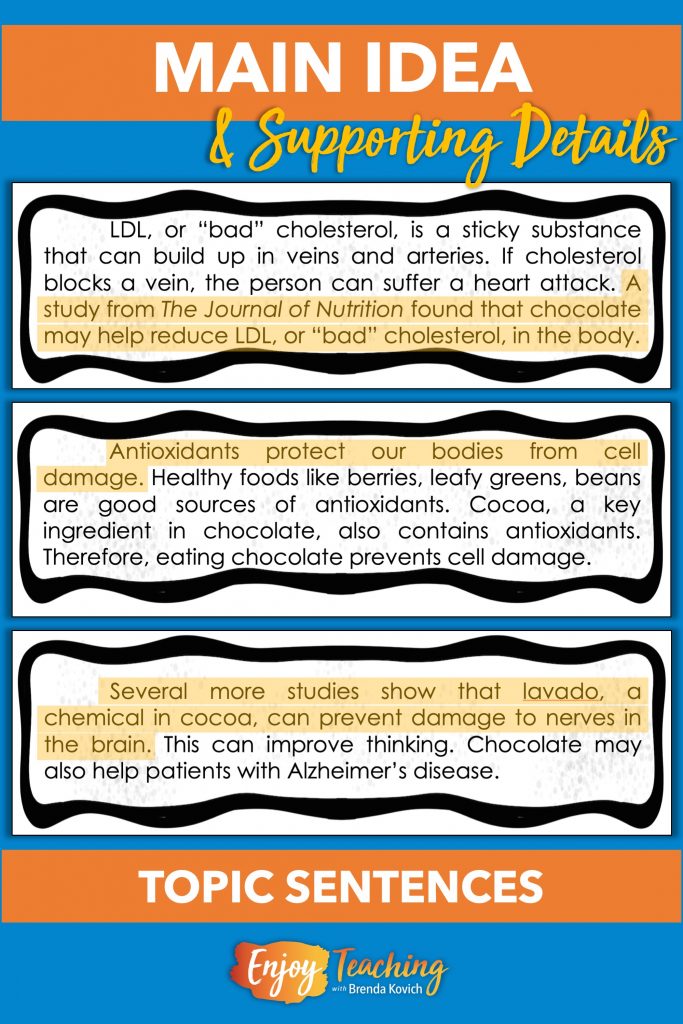
The effective use of supporting details requires a delicate balance between emotional resonance and logical validation. In professional brand communication, supporting details generally fall into three distinct categories: empirical evidence, expert testimonial, and contextual narrative.
Leveraging Empirical Evidence
Empirical evidence refers to the raw, quantifiable data that anchors your message. In the context of corporate identity, this might include performance metrics, growth percentages, or audited financial outcomes. Using specific numbers—such as “a 22% reduction in operational waste over eighteen months”—is vastly more powerful than using vague qualifiers like “a significant reduction in waste.” The precision inherent in these supporting details creates a sense of reliability. It suggests that your brand is methodical, data-driven, and transparent.
The Power of Contextual Narrative
While numbers provide the foundation, narratives provide the framing. Contextual narratives allow you to humanize your data. If your supporting detail is a customer satisfaction rating, the narrative aspect involves telling the story of a specific client whose workflow was transformed by your solution. This provides a “case study” structure, which remains one of the most effective tools in the B2B marketing arsenal. By pairing a quantitative supporting detail (the metric) with a qualitative narrative (the story), you satisfy both the logical and emotional centers of your audience’s decision-making process.
Structuring Your Content for Maximum Impact
To ensure your supporting details are doing the heavy lifting, you must be intentional about where and how you deploy them. Randomly sprinkling facts into a document creates noise; strategically placing them at key points of friction creates clarity.
The “Point-Support-Impact” Framework
A highly effective method for ensuring your supporting details are purposeful is the Point-Support-Impact (PSI) framework.
- Point: State your primary claim clearly. This is the “what.”
- Support: Provide the evidence. This is the “why” and “how.” This is where you insert your data, expert insights, or case studies.
- Impact: Explain the significance of the support in relation to the audience’s goal.
By following this structure, you ensure that every supporting detail serves a specific function. If a piece of evidence does not directly support the point or contribute to the impact, it becomes filler. In professional branding, filler is dangerous; it distracts the reader and weakens the authority of your core argument.
Avoiding the Pitfalls of Information Overload
One of the most common mistakes in branding is the “data dump.” Many organizations believe that overwhelming an audience with an excessive volume of supporting details will somehow prove their competence. In reality, it often achieves the opposite. If the audience has to work too hard to decipher which details are actually relevant to their specific problem, they will disengage. The secret to impactful branding is curation. Choose the most relevant, the most compelling, and the most reputable supporting details, and present them with brevity. Quality always supersedes quantity when building a brand identity.
Supporting Details as a Tool for Competitive Differentiation
In a crowded market, your product features may be identical to those of your competitors. How do you distinguish yourself? Often, the differentiator is not the product itself, but the depth of support you offer for your brand identity.
When you consistently provide high-quality supporting details—such as in-depth white papers, white-labeled research, or transparent documentation of your processes—you are signaling to your audience that your brand is thoughtful and reliable. This creates an implicit comparison. If Brand A makes an unsubstantiated claim and Brand B provides a detailed breakdown of the methodology behind that claim, the audience will naturally gravitate toward Brand B.
This level of detail also serves as a defensive moat for your brand. Competitors can easily copy your tagline or your aesthetic, but they cannot easily replicate the deep, institutional knowledge and empirical evidence you have curated over time. Your commitment to “showing your work” becomes a unique selling proposition in itself.
The Evolution of Credibility in Digital Branding
In the digital ecosystem, the definition of supporting details is evolving. Today, it is no longer enough to cite a study from five years ago. Audiences expect real-time, relevant, and verifiable supporting details. This means your brand strategy must incorporate a system for constant information updates.
Whether it is through real-time dashboards on your website, active participation in industry forums, or the regular publication of original research, your supporting details must feel current. When you fail to update your supporting evidence, your brand begins to look stagnant. Conversely, by maintaining a flow of fresh, data-backed insights, you communicate that your brand is agile and deeply embedded in the current industry landscape.
Ultimately, supporting details are the evidence of your commitment to excellence. They move the conversation from “trust us” to “check our track record.” When you master the art of selecting, structuring, and presenting these details, you move beyond simple marketing and into the realm of thought leadership. You are no longer just selling a service or a product; you are validating your existence in the market with every piece of content you produce. In a world where attention is the scarcest resource, the brands that provide the most credible, well-supported information are the ones that command loyalty and authority. Focus on the details, and the brand identity will build itself.
aViewFromTheCave is a participant in the Amazon Services LLC Associates Program, an affiliate advertising program designed to provide a means for sites to earn advertising fees by advertising and linking to Amazon.com. Amazon, the Amazon logo, AmazonSupply, and the AmazonSupply logo are trademarks of Amazon.com, Inc. or its affiliates. As an Amazon Associate we earn affiliate commissions from qualifying purchases.