
In the sophisticated world of financial markets, terminology often acts as the first barrier to entry for novice investors. Among the various phrases that populate trading platforms, “Sell to Close” is one of the most fundamental yet frequently misunderstood concepts. Whether you are trading equity options to hedge a portfolio or seeking speculative gains, understanding the mechanics of how to exit a position is just as critical as knowing how to enter one.
In the “Money” niche—encompassing personal finance and professional investing—mastering the lifecycle of a trade is paramount. “Sell to Close” represents the final act of a long position. It is the mechanism by which an investor realizes a profit or minimizes a loss on an option contract they previously purchased. This article provides a deep dive into what “Sell to Close” means, how it functions within a broader investment strategy, and why it is a vital tool for every disciplined trader.

Understanding the Mechanics of “Sell to Close”
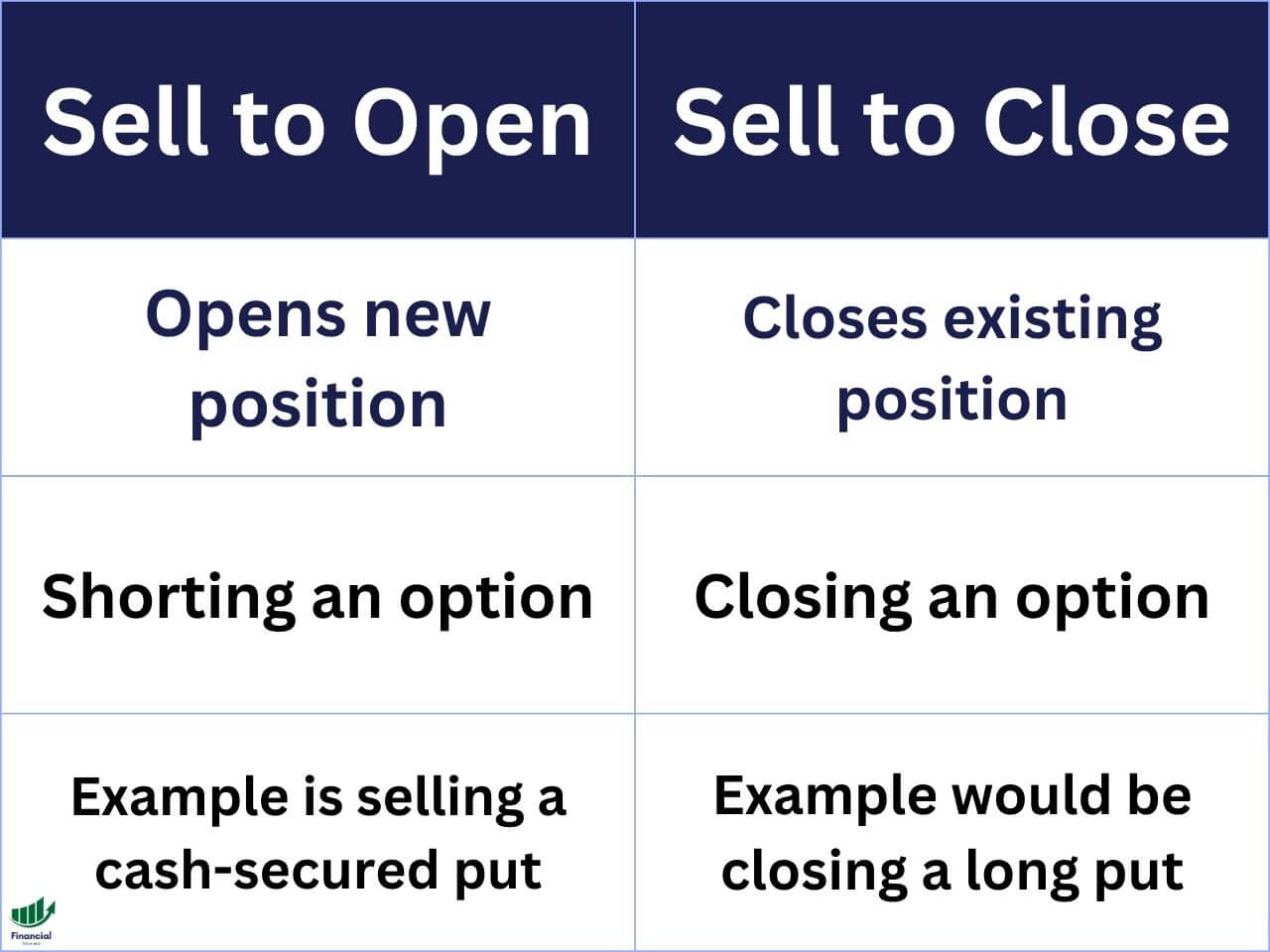
To understand “Sell to Close,” one must first understand the concept of a “long” position in the options market. In financial terms, being “long” means you have purchased an asset with the expectation that it will increase in value or provide a specific hedge. When you buy a call option or a put option, you are “Opening” a position.
Long Positions and the Initial Transaction
The lifecycle of this specific trade begins with a “Buy to Open” order. By executing a Buy to Open order, you pay a premium to acquire the rights (but not the obligation) associated with an option contract. At this stage, you own the contract. It sits in your brokerage account as an open liability for the seller and an open asset for you.
The Closing Transaction
“Sell to Close” is the inverse of that initial purchase. It is the formal instruction given to a broker to sell an option contract that you currently own. By doing so, you are “closing” your interest in that specific contract. Once the trade is executed, you no longer have any rights to the underlying security associated with that option, and you are no longer exposed to its price fluctuations.
Offsetting the Position
In the clearinghouse records, a Sell to Close order acts as an offset. If you own ten contracts of a specific strike price and expiration, and you execute a Sell to Close order for ten contracts, your net position becomes zero. This process is essential for maintaining the equilibrium of the options market, ensuring that for every long position closed, the corresponding obligations are accounted for.
When and Why Investors Use Sell to Close Orders
The decision to execute a Sell to Close order is rarely arbitrary. In professional money management, this action is usually the result of a predetermined exit strategy or a reaction to shifting market dynamics.
Realizing Profits on Successful Trades
The most desirable reason to Sell to Close is to lock in capital gains. If an investor buys a call option on a tech stock and the stock price surges, the premium of that call option will likely increase. To turn those “paper profits” into realized cash, the investor must Sell to Close the position.
Many traders use “Limit Orders” when selling to close for profit. For example, if you bought an option for $2.00 and your target is a 50% gain, you might set a Sell to Close limit order at $3.00. Once the market hits that price, the trade executes automatically, securing your return.
Mitigating Losses and Risk Management
Conversely, “Sell to Close” is the primary tool for capital preservation. If the market moves against your position, the value of your option will decline. Rather than allowing the option to expire worthless—which results in a 100% loss of the premium paid—an investor may choose to Sell to Close at a loss.
This is often executed via a “Stop-Loss” order. By setting a threshold, such as 20% below the purchase price, a trader ensures that they exit the market before a manageable loss turns into a catastrophic one. In the context of personal finance, this discipline is what separates successful long-term investors from gamblers.
Managing Time Decay (Theta)
Options are wasting assets. Every day that passes, an option loses a bit of its value due to “time decay,” known in the industry as Theta. Even if the underlying stock price remains stagnant, the option’s value will erode as it approaches expiration. Experienced investors often Sell to Close a position weeks before expiration to avoid the accelerated time decay that occurs in the final thirty days of a contract’s life.
Sell to Close vs. Other Option Order Types
To truly grasp the significance of Sell to Close, it is helpful to contrast it with the other three primary types of option orders. Confusion between these terms can lead to significant financial errors, such as accidentally shorting a stock or doubling down on a losing position.
Sell to Close vs. Buy to Open
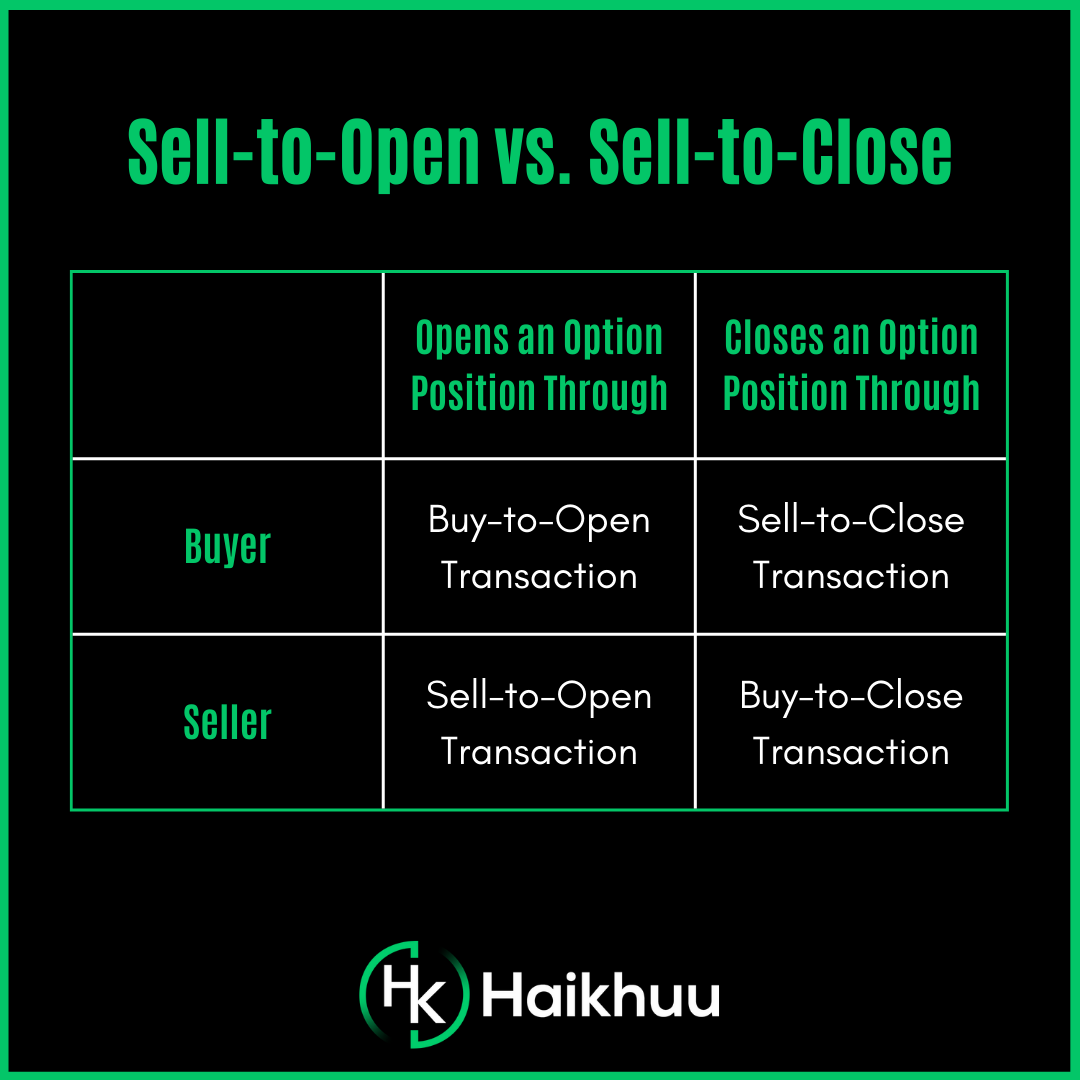
As established, these are two halves of the same whole for a long investor. You “Buy to Open” to enter the market and “Sell to Close” to exit. If you try to Sell to Close without first having a Buy to Open order on the books, your broker will likely reject the trade (unless you have the margin requirements to “Sell to Open”).
Sell to Close vs. Sell to Open
“Sell to Open” is the foundation of short selling in the options world. When you Sell to Open, you are creating a contract and selling it to someone else; you are the writer of the option. In this scenario, you receive the premium upfront but take on the obligation to deliver the stock (for a call) or buy the stock (for a put).
The distinction is critical:
- Sell to Close: You are getting rid of something you own.
- Sell to Open: You are creating a liability to collect immediate income.
Sell to Close vs. Buy to Close
“Buy to Close” is the exit strategy for someone who originally “Sold to Open.” If you wrote a covered call to generate income and now want to exit that obligation before expiration, you would Buy to Close. While Sell to Close results in a credit to your account, Buy to Close requires a debit (payment) to exit the position.
Strategic Considerations and Market Impact
Executing a Sell to Close order involves more than just clicking a button. To optimize financial outcomes, investors must consider the environment in which they are selling.
Liquidity and the Bid-Ask Spread
In the “Money” niche, efficiency is everything. When you Sell to Close, you are interacting with the “Bid” price—the highest price a buyer is willing to pay. If an option is illiquid (meaning there is low trading volume), the gap between the Bid and the Ask (the spread) can be wide. A wide spread can eat into your profits significantly. Smart investors look for high “Open Interest” before even entering a trade to ensure that when the time comes to Sell to Close, they can do so quickly and at a fair price.
The Role of Implied Volatility (Vega)
The price you receive when you Sell to Close is heavily influenced by market volatility. If the market becomes highly volatile, option premiums generally rise. An investor might find that even if the underlying stock hasn’t moved much, they can Sell to Close for a profit simply because the “Vega” (volatility sensitivity) increased the option’s value. Understanding these “Greeks” allows an investor to time their exit more effectively.
Tax Implications and Holding Periods
From a personal finance perspective, the timing of a Sell to Close order has tax consequences. In the United States, for instance, most options trades are considered short-term capital gains, which are taxed at higher ordinary income rates. However, the specific duration you held the contract and the type of underlying asset can influence your tax liability. Always consider the “net-of-tax” return when deciding whether to Sell to Close now or wait for a different tax window.
Conclusion: The Importance of Precision in Financial Execution
“Sell to Close” is more than just a menu option on a trading app; it is a fundamental pillar of risk management and capital allocation. By understanding that this order represents the formal termination of a long position, investors can navigate the markets with greater clarity and confidence.
In the journey of wealth creation, knowing how to enter a trade is only half the battle. The true skill lies in the exit. Whether you are protecting your downside during a market correction or harvesting gains after a bullish run, the Sell to Close order is your primary instrument for finalizing your financial intent. As you refine your investment strategy, treat every “Buy to Open” with the respect it deserves by having a clear, calculated plan for the eventual “Sell to Close.” This disciplined approach is what defines professional-grade money management and ensures long-term sustainability in the volatile world of investing.
aViewFromTheCave is a participant in the Amazon Services LLC Associates Program, an affiliate advertising program designed to provide a means for sites to earn advertising fees by advertising and linking to Amazon.com. Amazon, the Amazon logo, AmazonSupply, and the AmazonSupply logo are trademarks of Amazon.com, Inc. or its affiliates. As an Amazon Associate we earn affiliate commissions from qualifying purchases.