
The term “satellite” evokes images of orbiting marvels, intricate machinery, and the vastness of space. In the technological landscape, however, satellites represent far more than just celestial bodies. They are the silent enablers of countless modern conveniences, critical infrastructure for global communication, and indispensable tools for scientific discovery and Earth observation. Understanding what a satellite is and what it does within the tech sphere is crucial to appreciating the interconnectedness of our digital world and the future of technological advancement. From the GPS signals guiding your commute to the weather forecasts that inform your day, satellites are woven into the fabric of our daily lives, often in ways we don’t even consciously acknowledge.
The Foundational Technologies of Satellite Systems
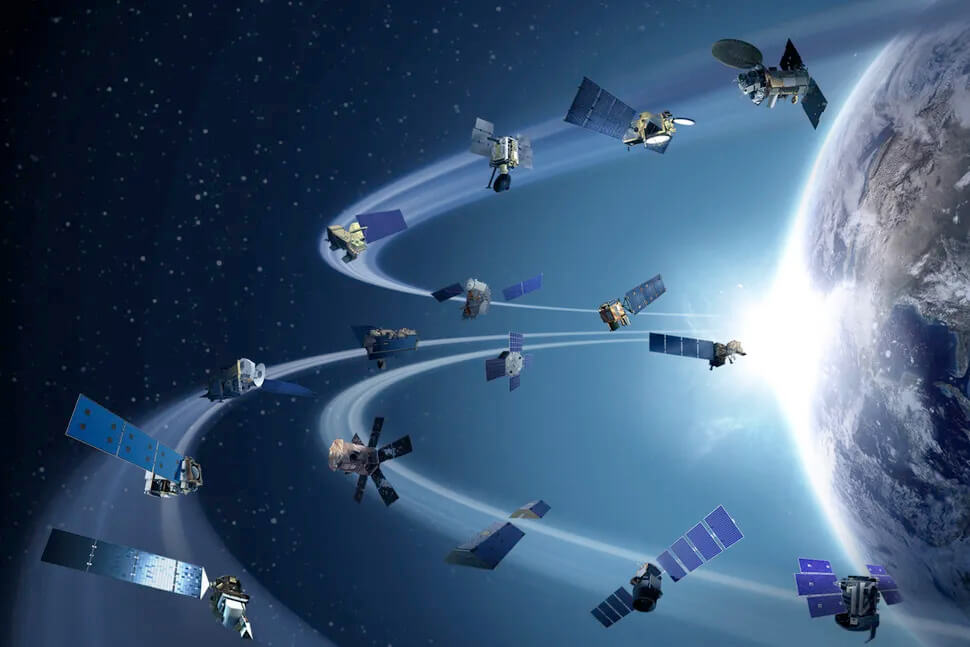
At its core, a satellite is an artificial object placed into orbit around a celestial body, most commonly Earth, for a specific purpose. These purposes are incredibly diverse, ranging from broadcasting television signals and facilitating global internet access to monitoring environmental changes and enabling scientific research. The technology underpinning these multifaceted roles is a marvel of engineering, involving a complex interplay of hardware, software, and sophisticated orbital mechanics.
Orbital Mechanics and Satellite Placement
The very act of placing a satellite into orbit is a feat of physics and engineering. Satellites are launched into specific trajectories, often requiring immense thrust to escape Earth’s gravity and achieve a stable orbital path. This path is determined by a delicate balance between the satellite’s velocity and the gravitational pull of the celestial body it orbits. Different orbits serve different purposes:
- Geostationary Orbit (GEO): Satellites in GEO orbit at an altitude of approximately 35,786 kilometers (22,236 miles) above the Earth’s equator. At this altitude, their orbital period matches the Earth’s rotation, making them appear stationary from a fixed point on the ground. This is ideal for broadcasting and telecommunications, as ground-based antennas do not need to track their movement.
- Low Earth Orbit (LEO): LEO satellites orbit much closer to Earth, typically between 160 and 2,000 kilometers (100 to 1,240 miles). Their faster orbital speeds mean they complete an orbit in as little as 90 minutes. This lower altitude is advantageous for applications requiring minimal signal delay, such as Earth observation, scientific research, and increasingly, global broadband internet services.
- Medium Earth Orbit (MEO): MEO satellites occupy an orbital band between LEO and GEO, generally between 2,000 and 35,786 kilometers. The Global Navigation Satellite System (GNSS) constellations, including GPS, GLONASS, Galileo, and BeiDou, primarily operate in MEO. This allows a sufficient number of satellites to be visible from most locations on Earth at any given time, ensuring continuous positioning data.
The precise placement and maintenance of these orbits are critical. Satellites are equipped with onboard thrusters for station-keeping, allowing them to make minor adjustments to their trajectory and counteract atmospheric drag or gravitational perturbations.
The Anatomy of a Satellite: Hardware and Systems
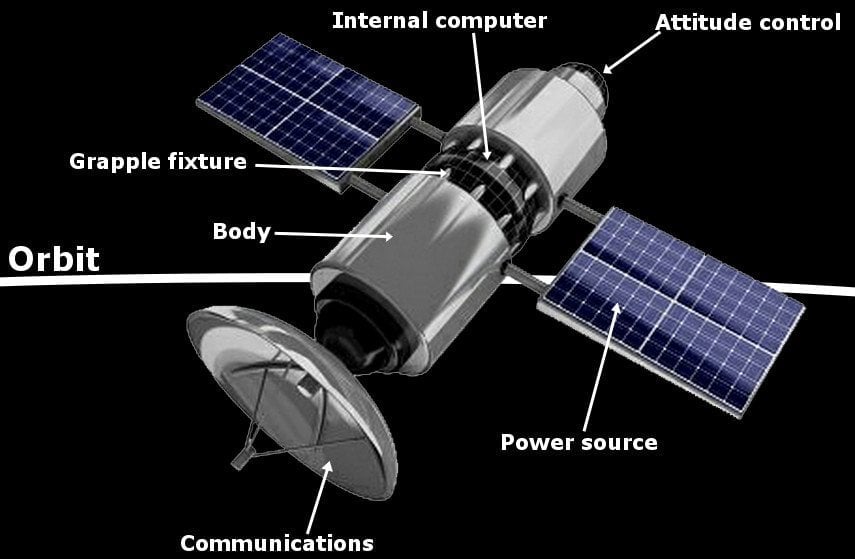
A satellite is a complex system designed to function autonomously in the harsh environment of space. Key components include:
- Payload: This is the primary functional component of the satellite, responsible for performing its mission. For a communication satellite, the payload might consist of transponders that receive, amplify, and retransmit signals. For an Earth observation satellite, it could be a high-resolution camera or a sophisticated sensor array.
- Bus: The bus provides the essential support systems for the payload. This includes:
- Power System: Typically composed of solar panels that convert sunlight into electricity, and batteries to store power for when the satellite is in Earth’s shadow.
- Attitude Determination and Control System (ADCS): This system uses sensors like star trackers and gyroscopes to determine the satellite’s orientation in space and actuators like reaction wheels or thrusters to maintain the desired pointing accuracy. This is vital for pointing antennas towards Earth or scientific instruments towards their targets.
- Telecommunications System: This comprises antennas for transmitting data to and receiving commands from ground stations, as well as the necessary radio frequency (RF) electronics.
- Propulsion System: Small thrusters used for orbit adjustments, station-keeping, and de-orbiting at the end of the satellite’s life.
- Thermal Control System: Manages the extreme temperature fluctuations in space, ensuring that sensitive electronic components operate within their specified temperature ranges.
- Onboard Computer and Software: The “brain” of the satellite, processing commands, managing systems, and collecting and formatting data.
The Multifaceted Roles of Satellites in Modern Technology
Satellites are not monolithic entities; their design and purpose are tailored to a vast array of applications that have fundamentally reshaped our technological capabilities and understanding of the world.
Global Connectivity and Communication
Perhaps the most pervasive impact of satellites on everyday technology is in the realm of communication. Satellites have democratized access to information and enabled instant global connectivity.
- Broadband Internet Access: Traditionally, satellite internet was a niche solution for remote areas lacking terrestrial infrastructure. However, with the advent of Low Earth Orbit (LEO) constellations like SpaceX’s Starlink and OneWeb, satellite internet is becoming a viable and increasingly competitive alternative for consumers and businesses worldwide. These constellations utilize thousands of smaller, interconnected satellites to provide lower latency and higher speeds than traditional geostationary satellite services.
- Television and Radio Broadcasting: Geostationary satellites remain the backbone of direct-to-home (DTH) satellite television and radio services. They broadcast signals to millions of dishes worldwide, providing access to a vast array of channels without the need for physical cables.
- Mobile Communication: While terrestrial cellular networks handle the bulk of mobile communication, satellites play a crucial role in extending coverage to oceanic areas, remote landmasses, and during emergencies when ground infrastructure is compromised. Satellite phones and specialized communication devices rely on these orbiting assets.
Navigation and Positioning Systems
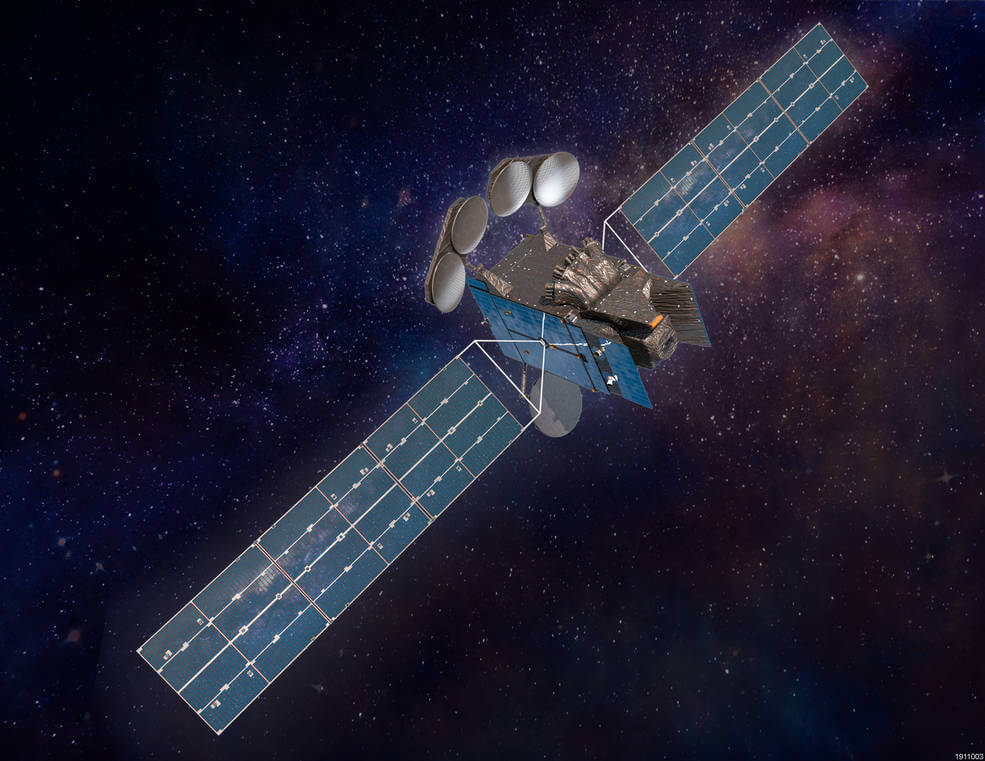
The ability to accurately determine one’s location on Earth is a foundational technology for countless applications, and this capability is almost entirely dependent on satellite constellations.
- Global Navigation Satellite Systems (GNSS): The most well-known GNSS is the United States’ GPS (Global Positioning System). However, other systems like Russia’s GLONASS, Europe’s Galileo, and China’s BeiDou offer similar functionalities, often working in conjunction to improve accuracy and availability. These systems consist of a network of satellites broadcasting precise timing and orbital data.
- Location-Based Services: The data from GNSS receivers, embedded in smartphones, vehicles, and specialized devices, powers a multitude of location-based services. This includes navigation apps, ride-sharing services, precision agriculture, surveying, emergency response coordination, and even the synchronization of critical financial and communication networks. The accuracy of these systems has become so precise that they can now pinpoint locations to within centimeters.
Earth Observation and Environmental Monitoring
Satellites provide an unparalleled vantage point for observing our planet, offering critical data for understanding and addressing environmental challenges, managing resources, and responding to natural disasters.
- Weather Forecasting and Climate Science: Meteorological satellites continuously monitor atmospheric conditions, cloud patterns, temperature, and humidity. This data is vital for creating accurate weather forecasts, tracking severe weather events like hurricanes and typhoons, and providing essential inputs for climate models that help us understand long-term climate change trends.
- Resource Management: Satellites equipped with specialized sensors can monitor land use, deforestation, agricultural yields, water resources, and mineral deposits. This information is invaluable for sustainable resource management, urban planning, and agricultural optimization.
- Disaster Response and Management: In the aftermath of natural disasters such as earthquakes, floods, and wildfires, satellite imagery can provide rapid assessments of damage, identify affected populations, and guide relief efforts. Real-time satellite data can also be used to monitor the spread of wildfires or the extent of flooding.
- Scientific Research: Satellites are used for a wide range of scientific research, from studying the Earth’s magnetic field and ionosphere to observing celestial phenomena beyond the reach of ground-based telescopes.
The Future of Satellite Technology: Miniaturization, Constellations, and Interconnectivity
The satellite industry is in a period of rapid evolution, driven by technological advancements and a growing demand for space-based services. The future promises even more sophisticated and integrated satellite systems.
The Rise of Small Satellites and Mega-Constellations
One of the most significant trends is the development of smaller, more cost-effective satellites, often referred to as “CubeSats” or “SmallSats.” These miniaturized spacecraft can be built and launched at a fraction of the cost of traditional large satellites.
- CubeSats and Nanosatellites: These standardized, often shoebox-sized satellites have opened up space to universities, research institutions, and even hobbyists, fostering innovation and democratizing access to space.
- Mega-Constellations: The proliferation of LEO satellites has led to the concept of “mega-constellations” comprising thousands or even tens of thousands of interconnected satellites. These constellations aim to provide global broadband internet coverage, high-resolution Earth observation, and other services by leveraging the sheer number of assets and their ability to dynamically route data.
Inter-Satellite Links and the Internet of Space
Future satellite systems are increasingly being designed to communicate directly with each other, forming a true “Internet of Space.”
- Inter-Satellite Links (ISLs): These laser or RF links allow satellites to exchange data directly, bypassing the need to communicate through ground stations for every transmission. This significantly reduces latency and increases the overall efficiency of data transfer within a constellation.
- Distributed Satellite Architectures: ISLs are paving the way for more distributed and resilient satellite networks. Instead of relying on a few large, centralized satellites, future systems may consist of numerous smaller satellites working collaboratively, making them less vulnerable to single points of failure.
Integration with Terrestrial Networks and Edge Computing
The lines between space-based and terrestrial technology are blurring. Satellites are becoming more integrated into existing communication infrastructures and are beginning to incorporate edge computing capabilities.
- Hybrid Networks: We will see more seamless integration of satellite communication with 5G and future terrestrial networks, providing a truly ubiquitous connectivity experience.
- Edge Computing in Space: Some advanced satellites are beginning to host processing capabilities, allowing them to analyze data onboard before transmitting it to Earth. This “edge computing in space” reduces the volume of data that needs to be transmitted and enables faster decision-making for applications like autonomous navigation or real-time anomaly detection.
In conclusion, “satellite” in the tech context represents a dynamic and rapidly evolving field. From enabling global communication and precise navigation to monitoring our planet and pushing the boundaries of scientific exploration, these orbiting platforms are indispensable. As technology advances, particularly with the proliferation of small satellites and intelligent network architectures, their role will only become more pronounced, further shaping the future of connectivity, data, and our interaction with the world.
aViewFromTheCave is a participant in the Amazon Services LLC Associates Program, an affiliate advertising program designed to provide a means for sites to earn advertising fees by advertising and linking to Amazon.com. Amazon, the Amazon logo, AmazonSupply, and the AmazonSupply logo are trademarks of Amazon.com, Inc. or its affiliates. As an Amazon Associate we earn affiliate commissions from qualifying purchases.