
The verse Revelation 3:20 stands as one of the most recognizable and frequently quoted passages in the New Testament. It reads: “Here I am! I stand at the door and knock. If anyone hears my voice and opens the door, the door, I will come in and eat with that person, and they with me.” While often utilized in evangelistic contexts to describe the initial act of inviting Christ into one’s life, a deeper investigation into the historical, cultural, and theological context reveals that this verse was never originally intended as a general invitation to the non-believer. Rather, it is a targeted message of restoration for an existing, yet spiritually lethargic, community.
The Historical Context of the Laodicean Church
To understand the weight of the knock described in Revelation 3:20, one must first understand the audience to whom it was addressed: the church in Laodicea. Unlike other churches mentioned in the early chapters of Revelation, the Laodiceans were not facing active persecution or suffering from internal heresy. Instead, they were struggling with a far more subtle and dangerous spiritual ailment: complacency born of affluence.
The City of Wealth and Self-Sufficiency
Laodicea was a hub of banking, textile production, and medicine. It was so wealthy that when an earthquake devastated the city in 60 A.D., the local leaders famously refused financial aid from Rome, declaring that they had sufficient resources to rebuild on their own. This spirit of self-sufficiency permeated the church. When the text describes them as “lukewarm,” it is a direct critique of their reliance on their own economic success rather than a reliance on the divine.
The Metaphor of the Lukewarm Water
The city’s water supply was famously tepid. Pipelines brought water from nearby hot springs, but by the time it reached Laodicea, it had lost its heat, becoming stagnant and nauseating. The spiritual condition of the church mirrored this water supply. They were neither “hot” (zealous and effective) nor “cold” (refreshing and clearly defined). They were comfortable, compromised, and utterly ineffective in their spiritual witness. It is into this atmosphere of smug self-satisfaction that the metaphor of the door is introduced.
Re-evaluating the “Door” Metaphor
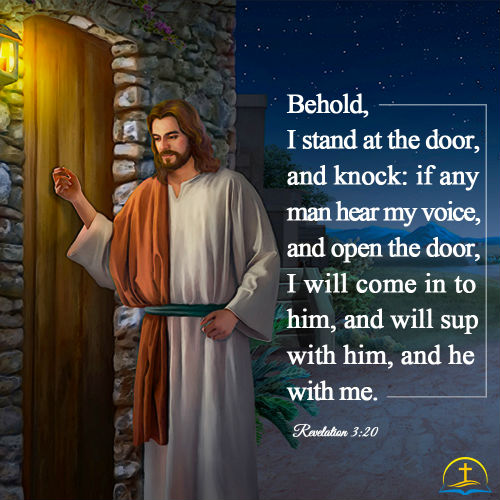
In contemporary evangelical thought, Revelation 3:20 is frequently depicted with art showing Jesus knocking at the door of a human heart, waiting for the “sinner” to let him in. While this serves as a powerful illustration of the gospel, the context of the passage suggests a different dynamic.
The Corporate Nature of the Message
The letter is addressed to the “angel of the church in Laodicea.” It is a corporate letter meant for a collective body of believers. When Jesus says, “I stand at the door and knock,” he is standing outside of his own church. The believers inside have become so focused on their wealth, their status, and their local influence that they have effectively shut Christ out of the decision-making and spiritual life of the congregation.
The Invitation to Re-fellowship
The “door” is the threshold between the church and the Savior. The imagery here is not of an initial salvation, but of a return to intimacy. The church has become an organization of men rather than an organism of God. Jesus is not asking for permission to save their souls in the traditional sense; he is asking to be invited back into the center of their collective life. The act of “opening the door” is an act of repentance—a radical shifting of priorities from self-reliance back to dependence on the presence of Christ.
The Intimacy of the Shared Meal
The culmination of the promise in Revelation 3:20 is found in the invitation: “I will come in and eat with that person, and they with me.” In the culture of the first-century Mediterranean world, dining together was the ultimate sign of friendship, covenant, and equality.
Breaking Barriers of Hierarchy
In a society obsessed with status, sharing a meal was a social statement. It implied a removal of barriers. When Jesus promises to eat with them, he is offering to restore the relationship that their pride had severed. He is not merely an external authority figure demanding compliance; he is a guest seeking fellowship. This highlights a crucial theological truth: that spiritual restoration is not achieved through rigorous law-keeping or improved moral performance, but through the re-establishment of a personal, intimate connection with the divine.
Dining as Symbolism for Sustenance
In the context of the “lukewarm” church, the meal is also a remedy for their spiritual malnutrition. They had sought to feed themselves on the world’s offerings—financial security, social status, and political influence. Jesus offers a different kind of bread. By inviting him in, the church ceases to rely on their own resources and begins to live off the sustenance provided by the Savior. The meal represents a transition from a life of worldly consumption to a life of spiritual sustenance.
The Implications for Modern Spirituality
While the historical context provides the original meaning, the application of Revelation 3:20 remains profoundly relevant. The “Laodicean trap” is one that many modern communities, both individual and corporate, fall into today.
The Dangers of Comfort
The primary enemy of the modern church is often not persecution, but comfort. In environments where faith is socially acceptable or culturally normalized, it is easy to become lukewarm. When we reach a state where our lives function perfectly well without an active, moment-by-moment dependence on God, we have effectively shut the door. The “knock” is the internal prompting of the Holy Spirit—an unsettling feeling, a sudden realization of emptiness, or a profound lack of spiritual fruit—that alerts us to the fact that we have drifted into a state of self-governance.
Moving from Self-Sufficiency to Dependence
To “open the door” today requires the same thing it required for the ancient Laodiceans: a willingness to acknowledge our own inadequacy. It is a humble admission that despite our organizational success, our digital influence, or our financial stability, we are essentially “wretched, pitiful, poor, blind, and naked” without the constant presence of Christ.
The promise of Revelation 3:20 is a hopeful one. It implies that no matter how far a community or an individual has strayed into the habit of self-reliance, the Savior remains near. He does not break the door down; he waits for an invitation. This intentional waiting honors human agency while highlighting the persistence of divine love. The invitation to dine remains open for any who recognize the sound of the knock.
Ultimately, Revelation 3:20 acts as a corrective lens for the human tendency to build kingdoms of our own making. It reminds us that the primary identity of the believer is not found in what they build, how much they possess, or how well they manage their affairs, but in the intimacy of their fellowship with the one who knocks. It is a call to move beyond the superficial, to dismantle the barriers of our own pride, and to re-invite the transformative presence of the divine into the center of our lives. When we hear the knock and respond, we find that the table is set, the meal is ready, and the isolation of self-sufficiency is replaced by the fullness of a life lived in direct communion with God.
aViewFromTheCave is a participant in the Amazon Services LLC Associates Program, an affiliate advertising program designed to provide a means for sites to earn advertising fees by advertising and linking to Amazon.com. Amazon, the Amazon logo, AmazonSupply, and the AmazonSupply logo are trademarks of Amazon.com, Inc. or its affiliates. As an Amazon Associate we earn affiliate commissions from qualifying purchases.