
In the high-stakes world of software development and digital transformation, the difference between a successful product launch and a catastrophic system failure often hinges on how well a team manages the invisible variables. As tech projects grow in complexity—involving multi-cloud environments, intricate API integrations, and distributed global teams—project managers and technical leads have turned to a foundational framework known as RAID.
RAID is an acronym for Risks, Assumptions, Issues, and Dependencies. While the term might sound like it belongs in a server room (referencing redundant arrays of independent disks), in the context of project management, it is a strategic tool used to categorize and monitor the critical factors that can influence a project’s lifecycle. For tech-focused organizations, a RAID log is not just a document; it is a vital piece of the project’s technical debt management and operational security.
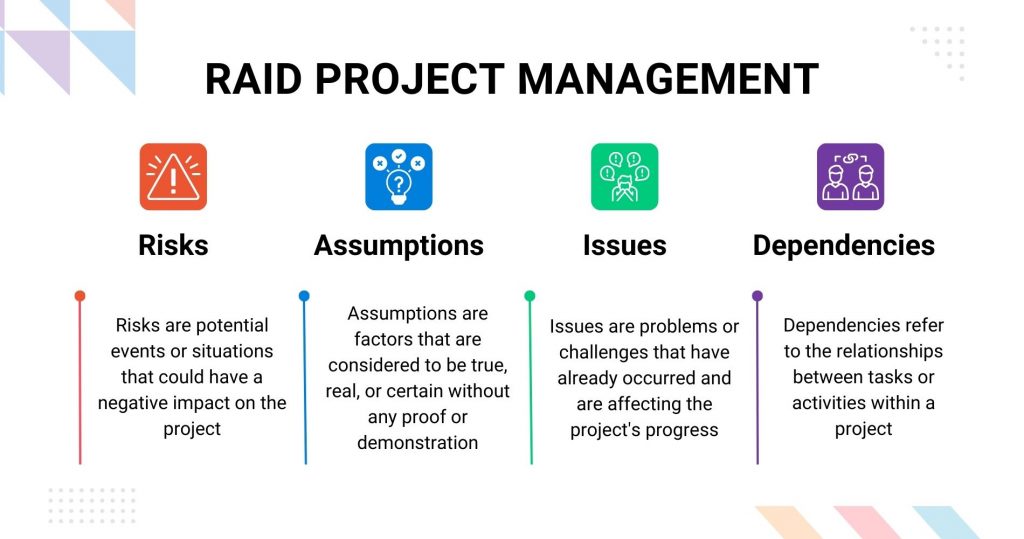
Decoding the RAID Framework: The Pillars of Software Project Success
To understand why RAID is indispensable in the tech sector, one must look at each of its components through the lens of technical execution. Each pillar represents a different type of information that must be tracked to ensure a project remains on schedule and within its technical specifications.
R – Risks: Anticipating the Unknown in Tech Development
In tech project management, a risk is a potential event that hasn’t happened yet but would negatively impact the project if it did. Unlike general business risks, technical risks often involve things like security vulnerabilities, potential failures in a third-party API, or the possibility of a specific technology stack becoming deprecated mid-project.
Managing risks requires a proactive mindset. For instance, if a team is building a decentralized application (dApp), a primary risk might be a delay in a smart contract audit. By identifying this risk early, the team can create a mitigation plan, such as scouting alternative auditors or adjusting the launch roadmap.
A – Assumptions: The Foundation of Technical Planning
Assumptions are factors that the project team believes to be true for the project to proceed, though they haven’t been definitively proven. In the tech world, assumptions often revolve around infrastructure and user behavior. A team might assume that the client’s existing server infrastructure can handle a 20% increase in traffic, or that a specific legacy database will be compatible with a new frontend framework.
Documenting assumptions is critical because if an assumption proves false, it often turns into an issue. In a tech stack transition, an unverified assumption about data migration speeds can lead to massive downtime during deployment.
I – Issues: Real-time Problem Solving in Agile Sprints
While risks are potential problems, issues are current problems. They are the bugs that need fixing, the server outages that stop development, or the sudden loss of a key developer. In an Agile environment, issues are often identified during daily stand-ups or sprint reviews.
Effective issue management in tech involves not just identifying the problem, but documenting the resolution path. For example, if a team discovers a critical cross-site scripting (XSS) vulnerability during development, this becomes a high-priority “Issue” in the RAID log that requires immediate technical intervention and a post-mortem to prevent recurrence.
D – Dependencies: Managing the Interconnected Web of Modern Infrastructure
Dependencies are perhaps the most technical aspect of the RAID log. They refer to any task that relies on the completion of another task, or any external factor that the project requires to move forward. In software engineering, this could be a “Finish-to-Start” dependency, where the backend team cannot begin API documentation until the database schema is finalized.
Modern tech projects often face “external dependencies,” such as waiting for a software license approval or a hardware shipment. Failing to track these can lead to “bottlenecking,” where a highly paid team of developers sits idle because a necessary third-party integration hasn’t been authorized.
Integrating RAID into the Modern Tech Stack
As digital ecosystems evolve, the methods we use to track RAID items have moved beyond static spreadsheets. Today, the integration of RAID management into specialized software tools and AI-driven platforms has streamlined how technical teams maintain project health.
Using SaaS Tools to Manage RAID Logs
In the modern tech landscape, the RAID log is usually a dynamic component of project management software like Jira, Asana, or ClickUp. In Jira, for example, “Issues” and “Risks” can be tagged with specific metadata, allowing for automated reporting and real-time visualization on a dashboard.
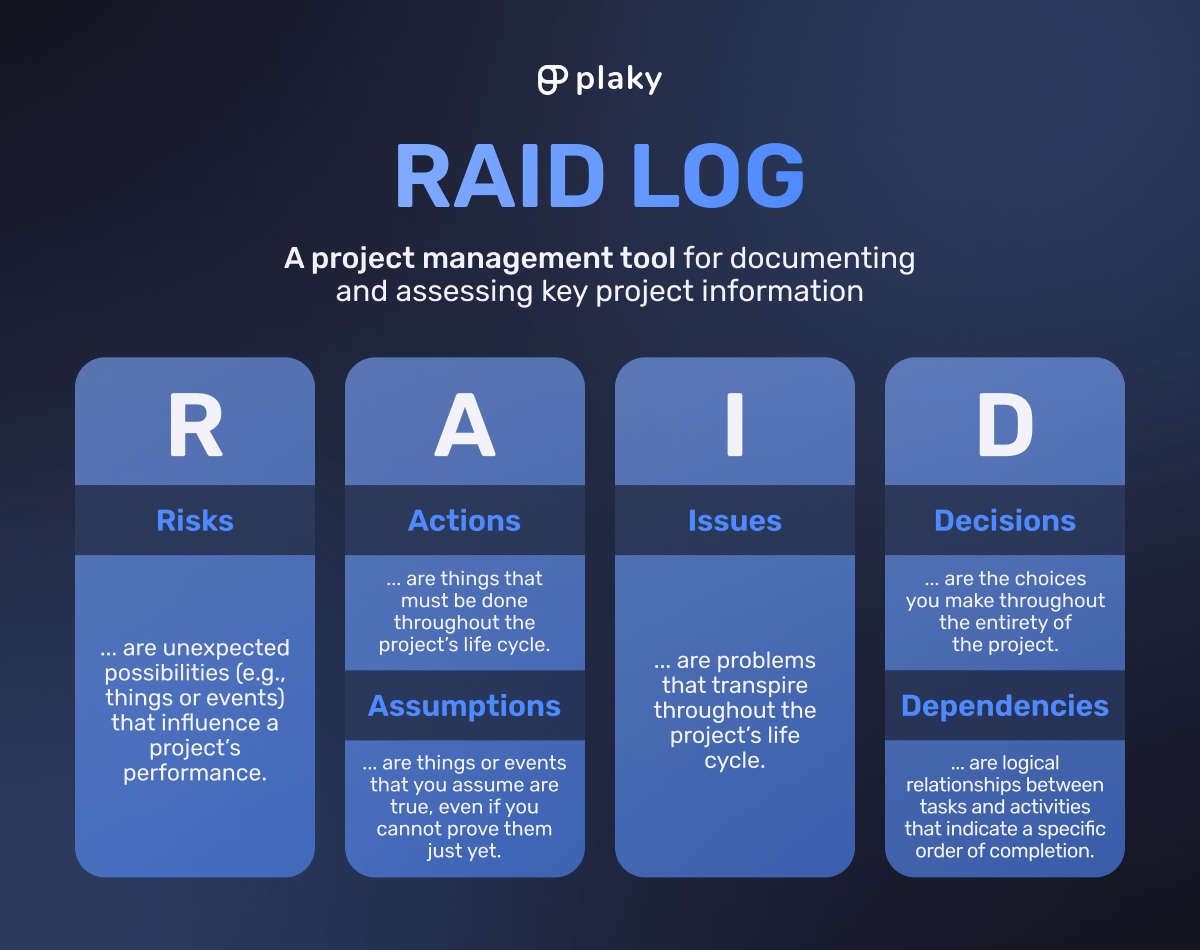
By using these SaaS tools, tech leads can link RAID items directly to code commits or pull requests. If a “Dependency” is noted—such as a specific library update—the tool can automatically notify the relevant developers the moment that library becomes available. This level of synchronization is essential for maintaining the velocity of Continuous Integration/Continuous Deployment (CI/CD) pipelines.
AI and Predictive Analytics in Risk Management
The emergence of Artificial Intelligence is revolutionizing how we identify the “R” in RAID. Advanced project management tools now use machine learning algorithms to analyze historical project data and predict potential risks before they materialize.
For example, an AI tool might notice that every time a project uses a specific legacy API, the “Issue” count spikes by 30%. The tool can then automatically flag this as a high-level “Risk” for any new project planning to use that same API. This shift from reactive to predictive management allows tech firms to allocate resources more efficiently and avoid the common pitfalls of technical debt.
Why Tech Leads Need RAID for Scalable Systems
Technical leadership requires more than just code proficiency; it requires the ability to oversee complex systems and the humans who build them. The RAID framework provides a structured way to communicate technical hurdles to non-technical stakeholders, ensuring that everyone is aligned on the project’s trajectory.
Enhancing Cross-Functional Collaboration
In large-scale tech companies, the development team often works alongside UI/UX designers, product managers, and cybersecurity experts. A centralized RAID log acts as a “single source of truth.” When the cybersecurity team identifies a “Risk” regarding data encryption, it is documented in the RAID log where the backend developers can see it immediately. This transparency prevents the “silo effect,” where critical technical information is trapped within one department.
Maintaining Digital Security and Compliance
For projects involving sensitive data—such as Fintech or Healthtech apps—the RAID log serves as a vital audit trail. Regulatory frameworks like GDPR or HIPAA require companies to prove they are actively managing risks. By maintaining a detailed RAID log, tech leads can demonstrate to auditors that security risks were identified, assumptions about data privacy were tested, and dependencies on third-party data processors were carefully monitored.
Creating a Living RAID Log: Best Practices for Dev Teams
A RAID log is only effective if it is updated and reviewed regularly. In the fast-paced world of technology, a risk identified three weeks ago may already have evolved into a critical issue today.
Ownership and Accountability
Every item in a RAID log should have a designated “owner.” In a technical environment, this owner is usually the person best equipped to handle the specific item. A “Risk” related to cloud infrastructure should be owned by a DevOps engineer, while a “Dependency” involving frontend assets should be owned by the Lead Designer.
Assigning ownership ensures that RAID items are not just documented, but actively managed. It prevents the common tech project pitfall where “everyone knows about a problem, but no one is fixing it.”
Iterative Review Cycles
In Agile development, the RAID log should be a recurring topic during sprint planning and retrospectives. Tech leads should ask:
- Which Risks have increased in probability?
- Which Assumptions have we validated through testing?
- Which Issues are blocking our current deployment?
- Are there new Dependencies created by our latest feature set?
By treating the RAID log as a living document rather than a one-time administrative task, tech teams can remain agile and responsive to the volatile nature of software development.
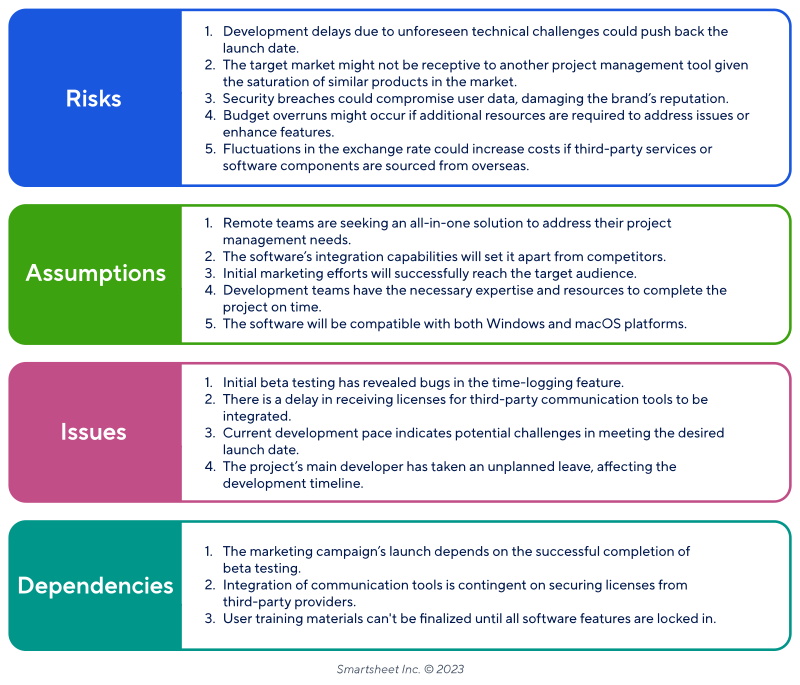
The Long-Term Value of RAID in Technical Innovation
The ultimate goal of any tech project is to deliver value—whether through a new app, a more secure network, or a more efficient internal tool. However, innovation is inherently risky. The RAID framework does not exist to eliminate risk, but to provide a structured environment where innovation can happen safely.
By mastering the RAID components, tech organizations can build more resilient systems. They can move faster, knowing that their dependencies are mapped and their assumptions are being tested. In an era where digital disruption is the norm, the ability to clearly identify and manage Risks, Assumptions, Issues, and Dependencies is what separates the industry leaders from those who are constantly sidelined by technical debt and unforeseen hurdles.
In summary, “RAID” in project management is the technical professional’s compass. It provides the clarity needed to navigate the complexities of modern software engineering, ensuring that even the most ambitious tech visions can be realized through disciplined, strategic execution.
aViewFromTheCave is a participant in the Amazon Services LLC Associates Program, an affiliate advertising program designed to provide a means for sites to earn advertising fees by advertising and linking to Amazon.com. Amazon, the Amazon logo, AmazonSupply, and the AmazonSupply logo are trademarks of Amazon.com, Inc. or its affiliates. As an Amazon Associate we earn affiliate commissions from qualifying purchases.