
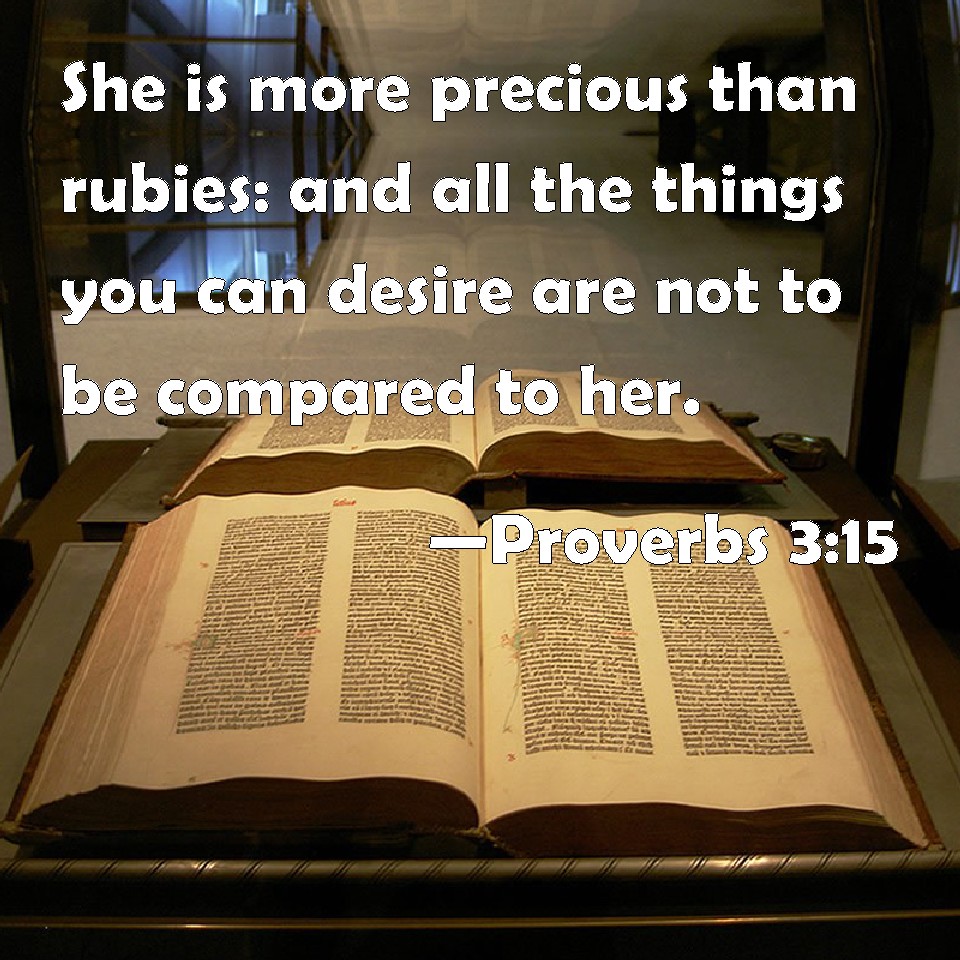
Proverbs 3:15 declares, “She is more precious than rubies; nothing you desire can compare with her.” While this verse, in its immediate context, speaks to the inestimable value of wisdom itself, its profound insights resonate deeply within the realm of personal finance, investment philosophy, and our understanding of true wealth. Often, we interpret ancient texts through a purely spiritual or moral lens, but the Book of Proverbs, in particular, is replete with practical guidance for daily living, including a significant emphasis on prudence, diligence, and the management of resources. To fully grasp the financial implications of Proverbs 3:15, we must first understand its place within a passage that directly contrasts wisdom with material riches, positioning it as the ultimate asset.

This article will delve into the multifaceted meaning of Proverbs 3:15, exploring how this ancient declaration offers timeless financial wisdom. We will uncover how the perceived value of wisdom, described as “more precious than rubies,” directly informs our approach to investing, understanding profitability, and redefining what it means to be truly wealthy in an ever-complex economic landscape.
Understanding the Ancient Valuation of Wisdom: A Superior Investment
To appreciate Proverbs 3:15, we must first look at the preceding verses, Proverbs 3:13-14: “Blessed are those who find wisdom, those who gain understanding, for she is more profitable than silver and yields better returns than gold.” This direct comparison immediately establishes wisdom not merely as a moral virtue, but as an economic asset. The ancient world understood the value of silver, gold, and rubies as universal measures of wealth and prosperity. By positioning wisdom as superior to these tangible assets, the proverb asserts a foundational principle for financial acumen: the greatest wealth lies not in what one possesses, but in the wisdom one applies.
Wisdom as a Superior Investment to Tangible Assets
In an age without formal financial markets as we know them, silver and gold represented the pinnacle of portable, universally recognized wealth. They were the ultimate hard assets. Yet, the author of Proverbs unequivocally states that wisdom surpasses even these. From a financial perspective, this suggests that while material assets like precious metals can store value, they do not inherently generate value or improve one’s condition in the way wisdom does. Wisdom, in this sense, is not just a store of value; it is a source of value creation. It empowers an individual to make sound decisions that lead to increased prosperity, mitigate risks, and navigate economic challenges.
Consider the modern financial parallel: many investors seek tangible assets like real estate or commodities. While these can be valuable, their profitability is often subject to market fluctuations, external forces, and requires wise management to truly thrive. Without wisdom, even the most promising physical asset can depreciate or be mismanaged. Wisdom, however, is an internal asset that appreciates with use, adapts to changing circumstances, and provides the framework for all successful financial endeavors. It is the ultimate intangible asset, yielding returns that far exceed mere capital gains.
The Enduring Returns of Prudent Understanding
The phrase “yields better returns than gold” is a striking financial metaphor. Gold, throughout history, has been a benchmark for wealth, a hedge against inflation, and a symbol of enduring value. Yet, wisdom promises “better returns.” What kind of returns are these? They are not merely monetary, but encompass a broader spectrum of benefits that enable financial success. Prudent understanding leads to:
- Better decision-making: Avoiding costly mistakes, identifying lucrative opportunities, and making informed choices about spending, saving, and investing.
- Enhanced resource management: Optimizing existing assets, minimizing waste, and maximizing efficiency.
- Increased earning potential: Wisdom often manifests as specialized knowledge, marketable skills, and a strong work ethic – all factors that command higher income.
- Resilience in adversity: The ability to pivot, adapt, and recover from financial setbacks, a characteristic often absent in those who rely solely on static wealth.
These “returns” are not subject to market volatility or economic downturns in the same way material investments are. They are internal, transferable, and grow exponentially over a lifetime. Investing in wisdom means investing in an asset that perpetually compounds, improving every facet of one’s financial life.
Proverbs 3:15 – Beyond Monetary Price Tags: The Incomparable Value
Proverbs 3:15 elevates wisdom even further: “She is more precious than rubies; nothing you desire can compare with her.” Here, the language shifts from “profitable” and “returns” to “precious” and “incomparable.” This transition emphasizes that wisdom’s value transcends mere utility or yield; it reaches into the realm of ultimate worth, suggesting that some assets are beyond price.
Defining “Preciousness” in a Financial Sense
Rubies, then as now, were among the most coveted and expensive gemstones. To be “more precious than rubies” implies that wisdom holds a value that cannot be quantified by market prices or even by the intrinsic worth of the rarest commodities. In a financial context, this speaks to the concept of intrinsic value versus market price. While rubies have a market price dictated by supply, demand, and quality, the intrinsic value of wisdom is self-evident and foundational.
Consider the role of wisdom in entrepreneurial ventures. A brilliant idea or innovative product might seem like a “ruby” in the market, but without the wisdom to execute, manage finances, adapt to challenges, and understand market dynamics, even the most promising venture can fail. The “preciousness” of wisdom lies in its ability to unlock, protect, and multiply value, often in ways that tangible assets cannot. It is the underlying capital that makes all other forms of capital truly productive.
This verse challenges us to consider what we truly deem “precious.” Is it the accumulation of wealth for its own sake, or the wisdom that enables us to create, maintain, and judiciously use that wealth to achieve meaningful goals and provide lasting security? The proverb posits that without wisdom, even the most valuable possessions are ultimately fleeting or unsatisfying.
The Limits of Material Wealth vs. Intangible Value
The declaration “nothing you desire can compare with her” is a powerful statement about opportunity cost and ultimate priorities. It suggests that if one were to list all the material desires – from luxurious homes and exotic travel to vast sums of money – wisdom would still outweigh them all in terms of true, enduring satisfaction and benefit.
From a financial planning perspective, this urges individuals to evaluate what constitutes genuine wealth. Is it the size of one’s investment portfolio, or the peace of mind derived from sound financial planning? Is it the immediate gratification of luxury purchases, or the disciplined saving and investing that provides long-term security and freedom? Proverbs 3:15 strongly advocates for prioritizing intangible assets like wisdom, knowledge, and sound judgment over the mere pursuit of material accumulation.
Many wealthy individuals can attest that money alone does not guarantee happiness, stability, or problem-free existence. In fact, large sums of money without wisdom can lead to mismanagement, exploitation, and even personal ruin. True financial prosperity, therefore, must be rooted in an understanding of value that extends beyond balance sheets and asset valuations. It embraces the qualitative aspects of a well-managed life, guided by principles of foresight, moderation, and understanding.
Practical Financial Applications of Proverbs 3:15 Today
The timeless wisdom of Proverbs 3:15 is remarkably applicable to contemporary financial challenges and opportunities. It provides a framework for how we should approach our investments, careers, and overall financial well-being.

Investing in Knowledge and Skill Over Fleeting Trends
If wisdom is more profitable than silver and yields better returns than gold, then investing in personal development, education, and skill acquisition should be a top financial priority. Rather than chasing every stock market trend or get-rich-quick scheme, a wise investor understands that their greatest asset is their own human capital. This means:
- Continuous Learning: Staying informed about market dynamics, economic principles, and new financial tools.
- Skill Development: Acquiring or honing skills that enhance earning potential or create new income streams.
- Financial Literacy: Educating oneself on budgeting, saving, investing, debt management, and retirement planning.
These investments in oneself do not diminish in value; they compound over time, providing a solid foundation for financial resilience and growth, irrespective of external market conditions. The “returns” on such investments are higher income, smarter investment decisions, and greater financial freedom.
The True Profitability of Prudence and Discipline
The message of Proverbs 3:15 underscores the profitability of prudence and discipline – key components of wisdom. In personal finance, prudence means making thoughtful, well-researched decisions rather than impulsive ones. Discipline means consistently adhering to a financial plan, whether it’s saving a portion of income, sticking to an investment strategy, or avoiding unnecessary debt.
- Budgeting and Saving: Disciplined budgeting ensures resources are allocated wisely, and consistent saving builds a crucial emergency fund and investment capital.
- Debt Management: Prudence dictates avoiding high-interest debt and strategically managing existing liabilities to free up capital for productive use.
- Long-Term Investing: Resisting the urge to react to short-term market fluctuations and instead focusing on a diversified, long-term investment strategy requires significant discipline.
These seemingly mundane practices, when consistently applied with wisdom, yield far better returns than any speculative venture, providing a stable path to wealth accumulation and financial security.
Long-Term Financial Security Through Wise Decision-Making
Ultimately, Proverbs 3:15 points to the path of long-term financial security and prosperity that is built on a foundation of wise decision-making rather than sheer luck or aggressive risk-taking. Wisdom encourages foresight, planning for the future, and understanding the interconnectedness of financial choices.
This translates to:
- Retirement Planning: Starting early, contributing consistently, and making informed investment choices for retirement are acts of wisdom that secure future well-being.
- Estate Planning: Thoughtful planning for the distribution of assets ensures that one’s legacy is preserved and future generations are provided for, reflecting a deep understanding of lasting value.
- Risk Management: Wisely assessing and mitigating financial risks through insurance, diversification, and contingency planning.
These are not merely financial transactions; they are manifestations of a deep understanding that true wealth is not just about what one has today, but about the security, freedom, and well-being that wise choices create for tomorrow and beyond.
Cultivating Wisdom for Financial Flourishing
Given the unparalleled value ascribed to wisdom by Proverbs 3:15, the logical next step is to actively cultivate it. Financial flourishing is not an accidental outcome; it is the deliberate result of an ongoing pursuit of wisdom and its practical application.
The Role of Continuous Learning in Personal Finance
The pursuit of wisdom is a lifelong journey. In the rapidly evolving world of finance, continuous learning is paramount. This includes:
- Reading and Research: Engaging with reputable financial literature, market analysis, and economic forecasts.
- Seeking Mentorship: Learning from experienced financial advisors, successful investors, and business leaders.
- Self-Reflection: Regularly reviewing one’s financial decisions, learning from mistakes, and adapting strategies.
Just as a professional continuously updates their skills, an individual committed to financial flourishing must continually refine their financial knowledge and understanding. This ongoing investment in intellectual capital is the most profitable investment one can make.
Prioritizing Values Beyond Monetary Accumulation
Finally, Proverbs 3:15 reminds us that even when discussing financial wisdom, the ultimate “preciousness” extends beyond mere monetary accumulation. Wisdom, when applied to finance, helps us understand that money is a tool, not an end in itself. It allows us to align our financial decisions with our deeper values, whether that’s providing for family, contributing to community, pursuing meaningful work, or achieving personal freedom.
The greatest return on wisdom is not just a larger bank account, but a richer, more secure, and more purpose-driven life. When we understand that “nothing you desire can compare” to wisdom, we are freed from the endless chase for material things and empowered to use our financial resources in ways that truly matter, building a legacy that is “more precious than rubies” in every sense.
Conclusion
Proverbs 3:15, “She is more precious than rubies; nothing you desire can compare with her,” is far more than a poetic endorsement of wisdom. When interpreted through a financial lens, alongside its preceding verses, it offers a foundational philosophy for building true, enduring wealth. It challenges us to look beyond immediate monetary gains and fleeting material possessions, advocating for wisdom as the ultimate asset – one that is more profitable than silver, yields better returns than gold, and possesses an incomparable value that no earthly desire can match. By prioritizing the cultivation of knowledge, prudence, and disciplined decision-making, we are not just making smart financial moves; we are investing in the most precious capital available, securing not just our finances, but our overall well-being and a legacy of lasting value. The ancient wisdom of Proverbs 3:15 remains an indispensable guide for anyone seeking financial flourishing in the modern world.
aViewFromTheCave is a participant in the Amazon Services LLC Associates Program, an affiliate advertising program designed to provide a means for sites to earn advertising fees by advertising and linking to Amazon.com. Amazon, the Amazon logo, AmazonSupply, and the AmazonSupply logo are trademarks of Amazon.com, Inc. or its affiliates. As an Amazon Associate we earn affiliate commissions from qualifying purchases.