
In the fast-paced world of digital communication, acronyms and abbreviations are the lifeblood of efficiency. They allow us to convey ideas and sentiments with speed and brevity, especially in text messages, instant messaging, and social media. Among the myriad of these digital shorthand terms, “NVM” stands out as a particularly common and often misunderstood one. Its prevalence in casual conversations can lead to confusion if its nuances aren’t fully grasped. This article delves into the meaning of “NVM” within the context of technology-driven communication, exploring its origins, typical usage, and the subtle implications it carries. We will navigate its role in various digital platforms and understand how its meaning can shift based on context, making it an essential piece of knowledge for anyone navigating the digital landscape.

The Genesis and Ubiquity of “NVM”
The digital age has fostered a unique linguistic evolution, where concise expressions gain traction due to the very nature of the mediums they inhabit. “NVM” is a prime example of this phenomenon, having emerged from the early days of online chat and messaging.
From Acronym to Digital Vernacular
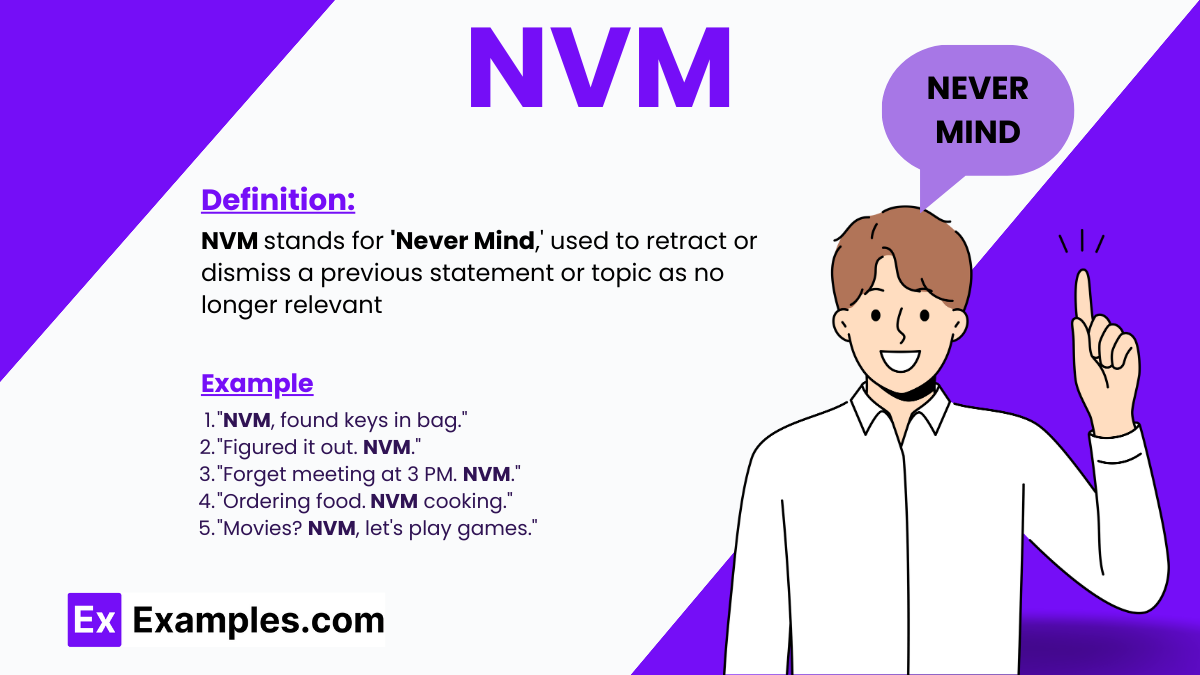
At its core, “NVM” is an acronym standing for “Never Mind.” Its genesis can be traced back to the early days of internet chat rooms and instant messaging platforms, where typing speed and character limits were significant considerations. Users sought ways to communicate quickly and efficiently, leading to the widespread adoption of abbreviations and acronyms. “NVM” proved to be an exceptionally useful tool for retracting a previous statement, indicating a change of mind, or signaling that a prior query or comment was no longer relevant.
The evolution of “NVM” from a simple abbreviation to an ingrained part of digital vernacular is a testament to its utility. It’s not just a shortcut; it’s a signal that subtly alters the conversational flow. Unlike more complex acronyms that require explanation, “NVM” is largely intuitive once its basic meaning is understood. Its adoption has been fueled by its versatility and its ability to de-escalate potentially awkward or unnecessary continuations of a conversation.
“NVM” Across Digital Platforms
The reach of “NVM” extends far beyond its initial chat room origins. It has permeated nearly every digital communication channel we utilize today.
Text Messaging and Instant Messaging
In the realm of SMS and instant messaging apps like WhatsApp, Telegram, and Signal, “NVM” is a workhorse. It’s often used when a sender realizes they’ve asked a question that they can answer themselves with a quick search, or when they’ve made a statement that they immediately regret or deem unimportant. For example, a user might text, “Hey, what’s the weather like tomorrow?” and then, upon glancing out the window or checking their phone’s weather app, immediately follow up with, “NVM, it looks clear.” This avoids the need for the recipient to expend energy responding to a question that has already been resolved by the sender.
Social Media and Online Forums
On social media platforms such as Twitter, Facebook, and Reddit, “NVM” serves a similar purpose. Users might post a comment or question, only to realize it’s been asked before, is irrelevant to the ongoing discussion, or they’ve decided against pursuing it. Typing “NVM” allows them to quickly backtrack without cluttering the thread with an abandoned thought. This is particularly valuable in public forums where contributions are visible to a wider audience. It’s a subtle way of managing one’s digital footprint and maintaining conversational coherence.
Gaming and Collaborative Environments
In online gaming communities and other collaborative digital environments, “NVM” is crucial for real-time communication. Players coordinating strategies might quickly ask for information, only to discover it themselves or realize the situation has changed. “NVM” allows them to swiftly cancel their request, keeping the communication channels open for more critical updates. This efficiency is paramount in fast-paced scenarios where every second counts. The ability to retract a message without disrupting the flow of critical operational dialogue is a significant benefit.
The Multifaceted Meanings and Nuances of “NVM”
While “Never Mind” is the primary and most recognized meaning of “NVM,” its application in digital communication is not always straightforward. Context plays a pivotal role in deciphering its exact intent.
Beyond Retraction: Signaling a Change of Mind
“NVM” is not solely about retracting a previous statement. It can also signify a genuine change of mind or a shift in the sender’s perspective.
Acknowledging a New Realization
Sometimes, a sender might express an initial thought or ask a question, but then, upon further reflection or receiving new information, they decide to let the matter drop. For instance, someone might text, “Should I order pizza tonight?” After a moment’s thought, they might realize they don’t really want pizza or have already eaten, and then send, “NVM, I’m not that hungry.” Here, “NVM” isn’t necessarily retracting a question, but rather updating the recipient on the sender’s current state of mind and decision. It’s a form of self-correction in conversation, providing an update without demanding a response.
De-escalating or Avoiding Unnecessary Discussion
In certain situations, “NVM” can be used to de-escalate a conversation or avoid a potentially drawn-out or unproductive discussion. If a sender realizes their initial comment might be misconstrued or lead to an argument they don’t wish to engage in, they might use “NVM” to signal that they’re letting the topic go. For example, in a group chat discussing a sensitive topic, someone might type something that sparks a debate, then quickly add “NVM” to indicate they don’t want to pursue that line of discussion. This can be a diplomatic way to steer clear of conflict or awkwardness, preserving the harmony of the digital interaction.
The Subtle Power of Implied Meaning
The effectiveness of “NVM” often lies in what it doesn’t explicitly state. Its brevity leaves room for interpretation, and this ambiguity can sometimes be part of its charm or utility.
When “Never Mind” Is Too Blunt
In some cases, simply saying “Never mind” aloud can sound abrupt or dismissive. In text, “NVM” can soften this sentiment, making it feel less confrontational. It conveys the same meaning but with a slightly more casual and less assertive tone. This is particularly useful in professional or semi-professional digital communications where maintaining a polite and considerate tone is important, even when retracting a statement or changing one’s mind. It suggests a gentle withdrawal rather than a sharp dismissal.
The “Don’t Worry About It” Implication
Often, “NVM” carries an implicit “don’t worry about it” or “it’s not important” message. When someone uses “NVM” after asking for something or expressing a need, it can signal that the need has been met, they’ve figured it out, or it’s no longer a priority. For instance, if a colleague texts, “Can you send me the report by 3 PM?” and then, realizing they’ve already received it from someone else, adds, “NVM, got it,” it implies that the original request is now null and void, and the sender doesn’t require further action from the recipient. This saves the recipient from needing to confirm they’ve received the information or to act on the request.
Navigating the Contextual Landscape of “NVM”
Understanding the precise meaning of “NVM” hinges on a careful analysis of the surrounding conversation and the relationship between the communicators. Its interpretation can vary significantly depending on these factors.
Analyzing the Preceding Message
The most direct clue to “NVM”‘s meaning lies in what was communicated immediately before it.
Correcting a Question or Statement
If the message preceding “NVM” was a question, it often means the sender has found the answer or no longer needs the information. If it was a statement, “NVM” typically signifies that the sender is retracting or rescinding that statement. For example, if someone texts, “I think I left my keys at the office,” and then immediately follows with “NVM, found them in my bag,” the “NVM” clearly indicates they are correcting their previous statement. This is a straightforward application of the acronym, ensuring clarity and preventing the recipient from worrying or offering solutions for a problem that no longer exists.
Acknowledging a Realization After an Initial Query
In cases where the sender asked for something and then realized they could obtain it themselves, “NVM” serves as an efficient way to communicate this resolution. A common scenario is in a collaborative project where one team member might ask for a specific piece of data. If they then realize they have access to that data through a shared drive or another channel, they might text, “Can you forward me the Q3 sales figures?” followed by “NVM, found them in the shared folder.” This saves the recipient time and effort in locating and sending the information, demonstrating an awareness of shared resources and efficient problem-solving.
The Role of Relationship and Platform
The dynamics of the sender-recipient relationship and the specific digital platform being used can also subtly influence the interpretation of “NVM.”
Casual vs. Formal Communication
In highly informal settings, such as close friends texting, “NVM” is almost always understood as a casual “never mind.” However, in slightly more formal digital interactions, like emails or professional chat platforms, while still understood as “never mind,” it might carry a slightly more considered tone, implying a more significant retraction or reconsideration. The context of professional communication often demands a higher degree of clarity and a more measured approach, even when employing abbreviations. Therefore, while “NVM” remains a valid tool, its use in professional settings might be more deliberate.
Platform-Specific Etiquette
Different platforms can foster slightly different norms. On platforms like Reddit, where lengthy explanations are common, an isolated “NVM” might prompt curiosity. In contrast, on rapid-fire instant messaging apps, it’s an expected part of the conversational rhythm. The etiquette surrounding “NVM” is thus shaped by the platform’s design and its typical user interactions. For instance, in a fast-paced gaming chat, “NVM” is a survival tool. In a thoughtful online forum discussion, it might be seen as a slightly abrupt way to disengage from a point. Understanding these platform-specific nuances can enhance one’s digital communication skills.
The Strategic Use of “NVM” in Digital Exchanges
Mastering the use of “NVM” goes beyond simply knowing its definition; it involves strategically deploying it to enhance the efficiency and clarity of your digital conversations.
Enhancing Conversational Flow and Efficiency
The primary benefit of “NVM” is its ability to streamline communication by allowing senders to quickly retract or update their thoughts, thereby keeping conversations moving smoothly.
Preventing Unnecessary Responses
By signaling that a previous query or statement is no longer relevant, “NVM” effectively prevents the recipient from expending time and effort responding to something that has already been resolved. This is particularly valuable in professional settings where time is a critical resource. For example, if a team member asks for clarification on a document and then realizes they can infer the meaning, sending “NVM” saves their colleague the trouble of providing an answer. This demonstrates thoughtfulness and respect for the other person’s time.
Minimizing Digital Clutter
In busy chat threads or social media feeds, “NVM” helps to minimize unnecessary clutter. By withdrawing irrelevant or redundant messages, senders contribute to a cleaner and more focused communication environment. This is especially important in large group chats or public forums where a multitude of messages can quickly become overwhelming. A well-placed “NVM” can prevent a conversation from veering off-topic or getting bogged down by abandoned inquiries, ensuring that important information remains accessible and that the overall flow of dialogue is maintained.
The Art of Subtle Communication
“NVM” allows for a degree of subtle communication, where the unspoken implications can be as important as the explicit meaning.
Conveying a Sense of Self-Sufficiency
When used after a query that the sender then resolves themselves, “NVM” subtly conveys a sense of self-sufficiency and problem-solving. It shows that the sender is capable of finding solutions independently, which can be perceived positively in both personal and professional contexts. This self-reliance, communicated through a simple abbreviation, can contribute to a sender’s perceived competence and resourcefulness.

Managing Expectations and Intentions
“NVM” can also be used to manage expectations and intentions. If a sender initially expresses interest in something but then decides against it, “NVM” allows them to backtrack gracefully without appearing indecisive or unreliable. This ability to adjust one’s stance and communicate that adjustment efficiently is a key aspect of effective digital interaction. It allows individuals to navigate conversations with flexibility and adaptability, ensuring that their communications accurately reflect their current intentions and decisions.
In conclusion, “NVM” is far more than a simple acronym; it is a sophisticated tool in the arsenal of digital communication. Its meaning, while predominantly “Never Mind,” carries a rich tapestry of nuances that are shaped by context, relationship, and platform. By understanding and strategically employing “NVM,” individuals can enhance the clarity, efficiency, and overall quality of their digital interactions, navigating the ever-evolving landscape of online communication with greater confidence and finesse. It stands as a testament to how language adapts and evolves in response to the technological tools we use, creating a dynamic and efficient way to connect.
aViewFromTheCave is a participant in the Amazon Services LLC Associates Program, an affiliate advertising program designed to provide a means for sites to earn advertising fees by advertising and linking to Amazon.com. Amazon, the Amazon logo, AmazonSupply, and the AmazonSupply logo are trademarks of Amazon.com, Inc. or its affiliates. As an Amazon Associate we earn affiliate commissions from qualifying purchases.