
In the lexicon of modern finance, few ticker symbols have garnered as much attention and debate as MSTR. While it represents MicroStrategy, an enterprise software company with a long history in business intelligence, its significance in the contemporary investment landscape has largely transcended its core business operations. Today, MSTR has become synonymous with a pioneering, and often polarizing, corporate strategy centered around Bitcoin, positioning the company as a unique vehicle for investors seeking exposure to the volatile world of digital assets.
Decoding the Ticker: MicroStrategy’s Financial Identity
To truly understand what MSTR signifies, one must trace its evolution from a conventional tech company to a trailblazing corporate Bitcoin holder. The ticker symbol MSTR is listed on the Nasdaq exchange and is primarily associated with the publicly traded stock of MicroStrategy Incorporated.
Beyond the Name: A Pioneer in Business Intelligence
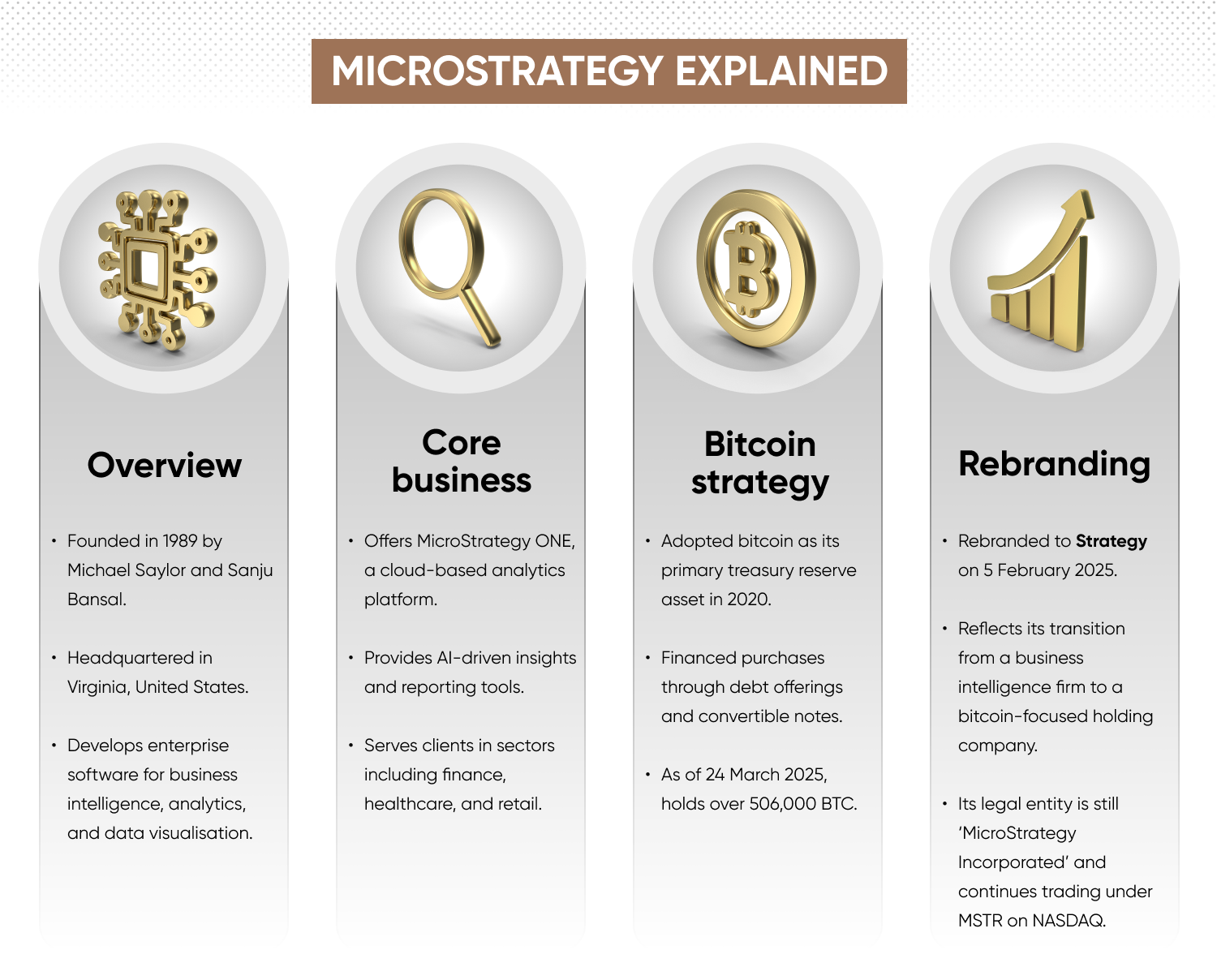
MicroStrategy was founded in 1989 by Michael Saylor, the company’s long-standing CEO and executive chairman. For decades, the company established itself as a leader in business intelligence (BI) software, providing analytics, mobile software, and cloud-based services to large enterprises. Its offerings help organizations make data-driven decisions by enabling them to analyze vast datasets, visualize trends, and generate actionable insights. Through its history, MicroStrategy has navigated various tech cycles, maintaining its presence in a competitive software market. Its financial performance, for much of its existence, was assessed through the lens of a typical software company: revenue growth, profitability margins, customer acquisition, and product innovation.
From Software to Speculation: The Bitcoin Shift
The most profound shift in MicroStrategy’s financial identity occurred in August 2020, when the company announced its decision to adopt Bitcoin as its primary treasury reserve asset. This move marked an unprecedented departure from traditional corporate finance practices, which typically favor low-volatility assets like cash, short-term government bonds, or highly liquid marketable securities for treasury reserves. Under Saylor’s leadership, MicroStrategy began acquiring substantial amounts of Bitcoin, fundamentally altering its balance sheet, risk profile, and market valuation. From this point forward, the company’s stock performance became increasingly correlated with the price movements of Bitcoin, transforming MSTR into a de facto proxy for the cryptocurrency in the public equity markets.
MicroStrategy’s Bitcoin Strategy: An Unprecedented Corporate Play
The rationale behind MicroStrategy’s aggressive Bitcoin acquisition strategy is multifaceted, driven by a combination of macroeconomic outlooks, philosophical beliefs about digital assets, and a bold re-evaluation of corporate treasury management.
The Rationale: Inflation Hedge and Treasury Management
Michael Saylor, the architect of this strategy, articulated a clear vision: to protect corporate value against inflationary pressures and the perceived devaluation of fiat currencies. In his view, traditional treasury assets like cash and bonds were yielding negative real returns, eroding purchasing power over time. Bitcoin, with its decentralized nature, finite supply cap (21 million coins), and increasing adoption, was identified as a superior store of value and an “inflation hedge” against currency debasement. Saylor argued that holding Bitcoin offered a potentially higher return on capital than traditional investments, thereby maximizing long-term shareholder value.
Furthermore, MicroStrategy positioned its Bitcoin strategy as a proactive approach to treasury management, aiming to convert excess cash and, subsequently, raise debt to invest in Bitcoin. This was not merely about holding a digital asset; it was a strategic pivot intended to capitalize on what the company saw as the future of money and a fundamental shift in the global financial system. The company’s conviction was that Bitcoin represented “digital gold” and would appreciate significantly over time, far outperforming conventional assets.
Accumulation and Its Impact: A Leveraged Bet
MicroStrategy’s accumulation strategy has been remarkably consistent and aggressive. The company has utilized several methods to acquire its Bitcoin holdings, including:
- Direct Purchases with Excess Cash: Initially, MicroStrategy used its existing cash reserves to buy Bitcoin.
- Convertible Senior Notes: The company issued convertible senior notes, essentially debt that can be converted into equity under certain conditions, specifically to raise capital for Bitcoin purchases. This allowed MicroStrategy to leverage its balance sheet to acquire more Bitcoin without diluting existing equity immediately.
- Stock Offerings: In some instances, the company also raised capital through stock offerings, using the proceeds for Bitcoin acquisitions.

This multi-pronged approach has resulted in MicroStrategy accumulating one of the largest corporate Bitcoin treasuries globally, often exceeding hundreds of thousands of Bitcoins. The scale of these holdings means that the company’s financial results and stock performance are inextricably linked to Bitcoin’s price movements. A significant rise in Bitcoin’s value directly increases the reported value of MicroStrategy’s assets, while a decline can lead to substantial impairment charges and put downward pressure on MSTR stock. Effectively, MSTR has become a leveraged bet on Bitcoin.
MSTR as an Investment: Opportunities and Risks
For investors, MSTR represents a unique, albeit complex, investment proposition. It offers a way to gain exposure to Bitcoin through a publicly traded equity, but it also carries distinct opportunities and risks that differ from directly owning Bitcoin or investing in other tech companies.
Understanding the “Bitcoin Proxy” Phenomenon
MSTR is widely regarded as a “Bitcoin proxy” or a “leveraged Bitcoin play” in the stock market. This means that its stock price often moves in tandem with Bitcoin’s price, and sometimes with greater volatility due due to its leveraged structure. For investors who are unable or unwilling to directly purchase and hold Bitcoin (perhaps due to regulatory concerns, custodial complexities, or personal preference for traditional equity markets), MSTR provides an accessible alternative.
The “proxy” status is attractive to institutional investors or funds with mandates that restrict direct cryptocurrency investments. By investing in MSTR, they can participate in the potential upside of Bitcoin while remaining within conventional equity market frameworks. This phenomenon also means that MSTR’s valuation is often less tied to its underlying business intelligence software revenues and more to the market’s perception of Bitcoin’s future value.
Volatility, Market Sentiment, and Valuation Challenges
Investing in MSTR comes with significant risks, primarily stemming from the inherent volatility of Bitcoin. Cryptocurrencies are known for their extreme price swings, and these fluctuations are directly reflected in MSTR’s stock performance. A sharp decline in Bitcoin’s price can lead to substantial losses for MSTR shareholders, exacerbated by the company’s leveraged exposure.
Furthermore, market sentiment plays a crucial role. Positive news surrounding Bitcoin (e.g., increased institutional adoption, regulatory clarity, halving events) tends to boost MSTR, while negative news (e.g., regulatory crackdowns, security breaches, market crashes) can trigger sharp sell-offs.
Valuation of MSTR is also challenging. Traditional equity valuation models (like discounted cash flow or price-to-earnings ratios) become less relevant when a significant portion of the company’s value is derived from a volatile, non-revenue-generating asset like Bitcoin. Analysts often resort to a “sum-of-the-parts” valuation, attempting to value the core BI business separately from its Bitcoin holdings, a task complicated by Bitcoin’s price fluctuations and the company’s debt structure. The premium or discount at which MSTR trades relative to its net asset value (NAV) of Bitcoin holdings can also fluctuate based on market sentiment and demand for a “Bitcoin proxy.”
Broader Implications for Business Finance and Investing
MicroStrategy’s bold strategy has not only redefined its own financial identity but has also had broader implications for corporate finance, investment strategies, and the ongoing integration of digital assets into the mainstream economy.
Redefining Corporate Treasury Management
MicroStrategy’s decision to embrace Bitcoin as a treasury asset has challenged conventional wisdom in corporate finance. While few companies have followed suit with the same intensity, MicroStrategy’s move has prompted other corporations to at least consider digital assets in their treasury strategies. It has sparked conversations among CFOs and corporate boards about portfolio diversification, inflation hedging, and the potential for non-traditional assets to drive shareholder value. This pioneering step has opened a pathway, albeit a controversial one, for the inclusion of cryptocurrencies in corporate balance sheets, potentially setting a precedent for a new era of corporate treasury management.

A Case Study in Digital Asset Integration
MSTR serves as a significant case study in the broader narrative of digital asset integration into traditional finance. It demonstrates how a public company can fundamentally alter its business model and investment thesis by allocating capital to cryptocurrencies. Its performance is closely watched by both crypto enthusiasts and skeptics, as it provides real-world data on the impact of large-scale corporate Bitcoin adoption. The success or failure of MicroStrategy’s strategy could influence future corporate decisions regarding Bitcoin and other digital assets, making MSTR not just a stock ticker, but a symbol of a paradigm shift in financial thinking.
In essence, “what does MSTR mean” extends far beyond its origins as a business intelligence software company. It represents a bold experiment in corporate finance, a direct investment vehicle for Bitcoin exposure, and a key indicator of the evolving relationship between traditional equity markets and the nascent world of digital currencies. For investors, understanding MSTR requires a keen awareness of both its core business and, more critically, its leveraged commitment to Bitcoin.
aViewFromTheCave is a participant in the Amazon Services LLC Associates Program, an affiliate advertising program designed to provide a means for sites to earn advertising fees by advertising and linking to Amazon.com. Amazon, the Amazon logo, AmazonSupply, and the AmazonSupply logo are trademarks of Amazon.com, Inc. or its affiliates. As an Amazon Associate we earn affiliate commissions from qualifying purchases.