
In the fast-paced world of technology, communication often relies on brevity and efficiency. Acronyms and abbreviations are the lifeblood of online forums, chat rooms, code repositories, and even internal team discussions. Among the myriad of these linguistic shortcuts, “IIRC” has become a common fixture, particularly when discussing technical matters or recalling past events. But what exactly does IIRC mean, and how is it used within the tech sphere? This article will delve into the origins, applications, and nuances of this ubiquitous tech acronym, providing a comprehensive understanding for anyone navigating the digital landscape.

The Genesis and Core Meaning of IIRC
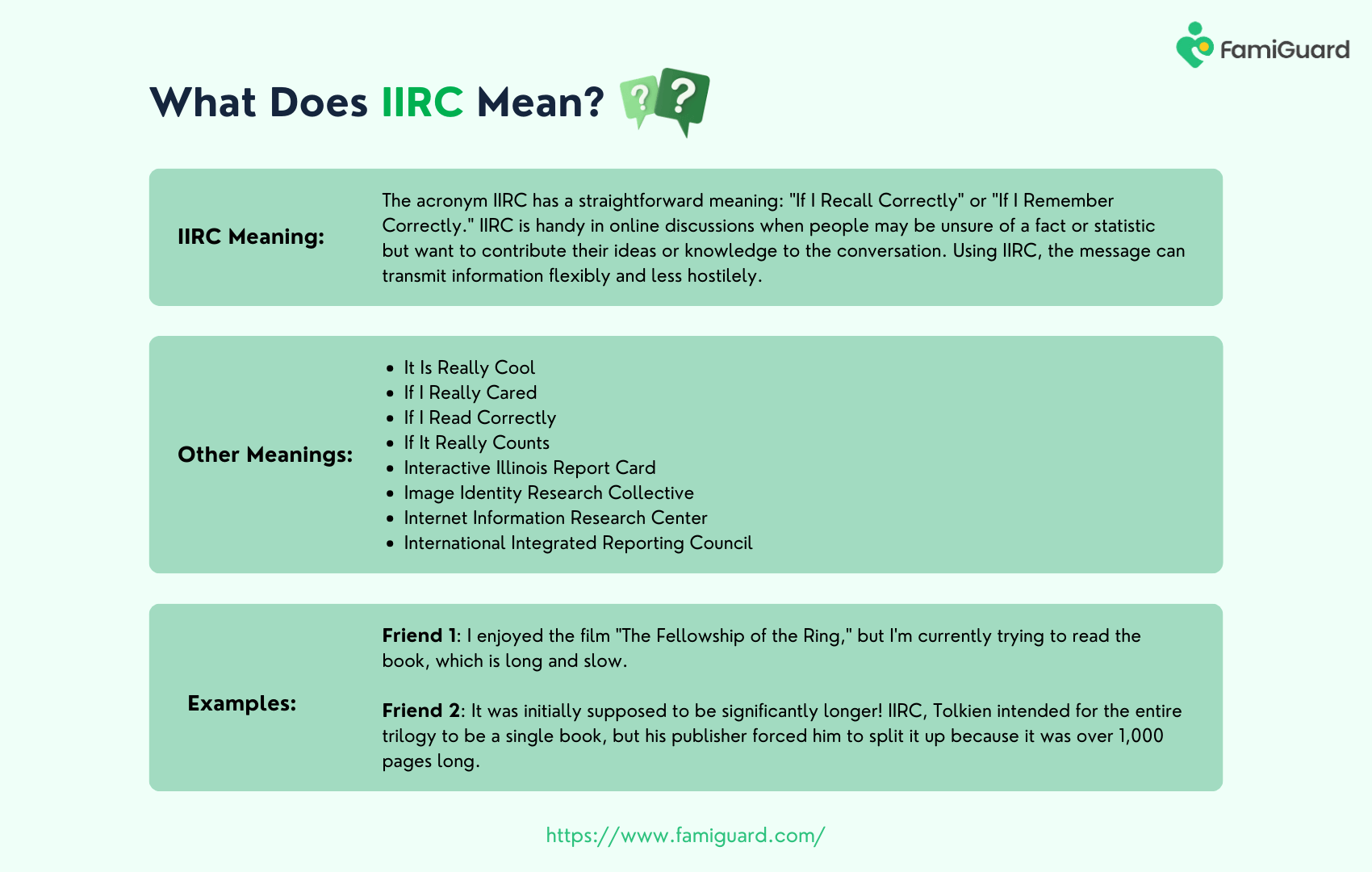
At its heart, IIRC is a simple yet effective abbreviation that stands for “If I Recall Correctly.” Its primary function is to preface a statement or piece of information that the speaker believes to be true, but acknowledges that their memory might not be perfectly accurate. This seemingly small qualifier carries significant weight in technical contexts, where precision is paramount and misremembered details can lead to errors or misunderstandings.
Origins in Online Communication
The widespread adoption of IIRC can be traced back to the early days of the internet and the burgeoning culture of online forums, Usenet groups, and chat rooms. As people engaged in rapid-fire discussions, especially those involving technical troubleshooting, software development, or hardware specifications, the need for concise communication became evident. Typing out “If I remember correctly” or “To the best of my recollection” was time-consuming and cumbersome. IIRC offered a neat and efficient alternative.
Its usage quickly permeated various online communities, from gaming forums to early tech support groups. The informal yet widely understood nature of the acronym made it a natural fit for the collaborative and often spontaneous exchanges that characterized these platforms. As these communities evolved and new digital communication tools emerged – instant messaging, social media, and collaborative software – IIRC continued to be a staple.
The Nuance of Uncertainty in Technical Discourse
In technology, certainty is often a rare commodity. Software can have undocumented behaviors, hardware specifications can be complex and subject to revision, and the memory of past implementations or configurations can fade. When discussing these topics, users often need to convey information while simultaneously signaling a degree of uncertainty. This is precisely where IIRC shines.
For instance, a developer might say, “IIRC, the API endpoint for user authentication was changed in version 3.2.” Here, IIRC serves to alert the listener that while the speaker believes this to be the case, it’s worth verifying. This is crucial because acting on incorrect information, especially in software development, can lead to wasted time, debugging efforts, and even system failures. It fosters a culture of critical thinking and encourages collaboration by prompting others to confirm or correct the recalled information.
Applications of IIRC Across Tech Disciplines
The utility of IIRC extends across a broad spectrum of technological disciplines. Its ability to express conditional recollection makes it invaluable in diverse scenarios, from debugging code to advising on system architecture.
Software Development and Debugging
In software development, accuracy is non-negotiable. When developers collaborate, they frequently refer to past decisions, code implementations, or bug fixes. IIRC is commonly used to:
- Recall specific code implementations: “IIRC, we introduced a caching layer to optimize database queries in the
UserServicemodule.” This prompts other developers to check theUserServicemodule and confirm the caching implementation. - Reference bug fixes or workarounds: “I seem to remember a similar issue being resolved by updating the dependency version. IIRC, it was version 1.5.2.” This guides the debugging process by suggesting a potential avenue for resolution.
- Discuss architectural decisions: “Wasn’t the original plan to use a message queue for asynchronous tasks? IIRC, we opted for a simpler polling mechanism due to time constraints.” This helps reconstruct the rationale behind architectural choices.
The use of IIRC in this context is not a sign of incompetence but rather a recognition of the complexity and dynamic nature of software projects. It encourages peer review and knowledge sharing, ensuring that collective understanding is built on verifiable facts rather than assumptions.
Hardware and Systems Administration
System administrators and hardware enthusiasts also frequently employ IIRC. When dealing with complex network configurations, server setups, or intricate hardware components, memory can be fallible. IIRC finds its place in discussions related to:
- Recalling specific hardware models or configurations: “I think we upgraded the RAM in the main web server last quarter. IIRC, we went with 64GB modules.” This is useful for inventory management, troubleshooting, or planning future upgrades.
- Remembering network settings: “The firewall rules for SSH access were quite restrictive. IIRC, only specific IP ranges were allowed.” This helps in understanding existing security policies and making necessary adjustments.
- Describing past maintenance or troubleshooting steps: “When we faced that intermittent network latency issue, IIRC, the solution involved adjusting the MTU settings on the router.” This can be a valuable starting point for diagnosing recurring problems.
In these situations, IIRC signals that the information is offered as a helpful starting point, but it’s always advisable to consult documentation, logs, or perform direct verification to confirm the details, especially when making critical changes to live systems.
User Support and Technical Forums
Online technical support forums and community helpdesks are fertile ground for IIRC. Users seeking solutions to problems or sharing their own experiences often rely on their memory of past interactions or technical knowledge.
- Suggesting potential solutions: “You might have encountered a common bug with that software version. IIRC, updating to the latest patch fixed it for me.” This offers a potential fix based on prior experience.
- Recalling troubleshooting steps: “Did you try restarting the service? IIRC, that often resolves this particular error message.” This provides a quick diagnostic suggestion.
- Sharing anecdotal evidence: “I remember having a similar issue with my graphics card a while back. IIRC, it was related to an outdated driver.” This adds personal experience to the collective problem-solving effort.

The community aspect of these forums means that an IIRC-prefaced statement often invites others to chime in with their own recollections, confirmations, or corrections, leading to a more robust and accurate resolution.
The Social and Professional Implications of Using IIRC
Beyond its functional utility, the use of IIRC also carries social and professional implications within the tech community. It demonstrates a certain level of self-awareness and respect for accuracy, which are highly valued traits.
Fostering a Collaborative Environment
By prefacing a statement with “If I recall correctly,” individuals signal that they are not presenting their knowledge as absolute fact. This humble approach encourages others to contribute, verify, or offer alternative perspectives without fear of being directly contradicted or invalidated. It fosters an environment where learning and problem-solving are collective endeavors.
This is particularly important in fields where knowledge is constantly evolving. No single individual can possibly retain every detail. IIRC acknowledges this reality and encourages a collaborative approach to knowledge acquisition and application. It implicitly invites dialogue and verification, which are crucial for building shared understanding and accurate knowledge bases.
Demonstrating Professionalism and Humility
In a professional context, accuracy and reliability are paramount. While confidence is important, overconfidence can lead to errors. Using IIRC demonstrates a professional maturity by acknowledging the fallibility of memory. It shows that the individual prioritizes accuracy and is willing to be corrected. This can build trust and credibility within a team or organization.
Imagine a scenario where a senior engineer states a piece of information with absolute certainty, only for it to be incorrect. This can undermine their authority and lead to significant problems. Conversely, if the same engineer prefaced their statement with “IIRC,” it softens the impact of any potential inaccuracy and frames it as an opportunity for collaborative correction. This humble approach can, paradoxically, enhance their professional standing.
Balancing Brevity with Clarity
The core appeal of IIRC lies in its ability to convey a significant amount of meaning with just four letters. It strikes a balance between the need for rapid communication in digital environments and the requirement for clarity and precision. While it might seem like a minor detail, the widespread adoption of such abbreviations speaks to their effectiveness in optimizing communication flows.
However, it’s also important to consider the context. In highly formal documentation or critical reports where absolute certainty is required, the use of IIRC would be inappropriate. Its strength lies in informal and semi-formal technical discussions, where a slight degree of acknowledged uncertainty is acceptable and even beneficial.
When to Use IIRC (and When Not To)
While IIRC is a valuable tool, its effective use depends on understanding its appropriate contexts.
Ideal Scenarios for IIRC
- Informal technical discussions: Chat, instant messaging, internal team discussions, online forums.
- Recalling past events or configurations: When you have a strong recollection but aren’t 100% sure.
- Prompting verification from others: When you want to share a piece of information but encourage someone else to confirm it.
- Brainstorming and idea generation: When exploring possibilities or reconstructing past decisions.
Situations to Avoid IIRC
- Formal documentation: Technical specifications, official reports, user manuals, contracts.
- Critical decision-making without verification: When the stakes are high and absolute accuracy is required before proceeding.
- When you are completely uncertain: If you have no recollection, it’s better to state that you don’t know or to research the information first.
- When addressing a completely unfamiliar topic: In such cases, expressing uncertainty without a basis for recollection might not be helpful.
Alternatives and Variations
While IIRC is dominant, other similar phrases exist:
- “If memory serves”: Similar meaning, slightly more formal.
- “To the best of my knowledge”: Indicates a higher degree of certainty but still acknowledges potential for error.
- “I believe” / “I think”: Less specific about the accuracy of recall, more about current belief.
In the tech world, IIRC’s brevity and widespread understanding make it the go-to choice for its specific function of conditional recollection.
The Enduring Relevance of IIRC in a Dynamic Tech Landscape
As technology continues to evolve at an unprecedented pace, so too does our language. Acronyms like IIRC are more than just linguistic shortcuts; they are functional tools that facilitate efficient and effective communication. In the complex and ever-changing realm of technology, where precision, collaboration, and continuous learning are paramount, “If I Recall Correctly” serves as a vital qualifier. It allows individuals to contribute their knowledge and experiences while acknowledging the inherent fallibility of memory, fostering a more accurate, collaborative, and ultimately, more successful technological landscape. Its continued prevalence in digital discourse is a testament to its enduring utility and its role in shaping how we share and refine technical knowledge.
aViewFromTheCave is a participant in the Amazon Services LLC Associates Program, an affiliate advertising program designed to provide a means for sites to earn advertising fees by advertising and linking to Amazon.com. Amazon, the Amazon logo, AmazonSupply, and the AmazonSupply logo are trademarks of Amazon.com, Inc. or its affiliates. As an Amazon Associate we earn affiliate commissions from qualifying purchases.