
In the intricate world of finance, few concepts hold as much power and relevance as compound interest. It’s often hailed as the “eighth wonder of the world” for a reason, fundamentally transforming how wealth grows over time. When this powerful force is paired with a specific frequency, such as “quarterly,” it provides a precise mechanism for calculating and understanding financial growth or cost. Understanding “compounded quarterly” is not merely academic; it is a vital tool for anyone navigating personal finance, investments, or debt management.
The Engine of Wealth: Understanding Compound Interest
To truly grasp what “compounded quarterly” means, one must first understand the bedrock principle of compound interest itself. It’s the engine that drives financial growth, distinct from its simpler counterpart.

Beyond Simple Interest
Imagine lending money or depositing funds into an account. With simple interest, the interest earned is calculated only on the initial principal amount. For instance, if you deposit $1,000 at a 5% simple annual interest rate, you would earn $50 each year, regardless of how long the money stays in the account. The principal always remains $1,000 for interest calculation purposes.
The Magic of Earning on Earnings
Compound interest, however, operates differently and far more advantageously for the saver or investor. It’s the process of earning interest not only on your initial principal but also on the accumulated interest from previous periods. This means your money begins to earn money on itself, creating an exponential growth curve. Each time interest is calculated and added to the principal, the new, larger sum becomes the base for the next interest calculation. This snowball effect is why compound interest is so powerful – it leverages time to create substantial wealth.
Time and Rate as Key Drivers
The two most critical factors influencing the impact of compound interest are the interest rate and the duration over which the interest compounds. A higher interest rate naturally leads to faster growth. More significantly, the longer your money has to compound, the more dramatic the effect. Early investment, even of small amounts, allows compound interest more time to work its magic, leading to significantly larger sums over decades compared to starting later with larger contributions.
Deciphering “Quarterly” in Financial Terms
When “compounded” is paired with “quarterly,” it specifies the frequency at which the magic of compound interest occurs. Understanding this frequency is crucial for accurate financial forecasting.
The Frequency of Calculation
“Quarterly” simply means four times a year. In a financial context, this typically corresponds to a three-month interval. These quarters usually align with the calendar year:
- Q1: January 1 – March 31
- Q2: April 1 – June 30
- Q3: July 1 – September 30
- Q4: October 1 – December 31
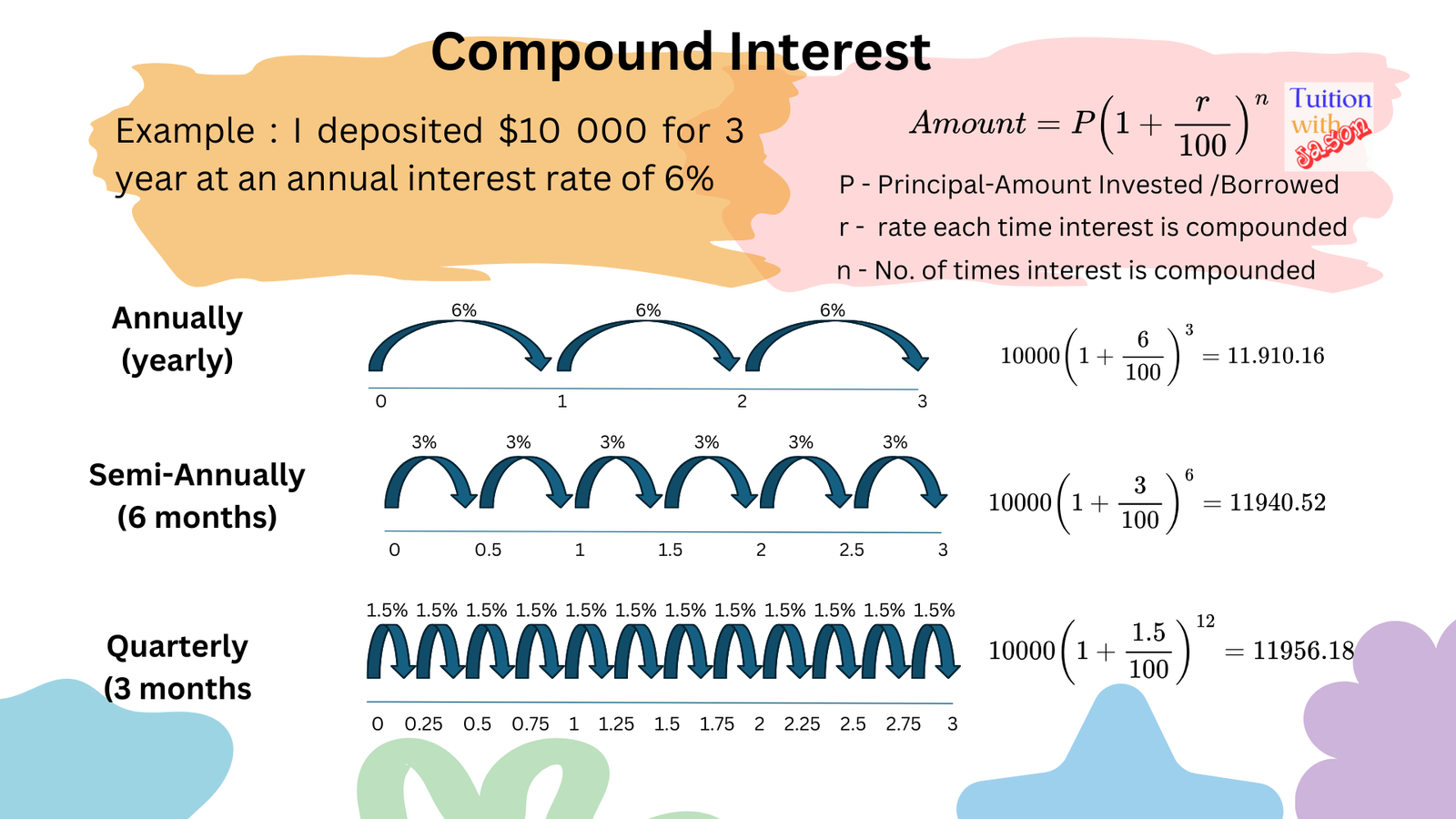
When an investment or loan is compounded quarterly, it means that the interest is calculated and added to the principal balance at the end of each of these three-month periods.
Impact on Interest Application
This quarterly frequency directly influences how the annual interest rate is applied. If an account has an Annual Percentage Rate (APR) of, say, 8% compounded quarterly, it doesn’t mean you earn 8% every three months. Instead, the annual rate is divided by the number of compounding periods in a year. For quarterly compounding, the 8% APR would be divided by four, resulting in a 2% interest rate applied to the balance at the end of each quarter.
Other Compounding Frequencies
Quarterly is just one of several common compounding frequencies. You might encounter:
- Annually: Once a year.
- Semi-Annually: Twice a year (every six months).
- Monthly: Twelve times a year.
- Daily: Every day (approximately 365 times a year).
- Continuously: Theoretically, an infinite number of times per year, though practically represented by a limit.
The more frequently interest is compounded, the faster your money grows (for investments) or your debt accrues (for loans), assuming the same annual interest rate. Quarterly sits in the middle ground, offering a more frequent compounding than annually or semi-annually, but less frequent than monthly or daily.
How Compounding Quarterly Amplifies Your Money
To truly appreciate the effect of quarterly compounding, it helps to walk through a practical example and understand its implications for your overall return.
The Mechanics of Calculation
Let’s illustrate with an example. Suppose you deposit $1,000 into a savings account that offers an 8% Annual Percentage Rate (APR), compounded quarterly.
- Determine the Quarterly Rate: The annual rate of 8% is divided by 4 (the number of quarters in a year). So, 8% / 4 = 2% per quarter.

- Calculate Interest for Each Quarter:
- End of Quarter 1:
- Starting Principal: $1,000.00
- Interest earned: $1,000.00 * 0.02 = $20.00
- New Balance: $1,000.00 + $20.00 = $1,020.00
- End of Quarter 2:
- Starting Principal: $1,020.00 (your initial principal PLUS the interest from Q1)
- Interest earned: $1,020.00 * 0.02 = $20.40
- New Balance: $1,020.00 + $20.40 = $1,040.40
- End of Quarter 3:
- Starting Principal: $1,040.40
- Interest earned: $1,040.40 * 0.02 = $20.81
- New Balance: $1,040.40 + $20.81 = $1,061.21
- End of Quarter 4:
- Starting Principal: $1,061.21
- Interest earned: $1,061.21 * 0.02 = $21.22
- New Balance: $1,061.21 + $21.22 = $1,082.43
- End of Quarter 1:
After one full year, your initial $1,000 has grown to $1,082.43. The total interest earned is $82.43.
Contrast this with simple interest: $1,000 * 0.08 = $80.00. The extra $2.43 ($82.43 – $80.00) is the power of quarterly compounding – you earned interest on your interest. While this difference might seem small in a single year with a modest principal, its impact scales dramatically over longer periods and with larger sums.
The Effect on Annual Percentage Yield (APY)
This example highlights a crucial distinction between APR (Annual Percentage Rate) and APY (Annual Percentage Yield). The APR is the nominal or stated interest rate, typically what a lender or bank advertises. The APY, also known as the effective annual rate, represents the actual rate of return you earn in a year, taking into account the effect of compounding.
Because interest is added to your principal multiple times within the year (quarterly in our case), the effective yield will always be slightly higher than the stated APR for any compounding frequency greater than annually. In our example:
- APR = 8%
- APY = (($1,082.43 / $1,000) – 1) * 100% = 8.243%
When comparing different savings accounts or investment products, always look at the APY to get a true picture of your potential earnings, as it accounts for the compounding frequency.
Where You Encounter Quarterly Compounding
Quarterly compounding is a common feature across various financial products and services, affecting both your savings and your debts.
Savings Accounts and Certificates of Deposit (CDs)
Many traditional savings accounts and Certificates of Deposit (CDs) in banks and credit unions compound interest on a quarterly basis. This provides a steady and predictable growth trajectory for your deposited funds. For CDs, the interest might also be paid out quarterly, or it might accrue and compound until the CD matures. Understanding this frequency is key to projecting the actual return on your safe, low-risk savings vehicles.
Investment Accounts
While less direct than a savings account, the concept of quarterly compounding implicitly applies to many investment scenarios. For instance, some bonds pay interest (coupons) quarterly, and if you reinvest these payouts, you are effectively compounding your returns. Similarly, many stocks pay dividends on a quarterly schedule. If these dividends are automatically reinvested to purchase more shares, you are leveraging quarterly compounding to grow your investment portfolio over time. Mutual funds and ETFs also often distribute earnings or dividends quarterly, which can then be reinvested.
Loans and Debt
Compounding works both ways. Just as it can help your investments grow, it can also cause your debt to swell if not managed responsibly. While many consumer loans like credit cards compound daily or monthly, some larger loans, such as certain student loans or lines of credit, may calculate and add accrued interest to the principal on a quarterly basis if payments aren’t made to cover the interest. This can lead to an increase in the principal amount you owe, a phenomenon known as negative amortization, making the debt more difficult to pay off over time. For borrowers, understanding this means being acutely aware of your payment schedule and ensuring you cover at least the interest portion of your debt to prevent it from compounding against you.
Retirement Plans
Retirement accounts like 401(k)s and IRAs are prime beneficiaries of quarterly (or more frequent) compounding. Contributions to these accounts, especially when invested in funds that pay dividends or interest, accrue earnings that are reinvested. Over the decades-long horizon of retirement planning, even slight differences in compounding frequency or interest rates lead to monumental differences in the final nest egg. The earlier you start and the more consistently you contribute, the greater the impact of quarterly compounding on your long-term wealth accumulation.
Maximizing Your Financial Strategy with Quarterly Compounding
Leveraging your understanding of quarterly compounding can significantly impact your financial well-being, whether you’re saving, investing, or managing debt.
For Savers and Investors
- The Power of Time: The single most impactful factor in compounding is time. Start saving and investing as early as possible. Even small, consistent contributions will yield substantial returns over decades due to the exponential nature of compounding.
- Regular Contributions: Consistently adding to your savings or investment accounts, perhaps even quarterly, further amplifies the compounding effect. Each new contribution immediately becomes part of the principal earning interest.
- Seek Favorable APYs: When choosing savings accounts or CDs, always compare their Annual Percentage Yields (APYs), not just the stated APRs. A higher APY means more frequent or more generous compounding.
- Reinvest Earnings: Wherever possible, opt to automatically reinvest interest, dividends, or capital gains. This ensures that every bit of return starts earning its own returns immediately, supercharging your growth.
For Borrowers
- Be Aware of Accrual: Understand how interest accrues on your loans, especially those that compound quarterly or more frequently. For many loans, interest may be calculated quarterly even if payments are due monthly. If your monthly payment doesn’t cover all the interest, the unpaid portion can be added to the principal and start compounding.
- Pay More Than the Minimum: For debts with compounding interest, paying more than the minimum required payment is a highly effective strategy. Any extra principal paid reduces the base on which future interest is calculated, leading to significant savings over the life of the loan.
- Prioritize High-Interest Debt: If you have multiple loans, focus on paying down the ones with the highest interest rates first. These debts compound most aggressively against you, and reducing their principal quickly minimizes their long-term cost.
The Long-Term Perspective
While the quarterly impact of compounding might seem modest in isolation, its true power unfolds over extended periods. Small, consistent actions and informed financial decisions, guided by a clear understanding of how “compounded quarterly” and other compounding frequencies work, can fundamentally reshape your financial future. It’s not just about earning interest; it’s about making your money work harder for you, every quarter.
aViewFromTheCave is a participant in the Amazon Services LLC Associates Program, an affiliate advertising program designed to provide a means for sites to earn advertising fees by advertising and linking to Amazon.com. Amazon, the Amazon logo, AmazonSupply, and the AmazonSupply logo are trademarks of Amazon.com, Inc. or its affiliates. As an Amazon Associate we earn affiliate commissions from qualifying purchases.